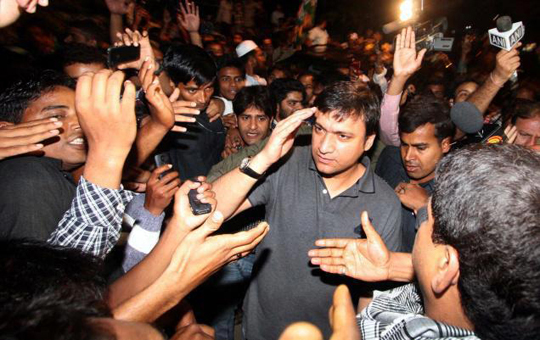
Can win 50 MP seats with votes of 'brethren', says Owaisi, BJP cries foul

Agencies
July 4, 2017

Hyderabad, Jul 4: AIMIM MLA Akbaruddin Owaisi stoked a controversy when he claimed his brother and party chief Asaduddin Owaisi could help the outfit win 50 seats in Parliament with the votes of "our brethren", remarks that BJP dubbed as "hate speech".

Owaisi

Owaisi was also purportedly shown in the video, which has gone viral, criticising the Modi government for the recent killing of Muslims.

He referred to the killings of Mohammed Akhlaq, Pehlu Khan and 15-year-old Junaid Khan and asked "if it is a crime to wear a cap, grow your beard and be a Muslim".

"There is no need for the sympathy, support of anybody. Our brother (his brother and MIM president Asaduddin Owaisi) can win 50 parliament seats for the party with the votes of our brethren," Akbaruddin, the MLA from Chandrayangutta in Hyderabad, was heard saying in the video.

Hitting out at the VHP and Bajrang Dal, he said: "Jitna ye mulkterahai, utna ye mulkmerabhihai". (This country is mine as much as it is yours).

It was not immediately clear where and when Akbaruddin Owaisi made the alleged speech.

Responding to Akbaruddin's alleged comments which were seen as appealing to Muslim sentiments, BJP spokesperson Krishna Saagar Rao alleged the MLA made a hate speech which could "incite" people.

Wondering why the TRS government in the state had not filed charge-sheet in the case of hate speech made earlier by Akbaruddin Owaisi, the BJP leader demanded that a police case be registered against him.

BJP would approach the Election Commission seeking cancellation of MIM's recognition, he said.

Comments

Fayaz
 - 
Friday, 7 Jul 2017

Terrorist grup tried to kill the innocent muslim guy..

s
 - 
Tuesday, 4 Jul 2017

anything a muslim says is hate?

Add new comment

  • Coastaldigest.com reserves the right to delete or block any comments.
  • Coastaldigset.com is not responsible for its readers’ comments.
  • Comments that are abusive, incendiary or irrelevant are strictly prohibited.
  • Please use a genuine email ID and provide your name to avoid reject.
News Network
January 1,2020

Jan 1: The ban on the practice of instant triple talaq, making it a penal offence and the increase in the strength of Supreme Court judges were two of the major achievements of the law ministry in 2019.

In July, Parliament gave its nod to The Muslim Women (Protection of Rights on Marriage) Bill, 2019. The new law makes talaq-e-biddat or any other similar form of talaq having the effect of instantaneous and irrevocable divorce pronounced by a Muslim husband void and illegal.

It makes it illegal to pronounce talaq three times in spoken, written or through SMS or WhatsApp or any other electronic chat in one sitting.

According to the new law, any Muslim who pronounces the illegal form of talaq upon his wife shall be punished with imprisonment for a term which may extend to three years, and shall also be liable to fine.

During the year, four new judges were appointed to the Supreme Court in September, taking its strength to 34, the highest-ever.

However, vacancies in high courts and lower courts are on the rise and convincing state governments and the 25 high courts to come on board to create an all-India judicial service to recruit judges for the subordinate courts tops the agenda of the Law Ministry in 2020.

Besides creating a consensus on setting up the All-India Judicial Services, the ministry will also have to focus on filling up vacancies in the high court. On an average, the vacancies stood at 400 throughout this year.

With more than 5,000 positions of judicial officers in district and subordinate courts lying vacant, the Law Ministry has pitched for setting up all-India judicial services.

The sanctioned strength of the judicial officers in district and subordinate courts was 22,644. The number of judicial officers in position and vacant posts is 17,509 and 5,135, respectively.

The government has proposed that while states and high courts can recruit judicial officers, the Union Public Service Commission (UPSC) can hold pan-India entrance tests.

The ministry has made it clear that such services would not encroach on the powers of the states.

As of now, the selection and appointment of judges in subordinate courts is the responsibility of the high courts and state governments concerned.

The Narendra Modi government has given a fresh push to the long-pending proposal to set up the new service to have a separate cadre for the lower judiciary in the country.

But there is a divergence of opinion among state governments and respective high courts on the constitution of the All India Judicial Service (AIJS).

One of the problems cited is that since several states have used powers under Code of Criminal Procedure (CrPC) and Code of Civil Procedure (CPC) to declare that the local language would be used in lower courts even for writing orders, a person say selected from Tamil Nadu may find it difficult to hold proceedings in states like Uttar Pradesh and Bihar.

The other point of opposition is that an all India service may hamper the career progression of state judicial services officers.

Another key issue the ministry has to handle in 2020 is vacancies in the 25 high courts.

Throughout 2019, on an average, the high courts faced a shortage of 400 judges.

According to Law Ministry data, as on September 1, the high courts had 414 vacant positions as compared to the sanctioned strength of 1,079 judges. The figure was 409 in August and 403 in July, as per the data.

A three-member Supreme Court collegium recommends the names of candidates for appointment as high court judges. In case of appointments to the Supreme Court, the collegium consists of five top judges of the top court.

High court collegiums shortlist candidates for their respective high courts and send the names to the law ministry.

The ministry, along with background check reports by the Intelligence Bureau, forwards it to the Supreme Court collegium for a final call.

The government has maintained that appointment of judges in the high courts is a "continuous collaborative process" between the Executive and the Judiciary, as it requires consultation and approval from various Constitutional authorities.

Vacancies keep arising on account of retirement, resignation or elevation of judges and increase in judges' strength. In June last year, the vacancy position stood at 399, while it was 396 in May.

In April, 399 posts of judges were vacant, while the figure was 394 in March. The vacancy position in February stood at 400 and in January, it was 392, according to the data collated by the Department of Justice.

Over 43 lakh cases are pending in the 25 high courts.

Another priority would be the finalisation of the memorandum of the procedure to guide the appointment and transfer of the Supreme Court and high court judges. The issue had now been pending for over two years now with the SC collegium and the government failing to reach a consensus.

Successive governments have also been working on making India a hub of international arbitration. It has taken several steps to change laws dealing with commercial disputes.


Comments

Add new comment

  • Coastaldigest.com reserves the right to delete or block any comments.
  • Coastaldigset.com is not responsible for its readers’ comments.
  • Comments that are abusive, incendiary or irrelevant are strictly prohibited.
  • Please use a genuine email ID and provide your name to avoid reject.
Agencies
May 14,2020

Mumbai, May 14: The Shiv Sena on Thursday raised questions over the Centre's Rs 20 lakh crore stimulus package announced to revive the COVID-hit economy, and asked if India is not a "self-reliant" country at present.

An editorial in Sena mouthpiece 'Saamana' wondered how Rs 20 lakh crore will be raised, and opined that an environment needs to be created where industrialists, trade and business sectors are encouraged to invest.

On the path of new self-reliance, India cannot afford industrialists running away, and for that "political institutions like the ED and CBI need to be put in lockdown for some time," it said.

Prime Minister Narendra Modi on Tuesday announced new financial incentives on top of the previously announced packages for a combined stimulus of Rs 20 lakh crore, saying the COVID-19 crisis has provided India an opportunity to become self-reliant and emerge as the best in the world.

The Sena said the country is being told that the package will be beneficial for MSMEs (micro, small and medium enterprises), poor labourers, farmers and the tax-paying middle class.

"The package (as per the Centre) will reach 130 crore Indians and the country will become self-reliant. Does this mean India is not a self-reliant country at present?" the Marathi daily asked.

It is good that PPE kits and N95 masks are now being manufactured in India, it said.

"Any country progresses ahead while learning from crisis and through struggle. Before Independence, not even a needle was manufactured in India but in 60 years, India became self-reliant in science, technology, agro business, defence, manufacturing and atomic science," it said.

An institution like the Indian Council of Medical Research (ICMR), which is helping in the manufacturing of PPE kits, is part of the self-reliant India, it noted.

Wondering how Rs 20 lakh crore, as announced in the central package, will be raised, the Sena said an "environment needs to be created where industrialists, trade and business sectors will be encouraged to invest".

"India, on path of new self-reliance, cannot afford industrialists running away, and for that political institutions like the Enforcement Directorate (ED) and the Central Bureau of Investigation (CBI) need to be put in lockdown for some time," the paper said.

Despite announcing the 'lockdown-4' and the economic package, why its impact has not been reflected in the share market? it asked.

"Investors are in a dilemma. The prime minister and chief ministers must show them trust and support," it said.

"Earlier it was Pandit Nehru and now it is Modi. If (former prime minister) Rajiv Gandhi had not laid the foundation of a digital India, there wouldn't be video conference of PM, CMs and bureaucracy in times of coronavirus," the Uddhav Thackeray-led party said.

It agreed with Modi that coronavirus will stay for long, and lives need not revolve around it.

"We need to get back on our feet again," the Sena said.

Comments

Add new comment

  • Coastaldigest.com reserves the right to delete or block any comments.
  • Coastaldigset.com is not responsible for its readers’ comments.
  • Comments that are abusive, incendiary or irrelevant are strictly prohibited.
  • Please use a genuine email ID and provide your name to avoid reject.
News Network
June 19,2020

Jun 19: Billionaire Mukesh Ambani on Friday announced that his oil-to-telecom conglomerate Reliance Industries is now net debt-free after raising a record Rs 1.69 lakh crore from global investors and a rights issue in under two months.

Reliance raised Rs 1.15 lakh crore from global tech investors by selling a little less than a quarter of the firm's digital arm, Jio Platforms Ltd, and another Rs 53,124.20 crore through a rights issue in the past 58 days.

Taken together with last year's sale of 49 per cent stake in fuel retailing venture to BP Plc of UK for Rs 7,000 crore, the total fund raised is in excess of Rs 1.75 lakh crore, the company said in a statement.

Reliance had a net debt of Rs 1,61,035 crore as on March 31, 2020. "With these investments, RIL has become net debt-free," it said.

"I have fulfilled my promise to the shareholders by making Reliance net debt-free much before our original schedule of March 31, 2021," Ambani said.

Jio Platforms - which houses the country's youngest but largest telecom firm Reliance Jio, raised Rs 1,15,693.95 crore from leading global investors including Facebook, Silver Lake, Vista Equity Partners, General Atlantic, KKR, Mubadala, ADIA, TPG, L Catterton and PIF since April 22, 2020.

Saudi Arabian sovereign wealth fund PIF buying 2.32 per cent stake in the unit for Rs 11,367 crore on June 18 "marks the end of Jio Platforms' current phase of induction of financial partners," the statement said.

Alongside, Reliance launched India's biggest right issue, which was subscribed to 1.59 times.

Though the rights issue size was Rs 53,124 crore, the company has got only 25 per cent of the money as the remaining is to be paid only next fiscal.

Ambani had at the company's annual general meeting on August 12, 2019, announced a roadmap for Reliance to become a net debt-free company before March 31, 2021.

"We have a very clear roadmap to becoming a zero net-debt company within the next 18 months that is by March 31, 202," he had said last year highlighting strong interest from strategic and financial investors in consumer businesses, Jio and Reliance Retail.

In the statement on Friday, he said he was both delighted and humbled to announce the fulfillment of the promise.

"Exceeding the expectations of our shareholders and all other stakeholders, again and yet again, is in the very DNA of Reliance," he said.

"Therefore, on the proud occasion of becoming a net debt-free company, I wish to assure them that Reliance in its Golden Decade will set even more ambitious growth goals, and achieve them," he added.

He said over the past few weeks, phenomenal interest was received from the global financial investor community in partnering with Jio.

"As our fundraising milestone from financial investors is achieved, we sincerely thank the marquee group of financial partners and warmly welcome them into Jio Platforms," he said.

"I also express my heartfelt gratitude to all the retail and institutional investors, both domestic and foreign, for their overwhelming participation in our record-setting Rights Issue," he added.

Comments

Add new comment

  • Coastaldigest.com reserves the right to delete or block any comments.
  • Coastaldigset.com is not responsible for its readers’ comments.
  • Comments that are abusive, incendiary or irrelevant are strictly prohibited.
  • Please use a genuine email ID and provide your name to avoid reject.