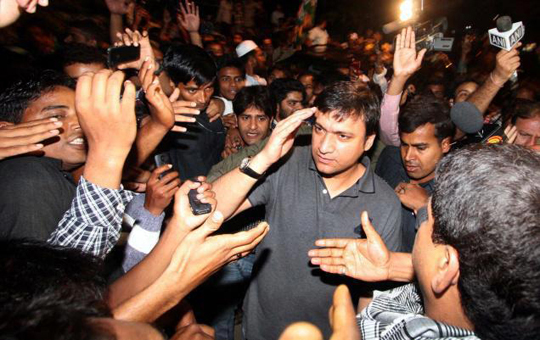
Can win 50 MP seats with votes of 'brethren', says Owaisi, BJP cries foul

Agencies
July 4, 2017

Hyderabad, Jul 4: AIMIM MLA Akbaruddin Owaisi stoked a controversy when he claimed his brother and party chief Asaduddin Owaisi could help the outfit win 50 seats in Parliament with the votes of "our brethren", remarks that BJP dubbed as "hate speech".

Owaisi

Owaisi was also purportedly shown in the video, which has gone viral, criticising the Modi government for the recent killing of Muslims.

He referred to the killings of Mohammed Akhlaq, Pehlu Khan and 15-year-old Junaid Khan and asked "if it is a crime to wear a cap, grow your beard and be a Muslim".

"There is no need for the sympathy, support of anybody. Our brother (his brother and MIM president Asaduddin Owaisi) can win 50 parliament seats for the party with the votes of our brethren," Akbaruddin, the MLA from Chandrayangutta in Hyderabad, was heard saying in the video.

Hitting out at the VHP and Bajrang Dal, he said: "Jitna ye mulkterahai, utna ye mulkmerabhihai". (This country is mine as much as it is yours).

It was not immediately clear where and when Akbaruddin Owaisi made the alleged speech.

Responding to Akbaruddin's alleged comments which were seen as appealing to Muslim sentiments, BJP spokesperson Krishna Saagar Rao alleged the MLA made a hate speech which could "incite" people.

Wondering why the TRS government in the state had not filed charge-sheet in the case of hate speech made earlier by Akbaruddin Owaisi, the BJP leader demanded that a police case be registered against him.

BJP would approach the Election Commission seeking cancellation of MIM's recognition, he said.

Comments

Fayaz
 - 
Friday, 7 Jul 2017

Terrorist grup tried to kill the innocent muslim guy..

s
 - 
Tuesday, 4 Jul 2017

anything a muslim says is hate?

Add new comment

  • Coastaldigest.com reserves the right to delete or block any comments.
  • Coastaldigset.com is not responsible for its readers’ comments.
  • Comments that are abusive, incendiary or irrelevant are strictly prohibited.
  • Please use a genuine email ID and provide your name to avoid reject.
News Network
January 24,2020

New Delhi, Jan 24: Although India's Ujjwala programme encouraged adoption of liquefied petroleum gas (LPG) for cooking among the poor, households availing the scheme have not shifted away from using highly polluting fuels like firewood, a study reveals.

The researchers, including those from the University of British Columbia (UBC) in Canada, found that additional incentives to encourage regular use of cooking gas are necessary for a complete transition to clean cooking fuel among poor rural households.

They noted that about 2.9 billion people across Asia, Africa, and Latin America burn solid fuels like firewood to meet their cooking energy needs.

This has significant negative implications for public health, the environment, and societal development, according to the researchers.

Through the Pradhan Mantri Ujjwala Yojana (PMUY), India has provided capital cost subsidies to poor women to adopt a clean-burning cooking fuel or LPG.

The researchers explained that within the first 40 months of the scheme, more than 80 million households obtained LPG stoves.

However, the full benefits of LPG adoption depend on near complete replacement of polluting fuels with LPG, according to a research-based policy brief published in the journal Nature Energy.

The scientists said this cannot be assumed solely on the basis of LPG presence in the household.

"Our research shows that Ujjwala was able to attract new consumers rapidly, but those consumers did not start using LPG on a regular basis," Abhishek Kar, a postdoc at Columbia University in the US, told PTI.

The study analysed LPG sales data for over 25,000 consumers, including PMUY beneficiaries, as well as general rural LPG consumers in Koppal district of Karnataka.

The scientists employed data covering all LPG purchases of PMUY beneficiaries through their first year in the programme.

They also assessed the general rural population's purchases during their first five years as consumers to assess the effect of experience on use.

The findings estimate that an average rural family needs to purchase five 14.2 kilogramme-cylinders annually to meet half of their cooking needs.

However, the study said just seven per cent of PMUY beneficiaries in Koppal purchased five or more cylinders annually, suggesting that the beneficiaries seldom use LPG.

The general (nonPMUY) consumers in this region use on average two times more LPG cylinders than PMUY beneficiaries, the researchers noted.

Yet, only 45 per cent of nonPMUY consumers use five or more cylinders per year -- even after several years of experience with LPG, they said.

The team assessed price and seasonal factors affecting LPG use among the general population over a three-year period.

It found that LPG consumers are sensitive to price and seasonality -- LPG cylinder refill rates are lower in the summer when agricultural activity is limited, and cash is scarce.

"There was no scheme incentives to promote use, except general LPG subsidies which is available to all, including the urban middle class," said Kar, who was a Ph.D. scholar at UBC when the research was published.

"If there is no additional income, what cost would a poor family on an already tight budget cut to pay for an extra expense on a regular basis.

"Ujjwala has started the scheme of 5 kg-cylinder in response, but the impact of that on LPG sales is still publicly unknown," he said.

These findings, the researchers noted, suggest the need for additional measures to promote regular LPG use for all rural populations.

Although the finding come from a single district in Southern India, it may also apply to other areas with similar socio-economic conditions, they said.

A more expansive evaluation of PMUY would help design targeted incentives to transform infrequent users to regular users, according to the researchers.


Comments

Add new comment

  • Coastaldigest.com reserves the right to delete or block any comments.
  • Coastaldigset.com is not responsible for its readers’ comments.
  • Comments that are abusive, incendiary or irrelevant are strictly prohibited.
  • Please use a genuine email ID and provide your name to avoid reject.
Agencies
February 17,2020

New Delhi, Feb 17: The Supreme Court said on Monday that people have a fundamental right to protest against a law but the blocking of public roads is a matter of concern and there has to be a balancing factor.

Hearing pleas over the road blocks due to the ongoing protests at Shaheen Bagh against the Citizenship Amendment Act (CAA), a bench comprising Justices S K Kaul and K M Joseph said its concern is about what will happen if people start protesting on roads.

Democracy works on expressing views but there are lines and boundaries for it, the bench said.

It asked senior advocate Sanjay Hegde and advocate Sadhana Ramachandran to talk to Shaheen Bagh protestors and persuade them to move to an alternative site where no public place is blocked.

The matter has been posted for next hearing on February 24.

People have a fundamental right to protest but the thing which is troubling us is the blocking of public roads, the bench said.

Solicitor General Tushar Mehta said Shaheen Bagh protestors should not be given a message that every institution is on its knees trying to persuade them on this issue.

The apex court said that if nothing works, we will leave it to the authorities to deal with the situation.

Protestors have made their made their point and the protests have gone on for quite some time, it said.

Restrictions have been imposed on the Kalindi Kunj-Shaheen Bagh stretch and the Okhla underpass, which were closed on December 15 last year due to the protests against CAA and Register of Citizens.

The top court had earlier said the anti-CAA protesters at Delhi's Shaheen Bagh cannot block public roads and create inconvenience for others.

The apex court was hearing an appeal filed by advocate Amit Sahni, who had approached the Delhi high court seeking directions to the Delhi Police to ensure smooth traffic flow on the Kalindi Kunj-Shaheen Bagh stretch, which was blocked by anti-CAA protesters on December 15.

While dealing with Sahni's plea, the high court had asked local authorities to deal with the situation keeping in mind law and order.

Separately, former BJP MLA Nand Kishore Garg has filed a petition in the apex court seeking directions to the authorities to remove the protestors from Shaheen Bagh.

One of the pleas has sought laying down of comprehensive and exhaustive guidelines relating to outright restrictions for holding protests or agitations leading to obstruction of public place.

In his plea, Garg has said that law enforcement machinery was being "held hostage to the whims and fancies of the protesters" who have blocked vehicular and pedestrian movement from the road connecting Delhi to Noida.

State has the duty to protect fundamental rights of citizen who were continuously being harassed by the blockage of arterial road, it said.

"It is disappointing that the state machinery is muted and a silent spectator to hooliganism and vandalism of the protesters who are threatening the existential efficacy of the democracy and the rule of law and had already taken the law and order situation in their own hand," the plea had said.

In his appeal, Sahni had sought supervision of the situation in Shaheen Bagh, where several women are sitting on protest, by a retired Supreme Court judge or a sitting judge of the Delhi High Court.

Sahni has said in his plea that protests in Shaheen Bagh has inspired similar demonstrations in other cities and to allow it to continue would set a wrong precedent.

Comments

Add new comment

  • Coastaldigest.com reserves the right to delete or block any comments.
  • Coastaldigset.com is not responsible for its readers’ comments.
  • Comments that are abusive, incendiary or irrelevant are strictly prohibited.
  • Please use a genuine email ID and provide your name to avoid reject.
Agencies
April 14,2020

Mumbai, Apr 14: Activist and scholar Anand Teltumbde was arrested by the National Investigation Agency (NIA) on Tuesday after he surrendered before it in connection with the Elgar Parishad-Maoist links case.

Teltumbde surrendered at the NIA office at Cumbala Hill in south Mumbai following the Supreme Court's directives.

He was subsequently arrested by the NIA and shall be produced before a court here shortly, an official said.

Earlier, the scholar reached the NIA office in the afternoon along with his wife Rama Teltumbde and brother-in- law and Dalit leader Prakash Ambedkar.

Anand Teltumbde is the grandson-in-law of Dalit icon Dr B R Ambedkar, whose 129th birth anniversary is being observed on Tuesday.

Civil rights activist Gautam Navlakha, a co-accused in the case, also surrendered before the NIA in Delhi. His anticipatory bail plea was also rejected by the apex court.

According to the official, Navlakha will be produced before the court in Mumbai through video conference.

The Supreme Court on March 17 this year rejected the pre-arrest bail pleas of Anand Teltumbde and Gautam Navlakha, and directed them to surrender before the investigating agency.

Teltumbde, Navlakha and nine other civil liberties activists have been booked under the stringent provisions of Unlawful Activities Prevention Act (UAPA) for having alleged Maoist links and conspiring the overthrow the government.

The apex court while rejecting Teltumbde and Navlakha's bail pleas on March 17, directed them to surrender before the prosecuting agency withing a period of three weeks.

The duo later sought extension of the time.

On April 9, the Supreme Court extended the time by one week by way of last chance.

The activists were booked initially by Pune Police following violence that erupted at Koregaon-Bhima there.

According to police, the activists made inflammatory speeches and provocative statements at the Elgar Parishad meet held in Pune on December 31, 2017, which triggered violence the next day.

The police also said these activists were active members of banned Maoist groups.

The case was later transferred to NIA. Teltumbde and Navlakha were given interim protection by the Bombay High Court while their pre-arrest bail pleas were being heard.

After the high court rejected their applications, the duo approached the Supreme Court.

Comments

Add new comment

  • Coastaldigest.com reserves the right to delete or block any comments.
  • Coastaldigset.com is not responsible for its readers’ comments.
  • Comments that are abusive, incendiary or irrelevant are strictly prohibited.
  • Please use a genuine email ID and provide your name to avoid reject.