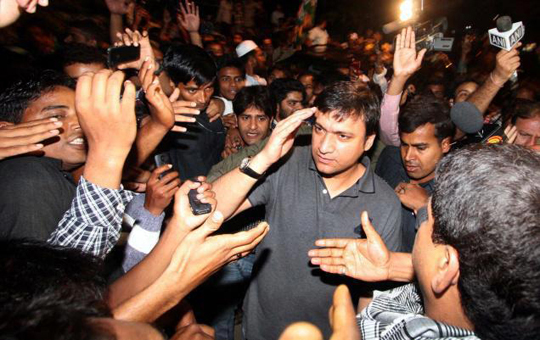
Can win 50 MP seats with votes of 'brethren', says Owaisi, BJP cries foul

Agencies
July 4, 2017

Hyderabad, Jul 4: AIMIM MLA Akbaruddin Owaisi stoked a controversy when he claimed his brother and party chief Asaduddin Owaisi could help the outfit win 50 seats in Parliament with the votes of "our brethren", remarks that BJP dubbed as "hate speech".

Owaisi

Owaisi was also purportedly shown in the video, which has gone viral, criticising the Modi government for the recent killing of Muslims.

He referred to the killings of Mohammed Akhlaq, Pehlu Khan and 15-year-old Junaid Khan and asked "if it is a crime to wear a cap, grow your beard and be a Muslim".

"There is no need for the sympathy, support of anybody. Our brother (his brother and MIM president Asaduddin Owaisi) can win 50 parliament seats for the party with the votes of our brethren," Akbaruddin, the MLA from Chandrayangutta in Hyderabad, was heard saying in the video.

Hitting out at the VHP and Bajrang Dal, he said: "Jitna ye mulkterahai, utna ye mulkmerabhihai". (This country is mine as much as it is yours).

It was not immediately clear where and when Akbaruddin Owaisi made the alleged speech.

Responding to Akbaruddin's alleged comments which were seen as appealing to Muslim sentiments, BJP spokesperson Krishna Saagar Rao alleged the MLA made a hate speech which could "incite" people.

Wondering why the TRS government in the state had not filed charge-sheet in the case of hate speech made earlier by Akbaruddin Owaisi, the BJP leader demanded that a police case be registered against him.

BJP would approach the Election Commission seeking cancellation of MIM's recognition, he said.

Comments

Fayaz
 - 
Friday, 7 Jul 2017

Terrorist grup tried to kill the innocent muslim guy..

s
 - 
Tuesday, 4 Jul 2017

anything a muslim says is hate?

Add new comment

  • Coastaldigest.com reserves the right to delete or block any comments.
  • Coastaldigset.com is not responsible for its readers’ comments.
  • Comments that are abusive, incendiary or irrelevant are strictly prohibited.
  • Please use a genuine email ID and provide your name to avoid reject.
News Network
July 14,2020

Jaipur, Jul 14: In a show of strength, Deputy Chief Minister Sachin Pilot-led Rajasthan Congress camp on Monday released a video showing at least 16 MLAs sitting together.

This comes hours after the Congress held a legislature party meeting. Party leaders said 106 of 122 MLAs attended, a claim contested by the Pilot camp.

The 10-second video was shared late at night on Pilot's official WhatsApp group.

In the video, at least 16 MLAs are seen sitting together in a close circle. Pilot is not seen in the video.

Six other people can be seen in the video but they could not be identified.

Some of the MLAs seen in the video are Indraraj Gurjar, Mukesh Bhakar, Harish Meena.

Tourism Minister Vishvendra Singh tweeted the video with the caption "Family".

Ladnun MLA Mukesh Bhakar tweeted, "...Loyalty in Congress means Ashok Gehlot's slavery. That is not acceptable to us."

Pilot has been upset since he was denied the Rajasthan chief minister's post after the December 2018 assembly elections.

On Sunday, he claimed to have the backing of 30 Congress MLAs and "some independents".

Those close to him disputed Gehlot's claim that his government had a majority, and said this is proven in the assembly and not at the CM's house.

Sources close to him have also ruled out the possibility of Pilot joining the BJP.

In the 200-member Rajasthan Assembly, the Congress has 107 MLAs and the BJP 72. In the past, the ruling party has claimed the support of 13 independents, two MLAs each from the CPM and the Bharatiya Tribal Party, and one from the Rashtriya Lok Dal.

Comments

Add new comment

  • Coastaldigest.com reserves the right to delete or block any comments.
  • Coastaldigset.com is not responsible for its readers’ comments.
  • Comments that are abusive, incendiary or irrelevant are strictly prohibited.
  • Please use a genuine email ID and provide your name to avoid reject.
Agencies
June 15,2020

New Delhi, Jun 15: Average temperature of India experienced a rise of 0.7 degree Celsius, along with decline in rainfall, significant increase in frequency of very severe cyclonic storms and droughts in over a decade due to human activities, the Ministry of Earth Sciences in its research report said.

The contentions were made in a report issued by the ministry on the impact of climate change. It will be published by Union Minister Harsh Vardhan on June 19.

According to the report, "Since the middle of the twentieth century, India witnessed rise in temperature; decrease in monsoon; rise in extreme temperature and rainfall, droughts, and sea levels; and increase intensity of severe cyclones.

The report, prepared by researchers of the Centre for Climate Change Research, a cell under The Ministry's Indian Institute of Tropical Meteorology, Pune, further stated that there is compelling scientific evidence that human activities have influenced these changes in regional climate.

India's average temperature has risen by around 0.7 degrees Celsius during 1901-2018, it said, adding that the rise is largely on account of GHG-induced warming and partially offset by forcing due to anthropogenic aerosols.

It states that the average temperature over India is projected to rise by 4.4 degrees Celsius, while the intensity of heat waves is likely to increase by 3-4 times by the end of the century.

In the 30-year period between 1986 and 2015, temperatures of the warmest day and the coldest night of the year have risen by about 0.63 degrees Celsius and 0.4 degree Celsius.

According to the report, by the end of the century, the temperatures of the warmest day and the coldest night are projected to rise by approximately 4.7 degrees Celsius and 5.5 degrees Celsius, respectively.

Alarmingly, sea surface temperature of the tropical Indian Ocean has also risen by one degrees Celsius on average during 1951-2015.

"The frequency of very severe cyclonic storms during the post-monsoon season has increased significantly (+1 event per decade) during the last two decades (2000-2018)," it added.

This came in the backdrop of Cyclone 'Amphan' and 'Nisarga' which made landfalls on May 20 and June 3 and killed several people, flattened villages, and destroyed farms.

"This is the first-ever climate change assessment report for India. This report will be very useful for policy makers, researchers, social scientists, economists, and students," said M. Rajeevan, secretary, the Ministry of Earth Sciences.

Besides this, the report also highlighted various other unnerving data on climate change in the country. Both the frequency and extent of droughts have increased significantly during 1951-2016.

The overall decrease of seasonal "summer monsoon rainfall" during the last 6-7 decades has led to an increased propensity for droughts over India.

"In particular, areas over central India, southwest coast, southern peninsula and north-eastern India have experienced more than 2 droughts per decade, on average, during this period. The area affected by drought has also increased by 1.3 per cent per decade over the same period."

The Hindu Kush Himalayas (HKH) also experienced a temperature rise of about 1.3 degree Celsius during 1951-2014.

Several areas of the Himalayas have experienced a declining trend in snowfall and also retreat of glaciers in recent decades. By the end of the twenty-first century, its annual mean surface temperature is projected to increase by about 5.2 degree Celsius.

The summer monsoon precipitation from June to September over India has also declined by around 6 per cent from 1951 to 2015, with notable decreases over the Indo-Gangetic Plains and the Western Ghats, the report further states.


Comments

Add new comment

  • Coastaldigest.com reserves the right to delete or block any comments.
  • Coastaldigset.com is not responsible for its readers’ comments.
  • Comments that are abusive, incendiary or irrelevant are strictly prohibited.
  • Please use a genuine email ID and provide your name to avoid reject.
News Network
May 21,2020

United Nations, May 21: At least 19 million children in parts of Bangladesh and India are at "imminent risk" from flash flooding and heavy rain as Cyclone Amphan makes landfall and the state of West Bengal is expected to take a direct hit from the powerful storm, the UN's children agency has warned.

The extremely severe cyclonic storm Amphan made a landfall at Digha in West Bengal and Bangladesh on Wednesday, leaving a trail of destruction. At least three persons were killed in India and seven in Bangladesh.

The UNICEF said that at least 19 million children in parts of Bangladesh and India are at “imminent risk from flash flooding, storm surges and heavy rain as Cyclone Amphan makes landfall.”

West Bengal, “home to more than 50 million people, including over 16 million children, is expected to take a direct hit from the powerful storm,” the UN agency said in a statement on Wednesday.

The UNICEF said it is also very concerned that the COVID-19 could deepen the humanitarian consequences of Cyclone Amphan in both the countries. Evacuees who have moved to crowded temporary shelters would be especially vulnerable to the spread of respiratory diseases like COVID-19, as well as other infections.

“We continue to monitor the situation closely,” said UNICEF Regional Director for South Asia Jean Gough.

“The safety of children and their families in the areas that will be impacted is a priority and it is good to see that the authorities have planned their urgent response factoring in the on-going COVID-19 pandemic.”

Across the region, the UNICEF is “working closely with the governments of Bangladesh and India and stands ready to support humanitarian operations to reach children and families affected by Cyclone Amphan.”

Based on the storm’s current trajectory, Cox’s Bazar in Bangladesh – now sheltering over 850,000 Rohingya refugees – is likely to experience high winds and heavy rains which may cause damage to homes and shelters in the refugee camps and Bangladeshi communities. This population is already highly vulnerable and cases of COVID-19 have recently been confirmed in the camps and host communities.

The UNICEF said it is working with the Deputy Commissioner’s Office in Cox’s Bazar, the Office of the Refugee Relief and Repatriation Commissioner, and humanitarian partners to help ensure Bangladeshi and Rohingya children and families remain protected.

These efforts include raising awareness among Rohingya and Bangladeshi communities on cyclone preparedness and prepositioning emergency life-saving water, sanitation, hygiene and medical supplies to meet immediate humanitarian needs.

Meanwhile, UN Secretary-General Antonio Guterres’ spokesperson Stephane Dujarric said at the daily press briefing that UN teams on the ground continue to work with the Government of Bangladesh to prepare and support those in need in the wake of the cyclone.

“Given the current pandemic, this support includes distributing personal protective equipment, disinfectants and other materials to evacuation shelters. To reduce the person-to-person contact during the delivery of aid, e-cash distributions will be used,” he said adding that the UN along with its partners is mobilising more than 1,700 mobile health teams and preparing for emergency food deliveries.

“The Super Cyclone is taking a westerly trajectory towards India, but nearly 8 million people in Bangladesh remain at risk,” he said adding that the Bangladesh government has evacuated more than 2 million people in high-risk areas. 

Comments

Add new comment

  • Coastaldigest.com reserves the right to delete or block any comments.
  • Coastaldigset.com is not responsible for its readers’ comments.
  • Comments that are abusive, incendiary or irrelevant are strictly prohibited.
  • Please use a genuine email ID and provide your name to avoid reject.