



Cattle smuggling, slaughter to be punishable under NSA, Gangsters Act in UP

June 6, 2017

Lucknow, Jun 6: The Uttar Pradesh Police today issued a terse warning that those involved in cow slaughter and illegal transport of milch animals will be booked under the stringent National Security Act and Gangsters Act.cow
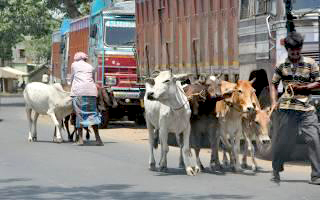
The directive has been conveyed to all district police chiefs by the state Director General of Police Sulkhan Singh.

A Government Order to ban cow slaughter and illegal transport of milch animals was passed during the previous Akhilesh Yadav government in the state but was never strictly implemented.

"NSA and Gangsters Act is to be invoked against those involved in cow slaughter and trafficking of milch animals for slaughter," the DGP's orders said.

Under NSA, the government can detain a person for as long as it wishes and the authorities need not disclose the grounds of detention.

A person booked under the provision of Gangsters Act becomes part of a gang listed in police records. It entitles the police to keep track of those booked under the Act and issue summons to them for attendance at the local police station for questioning even if no fresh case is lodged against them.

The Act permits the police to seek remand of an accused for a maximum of 60 days as compared to a maximum of 14 days under normal circumstances.

The DGP also directed SSPs and SPs of all districts to "effectively control" illegal activities committed by "vigilantes" in the name of cow protection, morality, religious conversion or illegal trafficking of milch animals.

Singh asked the officers to register FIRs against vigilantes when they violate the law and to prepare dossiers on them after identification with the help of intelligence networks.

"These people/organisations should be informed that they do not have a right to act illegally by taking the law into their hands," he said.

The directive comes against the backdrop of incidents in which 'gaurakshaks' or such organisations reach a spot where cow slaughter has taken place and cause traffic jams, assault people and indulge in arson.

Similar incidents have been reported about the illegal trafficking of milch animals in which 'gaurakshaks' damage vehicles and assault the driver.

The DGP has given directions to make police station in-charges aware about such trafficking and improve their intelligence networks.

The order comes amid a raging heated debate on the Centre's notification which bans the sale of cattle for slaughter in market places.

The notification has triggered protests from various quarters, including the Kerala government and certain BJP leaders in Meghalaya.

The Madras High Court had on May 30 stayed the notification for four weeks.

Kerala Chief Minister Pinarayi Vijayan had last week written against the notification to Prime Minister Narendra Modi.

He had also written a letter to counterparts in other states, including Uttar Pradesh Chief Minister Yogi Adityanath, saying the notification was "nothing but a covert attempt to usurp the powers of the state legislature".

Union Environment Minister Harsh Vardhan has said the Centre may consider any vital proposal on the new law on cattle trade and slaughter.

The Centre's new notification has imposed a blanket prohibition on the slaughtering of cattle (cows, bulls, buffaloes, camels, heifers) brought from animal markets.

The notification bans the sale of cattle for culling and also restrains sacrificing the animals for religious purposes.

The MoEF notified the stringent Prevention of Cruelty to Animals (Regulation of Livestock Markets) Rules, 2017 under the Prevention of Cruelty to Animals Act, 1960, on May 25, banning the sale and purchase of cattle from animal markets for slaughter.

In Uttar Pradesh, the Centre's decision had elicited a positive response from organisations running cow shelters, which termed it as an "appropriate step" in the "right direction."

Comments

Add new comment

  • Coastaldigest.com reserves the right to delete or block any comments.
  • Coastaldigset.com is not responsible for its readers’ comments.
  • Comments that are abusive, incendiary or irrelevant are strictly prohibited.
  • Please use a genuine email ID and provide your name to avoid reject.
Agencies
July 13,2020

Kolkata, July 13: Debendra Nath Roy, a member of the West Bengal legislative assembly (MLA) from the Bharatiya Janata Party (BJP), was found dead near his house in north Bengal’s Uttar Dinajpur district on Monday morning.

BJP leaders and his family members have alleged that he was murdered. 

BJP president JP Nadda has expressed “shock” at Roy’s “deplorable and suspected heinous killing” and condemned the incident.

He questioned the rise of “gunda raj” in West Bengal under Chief Minister Mamata Banerjee’s watch amid the worsening law and order in the state, which is slated to hold assembly polls next year, where the BJP is seen to be the primary challenger to the CM’s citadel.

“The suspected heinous killing of Debendra Nath Ray, BJP MLA from Hemtabad in West Bengal, is extremely shocking and deplorable. This speaks volumes of the gunda raj and failure of law and order in the Mamata Banerjee-led government. People will not forgive such a government in the future. We strongly condemn the incident,” he tweeted.

The BJP has demanded a Central Bureau of Investigation (CBI) probe into the lawmaker’s unnatural death.

His body was found in the balcony of a shop near his house at Bondol in Hemtabad, Uttar Dinajpur district, on Monday morning.

“The body has been sent for autopsy. We are investigating the case. No one has been detained for questioning or arrested so far,” said a police official from Uttar Dinajpur district, requesting anonymity.

“Roy was murdered. The way his body was found suggests that it was a premeditated murder and the accused tried to pass it off as a suicide. The ruling TMC (Trinamool Congress) is involved in his murder,” alleged Rahul Sinha, national secretary, BJP.

The TMC, however, refuted the BJP’s allegations.

“I heard that he (Roy) died by suicide. Police are investigating the case. Let the truth come out. If he has been murdered, then the culprits should be identified and punished as per law,” said Kanhaiyalal Agarwal, a TMC leader from Uttar Dinajpur district.

BJP leaders said some people had called Roy around 1 am on Monday and he went out of his home. His body was found on Monday morning.

Roy had won the Bengal assembly elections from Hemtabad on a Communist Party of India (Marxist) ticket in 2016, but joined the BJP last year.

Comments

Add new comment

  • Coastaldigest.com reserves the right to delete or block any comments.
  • Coastaldigset.com is not responsible for its readers’ comments.
  • Comments that are abusive, incendiary or irrelevant are strictly prohibited.
  • Please use a genuine email ID and provide your name to avoid reject.
coastaldigest.com news network
July 27,2020

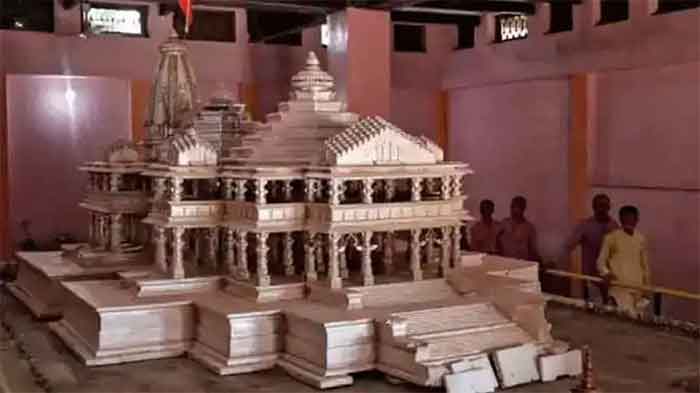
Ayodhya, Jul 27: With days to go for the August 5 "bhoomi pujan" ceremony of the Ram temple in Ayodhya, the mosques adjacent to the demolished Babri Masjid premises are spreading the message of a peaceful coexistence of Hindus and Muslims.

There are eight mosques and two mausoleums located close to the 70-acre Babri Masjid premises mandated by the Supreme Court for a temple of Sri Ram.

Azaan and namaaz are offered in the mosques and the annual "Urs" is held at the mausoleums without any objection from the local Hindus.

The eight mosques located near the upcoming Ram temple premises are Masjid Dorahikuan, Masjid Mali Mandir ke Bagal, Masjid Kaziyana Achchan ke Bagal, Masjid Imambara, Masjid Riyaz ke Bagal, Masjid Badar Paanjitola, Masjid Madaar Shah and Masjid Tehribazar Jogiyon ki.

The two mausoleums are Khanqaahe Muzaffariya and Imambara.

"It is the greatness of Ayodhya that the mosques surrounding the Ram temple are giving a strong message of communal harmony to the rest of the world," Haji Asad Ahmad, the corporator of the Ram Kot ward, said. The Ram temple area is situated in Ahmad's ward.

"Muslims take out the 'juloos' of Barawafaat that goes through the periphery of Ram Janmabhoomi. All religious functions and rituals of Muslims are respected by their fellow citizens," the corporator said.

Asked for a comment on the presence of mosques near the upcoming Ram temple premises, the chief priest of the temple, Acharya Satyendra Das, said, "We had a dispute only with the structure that was connected to the name of (Mughal emperor) Babur. We have never had any issue with the other mosques and mausoleums in Ayodhya. This is a town where Hindus and Muslims live in peace."

"Muslims offer namaaz, we perform our puja. The mosques around us will strengthen Ayodhya's communal harmony and peace will prevail," he added.

Both Hindus and Muslims have accepted the Supreme Court verdict over Ram Janmabhoomi, Das said, adding, "We have no dispute with each other."

Sayyad Akhlaq Ahmad Latifi, the "sajjada nasheen" and "pir" of the 500-year-old Khanqaahe Muzaffariya mausoleum, said Muslims in Ayodhya are performing all religious practices freely.

"We offer prayers five times a day in the mosque at Khanqaah and hold the yearly 'Urs'," he added.

"What a scene would it be -- a grand Ram temple surrounded by small mosques and mausoleums and everyone offering prayers according to their beliefs. That will be representative of the true culture of India," Mahant Yugal Kishore Sharan Shastri, the chief priest of the Sarayu Kunj temple adjacent to the Ram Janmabhoomi premises, said.

Reacting to the presence of mosques and mausoleums near the Ram Janmabhoomi premises, Triloki Nath Pandey, the decree holder of the land as the "first friend of Ram Lalla" as mandated by the Supreme Court, said, "We do not have any objection to either those mosques or any other mosques. We will not trigger a dispute regarding any structure, Ayodhya must live in peace and communal harmony."

Mahant Raju Das, the priest of the Hanumangarhi temple, said, "The presence of the mosques tells the story of Ayodhya's communal harmony. A Ram mandir will be built and there will be no objection to the mosques or religious practices of Muslims."

Comments

Add new comment

  • Coastaldigest.com reserves the right to delete or block any comments.
  • Coastaldigset.com is not responsible for its readers’ comments.
  • Comments that are abusive, incendiary or irrelevant are strictly prohibited.
  • Please use a genuine email ID and provide your name to avoid reject.
News Network
May 22,2020

Mumbai, May 22: The Reserve Bank of India (RBI) on Friday reduced repo rate by 40 basis points to 4 per cent in an effort to further boost liquidity in the economy which has been reeling under the impact of COVID-19 induced countrywide lockdown.

As a result, the reverse repo rate stands at 3.35 per cent, said RBI Governor Shaktikanta Das. The six-member monetary policy committee (MPC) voted 5:1 in favour of the decision.

Repo rate is the rate at which a country's central bank lends money to commercial banks, and the reverse repo rate is the rate at which it borrows from them. 

Comments

Add new comment

  • Coastaldigest.com reserves the right to delete or block any comments.
  • Coastaldigset.com is not responsible for its readers’ comments.
  • Comments that are abusive, incendiary or irrelevant are strictly prohibited.
  • Please use a genuine email ID and provide your name to avoid reject.