Celebrate I-Day and show us video proof: Yogi’s directive to madarsas

Agencies
August 11, 2017

Lucknow, Aug 11: Uttar Pradesh government's directive to the 'madrasas' (Islamic Schools) to celebrate Independence Day by unfurling the tricolour and recital of National Anthem and National Song has triggered a huge controversy with a section of the Muslim clergy taking umbrage to the directives saying that it was tantamount to calling their patriotism in question.

The state government, in a circular issued to all the 'madrasas', directed them to celebrate Independence Day as per the guidelines contained in it.

The 'madrasas' were directed to unfurl the tricolour at 8 in the morning to be followed by the recital of the national anthem and national song. It further directed them to explain to the students the significance of Independence Day followed by a recital of patriotic songs by the students.

The teachers were also directed to tell the students about the contribution of the freedom fighters.

What irked the Muslim clerics most was the directive to conduct videography of the entire program and submit the video, pictures to the concerned government official.

''The directive appears to question the patriotism of the madrasas.....the madrasas had also made a significant contribution to the freedom struggle....it is not proper to cast doubt on their patriotism,'' said the manager of a madrasa in the state capital.

Some school managers also voiced opposition to the singing of 'Vande Mataram'. ''No one should be compelled to sing Vande Mataram....besides we always celebrate Independence Day,'' the manager added.

''Why was such a circular not sent to all the schools?......why only to the madrasas?'' asked a senior Muslim cleric here on Friday.

According to the sources in the government, it was for the first time such a circular had been issued to the 'madrasas'.

UP minister Mohsin Raza, however, defended the circular and said that no one should have any objection to holding programs on the occasion of Independence Day.

Comments

abdulla
 - 
Monday, 14 Aug 2017

Muslims worship allah and don't want to say vandemataram.


Christians worship Jesus only still they do not have problem in singing vandemataram.


Bhudhist worship bhudha only still they do not have problem in singing vandemataram.


Jains worship mahavir only still they do not have problem in singing vandemataram.


why it is only problem for muslim to sing vandemataram.-

Sharief S
 - 
Saturday, 12 Aug 2017


Please everyone try to know, that Islam has codes to follow. Islam  strongly and strictly has to follow the  God’s rule. No human interference is allowed to complement to God’s rules. Islam has 2books. Quran and Hadees  the sayings of the prophet Muhammad (peace upon him PBU)

Muslims are not allowed to introduce new things which are contradictory to Islam.

Because Islam is flexible enough to allow allowable things. These things will suffice the needs. No need to invent the wheels. Islam is purely based on 1God and Message came thru prophet Muhammad PBU.

This is called 1ness of God.  Nothing should be worshipped other than 1 the true God. We worship only the God and we seek all our requirements with this 1God. This is the important message. Anyone contradicting and violating it by worshiping others or  praying others for our requirements is a unforgivable offense which leads to hell fire. it is command to us to be careful of this error.

30% of the teaching of Islam is repeatedly discouraging to worship or attribute others with the God. What a serious teaching we have to be careful of. This is repeated in Quran and hadees. Nothing is allowed even in a minute level to equate into the Quality of the God. This is oneness of God. Things against is called as doing shirk(associating to the God). May the God save us from this error.


1.VANDE MATARAM : We can not sing this song because its meaning contradicts the above oneness of the God.


2. Celebrating other festival      

Muslims are allowed to observe 2eids  (Eid ul Fitr.  This is after end of Ramadan fasting,  2nd is Eid us Adha)

Even we don’t celebrate the birth day of anyone including our prophet.


Patriotism

We are not against national interest. We have to fight for the right of our nation as long as we are not offending others. If required we are commanded  to fight and sacrifice our lives. What a great teaching. Is it in taught in any other books.


So we don’t celebrate even National independence day. No need for celebration but we are ready to sacrifice to defend the nation.


abdul
 - 
Saturday, 12 Aug 2017

Mr bogi , from last year rss nagpur headquartes started hoisting indian flag , from 1947 our madrasas hoisting clelebrating indipendence day , you sangis were with british when indians were fighting for freedom , now its time for indians  to fight against sangh parivar .

Right Ruler
 - 
Friday, 11 Aug 2017

To Yogi and his chela Mohsin: - Do you want the video that I'm Celebrating Ind. Pen Day and Fl-ag hosting in bathroom..........

Mohidin
 - 
Friday, 11 Aug 2017

Mr Yogi's statement is a proof for his trust in minorities, for video recording... Its better to send those Usthads who all attended the MRM meet yesterday in Bantwal constituency.  

Yogi ji could  you please request your headquarters in Nagpur to hoist national flag above RSS's Saffron flag,


Add new comment

  • Coastaldigest.com reserves the right to delete or block any comments.
  • Coastaldigset.com is not responsible for its readers’ comments.
  • Comments that are abusive, incendiary or irrelevant are strictly prohibited.
  • Please use a genuine email ID and provide your name to avoid reject.
News Network
April 23,2020

Washington, Apr 23: Air pollution over northern India has plummeted to a 20-year-low for this time of the year, according to satellite data published by US space agency National Aeronautics and Space Administration (NASA).
The US space agency's satellite sensors observed aerosol levels at a 20-year low post the countrywide lockdown, implemented to slow the spread of the novel coronavirus.

"We knew we would see changes in atmospheric composition in many places during the lockdown," said Pawan Gupta, a Universities Space Research Association (USRA) scientist at NASA''s Marshall Space Flight Center. "But I have never seen aerosol values so low in the Indo-Gangetic Plain at this time of year," added Mr Gupta.

Acting Assistant Secretary of State for South and Central Asia Alice G Wells tweeted, "These images from NASA were taken each spring starting in 2016 and show a 20-year low in airborne particle levels over India. When India and the world are ready to work and travel again, let's not forget that collaborative action can result in cleaner air."

The data published with maps show aerosol optical depth (AOD) in 2020 compared to the average for 2016-2019. Aerosol optical depth is a measure of how light is absorbed or reflected by airborne particles as it travels through the atmosphere.

If aerosols are concentrated near the surface, an optical depth of 1 or above indicates very hazy conditions. An optical depth, or thickness, of less than 0.1 over the entire atmospheric vertical column is considered "clean." The data were retrieved by the Moderate Resolution Imaging Spectroradiometer (MODIS) on NASA's Terra satellite.

In the first few days of the lockdown, it was difficult to observe a change in the pollution signature. "We saw an aerosol decrease in the first week of the shutdown, but that was due to a combination of rain and the lockdown," said Mr Gupta.

Around March 27, heavy rain poured over vast areas of northern India and helped clear the air of aerosols. Aerosol concentrations usually increase again after such heavy precipitation.

"After the rainfall, I was really impressed that aerosol levels did not go up and return to normal. We saw a gradual decrease and things have been staying at the level we might expect without anthropogenic emissions," Mr Gupta said.

On March 25, the Indian government placed its 1.3 billion citizens under a strict lockdown to reduce the spread of COVID-19. The countrywide mandate decreased activity at factories and severely reduced car, bus, truck and airplane traffic. Every year, aerosols from anthropogenic (human-made) sources contribute to unhealthy levels of air pollution in many Indian cities.

Aerosols are tiny solid and liquid particles suspended in the air that reduce visibility and can damage the human lungs and heart.

In southern India though, the story is a little hazier. Satellite data show aerosol levels have not yet decreased to the same extent. In fact, levels seem to be slightly higher than in the past four years. The reasons are unclear but could be related to recent weather patterns, agricultural fires, winds or other factors.

"This a model scientific experiment," Robert Levy, program leader for NASA's MODIS aerosol products, said about the lockdown and its effects on pollution.

"We have a unique opportunity to learn how the atmosphere reacts to sharp and sudden reductions in emissions from certain sectors. This can help us separate how natural and human sources of aerosols affect the atmosphere," Mr Levy added.

Comments

Add new comment

  • Coastaldigest.com reserves the right to delete or block any comments.
  • Coastaldigset.com is not responsible for its readers’ comments.
  • Comments that are abusive, incendiary or irrelevant are strictly prohibited.
  • Please use a genuine email ID and provide your name to avoid reject.
coastaldigest.com news network
August 7,2020


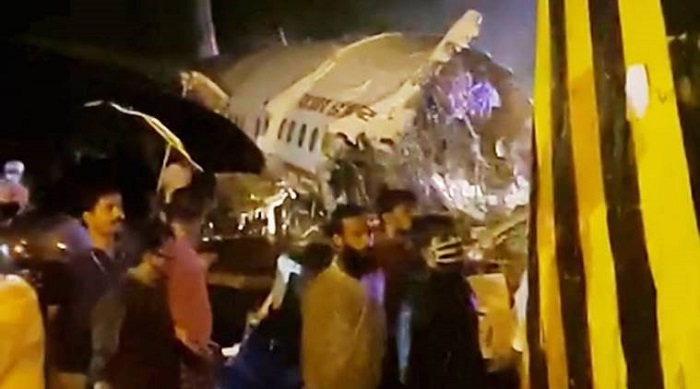
Kozhikode: An Air India Express flight from Dubai with 190 people on board overshot the Kozhikode tabletop runway on landing there today. The Boeing 737 “fell off” the runway into the valley, broke into two causing death and devastation. 

According to reports, around 20 people were dead including two pilots.

An Air India spokesperson said: “Air India Express flight IX 1344 operated by Boeing 737 aircraft from Dubai to Calicut overshot the runway at Kozhikode at 7.41 pm Friday. No fire reported at the time of landing. There are 174 passengers, 10 infants, two pilots and five cabin crew on board. Rescue operations are on and passengers are being taken to hospital for medical care. We will soon share the update in this regard.”

The Directorate General of Civil Aviation (DGCA) is probing this accident. “Prima facie, the aircraft landed beyond the touchdown point and fell into a valley. It has broken into two. We suspect some casualties. More information is awaited,” said a senior DGCA official.

Taking to twitter, defence minister Rajnath Singh wrote: “Devastating news from Kozhikode, Kerala. I am deeply anguished by the loss of lives due to an accident carrying several passengers on Air India flight. In this hour of grief, my thoughts are with the bereaved families. I pray for the speedy recovery of the injured.”

Foreign minister S Jaishankar tweeted: “Deeply distressed to hear about the Air India Express tragedy at Kozhikode. Prayers are with the bereaved families and those injured. We are ascertaining further details.”

While, senior BJP leader from Kerala K J Alphons tweeted: “Second tragedy of the day in Kerala: Air India Express skids off the run way at Kozhikode, front portion splits , pilot dies and lots of passengers injured . All passengers evacuated. Very lucky the aircraft didn’t catch fire.”

More details are awaited.

Watch video | Air India flight from Dubai skids off runway in Kerala, splits into two pic.twitter.com/qgGxEEG2e3

— coastaldigest.com (@coastaldigest) August 7, 2020

Comments

Add new comment

  • Coastaldigest.com reserves the right to delete or block any comments.
  • Coastaldigset.com is not responsible for its readers’ comments.
  • Comments that are abusive, incendiary or irrelevant are strictly prohibited.
  • Please use a genuine email ID and provide your name to avoid reject.
News Network
January 13,2020

Jan 13: For the first time in years, the government of India’s Prime Minister Narendra Modi is playing defense. Protests have sprung up across the country against an amendment to India’s laws — which came into effect on Friday — that makes it easier for members of some religions to become citizens of India. The government claims this is simply an attempt to protect religious minorities in the Muslim-majority countries that border India; but protesters see it as the first step toward a formal repudiation of India’s constitutionally guaranteed secularism — and one that must be resisted.

Modi was re-elected prime minister last year with an enhanced majority; his hold over the country’s politics is absolute. The formal opposition is weak, discredited and disorganized. Yet, somehow, the anti-Citizenship Act protests have taken hold. No political party is behind them; they are generally arranged by student unions, neighborhood associations and the like.

Yet this aspect of their character is precisely what will worry Modi and his right-hand man, Home Minister Amit Shah. They know how to mock and delegitimize opposition parties with ruthless efficiency. Yet creating a narrative that paints large, flag-waving crowds as traitors is not quite that easy.

For that is how these protests look: large groups of young people, many carrying witty signs and the national flag. They meet and read the preamble to India’s Constitution, into which the promise of secularism was written in the 1970’s.

They carry photographs of the Constitution’s drafter, the Columbia University-trained economist and lawyer B. R. Ambedkar. These are not the mobs the government wanted. They hoped for angry Muslims rampaging through the streets of India’s cities, whom they could point to and say: “See? We must protect you from them.” But, in spite of sometimes brutal repression, the protests have largely been nonviolent.

One, in Shaheen Bagh in a Muslim-dominated sector of New Delhi, began simply as a set of local women in a square, armed with hot tea and blankets against the chill Delhi winter. It has now become the focal point of a very different sort of resistance than what the government expected. Nothing could cure the delusions of India’s Hindu middle class, trained to see India’s Muslims as dangerous threats, as effectively as a group of otherwise clearly apolitical women sipping sweet tea and sharing their fears and food with anyone who will listen.

Modi was re-elected less than a year ago; what could have changed in India since then? Not much, I suspect, in most places that voted for him and his party — particularly the vast rural hinterland of northern India. But urban India was also possibly never quite as content as electoral results suggested. India’s growth dipped below 5% in recent quarters; demand has crashed, and uncertainty about the future is widespread. Worse, the government’s response to the protests was clearly ill-judged. University campuses were attacked, in one case by the police and later by masked men almost certainly connected to the ruling party.

Protesters were harassed and detained with little cause. The courts seemed uninterested. And, slowly, anger began to grow on social media — not just on Twitter, but also on Instagram, previously the preserve of pretty bowls of salad. Instagram is the one social medium over which Modi’s party does not have a stranglehold; and it is where these protests, with their photogenic signs and flags, have found a natural home. As a result, people across urban India who would never previously have gone to a demonstration or a political rally have been slowly politicized.

India is, in fact, becoming more like a normal democracy. “Normal,” that is, for the 2020’s. Liberal democracies across the world are politically divided, often between more liberal urban centers and coasts, and angrier, “left-behind” hinterlands. Modi’s political secret was that he was that rare populist who could unite both the hopeful cities and the resentful countryside. Yet this once magic formula seems to have become ineffective. Five of India’s six largest cities are not ruled by Modi’s Bharatiya Janata Party in any case — the financial hub of Mumbai changed hands recently. The BJP has set its sights on winning state elections in Delhi in a few weeks. Which way the capital’s voters will go is uncertain. But that itself is revealing — last year, Modi swept all seven parliamentary seats in Delhi.

In the end, the Citizenship Amendment Act is now law, the BJP might manage to win Delhi, and the protests might die down as the days get unmanageably hot and state repression increases. But urban India has put Modi on notice. His days of being India’s unifier are over: From now on, like all the other populists, he will have to keep one eye on the streets of his country’s cities.


Comments

Add new comment

  • Coastaldigest.com reserves the right to delete or block any comments.
  • Coastaldigset.com is not responsible for its readers’ comments.
  • Comments that are abusive, incendiary or irrelevant are strictly prohibited.
  • Please use a genuine email ID and provide your name to avoid reject.