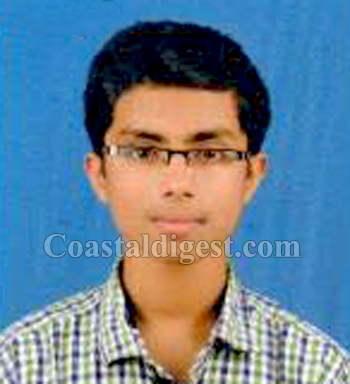
CET results announced; Ananth G from Alva's College is medical topper

[email protected] (CD Network)
May 28, 2016

Bengaluru, May 28: The Common Entrance Test results were announced on Saturday by Minister for Higher Education T.B. Jayachandra.

Of the 1.78 lakh candidates who had applied, 1.71 lakh students appeared for CET. Assessment of performance was done on the basis of the revised key answers. According to the merit list generated for different courses, 41,530 candidates are eligible for admission to medical and dental courses, 99,791 for Indian Systems of Medicine (ISM) and Homoeopathy courses, 1.27 lakh for engineering and technology courses and 1,395 for architecture course. That apart, 96,341 are eligible for agriculture, 99,788 for veterinary, 1.31 lakh for B.Pharma and Pharma-D courses.

ananthToppers

Ananth G. from Alva's PU College in Moodbidri has bagged the first rank in medical/ dental, and third rank in the ISM and Homoeopathy. The second and third ranks in medical/ dental have been secured by Sanjay M. Goudar from Seshadripuram PU College, Yelahanka, and Vachana Shree Patil from Shaheen Independent PU College in Bidar. Sanjay and Vachana Shree Patil have also bagged the first and second ranks in ISM and Homoeopathy.

In engineering, the first rank holder is Milind Kumar Vaddiraju from V.V.S. SardarPatel PU College, Bengaluru. The second and third rank holders have been bagged from Niranjan Kamath from Expert PU College and Divya A. Jamakhandi from KLES Independent PU College. In Architecture, the first three ranks have been bagged by Mrudulaa C.R. from CMR National Public School, Aishwarya Mahadevan from The Amrutha Academy, and Neha Sarah Abraham from Sophia High School.

Full scholarship

Mr. Jayachandra said that unlike previous years, the full scholarship for the top five rankers of CET will be extended to the full course from this year.

Meanwhile, there still is no clarity on whether CET will be applicable to only government quota seats in medical colleges. Minister for Medical Education Sharanprakash R. Patil said that the centre's Ordinance is clear on there being government quota seats in private colleges. "We are still seeking legal opinion to see what to make of the announcement made by the Karnataka Professional Colleges Foundation on Friday. The government was not consulted in this regard," he said.

Comments

ALI MOHAMMED
 - 
Saturday, 28 May 2016

Great achievement...Proud to be ALVA\s Alumuni..."

hemanth
 - 
Saturday, 28 May 2016

wow good news for coastal karnataka in every result we defeated bengaluru, bengaluru is all behind us.

Prakash Rao
 - 
Saturday, 28 May 2016

ohh anyways congo to this ananth. what if we lose here, sunday IPL will win it for sure

Roopesh
 - 
Saturday, 28 May 2016

congo boy. all the best. govt should support him to reach high level and implement his knowledge for the good cause.

Mohan Rao
 - 
Saturday, 28 May 2016

where is the treat bro,

Ismail
 - 
Saturday, 28 May 2016

well done ananth, indian stars!

Swetha
 - 
Saturday, 28 May 2016

all the best for the future studies, get good things to india, dont go to abroad,

Priyanka
 - 
Saturday, 28 May 2016

congratulations ananth, your hardwork treat to u,

Add new comment

  • Coastaldigest.com reserves the right to delete or block any comments.
  • Coastaldigset.com is not responsible for its readers’ comments.
  • Comments that are abusive, incendiary or irrelevant are strictly prohibited.
  • Please use a genuine email ID and provide your name to avoid reject.
News Network
February 26,2020

Feb 26: The Tamil Nadu government on Tuesday claimed that it prevented Karnataka from discussing the contentious Mekedatu reservoir issue at the Cauvery Water Management Authority (CWMA) meeting held in New Delhi.

Besides the representatives of Tamil Nadu and Karnataka at the fifth meeting of CWMA, presided over by Central Water Commission Chairman R K Jain, officials of Kerala and Puducherry also participated.

CWMA member and TN PWD Secretary K Manivasan told reporters after the meeting that the state government prevented Karnataka from discussing the dam issue by pointing out the pending petitions in the Supreme Court against the project filed by the E Palaniswami government.

"We have told participants of the meeting that Mekedatu reservoir will be against the interests of Tamil Nadu and its farmers. Our consistent stand is that it should not be built at any cost. Finally the issue was not discussed in the meeting," Manivasan said.

The Mekedatu reservoir is proposed to be constructed by Karnataka across Cauvery river near Mekedatu, about 110 km from Bengaluru, in Kanakapura taluk.

It was first proposed along with Shivanasamudra hydro power project at Shimsa in 2003 with an intention to use the water for a hydro power station and supply drinking water to Bengaluru city. It was designed to store 67 tmc feet of water.

While Tamil Nadu is claiming that the construction of a balancing reservoir will disturb Cauvery water flow to the state affecting irrigation, Karnataka says the project is basically designed to take care of the drinking water needs of Bengaluru after releasing water to Tamil Nadu as per the quantum specified by the Cauvery water disputes tribunal.

Comments

Add new comment

  • Coastaldigest.com reserves the right to delete or block any comments.
  • Coastaldigset.com is not responsible for its readers’ comments.
  • Comments that are abusive, incendiary or irrelevant are strictly prohibited.
  • Please use a genuine email ID and provide your name to avoid reject.
News Network
January 17,2020

New Delhi, Jan 17: The Supreme Court on Friday closed the monitoring of the killing of rationalist M M Kalburgi in 2015 in Dharwad.

A bench of Justices R F Nariman and S Ravindra Bhat noted that the charge sheet has already been filed and the matter was assigned to the sessions court. The court, however, noted two accused had absconded and could not be arrested till date, according to reports.

Senior advocate Devadatt Kamat, appearing for the Karnataka government, submitted that the High Court had also stopped monitoring of the matter.

The top court had in early last year directed that the Karnataka High Court's Dharwad bench to monitor the probe. The Karnataka police SIT, which investigated Gauri Lankesh case and filed the charge sheet, was allowed to take over the Kalburgi case.

Umadevi, in her 2017 plea, drew a parallel between Kalburgi's murder and killings of Narendra Dabholkar and Comrade Govind Pansare in Maharashtra and sought an SIT probe by a retired Supreme Court or a High Court judge. She urged the top court to monitor the probe till it reached its logical conclusion as there was no progress in the investigation conducted so far by the Karnataka police.

The court had earlier sought to know if there was a "common thread" in murder cases of Communist leader Pansare and rationalist Dabholkar in Maharashtra, and Kannada writer Kalburgi and journalist-activist Gauri Lankesh in Karnataka.

Comments

Add new comment

  • Coastaldigest.com reserves the right to delete or block any comments.
  • Coastaldigset.com is not responsible for its readers’ comments.
  • Comments that are abusive, incendiary or irrelevant are strictly prohibited.
  • Please use a genuine email ID and provide your name to avoid reject.
Ram Puniyani
February 4,2020

As democracy is seeping in slowly all over the world, there is an organization which is monitoring the degree of democracy in the individual countries, The Economist Intelligence Unit. As such in each country there are diverse factors which on one hand work to deepen it, while others weaken it. Overall there is a march from theoretical democracy to substantive one. The substantive democracy will herald not just the formal equality, freedom and community feeling in the country but will be founded on the substantive quality of these values. In India while the introduction of modern education, transport, communication laid the backdrop of beginning of the process, the direction towards deepening of the process begins with Mahatma Gandhi when he led the non-cooperation movement in 1920, in which average people participated. The movement of freedom for India went on to become the ‘greatest ever mass movement’ in the World.

The approval and standards for democracy were enshrined in Indian Constitution, which begins ‘We the people of India’, and was adopted on 26th January 1950. With this Constitution and the policies adopted by Nehru the process of democratization started seeping further, the dreaded Emergency in 1975, which was lifted later restored democratic freedoms in some degree. This process of democratisation is facing an opposition since the decade of 1990s after the launch of Ram Temple agitation, and has seen the further erosion with BJP led Government coming to power in 2014. The state has been proactively attacking civil liberties, pluralism and participative political culture with democracy becoming flawed in a serious way. And this is what got reflected in the slipping of India by ten places, to 51st, in 2019. On the index of democracy India slipped down from the score of 7.23 to 6.90. The impact of sectarian BJP politics is writ on the state of the nation, country.

Ironically this lowering of score has come at a time when the popular protests, the deepening of democracy has been given a boost and is picking up with the Shaheen Bagh protests. The protest which began in Shaheen Bagh, Delhi in the backdrop of this Government getting the Citizenship amendment Bill getting converted into an act and mercilessly attacking the students of Jamia Milia Islamia, Aligarh Muslim University along with high handed approach in Jamia Nagar and neighbouring areas.  From 15th December 2019, the laudable protest is on.

It is interesting to note that the lead in this protest has been taken by the Muslim women, from the Burqa-Hijab clad to ‘not looking Muslim’ women and was joined by students and youth from all the communities, and later by the people from all the communities. Interestingly this time around this Muslim women initiated protest has contrast from all the protests which earlier had begun by Muslims. The protests opposing Shah Bano Judgment, the protests opposing entry of women in Haji Ali, the protests opposing the Government move to abolish triple Talaq. So far the maulanas from top were initiating the protests, with beard and skull cap dominating the marches and protests. The protests were by and large for protecting Sharia, Islam and were restricted to Muslim community participating.

This time around while Narendra Modi pronounced that ‘protesters can be identified by their clothes’, those who can be identified by their external appearance are greatly outnumbered by all those identified or not identified by their appearance.

The protests are not to save Islam or any other religion but to protect Indian Constitution. The slogans are structured around ‘Defence of democracy and Indian Constitution’. The theme slogans are not Allahu Akbar’ or Nara-E-Tadbeer’ but around preamble of Indian Constitution. The lead songs have come to be Faiz Ahmad Faiz’s ‘Hum Dekhenge’, a protest against Zia Ul Haq’s attempts to crush democracy in the name of religion. Another leading protest song is from Varun Grover, ‘Tanashah Aayenge…Hum Kagaz nahin Dikhayenge’, a call to civil disobedience against the CAA-NRC exercise and characterising the dictatorial nature of the current ruling regime.

While BJP was telling us that primary problem of Muslim women is Triple talaq, the Muslim women led movements has articulated that primary problem is the very threat to Muslim community. All other communities, cutting across religious lines, those below poverty line, those landless and shelter less people also see that if the citizenship of Muslims can be threatened because of lack of some papers, they will be not far behind in the victimization process being unleashed by this Government.

While CAA-NRC has acted as the precipitating factor, the policies of Modi regime, starting from failure to fulfil the tall promises of bringing back black money, the cruel impact of demonetisation, the rising process of commodities, the rising unemployment, the divisive policies of the ruling dispensation are the base on which these protest movements are standing. The spread of the protest movement, spontaneous but having similar message is remarkable. Shaheen Bagh is no more just a physical space; it’s a symbol of resistance against the divisive policies, against the policies which are increasing the sufferings of poor workers, the farmers and the average sections of society.

What is clear is that as identity issues, emotive issues like Ram Temple, Cow Beef, Love Jihad and Ghar Wapasi aimed to divide the society, Shaheen Bagh is uniting the society like never before. The democratisation process which faced erosion is getting a boost through people coming together around the Preamble of Indian Constitution, singing of Jan Gan Man, waving of tricolour and upholding the national icons like Gandhi, Bhagat Singh, Ambedkar and Maulana Azad. One can feel the sentiments which built India; one can see the courage of people to protect what India’s freedom movement and Indian Constitution gave them.

Surely the communal forces are spreading canards and falsehood against the protests. As such these protests which is a solid foundation of our democracy. The spontaneity of the movement is a strength which needs to be channelized to uphold Indian Constitution and democratic ethos of our beloved country.


Comments

Add new comment

  • Coastaldigest.com reserves the right to delete or block any comments.
  • Coastaldigset.com is not responsible for its readers’ comments.
  • Comments that are abusive, incendiary or irrelevant are strictly prohibited.
  • Please use a genuine email ID and provide your name to avoid reject.