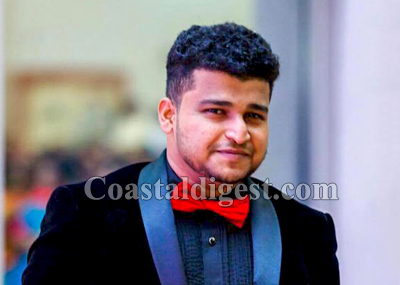
Chain snatching: Ullal CMC chief officer's son among 2 arrested

[email protected] (CD Network)
December 27, 2016

Mangaluru, Dec 27: Sleuths of the Mangaluru North Police have arrested two youths on the charge of chain snatching in two different places.

VimarshAlvaThe accused have been identified as Vimarsh Alva (21), son of Vani Alva, chief officer of Ullal City Municipal Council and resident of Maroli, and Shahil Hussain (21), a resident of Shivanagar, Pandeshwar.

The accused allegedly snatched a gold chain from women in Madyar under Ullal Police limits on December 13 and in Moodbidri Police limits on December 25.

They were apprehended on suspicion on Tuesday on GHS Road in the city.

Upon inquiry, they revealed involvement in commission of the crime, the police added.

Comments

ajit kumar
 - 
Thursday, 29 Dec 2016

mere waste for the parents, who brought them up,. should be punished severely.

Add new comment

  • Coastaldigest.com reserves the right to delete or block any comments.
  • Coastaldigset.com is not responsible for its readers’ comments.
  • Comments that are abusive, incendiary or irrelevant are strictly prohibited.
  • Please use a genuine email ID and provide your name to avoid reject.
News Network
June 4,2020

Bengaluru, Jun 4: The Karnataka government has tweaked quarantine requirements for people arriving from Maharashtra, raising the isolation time from a fortnight to three weeks, an official said on Wednesday.

"Returnees from Maharashtra will be sent to institutional quarantine for seven days, followed by 14 days strict home quarantine, total 21 days," tweeted Health Commissioner Pankaj Kumar Pandey.

The 21-day quarantine regimen is for all asymptomatic people returning from Maharashtra, considering most of the Covid cases in Karnataka are having domestic travel history to that state.

If any of the asymptomatic people develop symptoms during the isolation, they will be subjected to a Covid test.

However, some asymptomatic individuals from Maharashtra have been provided some exceptions from the three-week quarantine and designated as special category passengers.

Special category passengers include people who suffered a death in family, pregnant women, children below 10, elderly people above 60, individuals suffering from serious illness and human distress.

Similarly, the department has also made some provisions for business travellers from Maharashtra.

"To establish that one is a business visitor, (that) person should show confirmed return flight or train ticket which should not be more than seven days later from the date of arrival," ordered Chief Secretary T.M. Vijay Bhaskar.

Similarly, if a business visitor is arriving on road, he should provide the address proof of the person in Karnataka he intends to meet.

Additionally, such a person should also produce a Covid negative test certificate which is not more than two days old.

"One does not have a Covid negative test certificate such a person should go for institutional quarantine for two days within which Covid test should be conducted at his own cost. After the test result is negative, that person is exempted from quarantine," he said.

However, business travellers have been exempted from hand stamping.

Amending the Sunday orders, Bhaskar, has enhanced the quarantine requirements for Maharashtra returnees.

Many conditions for visitors from other states remain mostly unchanged as notified on Sunday.

Comments

Add new comment

  • Coastaldigest.com reserves the right to delete or block any comments.
  • Coastaldigset.com is not responsible for its readers’ comments.
  • Comments that are abusive, incendiary or irrelevant are strictly prohibited.
  • Please use a genuine email ID and provide your name to avoid reject.
News Network
January 2,2020

Tumakuru, Jan 2: Prime Minister Narendra Modi on Thursday paid respects to the 'Gadduge' (final resting place) of Shivakumara Swamiji at Siddaganga Math, a prominent Lingayat seminary here, and said the Swamiji's work would continue to inspire everyone.

The Swamiji, who was known as the 'Walking God' among his countless followers, had passed away last year at the age of 111. The Prime Minister, who arrived at the Yelahanka Airbase in Bengaluru, went directly to Tumakuru, where the Math is located, by a chopper along with Chief Minister B S Yediyurappa, Union Minister Pralhad Joshi and former Chief Minister D V Sadananda Gowda among others. Modi, after offering respects to the 'Gadduge', planted Bilva plant (Aegle marmelos) on the premises of the Math and also laid the foundation for the construction of a museum dedicated to Swamiji here before addressing the gathering, largely comprising students. Speaking on the occasion, Modi said he was feeling blessed to begin 2020 from the sacred land of Siddaganga, but at the same time was feeling the "vacuum" in the absence of Shivakumara Swamiji. "It is rare see the number of people swamiji had inspired during his life time. I'm really fortunate to lay the foundation for the museum in swamiji's memory. Through this museum, his works will continue to inspire generations," he said. Also, Prime Minister remembered Vishwesha Theertha of Udupi's Pejawar Math who passed away recently. Yediyurappa and the present pontiff of the Math Siddalinga Swamiji were among the others present. Known as "trivida dasohi" for his triple sacraments - food, shelter and education - among his followers, Shivakumara swamiji was considered as the incarnation of Basavanna, the 12th-century social reformer, as he accepted all irrespective of their religion or caste. There has been a growing clamour from people of different walks of life, including politicians, for conferring "Bharat Ratna" on the late Swamiji.

After the Swamiji's demise, the then Chief Minister H D Kumaraswamy had written to Modi urging him to confer the country's highest civilian order on the late seer.

Opposition Congress on Thursday questioned the Prime Minister about not conferring the"Bharat Ratna" on Shivakumara Swamiji.

Questioning Modi as to why he did not visit Tumakuru when Shivakumara Swamiji of Siddaganga Math passed away, the principal opposition party in the state assembly in a tweet also sought to know why the seer was not conferred with the Bharat Ratna yet, while pointing out that former Chief Minister Siddaramaiah had written a letter in this regard in January 2018.

The present seer of the seminary Siddalinga Swamiji presented Modi a silver statue of Shivakumara Swamiji as a memento.

Comments

Add new comment

  • Coastaldigest.com reserves the right to delete or block any comments.
  • Coastaldigset.com is not responsible for its readers’ comments.
  • Comments that are abusive, incendiary or irrelevant are strictly prohibited.
  • Please use a genuine email ID and provide your name to avoid reject.
Media Release
February 14,2020

Veteran journalist P. Sainath has said that the nation is in a crisis. And this crisis is not limited to just the rural area. It has become a national crisis at various areas such as agriculture, education, economy, job creation etc.

He was delivering the endowment lecture on the topic ‘Indian democracy at the post-liberalization and post-truth era’ at Media Manthan 2020 organized by the PG department of journalism and mass communication at St Aloysius College (Autonomous). 

Mr Sainath said that the many policies adopted in the 90s led to India becoming unusually unequal. Referring to the speech Ambedkar had made at the Constituent Assembly while handing over the draft of the Constitution, Mr Sainath said, “Ambedkar had warned about the weakness of Indian democracy that liberty without equality allows the supremacy of a few over the multitude. Liberty, equality and fraternity must be kept together as we cannot have one without the other.” 

Mr Sainath stated that the agrarian crisis was no longer about the loss of productivity, employment or about farmer suicide; it was a societal, civilizational crisis. Commenting on the lopsided policies such as cow-slaughter ban, he explained how cow slaughter ban had adversely affected many industries due to their interdependency. While Muslims who slaughtered cows were rendered helpless, the cattle traders who were mostly OBCs lost their earnings as the cattle prices crashed. An important industry like Kolhapur sandals industry in Maharashtra went bankrupt as a result of the cow slaughter ban in Maharashtra. He said the policymakers had no idea how the rural industries were interconnected. Demonetisation too devastated the rural economy as 98 percent of rural transactions happen through cash. 

Mr Sainath also spoke about the crisis of inequality which affects the Dalits and the Adivasis far more than anyone else as 90 percent of the rural households take home less than Rs 10,000/- per month. “Women are yet another group whose labour is never counted in the gross domestic product. Women and girls globally do unpaid work which amounts to about 12.5 billion working hours per year. Monetarily speaking, this is worth 10.8 trillion dollars,” Mr Sainath added. 

Speaking about the crisis of jobs Mr Sainath said that major companies were laying off employees just to create more profits for the investors and the adoption of artificial intelligence in the industry would further destroy millions of jobs.

Rector of St Aloysius College Institutions Fr Dionysius Vaz SJ, Principal Dr (Fr) Praveen Martis SJ, HOD of Journalism and Mass Communication department Dr (Fr) Melwyn Pinto SJ were present.

‘Veerappan and Vijay Mallya’s business models are interesting!’

Addressing the gathering during his endowment lecture on Friday, Mr Sainath made an interesting comment on the so called ‘revenue model’. “Whenever I visit IIMs and IITs for lectures on my PARI project, the students there ask me what my revenue model for my project is. I tell them that I do not have a revenue model. In fact, journalism does not begin with a revenue model. Gandhiji, Ambedkar, Bhagat Singh were all great journalists. But they did not have a revenue model,” Mr Sainath said.

On a lighter note, he said that the best revenue model that he liked was that of forest brigand Veerappan and liquor baron Vijay Mallya. “Veerappan ruled the forest for forty years and from the top ministers to the villagers he could dictate terms and liver royally. Similarly, Mallya’s revenue model was to steal the banks and run away abroad and live like a king,” Mr Sainath added.

Journalism is not and can never be a business. It is a calling, he opined. While newspaper can be a business, television can be a business, journalism per se cannot be reduced to a business. “Unfortunately today, journalists are recruited on a contract basis and they have no bargaining power; and there are no unions to fight for their cause. Hence, they are at the mercy of the corporate media houses for their survival and are made to write stories that cannot be called journalism,” Mr Sainath said.

Answering a question as to the pressures he faced as a journalist, he said that external pressures from the government or others could be very well handled. It is the internal pressures from once own media house that journalists find it difficult to manage.


 

Comments

Add new comment

  • Coastaldigest.com reserves the right to delete or block any comments.
  • Coastaldigset.com is not responsible for its readers’ comments.
  • Comments that are abusive, incendiary or irrelevant are strictly prohibited.
  • Please use a genuine email ID and provide your name to avoid reject.