


Chamundeshwari: HDK, CM up the campaign ante

DHNS
April 17, 2018

While JD(S) state president H D Kumaraswamy concluded his three-day election campaign in the Chamundeshwari Assembly segment on Monday, Chief Minister Siddaramaiah commenced his third round of canvassing in the constituency.

Chamundeshwari is considered as a high-profile segment as Chief Minister Siddaramaiah himself is the Congress candidate. Siddaramaiah is back in the segment after a gap of 12 years. It may be mentioned that during his first and second round of campaign, Siddaramaiah had to face embarrassment as a few of his supporters were denied support.

Kumaraswamy, during his three-day campaign in favour of JD(S) candidate G T Devegowda, took out roadshows along with Devegowda in a specially designed bus in nearly 70 villages across the constituency from Saturday. On day three, he visited nearly 20 villages.

Though the third-day campaign was scheduled to commence at 7.30 am, the event started at 11 am from Hootagalli. The roadshow passed through Belavadi, Koorgalli and Maidanahalli. The JD(S) leaders received a warm welcome in all the villages.

When the vehicle reached Koorgalli, a few women performed ‘aarathi’ to Kumaraswamy and wished him to become the next chief minister. They requested him to solve farmers’ issues.

Kumaraswamy said, “I don’t have the capacity to conduct elections with money power. My health condition is also not good. Siddaramaiah is luring the voters in the name of caste and with money power. The people, who have faith in democracy, will support the JD(S). People’s love and blessings is my strength”.

Speaking to reporters, Kumaraswamy said, the All India Majlis-e-Ittehadul Muslimeen (AIMIM) president Asaduddin Owaisi has extended support to the JD(S) in Karnataka. The support of AIMIM, Telangana Rashtra Samithi (TRS), Bahujan Samaj Party (BSP) to the JD(S) will definitely help the JD(S) to secure 113 seats. The parties want the regional party to come to power in the state and thus they have come under an alliance, he said.

“The Congress party is emotionally cheating Muslims. The Congress has failed to protect them and also in providing necessary facilities. But, the JD(S) has treated them as their brothers and thus Owaisi has extended his support,” he said.

CM campaigns

Similarly, Siddaramaiah, who arrived in a special flight to Mysuru on Monday morning, visited Siddappaji temple, Ramamandira and Manteswamy temple in Lingambudi Palya. The party supporters welcomed him by bursting crackers and with garlands. The supporters also donated a sword to the CM.

The CM will camp in the Chamundeshwari Assembly segment for five days from Monday. On day one, he took out roadshows at 18 villages. He visited several temples at the villages and also visited a few houses.

PWD Minister H C Mahadevappa accompanied the CM during the campaign.

Siddaramaiah participated in a conference organised for Bhovi community people. During his address, the CM said, after 2006, I am returning to the constituency. I will file my nomination on April 20, he said.

The CM said the JD(S) leaders have been claiming that the party is secular, but they have joined hands with communal parties. “What moral right do they have to claim themselves as secular,” he asked.

Comments

Farooq
 - 
Tuesday, 17 Apr 2018

Congress 

congress 

congress


Congress


congress


congress


Jai Siddaramaiah


Jai Congress


Danish
 - 
Tuesday, 17 Apr 2018

HDK trying to get votes by telling emotional lies.. father, family, health.. He is making us fools

Ganesh
 - 
Tuesday, 17 Apr 2018

As usual, Kumaraswamy tried to sack people by being emotional.. Shameless guy.. If you are telling about health issues, why you are sticking in poltics.. nobody forced you to be  active in politics.

Vignesh
 - 
Tuesday, 17 Apr 2018

Cong has less hope because of JDS.. JDS may score.. they are having some people

Add new comment

  • Coastaldigest.com reserves the right to delete or block any comments.
  • Coastaldigset.com is not responsible for its readers’ comments.
  • Comments that are abusive, incendiary or irrelevant are strictly prohibited.
  • Please use a genuine email ID and provide your name to avoid reject.
coastaldigest.com news network
August 8,2020

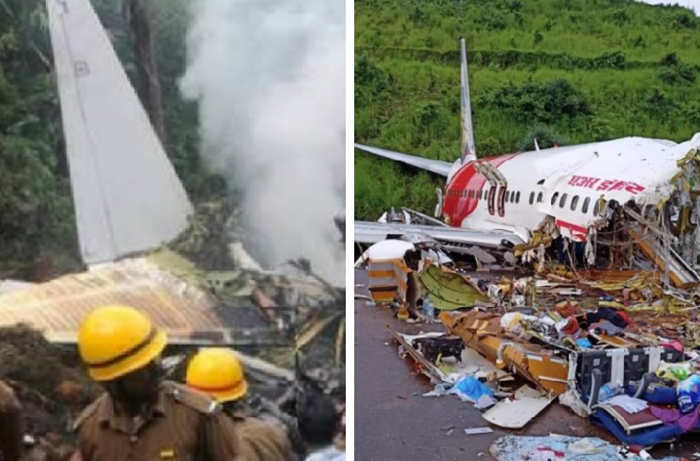
Mangaluru, Aug 8: As visuals of the Air India Express flight crash at Kozhikode international airport emerge, one cannot help but be reminded of an eerily similar and unfortunate accident that occurred a decade ago. The August 7, 2020 tragedy brought back memories of the 2010 crash.

It was on May 22, 2010 that an Air India Express Boeing 737-800 flight from Dubai to Mangaluru over shot the runway while landing at Bajpe airport and fell into a cliff. Of the 160 passengers and 6 crew members on board, 158 were killed (all crew members and 152 passengers) and only 8 survived.

Even back then, the plane had split into two. The crash has been termed as one of India's worst aviation disasters.

The final conversations between Air traffic control (ATC) and the pilot prior to the landing showed no indication of any distress.

Like the Mangaluru accident, Karipur crash too happened when the flight was attempting to land.

The captain of the aircraft which crashed at Mangaluru, Z Glucia, was an experienced pilot with 10,000 hours of flying experience and had 19 landings at the Mangalore airport. Co-pilot S S Ahluwalia, with 3,000 hours of flying experience had as many as 66 landings at this airport. Both the pilot and co-pilot were among the victims.

An investigation into the accident later found that the cause of the accident was the captain’s failure to discontinue an ‘unstabilised approach’ and his persistence to continue with the landing, despite three calls from the First Officer to ‘go-around’.

Comments

Add new comment

  • Coastaldigest.com reserves the right to delete or block any comments.
  • Coastaldigset.com is not responsible for its readers’ comments.
  • Comments that are abusive, incendiary or irrelevant are strictly prohibited.
  • Please use a genuine email ID and provide your name to avoid reject.
News Network
March 8,2020

Bengaluru, Mar 8: The Indian Council of Medical Research (ICMR) has identified three more locations to open Viral Research Diagnostic Laboratories (VRDL) including in Mysuru, Hassan, and Shivamogga in Karnataka.

According to a statement issued here on Sunday, these laboratories will start functioning shortly in Mysuru Medical College and Research Institute, Hassan Institute of Medical Sciences, and Shivamogga Institute of Medical Sciences. Besides, the ICMR has also identified sample collection centres in Vijayanagar Institute of Medical Science in Ballari and Kalaburgi Institute of Medical Sciences.

B G Prakash, State Joint Director (Communicable Diseases), said that the new Laboratories will help to ease the load on the two designated laboratories in Bengaluru. Currently, the virology laboratory in Bangalore Medical College and Research Institute and the NIV branch in Rajiv Gandhi Institute of Chest Diseases are doing COVID-19 tests in Karnataka.

Comments

Add new comment

  • Coastaldigest.com reserves the right to delete or block any comments.
  • Coastaldigset.com is not responsible for its readers’ comments.
  • Comments that are abusive, incendiary or irrelevant are strictly prohibited.
  • Please use a genuine email ID and provide your name to avoid reject.
Ram Puniyani
January 14,2020

In the beginning of January 2020 two very disturbing events were reported from Pakistan. One was the attack on Nankana Sahib, the holy shrine where Sant Guru Nanak was born. While one report said that the place has been desecrated, the other stated that it was a fight between two Muslim groups. Prime Minister of Pakistan Imran Khan condemned the incident and the main accused Imran Chisti was arrested. The matter related to abduction and conversion of a Sikh girl Jagjit Kaur, daughter of Pathi (One who reads Holy Guru Granth Sahib in Gurudwara) of the Gurudwara. In another incident one Sikh youth Ravinder Singh, who was out on shopping for his marriage, was shot dead in Peshawar.

While these condemnable attacks took place on the Sikh minority in Pakistan, BJP was quick enough to jump to state that it is events like this which justify the Citizenship Amendment Act (CAA). Incidentally CAA is the Act which is discriminatory and relates to citizenship with Religion, which is not as per the norms of Indian constitution. There are constant debates and propaganda that population of Hindus has come down drastically in Pakistan and Bangla Desh. Amit Shah, the Home minister stated that in Pakistan the population of Hindus has come down from 23% at the time of partition to 3.7% at present. And in Bangla Desh it has come down from 22% to present 8%.

While not denying the fact that the religious minorities are getting a rough deal in both these countries, the figures which are presented are totally off the mark. These figures don’t take into consideration the painful migrations, which took place at the time of partition and formation of Bangla Desh later. Pakistan census figures tell a different tale. Their first census was held in 1951. As per this census the overall percentage of Non Muslim in Pakistan (East and West together) was 14.2%, of this in West Pakistan (Now Pakistan) it was 3.44 and in Eat Pakistan it was 23.2. In the census held in Pakistan 1998 it became 3.72%. As far as Bangla Desh is concerned the share of Non Muslims has gone down from 23.2 (1951) to 9.6% in 2011.

The largest minority of Pakistan is Ahmadis, (https://minorityrights.org/country/pakistan/) who are close to 4 Million and are not recognised as Muslims in Pakistan. In Bangla Desh the major migrations of Hindus from Bangla Desh took place in the backdrop of Pakistan army’s atrocities in the then East Pakistan.

As far as UN data on refugees in India it went up by 17% between 2016-2019 and largest numbers were from Tibet and Sri Lanka.  (https://www.un.org/en/development/desa/population/migration/publication…)

The state of minorities is in a way the index of strength of democracy. Most South Asian Countries have not been able to sustain democratic values properly. In Pakistan, the Republic began with Jinnah’s classic speech where secularism was to be central credo of Pakistan. This 11th August speech was in a way what the state policy should be, as per which people of all faiths are free to practice their religion. Soon enough the logic of ‘Two Nation theory” and formation of Pakistan, a separate state for Muslim took over. Army stepped in and dictatorship was to reign there intermittently. Democratic elements were suppressed and the worst came when Zia Ul Haq Islamized the state in collusion with Maulanas. The army was already a strong presence in Pakistan. The popular formulation for Pakistan was that it is ruled by three A’s, Army, America and Allah (Mullah).

Bangla Desh had a different trajectory. Its very formation was a nail in the coffin of ‘two nation theory’; that religion can be the basis of a state. Bangla Desh did begin as a secular republic but communal forces and secular forces kept struggling for their dominance and in 1988 it also became Islamic republic. At another level Myanmar, in the grip of military dictatorship, with democratic elements trying to retain their presence is also seeing a hard battle. Democracy or not, the army and Sanghas (Buddhist Sang has) are strong, in Myanmar as well. The most visible result is persecution of Rohingya Muslims.

Similar phenomenon is dominating in Sri Lanka also where Budhhist Sanghas and army have strong say in the political affairs, irrespective of which Government is ruling. Muslim and Christian minorities are a big victim there, while Tamils (Hindus, Christians etc.) suffered the biggest damage as ethnic and religious minorities. India had the best prospect of democracy, pluralism and secularism flourishing here. The secular constitution, the outcome of India’s freedom struggle, the leadership of Gandhi and Nehru did ensure the rooting of democracy and secularism in a strong way.

India so far had best democratic credentials amongst all the south Asian countries. Despite that though the population of minorities rose mainly due to poverty and illiteracy, their overall marginalisation was order of the day, it went on worsening with the rise of communal forces, with communal forces resorting to identity issues, and indulging in propaganda against minorities.

While other South Asian countries should had followed India to focus more on infrastructure and political culture of liberalism, today India is following the footsteps of Pakistan. The retrograde march of India is most visible in the issues which have dominated the political space during last few years. Issues like Ram Temple, Ghar Wapasi, Love Jihad, Beef-Cow are now finding their peak in CAA.

India’s reversal towards a polity with religion’s identity dominating the political scene was nicely presented by the late Pakistani poetess Fahmida Riaz in her poem, Tum bhi Hum Jaise Nikle (You also turned out to be like us). While trying to resist communal forces has been an arduous task, it is becoming more difficult by the day. This phenomenon has been variously called, Fundamentalism, Communalism or religious nationalism among others. Surely it has nothing to do with the religion as practiced by the great Saint and Sufi traditions of India; it resorts mainly to political mobilization by using religion as a tool.

Comments

Ashi
 - 
Tuesday, 14 Jan 2020

If Malaysia implement similar NRC/CAA, India and China are the loser.

Add new comment

  • Coastaldigest.com reserves the right to delete or block any comments.
  • Coastaldigset.com is not responsible for its readers’ comments.
  • Comments that are abusive, incendiary or irrelevant are strictly prohibited.
  • Please use a genuine email ID and provide your name to avoid reject.