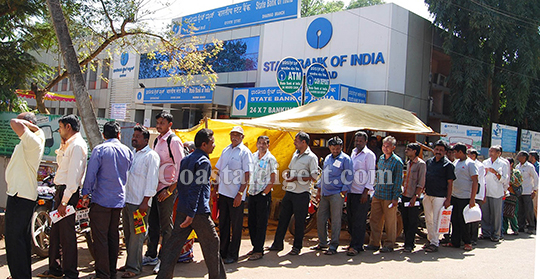
Chaos, long queues continue at banks; many ATMs still inactive

November 11, 2016

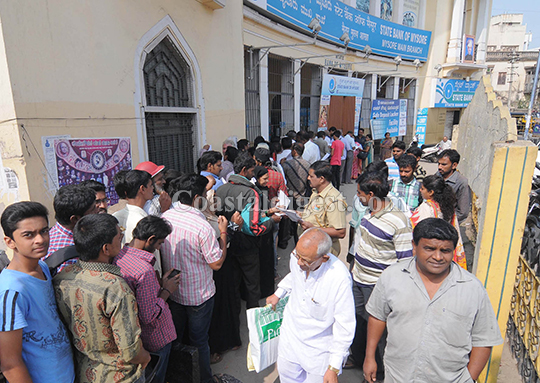
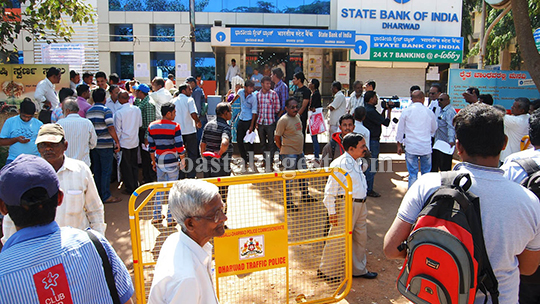
New Delhi, Nov 11: Queues outside banks grew longer as did confusion and chaos, with all cash vending machines still not functioning despite a two-day break for stocking up new currency notes.
qq 1

People waited for hours to get the cash needed to meet their daily expenses as most prevalent higher denomination currency notes of Rs 500 and Rs 1000 were declared invalid.

ATMs, which reopened two days after Prime Minister Narendra Modi announced demonetisation of two biggest currency notes, had people queued up since early morning.

But not all of them were operating and the crowds at many of the machines grew increasingly agitated on learning that they were still inactive. Bank officials said all ATMs should start functioning by tomorrow after old notes are removed and new Rs 500 and Rs 2000 ones stocked in them.

However, withdrawal from ATMs is limited to a maximum of Rs 2,000 per card in a day up to November 18, 2016. The limit will be raised to Rs 4,000 per day per card from November 19, 2016 onwards, bankers said.

State Bank of India, the nation's largest lender, said it could take 10 days for ATM services to settle down to normal.

There are nearly 2 lakh ATMs in the country. Many of them are configured to dispense only Rs 500 or Rs 1,000 notes and cannot dispense Rs 100 or Rs 2000 notes, so they have to be reconfigured too.

Yesterday, when banks opened after a day's break, millions rushed to deposit and swap Rs 500 and Rs 1,000 notes. Only a maximum of Rs 4,000 per person was being exchanged at banks and select post offices.

Banks opened additional counters to exchange notes as also allow withdrawal from bank accounts through cheque or withdrawal slips with a ceiling of Rs 10,000 in a day within an overall limit of Rs 20,000 in a week (including withdrawals from ATMs) for the first fortnight i.e. up to November 24.

Interestingly, today is the last date for old notes to be accepted as payment for water and electricity bills, government penalties, and at state-run petrol pumps, government hospitals, metros and railway tickets.

After midnight tonight, even these utility payments would have to be done in either lower denomination currency or in new currency notes, which will add to the pressure on banks and ATMs.

Banks will work on weekend and till at least 7 pm on these days to cater to the rush.
qq 3

qq 2

Comments

Jeevan
 - 
Friday, 11 Nov 2016

Reserve Bank and working finance experts behind this to be honored. Reserve bank must remove and keep away all political back staff from the dept. The ex financial adviser of Ambani is serving in Reserve Bank. Opposition and leaders like Anna Azare; Assaduddim Owaisi;Kejriwaal must join together and find out the truth and gamr behind this and bring the culprit in front of India Citizens.
Jai Hind !

Add new comment

  • Coastaldigest.com reserves the right to delete or block any comments.
  • Coastaldigset.com is not responsible for its readers’ comments.
  • Comments that are abusive, incendiary or irrelevant are strictly prohibited.
  • Please use a genuine email ID and provide your name to avoid reject.
Agencies
June 26,2020

New Delhi, Jun 26: With looming uncertainty and no likelihood of an early economic recovery in sight, the bull run in gold prices is here to stay. Analysts expect domestic futures to touch ₹ 52,000 per 10 grams in the next few months, till Diwali.

Experts also predict that with the current trend, gold may reach historic levels around ₹ 65,000 per 10 grams in two years time.

Futures of the yellow metal have touched new highs in India off late. On Wednesday, the August contract of gold futures on the Multi-Commodity Exchange (MCX) touched an all-time high of Rs 48,589 per 10 grams.

It has, however corrected since and is currently trading at ₹ 48,057 on the MCX, higher by ₹ 116 or 0.24 per cent from its previous close.

Market experts are of the view that both domestic and international gold prices are yet not done breaching records and will touch new highs in days to come.

The resurgence in the number of new cases of coronavirus infection across the globe has added to the uncertainty and fears.

Speaking to media persons, Anuj Gupta, DVP for Commodities and Currencies Research at Angel Broking, noted: "In short term we are expecting it to reach ₹ 48,800-49,000 and for long term, we are expecting ₹ 51,000-Rs 52,000 till Diwali."

On the prices in the international market, he said that it may reach around $1,790 per ounce in the near term from the current levels of $1,762 and the long term, it is likely to be around $1,820-1,850 per ounce.

Gupta noted that with International Monetary Fund's (IMF) latest downward revision of economic outlook, both global and of India, and the rising number of cases and high demand by gold exchange traded funds (ETF) have led to this record breaking rise in gold prices.

Covid-19 battered India's economy is projected to contract by 4.5 per cent this fiscal, according to the IMF and the global output is projected to decline by 4.9 per cent in 2020, 1.9 percentage points below the IMF's April forecast.

Hareesh V, Head of Commodity Research at Geojit Financial Services, said that gold's safe haven appeal will remain on the higher side as there is little hope of a quick global economic recovery amid rising virus cases across the world.

"Increased geopolitical instability and an under-performing dollar also lift the metal's sentiments," he added.

According to Prathamesh Mallya, AVP Research, Non-Agro Commodities & Currencies at Angel Broking, said that with the global output to contract and the economies in a deeper recession than most anticipate, gold as an asset class is a safe bet for investors across the globe.

"Although, the physical demand has declined drastically due to the restrictions and lockdowns, the activity of global central banks and their net purchases of gold signal that uncertainty will continue for most of 2020," he said.

He was also of the view that in the international market price of the metal may move towards $1,850 per ounce and in the domestic market it is likely to move higher towards Rs 50,000 per 10 grams.

"The investment demand as seen in the net additions of ETF holdings also signals that gold will shine for a much longer time even if the pandemic is under control. Till then, keep buying gold, if not in physical form, but in digital form," Mallya added.

Industry insiders like Aditya Pethe, Director, WHP Jewellers said: "I basically feel that the current trend for the gold is bullish and for the coming next 2 years, it is likely to move upwards. No one can predict the exact price as currently the trend is on rise but it might change after 6 months. In general for the coming 6 months to one year, the gold prices are likely to cross $2,000 which comes to roughly Rs 55,000. For a temporary moment it may reduce, basically fluctuate as well but overall trend of gold is going to be bullish."

On his part, Ishu Datwani, Founder, Anmol Jewellers said: "Yes - it's very likely that the gold price could easily go up to Rs 60,000-Rs 65,000 in the next two years. There is also a possibility of it going up even more."

"A lot of banks have been buying gold and there is also a possibility that the Indian rupee will depreciate against the dollar. This and geopolitical reasons will cause bullishness in gold."

Comments

Add new comment

  • Coastaldigest.com reserves the right to delete or block any comments.
  • Coastaldigset.com is not responsible for its readers’ comments.
  • Comments that are abusive, incendiary or irrelevant are strictly prohibited.
  • Please use a genuine email ID and provide your name to avoid reject.
News Network
July 14,2020

Bengaluru, Jul 14: The Karnataka government on Tuesday made changes to the Land Reforms Act 1961 through an ordinance to allow non-agriculturists to buy and own farmland for farming.

“The Land Reforms Act has been amended through an ordinance and notified after Governor Vajubhai R Vala gave his assent to it on Monday night,” a Revenue Department official told media persons.

It now permits non-farmers to buy farmland and grow food crops. But they can’t use it for other activities.

“Sections 79 A, B and C of the Act have been repealed, paving way for bona fide citizens to invest in farmland and take to farming as a hobby, passion or additional occupation, which is rewarding,” the official said.

The amended Act will enable the state to attract investment in the farm sector and boost food output. The farm sector’s contribution to the state’s gross domestic product (GDP) has been less than the manufacturing and services sectors over the last two decades.

Criticism by farmers, the Congress and the JD(S) since the cabinet approved changes on June 11 forced the state government to retain section 80 of the Act, with an amendment, to prevent sale of dam water irrigated farmland.

“The ordinance has also added a new section (80A), which says relaxations under the Act will not apply to land given to farmers under the Karnataka SC and ST (Scheduled Caste and Tribe) Act 1978,” the official said.

The changes permit mortgage of farmland only to the state-run institutions, firms and cooperative societies specified in the Act. The ordinance also makes legal cases pending in courts against the sections amended redundant as the new Act addresses the concerns raised in them.

“Besides generating substantial revenue for the state government, the Act will now allow farmers who find the occupation non-remunerative and risky due to droughts/floods and labour shortage to sell their surplus land to urban buyers,” the official said.

Ruling BJP Rajya Sabha member KC Ramamurthy from Bengaluru said the amended Act would allow any citizen to buy farmland.

“Though hundreds of people petitioned successive governments for the past 45 years to abolish the ‘draconian’ sections, they were ignored. I compliment Chief Minister BS Yediyurappa and Revenue Minister R Ashoka for the decision to allow everyone to buy farmland irrespective of their occupation or profession,” Ramamurthy told media persons.

Comments

Add new comment

  • Coastaldigest.com reserves the right to delete or block any comments.
  • Coastaldigset.com is not responsible for its readers’ comments.
  • Comments that are abusive, incendiary or irrelevant are strictly prohibited.
  • Please use a genuine email ID and provide your name to avoid reject.
coastaldigest.com news network
May 10,2020

In a shocking incident, a pharmacist-cum-production manager of an Ayurvedic product company in Chennai’s T.Nagar died after drinking a chemical preparation he reportedly formulated for tackling the Coronavirus.

The managing director of the company, who is an ophthamologist by qualification, was hospitalised after he fainted soon after he ingested the chemical component.

The deceased, K.Sivanesan, 47, of Perungudi, was with Chennai-based Sujatha Biotech, an Ayurvedic and herbal products company which was founded 30 years ago. It has a plant in Kashipur, Uttarakhand, where Sivanesan was working. Sivanesan had devised formulas of various products and used to visit his managing director Dr. Rajkumar frequently in the city.

Due to the lockdown, Sivanesan came to Chennai and stayed with his family in Perungudi. On Thursday morning, he procured the chemical component from a market in Parry’s Corner.

First he gave a small amount powder he derived from the chemical to 67 years-old Rajkumar who fainted after tasting it.

Even as he was being resuscitated, Sivanesan went into the kitchen of the house and gulped it in liquid form after adding water to it. He could not be revived.

Deputy Commissioner of Police, T.Nagar, Ashok Kumar, said, “Our investigation revealed that Sivanesan died after drinking the preparation he claimed would help COVID-19 patients. His managing director fainted after tasting it initially. Further investigation is on.”

Sivanesan was rushed to a private hospital in T.Nagar and declared dead by the doctors there. Later his body was shifted to Government Royapettah Hospital for post-mortem. Teynampet police registered a case under section 174 of Criminal Procedure Code for unnatural death.

N.S.Vasan, designer-cum-media manager of the company said, “Due to the lockdown, Sivanesan stayed in the city and one day told us he heard of some medicine from U.S. President Donald Trump’s recent speech for curing Coronavirus. He said it would bring more immunity and help to prevent COVID-19. Deciding to test the effect of the medicine, he went to Parry’s Corner and bought the powder.” He added that Sivanesan must have taken a heavy dosage of the ‘drug’ and he was killed instantly.

Comments

Add new comment

  • Coastaldigest.com reserves the right to delete or block any comments.
  • Coastaldigset.com is not responsible for its readers’ comments.
  • Comments that are abusive, incendiary or irrelevant are strictly prohibited.
  • Please use a genuine email ID and provide your name to avoid reject.