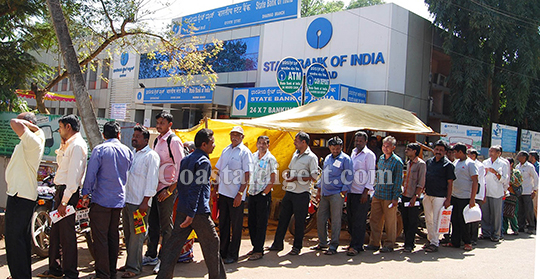
Chaos, long queues continue at banks; many ATMs still inactive

November 11, 2016

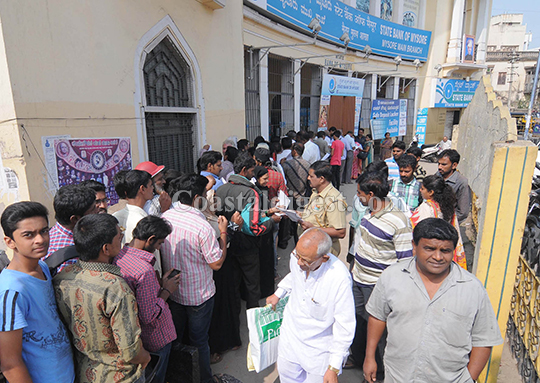
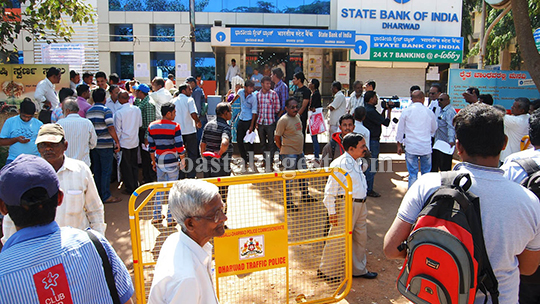
New Delhi, Nov 11: Queues outside banks grew longer as did confusion and chaos, with all cash vending machines still not functioning despite a two-day break for stocking up new currency notes.
qq 1

People waited for hours to get the cash needed to meet their daily expenses as most prevalent higher denomination currency notes of Rs 500 and Rs 1000 were declared invalid.

ATMs, which reopened two days after Prime Minister Narendra Modi announced demonetisation of two biggest currency notes, had people queued up since early morning.

But not all of them were operating and the crowds at many of the machines grew increasingly agitated on learning that they were still inactive. Bank officials said all ATMs should start functioning by tomorrow after old notes are removed and new Rs 500 and Rs 2000 ones stocked in them.

However, withdrawal from ATMs is limited to a maximum of Rs 2,000 per card in a day up to November 18, 2016. The limit will be raised to Rs 4,000 per day per card from November 19, 2016 onwards, bankers said.

State Bank of India, the nation's largest lender, said it could take 10 days for ATM services to settle down to normal.

There are nearly 2 lakh ATMs in the country. Many of them are configured to dispense only Rs 500 or Rs 1,000 notes and cannot dispense Rs 100 or Rs 2000 notes, so they have to be reconfigured too.

Yesterday, when banks opened after a day's break, millions rushed to deposit and swap Rs 500 and Rs 1,000 notes. Only a maximum of Rs 4,000 per person was being exchanged at banks and select post offices.

Banks opened additional counters to exchange notes as also allow withdrawal from bank accounts through cheque or withdrawal slips with a ceiling of Rs 10,000 in a day within an overall limit of Rs 20,000 in a week (including withdrawals from ATMs) for the first fortnight i.e. up to November 24.

Interestingly, today is the last date for old notes to be accepted as payment for water and electricity bills, government penalties, and at state-run petrol pumps, government hospitals, metros and railway tickets.

After midnight tonight, even these utility payments would have to be done in either lower denomination currency or in new currency notes, which will add to the pressure on banks and ATMs.

Banks will work on weekend and till at least 7 pm on these days to cater to the rush.
qq 3

qq 2

Comments

Jeevan
 - 
Friday, 11 Nov 2016

Reserve Bank and working finance experts behind this to be honored. Reserve bank must remove and keep away all political back staff from the dept. The ex financial adviser of Ambani is serving in Reserve Bank. Opposition and leaders like Anna Azare; Assaduddim Owaisi;Kejriwaal must join together and find out the truth and gamr behind this and bring the culprit in front of India Citizens.
Jai Hind !

Add new comment

  • Coastaldigest.com reserves the right to delete or block any comments.
  • Coastaldigset.com is not responsible for its readers’ comments.
  • Comments that are abusive, incendiary or irrelevant are strictly prohibited.
  • Please use a genuine email ID and provide your name to avoid reject.
News Network
March 14,2020

Kalaburagi, Mar 14: Utter negligence of Kalaburagi health department officials was one of the main reasons for the death of his father, alleged family member of Kalaburagi man and India's first COVID-19 victim here on Friday.

The victim's son said 'if officials of Kalaburagi health department had advised us to admit his father in isolated ward, which was opened in Gulbarga Institute of Medical science (GIMS), my father's survival time may have been extended,' he said.

Comments

Add new comment

  • Coastaldigest.com reserves the right to delete or block any comments.
  • Coastaldigset.com is not responsible for its readers’ comments.
  • Comments that are abusive, incendiary or irrelevant are strictly prohibited.
  • Please use a genuine email ID and provide your name to avoid reject.
News Network
April 19,2020

Kasaragod, Apr 19: Kasaragod, Kerala's COVID-19 hotspot, is the only district in the southern state lacking adequate health infrastructure.

In spite of treating the highest number of COVID-19 patients in the state with meagre infrastructural facilities and even without the support of a medical college in the north Kerala district, no deaths have been reported due to coronavirus.

The state health department views the performance of M Kunhiraman and his team, consisting of Janardhana Naik and Krishna Naik, at the General hospital in Kasaragod as a success story.

"Not only did they control the situation quickly with minimum infrastructure, they also started turning out a large number of negative cases within a few weeks and creditably ensured zero mortality.

This can be showcased as a best global model," Chairman of the Information Education and Communication (IEC) Committee and Project Director Kerala State Aids Control Society, R Ramesh said.

Recalling the ordeal, Janardhana Naik said his first major challenge was the physical examination of a patient with suspected COVID-19.

"Even with the PPE kit, nobody knew how effective they were and it took a whole 30 minutes to wear them properly.

But as time passed, we got accustomed to it," he said.

The traditional method of dealing with a patient involved knowing his or her history, observation and physical examination.

For hundreds of years, the hands-on body approach has been the soul of the doctor-patient relationship -- taking the pulse, tapping on and listening to the chest, feeling lumps.

With the onset of COVID-19 all that has changed.

"In fact, the whole exercise was fraught with grave risks because everything connected with COVID-19 was new.

Doctors have to keep a distance even though the physical examination wearing a Personal Protective Equipment (PPE) is difficult.

Sounds from the body are inaudible, vision is blurred through the smog-covered goggles and a stethoscope seldom has any use," Janardhana Naik said.

It was from March 15 that the hospital started receiving COVID-19 patients, primarily from Dubai.

By the time the first person came, the hospital was ready for him.

Soon, patient numbers began to swell and in a couple of weeks they reached about 91.

From then on, it was teamwork.

Committees were formed for each and every task, including the help desk, IT, treatment, medical board, training, food, waste disposal and data maintenance.

Initially, patients had many misgivings about the hospital.

"Some were disillusioned and even aggressive. Some were not happy with the facilities the hospital had to offer.

But gradually through good treatment and counselling by a psychiatrist, who visited the hospital on alternate days, the confidence and mood of the patients changed and they became friendly with the staff," Naik elaborated.

Counselling was also given to the concerned family members of the patients.

Besides treatment, the medical staff had to spend a considerable amount of time clearing the doubts of patients.

When they got discharged some patients insisted on seeing the faces of the medical staff, who till then were anonymous entities covered from head to toe.

Some even wanted to take selfies with them.

However, the medical team politely turned down their requests and preferred to remain hidden in their work attires.

The mood of the patients also rubbed off on the doctors and hospital staff.

All the physicians and hospital staff are now more confident of dealing with contagious diseases after treating COVID-19 patients.

"Our previous experience of treating H1N1, Chikungunya and Dengue cases helped us a lot.

Words of encouragement from the Health Minister K K Shailaja, Health Principal Secretary Dr Rajan N Khobragade and Health Services Director Dr Sarita R L gave us the impetus to build up confidence.

Moreover, the field health workers did a wonderful job in containing the viral spread," Naik added.

As the number of coronavirus cases rose, the state government on April 5 deputed a 26-member medical team from Thiruvananthapuram to set up a COVID-19 hospital in the district.

They turned a block of the under construction Government Medical College as a hospital-like facility, setting up a 200 bed facility to treat coronavirus patients.

Comments

Add new comment

  • Coastaldigest.com reserves the right to delete or block any comments.
  • Coastaldigset.com is not responsible for its readers’ comments.
  • Comments that are abusive, incendiary or irrelevant are strictly prohibited.
  • Please use a genuine email ID and provide your name to avoid reject.
coastaldigest.com news network
July 8,2020

Udupi, Jul 8: A 15-year-old boy belonging to Saligrama in Udupi district, who was under home quarantine with his mother, allegedly committed suicide by hanging himself yesterday.

His throat swabs were sent for testing. The report received today and it showed that he did not have coronavirus.
 
The boy, a class ten student studying in Kota, was quarantined along with his mother at home after a person in a family, where she was working as a maid tested positive for Covid-19.

The boy is suspected to have taken the extreme step out of depression as he was not allowed to go out. The last rites were held today.

Comments

Add new comment

  • Coastaldigest.com reserves the right to delete or block any comments.
  • Coastaldigset.com is not responsible for its readers’ comments.
  • Comments that are abusive, incendiary or irrelevant are strictly prohibited.
  • Please use a genuine email ID and provide your name to avoid reject.