


Chhattisgarh Congress leader Ramdayal Uike joins BJP in Amit Shah's presence

Agencies
October 13, 2018

Bilaspur, Oct 13: In a major setback to the opposition Congress in poll-bound Chhattisgarh, its state working president and MLA Ramdayal Uike Saturday joined the ruling Bharatiya Janata Party.

Mr. Uike, who represents Pali-Tanakhar constituency, joined the BJP in the presence of the party chief Amit Shah and Chief Minister Raman Singh in Bilaspur district headquarter.

Mr. Uike, considered a popular tribal leader in Bilaspur division, said he was feeling suffocated in the Congress as Scheduled Tribes (ST) leaders were being neglected by the party leadership.

In a press conference held in Bilaspur in the presence of the Chief Minister as well BJP state unit president Dharamlal Kaushik, he announced that he joined the BJP.

‘CD politics of Congress’

“I had been feeling suffocated in Congress for the last several years. Congress has diverted from its ideology and principles. The CD politics of Congress has tarnished its image. State Congress chief Bhupesh Baghel has maligned the image of the party by encouraging the obscene CD politics,” he said.

Mr. Uike was apparently referring to a case of circulation of a ‘sex CD’ purportedly featuring a State Minister, in which Mr. Baghel was named as one of the five accused.

He further said his party high command did not pay attention to his demand to remove Mr. Baghel from the post of state unit president.

“Congress has neglected the interests of tribals, backward and poor people and I was pained over it as I represent a tribal region.

“CM Raman Singh has been making efforts for overall development of tribals and backward people and his development oriented policies have impressed me to rejoin my home party,” he said.

“A ghar wapsi”

Mr. Uike, who had quit the BJP and joined the Congress in 2000, described his return to the ruling party as “ghar wapsi”.

When asked about contesting elections, he said he will follow the directions of the party leadership in this regard.

Reacting to the development, Congress dubbed Mr. Uike as an “opportunist” and said his decision will not harm the opposition party.

“Mr. Uike has gone back to BJP, which he had left earlier for opportunistic reasons. He has again proved that he is an opportunist,” Congress state communication wing chief Shailesh Nitin Trivedi said.

No harm to party, says Congress

“His decision is not going to harm Congress in any way as history is witness that the party in which Mr. Uike was there it had never won. In fact we are thankful to Mr. Uike that he has left our party and ensured victory to us,” Mr. Trivedi said.

After the formation of Chhattisgarh in 2000, Mr. Uike who was a BJP MLA from Marwahi seat had joined Congress and vacated his seat to facilitate the entry of Ajit Jogi into the Chhattisgarh Legislative Assembly after he was sworn-in as first Chief Minister of Chhattisgarh.

According to BJP sources, Mr. Uike was not happy after he was ousted from the Congress screening committee and since then he had been in touch with ruling party leadership.

The BJP may field Mr. Uike either from Marwahi or Pali Tanakhar — the ST reserved seats, both considered as his stronghold.

In the state, 18 naxal-affected constituencies will go to polls in the first phase on November 12, while the rest of the 72 constituencies would go to polls in the second phase on November 20.

Comments

Fairman
 - 
Saturday, 13 Oct 2018

Thanks God, dirty things are removed.


BJP is built with wrong, ideology and how can it longlast. It can last only until fools around them are in majaority.

Congress should do TIT for TAT.

Sharafat for Shareefs only. It wont work with dishonest people.


Add new comment

  • Coastaldigest.com reserves the right to delete or block any comments.
  • Coastaldigset.com is not responsible for its readers’ comments.
  • Comments that are abusive, incendiary or irrelevant are strictly prohibited.
  • Please use a genuine email ID and provide your name to avoid reject.
Agencies
August 3,2020

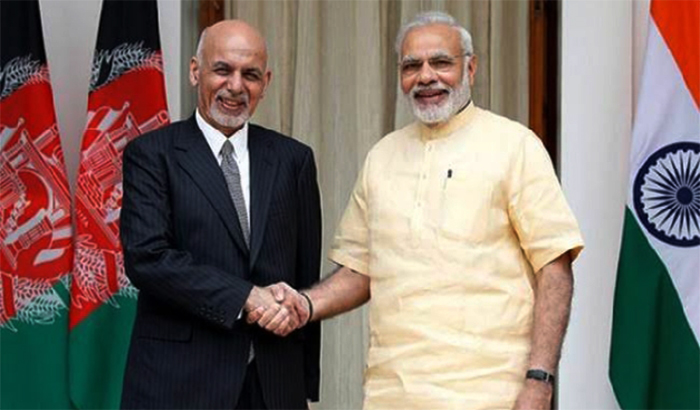
New Delhi, Aug 3: Afghanistan President Ashraf Ghani on Monday thanked Prime Minister Narendra Modi for the timely supply of food and medical assistance to meet the requirement in Afghanistan.

During their telephonic conversation, PM Modi also reiterated India's commitment to the people of Afghanistan in their quest for a peaceful, prosperous and inclusive Afghanistan, the Prime Minister's Office said in a statement on Monday.

The two leaders also exchanged views on the evolving security situation in the region and other areas of mutual bilateral interest.
Both leaders also exchanged greetings on Eid-Al-Adha. 

Comments

Add new comment

  • Coastaldigest.com reserves the right to delete or block any comments.
  • Coastaldigset.com is not responsible for its readers’ comments.
  • Comments that are abusive, incendiary or irrelevant are strictly prohibited.
  • Please use a genuine email ID and provide your name to avoid reject.
News Network
March 26,2020

Mar 26: As Kashmir reported its first COVID-19 death on Thursday, Islamic scholars urged people to follow the Ministry of Home Affairs guidelines on funeral and burial of those who die due to coronavirus pandemic.

“Medical science can’t be ignored and whatever directions there are in the (MHA) guidelines should be followed. As far as the funeral of the person, only family members should participate in the funeral and burial after wearing the protection kits,” the scholars said.

The MHA has stressed that there should be no bathing, kissing, hugging and reciting of verses while the body should be transported in a secured bag. Health experts have stressed that the grave for the person should be dug eight feet deep instead of normal six feet.

“The body of the person should be transported in a secured bag and the vehicle in which he is transported has to be decontaminated by the trained staff who should be wearing N-95 masks and protection equipment,” read the MHA guidelines.

Kashmir witnessed the first death of a COVID-19 patient from uptown city Hyderpora, who had a travel history of outside J&K as he was part of a ‘Tableegi Jamaat’.

Dr Naveed, Head of Department, at Chest Diseases Hospital Srinagar, said that no one from the family should go closer to the body and if someone from the family wants to see the face, he/she has to wear a complete protective gear.

“Burial bath is not recommended for the body. Grave for him should be dug eight feet deep instead of normal six feet,” he said.

As far as funeral prayers, he said, those intending to offer funeral should wear protective gear and maintain sufficient distance between the body and people.

Comments

Add new comment

  • Coastaldigest.com reserves the right to delete or block any comments.
  • Coastaldigset.com is not responsible for its readers’ comments.
  • Comments that are abusive, incendiary or irrelevant are strictly prohibited.
  • Please use a genuine email ID and provide your name to avoid reject.
News Network
May 28,2020

May 28: Abdul Kareem was forced out of school and into a life of odd jobs like repairing bicycles before he finally managed to pull his family out of abject poverty transporting goods across Delhi in a mini truck.

The job, and the slim financial security that came with it, was the first stepping stone to a better life.

All that is now gone as India reels under the economic impact of its protracted coronavirus lockdown. Mr Kareem's out of a job and stranded in his village in Uttar Pradesh with his wife and two children. Their minuscule savings from his Rs 9,000 a month job have been exhausted, and the money he saved for books and school uniforms is spent.

"I don't know what the job situation will be in Delhi once we go back," Mr Kareem said. "We can't stay hungry so I will do whatever I find."

At least 49 million people across the world are expected to plunge into "extreme poverty" -- those living on less than $1.90 per day -- as a direct result of the pandemic's economic destruction and India leads that projection, with the World Bank estimating some 12 million of its citizens will be pushed to the very margins this year.

Some 122 million Indians were forced out of jobs last month alone, according to estimates from the Center for Monitoring Indian Economy, a private sector think tank. Daily wage workers and those employed by small businesses have taken the worst hit. These include hawkers, roadside vendors, workers employed in the construction industry and many who eke out a living by pushing handcarts and rickshaws.

For Prime Minister Narendra Modi, who came to power in 2014 promising to lift the poorest citizens out of poverty, the fallout from the lockdown brings with it significant political risk. He won an even larger second term majority last year on the strength of his government's popular social programs that directly targeted the poor, such as the provision of cooking gas cylinders, power and public housing. The breadth and depth of this renewed economic pain will only increase the pressure on his government as it works to steer the country's economy back on track.

"Much of the Indian government's efforts to mitigate poverty over the years could be negated in a matter of just a few months," said Ashwajit Singh, managing director of IPE Global, a development sector consultancy that advises several multinational aid agencies. Noting that he did not expect unemployment rates to improve this year, Singh said: "More people could die from hunger than the virus."

Desperate Times

Mr Singh points to a United Nations University study estimating 104 million Indians could fall below the World Bank-determined poverty line of $3.2 a day for lower-middle-income countries. This will take the proportion of people living in poverty from 60% -- or 812 million currently, to 68% or 920 million -- a situation last seen in the country more than a decade ago, he said.

A World Bank report found the country had been making significant progress and was close to losing its status as the country with the most poor citizens. The impact of PM Modi's lockdown risks reversing those gains.

The World Bank and the CMIE estimates were published in late April and early May respectively. Since then the situation has only become grimmer, with harrowing images of people making desperate attempts to reach their villages, on crowded buses, the flatbeds of trucks and even on foot or on bicycles dominating media coverage.

The Rustandy Center for Social Sector Innovation at the University of Chicago Booth School of Business analyzed the unemployment data from the CMIE, collected through surveys covering about 5,800 homes across 27 states in April.

Researchers found rural areas were the hardest hit, and the economic misery was the result of the lockdown, rather than the spread of infections in the hinterland. More than 80% of households had experienced a drop income and many won't survive much longer without aid, they wrote in a report.

The government has promised cheap credit to farmers, direct transfer of money to the poor and eased access to food security programs -- but these help people who have some documentation, which many of the poorest don't. With millions of impoverished people now in transit across the country, the food security situation is dire -- news reports are emerging of people foraging through piles of rotting fruit or eating leaves.

Shattered Economy

The economy was already growing at its slowest pace in over a decade when the virus struck. The lockdown, which came into effect on March 25, has hammered it, stalling business activity and putting a lid on consumption, pushing the economy to what may be its first full-year contraction in more than four decades.

It's dire enough to warrant the country exiting its lockdown, as it has been doing incrementally since May 4, even as its infections are surging. India is now Asia's virus hotspot with infections crossing 151,000 according to data from Johns Hopkins University.

PM Modi, who has come under criticism for the pain inflicted on the poor, has said his government will spend $265 billion or about 10% of its GDP to help Asia's third-largest economy weather the pandemic's fallout. But experts say only a part of it is direct fiscal stimulus, and probably smaller than the total damage done to the economy during the lockdown period.

"What is especially worrying is the government's response," said Reetika Khera, an economics professor at the Indian Institute of Technology in Delhi. "The epidemic will magnify existing -- and already high -- inequalities in India."

Still, the economic measures aren't going to kick in for some time and industry will likely struggle to restart because of the flight of labour from industrial hubs.

And as the harsh summer unfolds more pain lies in store in the villages now dealing with returning migrant workers.

"There are no factories or industries here, there are just hills," said Surendra Hadia Damor, who had walked nearly 100 km from Ahmedabad, Gujarat, before a voluntary organisation drove him to his village in the neighboring state of Rajasthan. "We can survive for a month or two and then try and find a job nearby -- we will see what happens."

Comments

Add new comment

  • Coastaldigest.com reserves the right to delete or block any comments.
  • Coastaldigset.com is not responsible for its readers’ comments.
  • Comments that are abusive, incendiary or irrelevant are strictly prohibited.
  • Please use a genuine email ID and provide your name to avoid reject.