Chhattisgarh Congress leader Ramdayal Uike joins BJP in Amit Shah's presence

Agencies
October 13, 2018

Bilaspur, Oct 13: In a major setback to the opposition Congress in poll-bound Chhattisgarh, its state working president and MLA Ramdayal Uike Saturday joined the ruling Bharatiya Janata Party.

Mr. Uike, who represents Pali-Tanakhar constituency, joined the BJP in the presence of the party chief Amit Shah and Chief Minister Raman Singh in Bilaspur district headquarter.

Mr. Uike, considered a popular tribal leader in Bilaspur division, said he was feeling suffocated in the Congress as Scheduled Tribes (ST) leaders were being neglected by the party leadership.

In a press conference held in Bilaspur in the presence of the Chief Minister as well BJP state unit president Dharamlal Kaushik, he announced that he joined the BJP.

‘CD politics of Congress’

“I had been feeling suffocated in Congress for the last several years. Congress has diverted from its ideology and principles. The CD politics of Congress has tarnished its image. State Congress chief Bhupesh Baghel has maligned the image of the party by encouraging the obscene CD politics,” he said.

Mr. Uike was apparently referring to a case of circulation of a ‘sex CD’ purportedly featuring a State Minister, in which Mr. Baghel was named as one of the five accused.

He further said his party high command did not pay attention to his demand to remove Mr. Baghel from the post of state unit president.

“Congress has neglected the interests of tribals, backward and poor people and I was pained over it as I represent a tribal region.

“CM Raman Singh has been making efforts for overall development of tribals and backward people and his development oriented policies have impressed me to rejoin my home party,” he said.

“A ghar wapsi”

Mr. Uike, who had quit the BJP and joined the Congress in 2000, described his return to the ruling party as “ghar wapsi”.

When asked about contesting elections, he said he will follow the directions of the party leadership in this regard.

Reacting to the development, Congress dubbed Mr. Uike as an “opportunist” and said his decision will not harm the opposition party.

“Mr. Uike has gone back to BJP, which he had left earlier for opportunistic reasons. He has again proved that he is an opportunist,” Congress state communication wing chief Shailesh Nitin Trivedi said.

No harm to party, says Congress

“His decision is not going to harm Congress in any way as history is witness that the party in which Mr. Uike was there it had never won. In fact we are thankful to Mr. Uike that he has left our party and ensured victory to us,” Mr. Trivedi said.

After the formation of Chhattisgarh in 2000, Mr. Uike who was a BJP MLA from Marwahi seat had joined Congress and vacated his seat to facilitate the entry of Ajit Jogi into the Chhattisgarh Legislative Assembly after he was sworn-in as first Chief Minister of Chhattisgarh.

According to BJP sources, Mr. Uike was not happy after he was ousted from the Congress screening committee and since then he had been in touch with ruling party leadership.

The BJP may field Mr. Uike either from Marwahi or Pali Tanakhar — the ST reserved seats, both considered as his stronghold.

In the state, 18 naxal-affected constituencies will go to polls in the first phase on November 12, while the rest of the 72 constituencies would go to polls in the second phase on November 20.

Comments

Fairman
 - 
Saturday, 13 Oct 2018

Thanks God, dirty things are removed.


BJP is built with wrong, ideology and how can it longlast. It can last only until fools around them are in majaority.

Congress should do TIT for TAT.

Sharafat for Shareefs only. It wont work with dishonest people.


Add new comment

  • Coastaldigest.com reserves the right to delete or block any comments.
  • Coastaldigset.com is not responsible for its readers’ comments.
  • Comments that are abusive, incendiary or irrelevant are strictly prohibited.
  • Please use a genuine email ID and provide your name to avoid reject.
News Network
January 27,2020

Jehanabad, Jan 27: The police here carried out a raid at the ancestral house of anti-CAA activist Sharjeel Imam, who has been slapped with a sedition case in the national capital for alleged inflammatory speeches he gave at Shaheen Bagh and the Jamia Milia Islamia, a senior official said on Monday.

According to Superintendent of Police, Jehanabad, Manish Kumar, Imams house in Kako police station area was raided late on Sunday night following "help sought by central agencies" which are investigating the cases lodged against the JNU research scholar.

Imam was not found at his house but two of his relatives and their driver were detained for interrogation and let off thereafter, the SP said.

A graduate in computer science from IIT-Mumbai, Sharjeel Imam had shifted to Delhi for pursuing research at the Centre for Historical Studies, JNU.

He was slapped with a sedition case after his alleged speeches went viral on the social media wherein he was heard speaking about Assam's possible secession from the country in the wake of the Citienship (Amendment) Act (CAA).

Earlier, he had been booked on similar charges at a police station in Aligarh for a speech he delivered on the AMU campus.

Besides, a case under the stringent anti-terror law UAPA has been registered against him at Assam.

Imams late father Akbar Imam was a local JD(U) leader who had unsuccessfully contested an assembly election in his lifetime.

Reacting to the developments, his distraught mother Afshan Rahim told the media, "My son is innocent. He is a bright young man and not a thief or a pickpocket. I swear in the name of God that I do not know about his whereabouts. But I can guarantee that upon learning about the cases, he will appear before the investigating agencies and fully cooperate in the probe."

She said that it has been a long time since she met her son though she had a telephonic conversation with him a few weeks ago.

"He was obviously disturbed by the CAA and fears of the National Register of Citiznes (NRC) about being implemented across the country which, he said, would affect not just Muslims but all poor people," she said.

In fact, after 15 days of Shaheen Bagh protest, he had asked the agitators there to withdraw and watch the situation for a month, and then decide on the further course of action, she said. "But they refused to relent. He was calling for a 'chakkajam' (road blockade). He is just a kid and not capable of instigating people for secession," she added.

Comments

Add new comment

  • Coastaldigest.com reserves the right to delete or block any comments.
  • Coastaldigset.com is not responsible for its readers’ comments.
  • Comments that are abusive, incendiary or irrelevant are strictly prohibited.
  • Please use a genuine email ID and provide your name to avoid reject.
coastaldigest.com web desk
August 1,2020

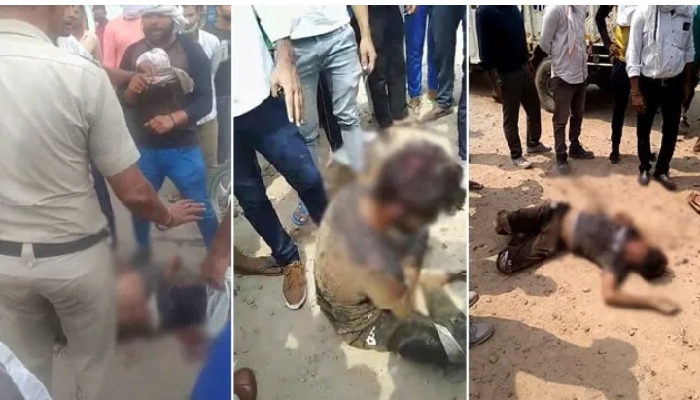
New Delhi, July 1: In a terrific incident with chilling echoes of the 2015 Dadri mob lynching, a Muslim man, who was carrying meat, was savagely attacked by a mob belonging to a saffron outfit in the presence of in BJP ruled Haryana on the eve of Eid al-Adha. 

The incident occurred at around 9 a.m. on Friday, July 31 at Badshahpur village in Haryana’s Gurgaon, when Lukman was transporting meat in a pic-kup truck. 

The attack was captured on mobile phones by onlookers and the video clips of the incident are now spreading on social media. 

A group of saffronite cow vigilantes chased the truck for about 8 km managed waylay it. Lukman, who was driving the truck was pulled out and brutally assaulted on the suspicion that he was transporting cow meat.

Just like Dadri, the police were faster at sending the meat to a lab for testing than catching any one of the suspects. One of the assailants - Pradeep Yadav- has been arrested. 

After being beating to an inch of his life, Lukman was bundled into the pick-up truck and taken back to Gurgaon's Badshahpur village where the goons started thrashing him again.

This is when the police stepped in and stopped them - only to find the assailants fearless enough to even take on them.

Lukman was taken to a hospital and the police filed a case against "unidentified individuals" even though the video of the incident recorded by witnesses shows the faces of the assailants.

The owner of the vehicles said that the meat was buffalo and he has been in the business for 50 years.

The police have so far refused to give a statement on record on the incident and explain their inaction as seen on video.

Comments

Add new comment

  • Coastaldigest.com reserves the right to delete or block any comments.
  • Coastaldigset.com is not responsible for its readers’ comments.
  • Comments that are abusive, incendiary or irrelevant are strictly prohibited.
  • Please use a genuine email ID and provide your name to avoid reject.
News Network
January 13,2020

Jan 13: For the first time in years, the government of India’s Prime Minister Narendra Modi is playing defense. Protests have sprung up across the country against an amendment to India’s laws — which came into effect on Friday — that makes it easier for members of some religions to become citizens of India. The government claims this is simply an attempt to protect religious minorities in the Muslim-majority countries that border India; but protesters see it as the first step toward a formal repudiation of India’s constitutionally guaranteed secularism — and one that must be resisted.

Modi was re-elected prime minister last year with an enhanced majority; his hold over the country’s politics is absolute. The formal opposition is weak, discredited and disorganized. Yet, somehow, the anti-Citizenship Act protests have taken hold. No political party is behind them; they are generally arranged by student unions, neighborhood associations and the like.

Yet this aspect of their character is precisely what will worry Modi and his right-hand man, Home Minister Amit Shah. They know how to mock and delegitimize opposition parties with ruthless efficiency. Yet creating a narrative that paints large, flag-waving crowds as traitors is not quite that easy.

For that is how these protests look: large groups of young people, many carrying witty signs and the national flag. They meet and read the preamble to India’s Constitution, into which the promise of secularism was written in the 1970’s.

They carry photographs of the Constitution’s drafter, the Columbia University-trained economist and lawyer B. R. Ambedkar. These are not the mobs the government wanted. They hoped for angry Muslims rampaging through the streets of India’s cities, whom they could point to and say: “See? We must protect you from them.” But, in spite of sometimes brutal repression, the protests have largely been nonviolent.

One, in Shaheen Bagh in a Muslim-dominated sector of New Delhi, began simply as a set of local women in a square, armed with hot tea and blankets against the chill Delhi winter. It has now become the focal point of a very different sort of resistance than what the government expected. Nothing could cure the delusions of India’s Hindu middle class, trained to see India’s Muslims as dangerous threats, as effectively as a group of otherwise clearly apolitical women sipping sweet tea and sharing their fears and food with anyone who will listen.

Modi was re-elected less than a year ago; what could have changed in India since then? Not much, I suspect, in most places that voted for him and his party — particularly the vast rural hinterland of northern India. But urban India was also possibly never quite as content as electoral results suggested. India’s growth dipped below 5% in recent quarters; demand has crashed, and uncertainty about the future is widespread. Worse, the government’s response to the protests was clearly ill-judged. University campuses were attacked, in one case by the police and later by masked men almost certainly connected to the ruling party.

Protesters were harassed and detained with little cause. The courts seemed uninterested. And, slowly, anger began to grow on social media — not just on Twitter, but also on Instagram, previously the preserve of pretty bowls of salad. Instagram is the one social medium over which Modi’s party does not have a stranglehold; and it is where these protests, with their photogenic signs and flags, have found a natural home. As a result, people across urban India who would never previously have gone to a demonstration or a political rally have been slowly politicized.

India is, in fact, becoming more like a normal democracy. “Normal,” that is, for the 2020’s. Liberal democracies across the world are politically divided, often between more liberal urban centers and coasts, and angrier, “left-behind” hinterlands. Modi’s political secret was that he was that rare populist who could unite both the hopeful cities and the resentful countryside. Yet this once magic formula seems to have become ineffective. Five of India’s six largest cities are not ruled by Modi’s Bharatiya Janata Party in any case — the financial hub of Mumbai changed hands recently. The BJP has set its sights on winning state elections in Delhi in a few weeks. Which way the capital’s voters will go is uncertain. But that itself is revealing — last year, Modi swept all seven parliamentary seats in Delhi.

In the end, the Citizenship Amendment Act is now law, the BJP might manage to win Delhi, and the protests might die down as the days get unmanageably hot and state repression increases. But urban India has put Modi on notice. His days of being India’s unifier are over: From now on, like all the other populists, he will have to keep one eye on the streets of his country’s cities.

Comments

Add new comment

  • Coastaldigest.com reserves the right to delete or block any comments.
  • Coastaldigset.com is not responsible for its readers’ comments.
  • Comments that are abusive, incendiary or irrelevant are strictly prohibited.
  • Please use a genuine email ID and provide your name to avoid reject.