


China moving ahead, talking about temples and mosques will waste our time: Ex-Navy chief

Agencies
August 12, 2019

New Delhi, Aug 12: China is moving ahead in areas like artificial intelligence (AI) and robotics and it would be a waste of time if India distracts itself by talking about temples and mosques, former Navy chief Arun Prakash said on Sunday.

However, Arun Prakash expressed hope that the abrogation provision of Article 370 and the change in the status of Jammu and Kashmir will bring peace and help foster integration and economic development in the region.

"For our whole existence as an independent nation, we have seen and suffered from these fissures - linguistic, religious, caste, etc. These conflicts have continued throughout our independent existence," Admiral Arun Prakash (Retd), while delivering Prem Bhatia Memorial Lecture in New Delhi, said.

"What we need to do is to try and tamp them rather than to exploit them. China is talking about artificial intelligence, robotics and machine learning and all that. And if we are going to talk about temples and mosques and so on, then obviously we are going to waste time," Arun Prakash added.

Curious to know whether anyone from the 'Raghuvansha' (descendants of Lord Ram) was still residing in Ayodhya, the Supreme Court on Friday had put this query to 'Ram Lalla Virajman', the deity and one of the parties in the politically sensitive Ram Janmabhoomi-Babri Masjid land dispute case.

Fourteen appeals have been filed in the apex court against the 2010 Allahabad High Court judgment, delivered in four civil suits, that the 2.77-acre land in Ayodhya be partitioned equally among the three parties -- the Sunni Waqf Board, the Nirmohi Akhara and Ram Lalla.

Arun Prakash, who served as the chief of Naval staff from July 2004 to October 2006, said on Sunday, "It is in key interest of national security to ensure peace and tranquillity domestically before even looking outside."

"So to take away the half front, which the Army Chief [Bipin Rawat] mentions, we need to ensure domestic peace, harmony, etc. Therefore, the issues that are of a divisive nature need to be minimised rather than exploited," Arun Prakash added.

In June this year, Army Chief Bipin Rawat said that Indian armed forces are ready for a "two-and-a-half-front war". Bipin Rawat was referring to Pakistan and China as two fronts and internal security threats as the half front.

Arun Prakash said Sunday, "Our actual preparation should have been to ward off Chinese pressure. They don't have to fire a bullet. There are many other ways of pushing India. And if we prepare to counter China, then Pakistan would automatically be taken care of."

Talking about recent situation in Jammu and Kashmir, Arun Prakash said, "One hopes that the recent abrogation of Article 370 and the changes in the status of erstwhile J&K [Jammu and Kashmir] will bring peace and help foster integration and economic development."

Earlier this week, the government revoked provisions of Article 370 of the Constitution, withdrawing special status to Jammu and Kashmir, and split the state into two Union Territories -- Jammu and Kashmir, and Ladakh.

"If we are to debunk Jinnah's two-nation theory and convince the Muslim majority Union Territory (UT) of J&K that they made the right choice in 1947, then we need to reflect seriously on some larger issues," Arun Prakash said.

"One, whether the pursuit of majoritarianism of any kind is a good idea for a multi-religious, multi-ethnic and multi-lingual country like India. Two, whether in generating insecurity amongst any section of our people will enhance India's security or undermine it," Arun Prakash added.

Comments

Mr Frank
 - 
Tuesday, 13 Aug 2019

When china products in every field available globally India is lagging far behind filled with hate crime and polarisation and rapings..development remains only a slogan.

Add new comment

  • Coastaldigest.com reserves the right to delete or block any comments.
  • Coastaldigset.com is not responsible for its readers’ comments.
  • Comments that are abusive, incendiary or irrelevant are strictly prohibited.
  • Please use a genuine email ID and provide your name to avoid reject.
Agencies
May 23,2020

New Delhi, May 23: The nationwide lockdown will no longer help India in its fight against COVID-19, and in its place community-driven containment, isolation and quarantine strategies have to be brought into play, leading virologist Shahid Jameel said.

The recipient of Shanti Swarup Bhatnagar Prize for Science and Technology also stressed that testing should be carried out vigorously to identify coronavirus hotspots and isolate those areas.

"Our current testing rate at 1,744 tests per million population is one of the lowest in the world. We should deploy both antibody tests and confirmatory PCR tests. This will tell us about pockets of ongoing infection and past (recovered) infection. This will provide data to open up gradually and let economic activity resume," Jameel told PTI in an interview.

He stressed that testing has to be dynamic to continuously monitor red, orange and green zones and change these based on that data.

About community transmission of COVID-19 in India, Jameel said the country reached that stage long ago.

"We reached community transmission a long time ago. It's just that the health authorities are not admitting it. Even ICMR's own study of SARI (severe acute respiratory illness) showed that about 40 per cent of those who tested positive for SARS-CoV-2 did not have any history of overseas travel or contact to a known case. If this is not community transmission, then what is?" he posed.

Lockdown bought India time in its fight against coronavirus, but continuing it is unlikely to yield any further dividend, Jameel said.

"Instead, community-driven local lockdowns, isolations and quarantines have to come into play. Building trust is most important so that people follow rules. A public health problem cannot be dealt with as a law-and-order problem."

The nationwide lockdown, initially imposed from March 25 to April 14, has been extended thrice and will continue at least till May 31. The virus has claimed 3,720 lives and infected over 1.25 lakh people in the country so far.

Jameel has expertise in the fields of molecular biology, infectious diseases, and biotechnology. He is the CEO of Wellcome Trust/Department of Biotechnology's India Alliance and is best known for extensive research in Hepatitis E virus and HIV.

He said COVID-19 will eventually be controlled through herd immunity, which is acquired in two ways – when a sufficient fraction of the population gets infected and recovers, and with vaccination.

"It is estimated that for SARS-CoV-2 at least 60 per cent of the population would have to be infected and recovered, or vaccinated. This will happen over the course of the next few years," Jameel said.

Herd immunity is reached when the majority of a population becomes immune to an infectious disease, either because they have become infected and recovered, or through vaccination. When that happens, the disease is less likely to spread to people who aren't immune, because there just aren't enough infectious carriers.

"India has 1.38 billion people, a population density of about 400/sq km and a healthcare system ranked at 143 in the world. If we allow 60 per cent people to get infected quickly in the hopes of herd immunity, that would mean 830 million infections," Jameel said.

"If 15 per cent need hospitalization that means about 125 million isolation beds (we have 0.3 million). If five per cent need oxygen and ventilatory support, this amounts to about 42 million oxygen support and ICU beds; we have 0.1 million oxygen support beds and 34,000 ICU beds. This would overwhelm the healthcare system causing mayhem," he said.

Jameel said if the population level mortality is 0.5 per cent that would mean 40 lakh deaths. "Are we prepared to pay this price for herd immunity in the short term? Clearly not," he said.

He said it is unlikely that a vaccine would be available by the end of the year.

"Even then, we don't know yet how long it would give protection – weeks, months, one year, a few years? I don't think we will return to pre-coronavirus days for at least the next 3-5 years. This is also a chance to evaluate if we want to return to those unsustainable, environment-damaging ways. COVID-19 is a timely warning to reform our way of living," he said.

Jameel said it is hard to predict but plausible that COVID-19 would return in second or third wave.

"Later waves come when we don't understand the disease and become lax. A comparison to Spanish Flu is not entirely valid because in 1918 no one knew what caused it. No one had seen a virus till the mid-1930s as the electron microscope needed to view those was invented in 1931," he said.

"Today we know a lot more about the pathogen, its genetic makeup, how it transmits and how to prevent it. We need to be sensible and follow expert advice," he said.

If there is any scientific evidence linking deforestation, rapid urbanisation, climate change with pandemics like COVID-19, he said zoonotic viruses -- those that jump from animals to humans -- happen so when wild animal–human contacts increase.

"Deforestation destroys animal habitats bringing them closer to humans. When you cut forests, bats come to roost on trees closer to human habitations. Their viruses in secretions/stool get transmitted to domestic animals and on to humans. This happened clearly with Nipah virus outbreak in Malaysia in 1997-98 from fruit bats to pigs to humans," he said.

"COVID-19 possibly arose in wet animal markets due to dietary habits that bring all kinds of live and dead wild animals in close contact with humans," Jameel added.

Comments

Add new comment

  • Coastaldigest.com reserves the right to delete or block any comments.
  • Coastaldigset.com is not responsible for its readers’ comments.
  • Comments that are abusive, incendiary or irrelevant are strictly prohibited.
  • Please use a genuine email ID and provide your name to avoid reject.
News Network
August 8,2020

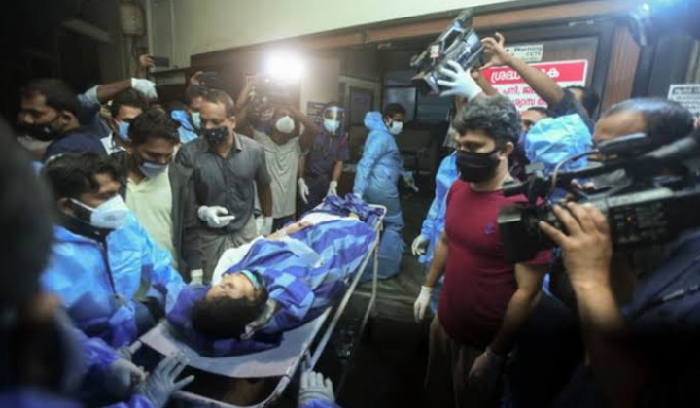
Kozhikode, Aug 8: A family of five, returning to their hometown at Koducalli in Kozhikode from Dubai, were aboard the fateful Air India Express flight that crash-landed at the Kozhikode airport claiming at least 18 lives on Friday.

Saifudheen, 40, is a businessman in Dubai. During the vacation when schools were closed here, his wife Fasalunnisa travelled, along with their children Muhammad Shahil, Fathima Sana and Aysha Shanza, to meet her husband.

On Friday, they were all travelling in the Air India aircraft to Kozhikode.

All five have received injuries and have been admitted to Baby Memorial Hospital Kozhikode except Sana, who is admitted to Al Shifa Hospital at Perinthalmanna in Malappuram.

"Saifudheen is my uncle. He and his family members were returning from Dubai when this unfortunate incident occurred. We were informed about the mishap at 8 pm. Now the family members have been shifted to Baby Memorial Hospital and everyone is fine now," Muhammad Salih, nephew of Saifudheen said.

The death toll in the flight crash landing incident at Kozhikode International Airport in Kerala rose to 18, including two pilots, Civil Aviation Minister Hardeep Singh Puri said on Saturday.

The minister said that he will visit the Kozhikode airport to take stock of the situation.

Two special relief flights have been arranged from Delhi and one from Mumbai for rendering humanitarian assistance to all the passengers and the family members.

Aircraft Accident Investigation Bureau (AAIB), Directorate General of Civil Aviation (DGCA) and Flight Safety Departments have reached to investigate the incident, the Air India Express stated.

Comments

Add new comment

  • Coastaldigest.com reserves the right to delete or block any comments.
  • Coastaldigset.com is not responsible for its readers’ comments.
  • Comments that are abusive, incendiary or irrelevant are strictly prohibited.
  • Please use a genuine email ID and provide your name to avoid reject.
News Network
April 20,2020

London, Apr 20 : Embattled liquor baron Vijay Mallya, who is wanted in India on alleged fraud and money laundering charges amounting to an estimated ₹9,000 crore, today lost a High Court appeal in UK against his extradition order to India.

A consortium of Indian public sector banks led by the State Bank of India had sought a bankruptcy order against Mallya as part of efforts to recoup around GBP 1.145 billion of unpaid loans from Mallya.

The 64-year-old former Kingfisher Airlines boss had appealed to the High Court against his extradition to India at a hearing in February this year.

Lord Justice Stephen Irwin and Justice Elisabeth Laing, the two-member bench at the Royal Courts of Justice in London presiding over the appeal, dismissed the appeal in a judgment handed down remotely due to the current coronavirus lockdown.

"We consider that while the scope of the prima facie case found by the SDJ [Senior District Judge] is in some respects wider than that alleged by the Respondent in India [Central Bureau of Investigation (CBI) and Enforcement Directorate (ED)], there is a prima facie case which, in seven important respects, coincides with the allegations in India," the judges ruled.

Earlier this month, the High Court in London had deferred hearings on a plea by the SBI-led consortium of Indian banks, seeking the indebted tycoon to be declared bankrupt to enable them recover their loan from him.

Justice Michael Briggs of the insolvency division of the High Court granted relief to Mallya, ruling that he should be given time till his petitions to the Supreme Court of India and his settlement proposal before the Karnataka High Court be determined, allowing him time to repay his debts to the banks in full.

Comments

Add new comment

  • Coastaldigest.com reserves the right to delete or block any comments.
  • Coastaldigset.com is not responsible for its readers’ comments.
  • Comments that are abusive, incendiary or irrelevant are strictly prohibited.
  • Please use a genuine email ID and provide your name to avoid reject.