


China moving ahead, talking about temples and mosques will waste our time: Ex-Navy chief

Agencies
August 12, 2019

New Delhi, Aug 12: China is moving ahead in areas like artificial intelligence (AI) and robotics and it would be a waste of time if India distracts itself by talking about temples and mosques, former Navy chief Arun Prakash said on Sunday.

However, Arun Prakash expressed hope that the abrogation provision of Article 370 and the change in the status of Jammu and Kashmir will bring peace and help foster integration and economic development in the region.

"For our whole existence as an independent nation, we have seen and suffered from these fissures - linguistic, religious, caste, etc. These conflicts have continued throughout our independent existence," Admiral Arun Prakash (Retd), while delivering Prem Bhatia Memorial Lecture in New Delhi, said.

"What we need to do is to try and tamp them rather than to exploit them. China is talking about artificial intelligence, robotics and machine learning and all that. And if we are going to talk about temples and mosques and so on, then obviously we are going to waste time," Arun Prakash added.

Curious to know whether anyone from the 'Raghuvansha' (descendants of Lord Ram) was still residing in Ayodhya, the Supreme Court on Friday had put this query to 'Ram Lalla Virajman', the deity and one of the parties in the politically sensitive Ram Janmabhoomi-Babri Masjid land dispute case.

Fourteen appeals have been filed in the apex court against the 2010 Allahabad High Court judgment, delivered in four civil suits, that the 2.77-acre land in Ayodhya be partitioned equally among the three parties -- the Sunni Waqf Board, the Nirmohi Akhara and Ram Lalla.

Arun Prakash, who served as the chief of Naval staff from July 2004 to October 2006, said on Sunday, "It is in key interest of national security to ensure peace and tranquillity domestically before even looking outside."

"So to take away the half front, which the Army Chief [Bipin Rawat] mentions, we need to ensure domestic peace, harmony, etc. Therefore, the issues that are of a divisive nature need to be minimised rather than exploited," Arun Prakash added.

In June this year, Army Chief Bipin Rawat said that Indian armed forces are ready for a "two-and-a-half-front war". Bipin Rawat was referring to Pakistan and China as two fronts and internal security threats as the half front.

Arun Prakash said Sunday, "Our actual preparation should have been to ward off Chinese pressure. They don't have to fire a bullet. There are many other ways of pushing India. And if we prepare to counter China, then Pakistan would automatically be taken care of."

Talking about recent situation in Jammu and Kashmir, Arun Prakash said, "One hopes that the recent abrogation of Article 370 and the changes in the status of erstwhile J&K [Jammu and Kashmir] will bring peace and help foster integration and economic development."

Earlier this week, the government revoked provisions of Article 370 of the Constitution, withdrawing special status to Jammu and Kashmir, and split the state into two Union Territories -- Jammu and Kashmir, and Ladakh.

"If we are to debunk Jinnah's two-nation theory and convince the Muslim majority Union Territory (UT) of J&K that they made the right choice in 1947, then we need to reflect seriously on some larger issues," Arun Prakash said.

"One, whether the pursuit of majoritarianism of any kind is a good idea for a multi-religious, multi-ethnic and multi-lingual country like India. Two, whether in generating insecurity amongst any section of our people will enhance India's security or undermine it," Arun Prakash added.

Comments

Mr Frank
 - 
Tuesday, 13 Aug 2019

When china products in every field available globally India is lagging far behind filled with hate crime and polarisation and rapings..development remains only a slogan.

Add new comment

  • Coastaldigest.com reserves the right to delete or block any comments.
  • Coastaldigset.com is not responsible for its readers’ comments.
  • Comments that are abusive, incendiary or irrelevant are strictly prohibited.
  • Please use a genuine email ID and provide your name to avoid reject.
Agencies
February 25,2020

Agra, Feb 25: The architectural grandeur of 17th century Taj Mahal and the story of its construction by Mughal Emperor Shah Jahan left US President Donald Trump "impressed" during his visit to the famed mausoleum, according to the guide who accompanied him.

Nitin Kumar, an Agra-based guide, said the first word the president said after laying his eyes on the marble marvel was "incredible".

He and First Lady Melania Trump visited on Monday the iconic Taj Mahal in Agra, the second stop on his little less than 36-hour-long trip of India, and marvelled at the Mughal-era mausoleum built as a monument of love.

After Dwight David Eisenhower (1959) and Bill Clinton (2000), he became the third US president to visit the architectural icon.

"I told them the story of the Taj Mahal, the construction, and the story behind it. President Trump got very emotional after knowing the story of Shah Jahan and his wife Mumtaz Mahal. How he was kept under house arrest by his own son Aurangzeb, and buried here at Taj, next to Mumtaz's grave, after his death," Kumar told reporters.

The couple was left speechless on the first sight of the monument, and showed interest when they were told about the history and architecture of the dome, and the design details, Kumar said.

"Melania Trump asked about the mud-pack treatment and was amazed when she got to know the details of the process," he said.

One of the most photographed sites in the world, it is always high on the itinerary of head of states visiting India.

The monument was built over a period of nearly 20 years by Shah Jahan in memory of his wife after her death in 1631.

"The Taj Mahal inspires awe, a timeless testament to the rich and diverse beauty of Indian Culture!' Thank You, India," the US President and First Lady jointly wrote in the visitors' book before signing it.

According to Mohammed Zafar, who lives close to Taj Mahal complex, Nitin has been conducting guided tours for many years. "He was selected for this VVIP visit," he said.

"Many people were taking selfies with him, after the end of the visit. So, many media persons interacted with him. He has got some instant fame of sorts," Zafar said.

Authorities at Archaeological Survey of India had "advanced the dates" for mud-pack treatment for the graves of Shah Jahan and Mumtaz Mahal at Taj Mahal in view of the US President Trump's visit to Taj, a senior official had earlier said.

Comments

Add new comment

  • Coastaldigest.com reserves the right to delete or block any comments.
  • Coastaldigset.com is not responsible for its readers’ comments.
  • Comments that are abusive, incendiary or irrelevant are strictly prohibited.
  • Please use a genuine email ID and provide your name to avoid reject.
Agencies
August 2,2020

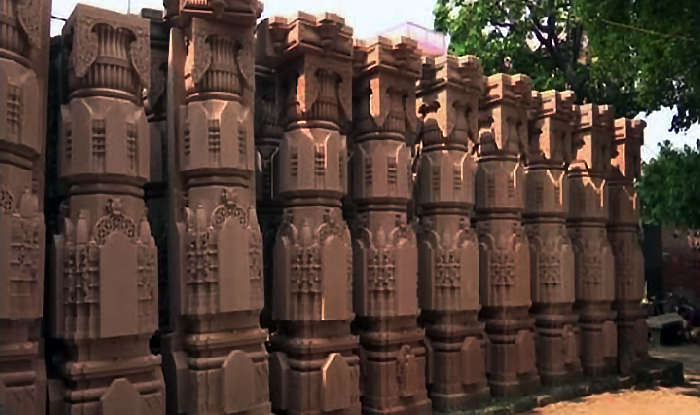
Ayodhya, Aug 2: With the foundation laying ceremony of the grand Ram temple around the corner, the work at the stone-carving workshop of Ram Janambhoomi in Ayodhya has reached its final stage.

Speaking to news agency, caretaker of Ram temple stone workshop Hanuman Yadav said, "Stonework is ready for the construction work till the first floor of the temple. Cleaning work is almost done but some work is still left which will be done soon after the trust's meeting."

Talking about the characteristics of the sandstone chosen work the construction, he said, "It was chosen for the construction as it can withstand rigours for thousands of years. These designated stones are minutely carved according to the need of the temple."

The stone-carving workshop for the Ram temple construction was established in Ayodhya by the Vishwa Hindu Parishad (VHP) in 1990.

On August 5 when Prime Minister Narendra Modi will visit Ayodhya for rituals that will mark the beginning of Ram temple construction, Hanumangarhi is the first stop he would be visiting.

The construction of Ram temple will begin in Ayodhya after the ceremony to lay the foundation stone in which various dignitaries from the political and religious fields are likely to participate apart from RSS chief Mohan Bhagwat. 

Comments

Add new comment

  • Coastaldigest.com reserves the right to delete or block any comments.
  • Coastaldigset.com is not responsible for its readers’ comments.
  • Comments that are abusive, incendiary or irrelevant are strictly prohibited.
  • Please use a genuine email ID and provide your name to avoid reject.
News Network
January 10,2020

New Delhi, Jan 10: One woman reported a rape every 15 minutes on average in India in 2018, according to government data released on Thursday, underlining its dismal reputation as one of the worst places in the world to be female.

The highly publicised gang rape and murder of a woman in a bus in New Delhi in 2012 brought tens of thousands onto the streets across India and spurred demands for action from film stars and politicians, leading to harsher punishments and new fast-track courts. But the violence has continued unabated.

Women reported almost 34,000 rapes in 2018, barely changed from the year before. Just over 85% led to charges, and 27% to convictions, according to the annual crime report released by the Ministry of Home Affairs.

Women's rights groups say crimes against women are often taken less seriously, and investigated by police lacking insensitivity.

"The country is still run by men, one (female prime minister) Indira Gandhi is not going to change things. Most judges are still men," said Lalitha Kumaramangalam, former chief of the National Commission for Women.

"There are very few forensic labs in the country, and fast-track courts have very few judges," said Kumaramangalam, a member of Prime Minister Narendra Modi's Bharatiya Janata Party (BJP).

The rape of a teenager in 2017 by former BJP state legislator Kuldeep Singh Sengar gained national attention when the accuser tried to kill herself the following year, accusing the police of inaction.

Five months before Sengar was convicted last December, the accuser's family had to be provided with security after a truck crashed into the car she was in, injuring her and killing two of her relatives.

A 2015 study by the Centre for Law & Policy Research in Bengaluru found that fast-track courts were indeed quicker, but did not handle a high volume of cases.

And a study in 2016 by Partners for Law in Development in New Delhi found that they still took an average of 8.5 months per case - more than four times the recommended period.

The government statistics understate the number of rapes as it is still considered a taboo to report rape in some parts of India and because rapes that end in the murder are counted purely as murders.

Comments

Add new comment

  • Coastaldigest.com reserves the right to delete or block any comments.
  • Coastaldigset.com is not responsible for its readers’ comments.
  • Comments that are abusive, incendiary or irrelevant are strictly prohibited.
  • Please use a genuine email ID and provide your name to avoid reject.