


Circle Inspector shoots himself to death in police station

[email protected] (CD Network)
October 18, 2016

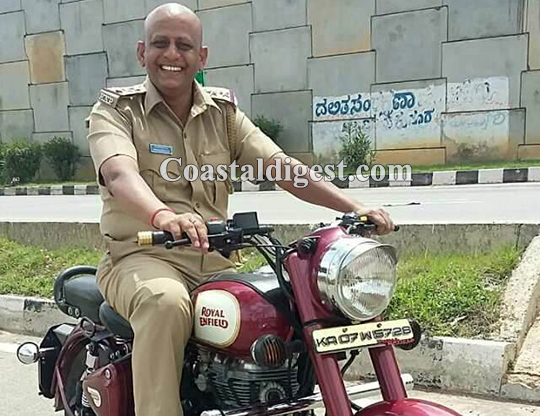
Kolar, Oct 18: In the third such case in recent months in Karnataka, a police official allegedly shot himself dead with his service revolver at Malur Police Station in Kolar district in the early hours today.
policeSui

38-year-old Raghavendra Muniyappa, a circle inspector, returned to the police station after a night patrol and shot himself fatally around 2 AM, police said.

The reason for the extreme step by the police official was not known immediately, they said.

Kolar district Superintendent of Police Divya Gopinath said the reason for the alleged suicide was not known and police were investigating the case.

The latest alleged suicide by a police official comes months after two similar incidents which had triggered a controversy.

DySP in Mangaluru M K Ganapathy had allegedly committed suicide in July, which had stirred a huge political storm, as he had blamed Minister K J George and two top IPS officials for his extreme step.

George had resigned as minister amid the controversy but was recently reinducted after the Karnataka CID gave a clean chit to him and the two senior police officers in its 'B' report filed in a court in Madikeri court.

Ganapathy was found hanging from a ceiling fan in a room at a lodge in Madikeri, prior to which told a local TV channel that George and IPS officers AM Prasad and Pranab Mohanty would be responsible "if anything happens to me."

On July 5, the body of deputy SP of Chikkamagaluru sub-division Kallappa Handibag (35), accused of kidnapping a person for ransom, was found hanging in his father-in-law's home at Murgod in Belagavi district.

Comments

Sahil
 - 
Tuesday, 18 Oct 2016

Easy way to escape from all karmas done previously!

Rikaz
 - 
Tuesday, 18 Oct 2016

committing suicide is not a solution for any problems....he should have faced it instead...it looks like he was not daring....not fit for police job...

Shetty
 - 
Tuesday, 18 Oct 2016

RIP. If those supposed to protect others kill themselves, then what about common people?

Pooja
 - 
Tuesday, 18 Oct 2016

What's going on in our state. Farmers suicide not stopped. Now police also started commiting suicide. who will find solution?

kiran rao
 - 
Tuesday, 18 Oct 2016

Ganapathi suicide and this shows the clear view of corrupt politics of congress.

Fayaz
 - 
Tuesday, 18 Oct 2016

now bjp goondas will start blaming congress!

priyanka
 - 
Tuesday, 18 Oct 2016

seriously this is going ugly and must be stopped. we are loosing good officers like ganapathi. politicians like K G George must be sent out of the country.

Manish
 - 
Tuesday, 18 Oct 2016

In congress ruled Karnataka there is no place for sincere police officers. One killer minister was recently re inducted into cabinet.

Add new comment

  • Coastaldigest.com reserves the right to delete or block any comments.
  • Coastaldigset.com is not responsible for its readers’ comments.
  • Comments that are abusive, incendiary or irrelevant are strictly prohibited.
  • Please use a genuine email ID and provide your name to avoid reject.
News Network
April 22,2020

Bengaluru, Apr 22: The Karnataka government has announced partial relaxation of COVID-19 lockdown norms in the state allowing certain construction activities, manufacturing of packaging materials, courier services, among others, from April 23.

The activities will be permitted only outside the COVID-19 containment zones identified by the government.

Service provided by self-employed people like electrician, IT repair, plumbers, motor mechanics, and carpenters in local areas have also been given exemption.

Tea, coffee and rubber plantation have been allowed to work with 50 per cent workforce, and a similar exemption have been given to processing, packaging, sale and marketing of these produce.

“To mitigate hardship to the public, select additional activities have been allowed,which will come into effect from 00.00 hours of April 23,” Chief Secretary TM Vijay Bhaskar said in an order on Wednesday.

However, these additional activities will be operationalised by District Administrations and BBMP (city corporation in the case of Bengaluru city) based on strict compliance to the guidelines on lockdown measures, it said.

Before operating these relaxations, district administrations and BBMP (city corporation) shall ensure that all the preparatory arrangements on social distancing in offices, work place establishments as also sectoral requirements are in place, it said, adding that relaxations will not apply in containment zones.

Facing a financial crunch, the state government has been eager to kick-start economic activities in the state that had come to halt due to the coronavirus lockdown.

While hospitality services, bars, malls, theatres, shopping complexes, religious and places of worship among others will continue to remain shut, relaxation of norms has been for activities that are linked to essential services such as health, infrastructure and agriculture.

As per the order, while, public transportation will continue to remain suspended till May 3,private vehicles with passes for emergency services and personnel commuting with passes to places of work and back will be allowed.

Activities permitted include construction of roads, irrigation projects, buildings and all kinds of industrial projects, including MSMEs, in rural areas and all kinds of projects in industrial estates, where workers are available on site and no one is required to be brought in from outside.

Also permitted to function are manufacturing units of essential goods – drugs, pharmaceuticals, medical devices, their raw materials and intermediates;

food processing industries in rural areas, coal production (mines and mineral production and activities incidental to mining) besides manufacturing units of packaging materials.

Comments

Add new comment

  • Coastaldigest.com reserves the right to delete or block any comments.
  • Coastaldigset.com is not responsible for its readers’ comments.
  • Comments that are abusive, incendiary or irrelevant are strictly prohibited.
  • Please use a genuine email ID and provide your name to avoid reject.
Wafa Sultana
April 4,2020

Over the last couple of days when the world was occupied with unifying efforts to fight the deadly Covid19 pandemic, sections of Indian media provided viewers a familiar scapegoat – the Indian Muslims – who are often stereotyped as a community being constantly at loggerheads with the citizenry and the State. Biased media channels were quick to resort to blaming the entire Muslim community for the spread of the disease in the country, thanks to an ill-timed Tablighi Jamaat gathering at its international headquarters in Delhi’s Nizamuddin. Unsurprisingly, the opprobrium was also marked by a sudden spike in WhatsApp forwards of videos with people wearing skullcaps licking spoons and performing Sufi breathing rituals, suggesting some sort of wild conspiracy on the part of the community to spread the virus.  Some media channels were quick to formulate, hypothesize and provide loose definitions of a newly discovered form of Jihad i.e. ‘Corona Jihad ’ thereby vilifying the Islamic faith and its followers.

While the investigation on the culpability of the organizers of the Nizamuddin event is still ongoing, there is enough information to suggest that the meeting was held before any lockdown was in force, and the problem began when there was no way of getting people out once the curfew was announced. Be that as it may, there is little doubt that organizing a meet of such a scale when there is a global pandemic smacks of gross misjudgment, and definitely the organizers should be held accountable if laws or public orders were defied. Attendees who attempt to defy quarantine measures must be dealt with strictly. However, what is alarming is that the focus and narrative have now shifted from the unfortunate event at Nizamuddin to the Tablighi Jamaat itself.

For those not familiar with the Tablighi Jamaat, the organization was founded in 1926 in Mewat by scholar Maulana Mohammad Ilyas. The Jamaat’s main objective was to get Muslim youth to learn and practice pristine Islam shorn of external influences. This is achieved through individuals dedicating time for moral and spiritual upliftment secluded from the rest of the world for a brief period of time. There is no formal membership process. More senior and experienced participants typically travel from one mosque to other delivering talks on religious topics, inviting local youth to attend and then volunteer for a spiritual retreat for a fixed number of days to a mosque in a nearby town or village to present the message to their co-religionists. Contrary to ongoing Islamophobic rhetoric, the movement does not actively proselytize. The focus is rather on getting Muslims to learn the teachings and practices of Islam.  This grassroots India-based movement has now grown to almost all countries with substantial Muslim populations. Its annual meets, or ‘ijtemas’ are among the largest Islamic congregations in the world after the annual Haj. One of the reasons for its popularity and wide network in the subcontinent and wordwide is the fact that it has eschewed the need for scholarly intervention, focusing on peer learning of fundamental beliefs and practice rather than high-falutin ideological debates. The Tablighi Jamaat also distinguishes itself from other Islamic movements through its strictly apolitical nature, with a focus on individual self-improvement rather than political mobilization. Hardships and difficulty in the world are expected to be face through ‘sabr’ (patience) and ‘dua’ (supplication),  than through quest for political power or influence. In terms of ideology, it is very much based on mainstream Sunni Islamic principles derived from the Deobandi school.

So, why is all this background important in the current context? While biased media entities have expectedly brought out their Islamophobic paraphernalia out for full display, more neutral commentators have tried to paint the Tablighi Jamaat as a fringe group and have tried to distance it from 'mainstream Muslims'. While the intent is no doubt innocent, this is a trap we must not fall into. This narrative, unfortunately, is also gaining ground due to apathy some Muslims have for the group, accusing it of being “disconnected from the realities of the world”. Unlike other Muslim organizations and movements, the Tablighi Jamat, by virtue of its political indifference, does not boast of high-profile advocates and savvy spokespersons who can defend it in mainstream or social media.  The use of adjectives such as 'outdated' and 'orthodox' by liberal columnists to describe the Jamaat feeds into the malignant attempt to change the narrative from the control of the spread of the pandemic due to the Nizamuddin gathering to 'raison d'etre' of the organization itself.

A large mainstream religious group like the Tablighi Jamaat with nearly a hundred-year history, normally considered to be peaceful, apolitical and minding its own business is now suddenly being villainized owing to unfortunate circumstances. Biased media reactions filled with disgust and hate seem to feed the Indian public conscience with a danngerous misconception - to be a nominal Muslim is okay but being a practicing one is not.  For those committed to the truth and fighting the spread of Islamophobia, the temptation to throw the entire Tablighi Jamaat under the bus must be resisted.

The writer is a lawyer and research scholar at Qatar University. Her research interests include Islamic law and politics.

Comments

zahoorahmed
 - 
Saturday, 4 Apr 2020

great article! provides a great perspective on tableeg jamat

Add new comment

  • Coastaldigest.com reserves the right to delete or block any comments.
  • Coastaldigset.com is not responsible for its readers’ comments.
  • Comments that are abusive, incendiary or irrelevant are strictly prohibited.
  • Please use a genuine email ID and provide your name to avoid reject.
News Network
February 24,2020

New Delhi, Feb 24: India has deeply appreciated the Senegal government's decision to extradite fugitive gangster Ravi Poojary to India, official sources said on Sunday.

Facilitation of transit provided by the Government of France has also been acknowledged, they said.

Ravi Prakash Poojary, accused of committing a number of serious offences including murder and extortion in multiple jurisdictions, was extradited from Senegal on Saturday.

The probe agencies have persistently pursued the case for his extradition with the authorities in Senegal. India had made a request with Senegal for his extradition in early 2019, sources said.

Poojary was associated with gangster Chhota Rajan, but he also worked for fugitive underworld don Dawood Ibrahim.

Comments

Add new comment

  • Coastaldigest.com reserves the right to delete or block any comments.
  • Coastaldigset.com is not responsible for its readers’ comments.
  • Comments that are abusive, incendiary or irrelevant are strictly prohibited.
  • Please use a genuine email ID and provide your name to avoid reject.