Class 1 girl dies after school bus knocks her down

coastaldigest.com news network
February 14, 2018

A six-year-old girl, who had suffered critical injuries in a freak accident on Monday in Sullia taluk of Dakshina Kannada district on Monday, breathed her last on Tuesday at a hospital.

The victim is Aagneya Balu, daughter of Appakunji, resident of Biliyaru in Aranthodu village. She was a student of first standard at KVG School, Sullia.

Aagneya had just alighted the school bus and was getting her snacks box from her friends in the bus. Bus driver, Dhananjay, without noticing the girl, moved the bus as a result of which she came under the rear wheels of the bus, sustaining injuries. She died of injuries on Tuesday.

There was no conductor in the bus at the time of the accident. Sullia police have registered a case of negligent driving and Dhananjaya, who was arrested, has been remanded to judicial custody, police said.

Comments

Riyaz
 - 
Wednesday, 14 Feb 2018

إِنَّا لِلّهِ وَإِنَّـا إِلَيْهِ

Ibrahim
 - 
Wednesday, 14 Feb 2018

Inna lillahi wa inna ilayhi raji'un

Add new comment

  • Coastaldigest.com reserves the right to delete or block any comments.
  • Coastaldigset.com is not responsible for its readers’ comments.
  • Comments that are abusive, incendiary or irrelevant are strictly prohibited.
  • Please use a genuine email ID and provide your name to avoid reject.
News Network
February 8,2020

Mangaluru, Feb 8: Professional services company Cognizant on Friday opened a new facility in Mangaluru, expanding its presence in Karnataka. Located in the heart of the city, the new 100,000 sq- ft facility can accommodate more than 1,100 employees, the NASDAQ-listed company said in a statement.

Cognizant has had an association with Mangaluru since 2011 when it acquired CoreLogic Global Services Private Limited (CoreLogic India), the India-based captive operations of CoreLogic, one of the largest real estate information and analytics provider in the US market.

From its existing centre in Mangaluru, Cognizant provides consulting, enterprise applications and business process services in the area of mortgage processing covering property taxes, research and investigations, property data warehousing and management of geospatial data.

The company currently employs more than 600 professionals in Mangaluru, more than 50 per cent of whom are women.

In addition to experienced professionals, Cognizant also hires fresh graduates for its Mangaluru centre from leading institutions such as Sahyadari Institute of Technology and Management, Manipal Institute of Technology, N.M.A.M. Institute of Technology, St Joseph's College of Engineering, Canara Engineering College, N.I.T.K. Surathkal, PA College of Engineering and Srinivas College of Engineering, as mortgage origination and servicing specialists, business analysts, consultants, automation specialists and software engineers.

In Karnataka, Cognizant also has operations in Bengaluru and Mysuru. The company has more than 28,000 professionals in Bengaluru and nearly 700 professionals in Mysuru.

States and union territories of India, Service companies, Rail transport in Karnataka, Cognizant, Dun & Bradstreet, Teaneck, New Jersey,Transport in Karnataka, Transport in Mangalore, Mangalore, Karnataka, Udupi railway station, Mangalore Junction railway station, St Joseph's College of Engineering, Sahyadari Institute of Technology, CoreLogic Global Services Private Limited, Canara Engineering College, Srinivas College of Engineering,real estate information, PA College of Engineering, N.M.A.M. Institute of Technology, st joseph's, N.I.T.K. Surathkal, Manipal Institute of Technology, software engineers, United States, business process services, mortgage processing, Institute of Technology


Comments

Add new comment

  • Coastaldigest.com reserves the right to delete or block any comments.
  • Coastaldigset.com is not responsible for its readers’ comments.
  • Comments that are abusive, incendiary or irrelevant are strictly prohibited.
  • Please use a genuine email ID and provide your name to avoid reject.
News Network
March 28,2020

Bengaluru, Mar 28: Sun Tsu, in 'The Art of War' speaks of a skilful general who can subdue his enemy without any fighting. This constitutes the ultimate triumph which is referred to as stratagem. Today, we would need one such when we are faced with the '21-day corona challenge' for India.
Nearly four weeks back, Dr Jyothsna Rao, Dr Gururaj Rao and I sat across the OPD in the afternoon at HCG Bengaluru discussing our ongoing cancer immunology research. While on this topic, we drifted into the discussion on the coronavirus. During this engaging discussion, we wondered the similarity of the enigma between the virus and cancer. I paused to ask Dr Jyothsna and Dr Guru - how we wish we could do something against this virus.
Dr Jyothsna is a PhD from NCBS and had worked under Dr Ralph Steinman, physician and researcher from Rockefeller University, who won the Nobel Prize for his discovery of the dendritic cell and its role in adaptive immunity in 2011. Dr Gururaj is a molecular and cell biologist who did his PhD at the Chapel Hill, University of North Carolina and is the Director of iCrest.
Jyothsna while hearing our perplexing conversation on the covid intervened, "Yes, surely. I think we should take a break from cancer and focus on the innate and adaptive immunity role in COVID-19."
Thus began this sincere attempt to relook the human immune system from the eyes of the COVID-19.
We have 10 types of immune cells at the least which are widely dispersed in millions across the body. When our body is invaded by a foreign organism (bacteria, fungi or virus), these cells work with each other to destroy the invader.
Now, the question is - how do the immune cells talk to each other? They use small-molecule substances called cytokines (cyto means cells; kine means movement). There are many cytokines that are involved in work on the immune system. The most relevant for viruses are interferons.
Interferons (IFN) as the name reflects have an ability to interfere with the viral activity and stop their multiplication. These specialised signal proteins are released by our cells in response to a viral attack to forewarn other cells. They help build the antiviral proteins within the cells to kill the virus as it tries to invade the new cells.
Historically, interferons are a group of cytokines known to be potent antiviral agents against viruses and a hallmark cytokine induced by the host upon viral infections. Interferons possess unique immunoregulatory activities and are signature cytokines released by (TH1) T immune cells, which are crucial in viral infections.
As the outbreak of COVID-19 grapples us, an urgent need for finding strategies to combat the virus is growing. Coronaviruses (CoVs) are a group of RNA viruses. In patients infected with coronavirus, it was indicated that the activation of the IFN does not occur until 48 hours post-infection. Thus the delayed IFN-related antiviral response by the healthy cells leads to coronavirus evade the immune response.
Numerous studies have presented the success in defeating CoVs by the direct administration of IFNs. In a combination as a concoction, it was shown to synergistically inhibit the virus replication in vitro.
Moreover, it is understood that the earlier induction of IFNs in children although they have a less developed immune system could be the reason behind the children being least affected.
The key to success in reducing the disease fatality might be the stimulation of the immune responses to trigger IFN production at the very early stages of the disease, which might be done through the administration of IFN. Despite the evidence for the efficacy of IFNs in treating CoV-induced infections, the proper dosing and ideal timing for such interventions needs to be verified in clinical trials.
For the later stages of the diseases in advance stages where patients are on ventilator and have developed respiratory distress, we propose to utilise the mesenchymal cells derived from donor bone marrow that have been known to treat acute respiratory syndrome. Mesenchymal cells are known to possess anti-inflammatory activity and thus used often in autoimmune diseases.
With this scientific background, we have activated T cells from healthy donors, in a cGMP facility at iCrest - HCG hospital with an enriched cocktail of cytokines rich in Interferons. Injections of this cocktail we believe will result in a surge of cytokines in the body of the infected person and will boost his ability to fight the virus in the early phases. We are in the initial phases of this study and hope to be ready in the coming weeks with meaningful data on its potential utility.
Currently, it awaits government approvals (Union and state) and we have applied to central drugs authority for their initial evaluation and further directions.
As my Guru often expounded the philosophy of 'Seva' - the goal of education is knowledge, the end goal of knowledge is service. In this attempt to serve our fellow humans at this brink of unprecedented crisis, medical fraternity stands with you and promises to do our best for your safety.
We assure to exhaust every bit of our spirit in this fight against coronavirus. We have lost the sight of shores and travelled thus far, but that is the mandatory first step to cross the ocean. Are we going to succeed in this battle, is something only time will answer. 

Comments

Add new comment

  • Coastaldigest.com reserves the right to delete or block any comments.
  • Coastaldigset.com is not responsible for its readers’ comments.
  • Comments that are abusive, incendiary or irrelevant are strictly prohibited.
  • Please use a genuine email ID and provide your name to avoid reject.
coastaldigest.com news network
August 8,2020

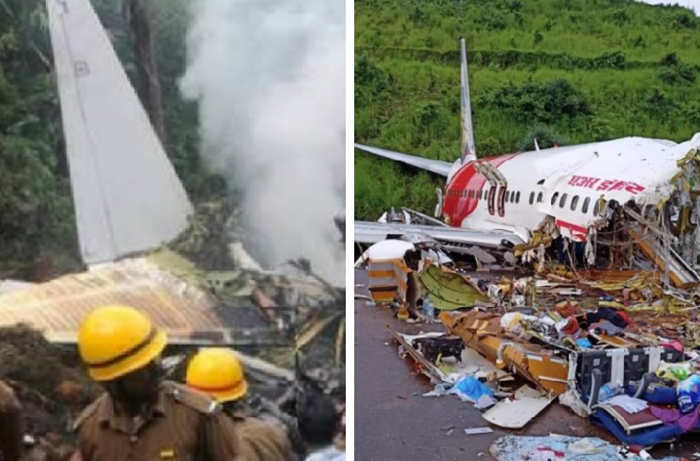
Mangaluru, Aug 8: As visuals of the Air India Express flight crash at Kozhikode international airport emerge, one cannot help but be reminded of an eerily similar and unfortunate accident that occurred a decade ago. The August 7, 2020 tragedy brought back memories of the 2010 crash.

It was on May 22, 2010 that an Air India Express Boeing 737-800 flight from Dubai to Mangaluru over shot the runway while landing at Bajpe airport and fell into a cliff. Of the 160 passengers and 6 crew members on board, 158 were killed (all crew members and 152 passengers) and only 8 survived.

Even back then, the plane had split into two. The crash has been termed as one of India's worst aviation disasters.

The final conversations between Air traffic control (ATC) and the pilot prior to the landing showed no indication of any distress.

Like the Mangaluru accident, Karipur crash too happened when the flight was attempting to land.

The captain of the aircraft which crashed at Mangaluru, Z Glucia, was an experienced pilot with 10,000 hours of flying experience and had 19 landings at the Mangalore airport. Co-pilot S S Ahluwalia, with 3,000 hours of flying experience had as many as 66 landings at this airport. Both the pilot and co-pilot were among the victims.

An investigation into the accident later found that the cause of the accident was the captain’s failure to discontinue an ‘unstabilised approach’ and his persistence to continue with the landing, despite three calls from the First Officer to ‘go-around’.

Comments

Add new comment

  • Coastaldigest.com reserves the right to delete or block any comments.
  • Coastaldigset.com is not responsible for its readers’ comments.
  • Comments that are abusive, incendiary or irrelevant are strictly prohibited.
  • Please use a genuine email ID and provide your name to avoid reject.