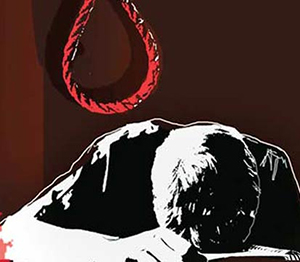
Class 10 boy kills self after failing home test; brother, parents too commit suicide

News Network
June 24, 2017

Bengaluru, Jun 24: What started with a 15-year-old's inability to doing well in a home test given by his mother and brother ended in the entire family of four committing suicide in separate incidents over the past week. While the boy Chandrateja ended his life on June 16(Friday), the father Subramanya ended his life on June 23 (Friday).suicide-photo

It all started with Chandrateja, a class 10 student failing a test given by his brother Suryateja, a II PU student of Government College in Vishwanathapura. Suryateja and his mother Sujatha were upset with Chandrateja, and she shouted and reprimanded him, police said.

Chandrateja allegedly consumed pesticide later that night, following which he was admitted to a government hospital in Devanahalli after midnight. After being admitted to two hospitals, he died on Saturday. Around 10pm Monday, Sujatha and Suryateja left home when Subramanya was not at home and jumped in front of a train between Devanahalli and Chikkaballapur.

Police recovered their bodies along with a suicide note in which Suryateja requested his father to bury him with his cricket bat, ball and new slippers, next to Chandrateja's grave.

On Friday, Subramani was found hanging at his house in Devanahalli after performing the last rites of his family.

Comments

Aslam Sheikh
 - 
Monday, 26 Jun 2017

Heartbreaking, no words.... RIP.

Add new comment

  • Coastaldigest.com reserves the right to delete or block any comments.
  • Coastaldigset.com is not responsible for its readers’ comments.
  • Comments that are abusive, incendiary or irrelevant are strictly prohibited.
  • Please use a genuine email ID and provide your name to avoid reject.
News Network
March 9,2020

Bengaluru, Mar 9: The political crisis faced by Kamal Nath government in Madhya Pradesh appears to have accentuated with 13 party MLAs and six ministers reported to be in Bengaluru.

The developments have come amid factional differences in the party unit and at a time the party has to finalise its Rajya Sabha candidates from the state.

Sources said the number of Congress MLAs who were in Bengaluru had gone up to 19 and one more MLA expected to reach Bengaluru by Monday night. They said the MLAs have come in batches and include six ministers from Madhya Pradesh.

The developments came on a day state chief Chief Minister Kamal Nath met party chief Sonia Gandhi and discussed the political situation in the state.

The sources said that MLAs are likely to be shifted to a resort on the outskirts of Bengaluru.

According to the sources, BJP Mahadevpura MLA Arvind Limbavali has been in touch with the Congress MLAs. They said 16 MLAs were brought at HAL airport Bengaluru by a special flight and were staying in a hotel at present.

The session of Madhya Pradesh assembly will begin on March 16 and the BJP may bring no-confidence motion against the Kamal Nath government.

Kamal Nath had said after his meeting with Gandhi that Congress MLAs who were reportedly missing have returned and had informed him that they were on 'tirth yatra'.

"Congress MLAs came back and said to me that they went on' tirth yatra (pilgrimage)".

The Congress has accused the BJP of trying to topple the party government. Party leader Digvijaya Singh had earlier alleged that BJP leaders Shivraj Singh Chouhan and Narottam Mishra were offering bribes of Rs 25-35 crore to Congress MLAs in order to bring down the Congress government in the state. The BJP had refuted the allegations.

In 2018 assembly elections, Congress won 114 seats in the 230-member Assembly and formed the government with the support of four Independent MLAs and two BSP MLAs and a legislator from the Samajwadi Party (SP). The BJP had secured 109 seats in the state assembly.

Last week,Madhya Pradesh Labour Minister Mahendra Singh Sisodia had warned that the state government will face a crisis if it "ignores or disrespects" party leader Jyotiraditya Scindia.

Scindia had said last month that he will not hesitate to hit the roads if promises made in a manifesto by Kamal Nath-led government in Madhya Pradesh were not fulfilled.

Kamal Nath had responded to the remarks saying, "To utar jayein" (Let him hit the streets if he wants to).

Congress MLA Bisahulal Singh, who was "missing" for the past few days, returned to Bhopal on Sunday and said he had gone on a pilgrimage.

Independent MLA Surendra Singh said on Monday that he was hoping to become a minister in Madhya Pradesh government soon.

Comments

Add new comment

  • Coastaldigest.com reserves the right to delete or block any comments.
  • Coastaldigset.com is not responsible for its readers’ comments.
  • Comments that are abusive, incendiary or irrelevant are strictly prohibited.
  • Please use a genuine email ID and provide your name to avoid reject.
News Network
February 23,2020

Mysuru, Feb 23: A Quarantine station for rescued wild animals for rehabilitation will soon come up at Chamundi Animal Conservation, Rescue and Rehabilitation Centre at Koorgalli, an independent facility developed by the Mysuru Zoo on the outskirts of the City of Palaces and it complies with the recommended quarantine procedures followed globally by Zoological gardens.

The work on the construction was expected to start soon as the tender process had been under progress.

The Zoo was using its own funds to develop the facility for multiple animal species and to ensure that no infections from the wild animals were spread to the healthy animals already in captivity since many years.

Comments

Add new comment

  • Coastaldigest.com reserves the right to delete or block any comments.
  • Coastaldigset.com is not responsible for its readers’ comments.
  • Comments that are abusive, incendiary or irrelevant are strictly prohibited.
  • Please use a genuine email ID and provide your name to avoid reject.
Agencies
May 8,2020

Washington D.C., May 8: The prime time for brain development in a child's life is the first year, where the infant spends most of the time asleep. It is the time when neural connections form and sensory memories are encoded.

However, when sleep is disrupted, as occurs more often among children with autism, brain development may be affected, too.

New research led by the University of Washington finds that sleep problems in a baby's first 12 months may not only precede an autism diagnosis but also may be associated with altered growth trajectory in a key part of the brain, the hippocampus.

The study, which was published in the American Journal of Psychiatry, researchers report that in a sample of more than 400 taken of 6- to 12-month-old infants, those who were later diagnosed with autism were more likely to have had difficulty falling asleep.

It also states that this sleep difficulty was associated with altered growth trajectories in the hippocampus.

"The hippocampus is critical for learning and memory, and changes in the size of the hippocampus have been associated with poor sleep in adults and older children.

As many as 80 per cent of the children with autism spectrum disorder have sleep problems," said Annette Estes, director of the UW Autism Center and senior author of the study.

"In our clinical experience, parents have a lot of concerns about their children's sleep, and in our work on early autism intervention, we observed that sleep problems were holding children and families back," added Estes, who is also a UW professor of speech and hearing sciences.

"It could be that altered sleep is part-and-parcel of autism for some children. One clue is that behavioural interventions to improve sleep don't work for all children with autism, even when their parents are doing everything just right. This suggests that there may be a biological component to sleep problems for some children with autism," said Estes.

To consider links among sleep, brain development, and autism, researchers at the IBIS Network looked at MRI scans of 432 infants, surveyed parents about sleep patterns, and measured cognitive functioning using a standardized assessment.

At the outset of the study, infants were classified according to their risk for developing autism: Those who were at higher risk of developing autism -- about two-thirds of the study sample -- had an older sibling who had already been diagnosed.

Infant siblings of children with autism have a 20 per cent chance of developing autism spectrum disorder -- a much higher risk than children in the general population.

In the current study, 127 of the 432 infants were identified as "low risk" at the time the MRI scans were taken because they had no family history of autism.

They later evaluated all the participants at 24 months of age to determine whether they had developed autism. Of the roughly 300 children originally considered "high familial risk," 71 were diagnosed with autism spectrum disorder at that age.

Problems with sleep were more common among the infants later diagnosed with an autism spectrum disorder, as were larger hippocampi. No other subcortical brain structures were affected, including the amygdala, which is responsible for certain emotions and aspects of memory, or the thalamus, a signal transmitter from the spinal cord to the cerebral cortex.

The authors note that while parents reported more sleep difficulties among infants who developed autism compared to those who did not, the differences were very subtle and only observed when looking at group averages across hundreds of infants.

Sleep patterns in the first years of life change rapidly as infants transition from sleeping around the clock to a more adult-like sleep/wake cycle. Until further research is completed, Estes said, it is not possible to interpret challenges with sleep as an early sign of increased risk for autism.


Comments

Add new comment

  • Coastaldigest.com reserves the right to delete or block any comments.
  • Coastaldigset.com is not responsible for its readers’ comments.
  • Comments that are abusive, incendiary or irrelevant are strictly prohibited.
  • Please use a genuine email ID and provide your name to avoid reject.