CM promises govt job to wife of DySP who ended life after allegedly helping kidnappers

July 26, 2016

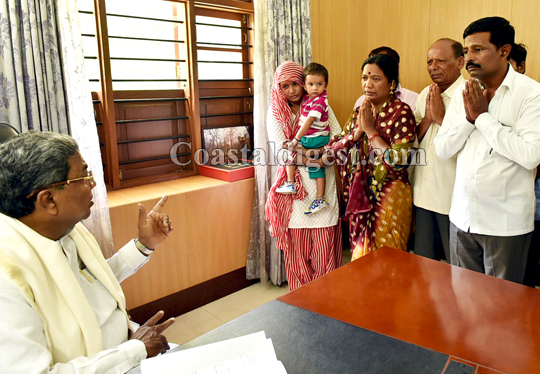
Bengaluru, Jul 26: Chief Minister Siddaramaiah on Monday said a government job will soon be provided to Vidya, wife of late police officer Kallappa Handibag, on compassionate grounds.

handibag1

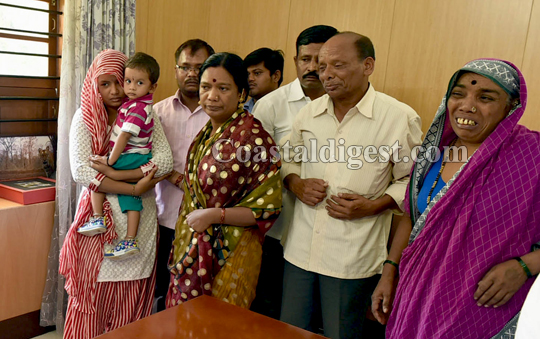
Deputy superintendent of police Handibag had committed suicide earlier this month after a kidnaping case was registered against him in Belagavi. On Monday, the family members of Handibag, including his parents, wife, and siblings met Chief Minister Siddaramaiah in Bengaluru.

They told the chief minister that Handibag was innocent and he was falsely trapped in a kidnaping case by the gambling mafia for targeting them. They sought action against those responsible for Handibag's suicide.

Devarahippargi MLA?A?S?Patil (Nadahalli), who had arranged the meeting of Handibag's family with Siddaramaiah, said 60 legislators had signed a petition seeking a government job for the late police officer's wife. Vidya has passed her SSLC and has a one-year-old child.

Congress MLA?S?T?Somashekar said he would provide a job to Handibag's sister in a cooperative institution. Somashekar has worked in the cooperative sector and headed the Karnataka State Cooperative Housing Federation.

Later in the day, Handibag's father Basappa was admitted to M?S?Ramaiah?Hospital for treatment of partial paralysis.

Court quashes suspects' bail pleas

A local court on Monday quashed the bail pleas of two suspects in the Handibag suicide case.

VHP activist Khandya Praveen, the prime suspect in the case who is evading arrest, had applied for anticipatory bail, while another suspect Kalmane Nataraj, who has been already arrested by the CID, had filed a regular bail application.

According to sources, the advocates representing the duo are preparing to move the High Court for bail.

Abhiram and Joy Milton, who have been arrested in the case, were remanded in judicial custody.

handibag2

Comments

Add new comment

  • Coastaldigest.com reserves the right to delete or block any comments.
  • Coastaldigset.com is not responsible for its readers’ comments.
  • Comments that are abusive, incendiary or irrelevant are strictly prohibited.
  • Please use a genuine email ID and provide your name to avoid reject.
News Network
April 12,2020

Raipur, Apr 12: As many as 108 out of the 159 people that were quarantined by the Chhattisgarh government last week for allegedly taking part in Delhi’s Tablighi Jamaat congregation are Hindus, according to reliable sources. 

The names of these 159 people, who were said to be in Delhi’s Nizamuddin area when the Tablighi Jamaat congregation was held mid-March, were mentioned in a list issued by the state home department last month. 

The list has been accessed by the many media outlets. But, Raipur Collector S. Bharti Dasan and the state’s Principal Secretary, Home, Subrata Sahu, claimed no such list was issued.

However, a senior state home department official, who didn’t want to be named, said: “Listing of the names was done on the basis of location of mobile phones traced in Nizamuddin in the month of March during the period when congregation of Tablighi Jamaat was held.

“It was subsequently sent to the chief medical officers in the respective districts for further action,” the official added.

These 159 people have either been quarantined at their homes or at government isolation centres. The quarantine exercise took place between 31 March and 1 April.

Interestingly, almost all the people named in the list have denied attending the massive Jamaat congregation, which had seen the participation of over 3,000 people, including foreigners.

Under quarantine “forcefully”, these people alleged they are facing social boycott as they have been “linked to the Tablighi”.

Those placed under quarantine, told media if their phone locations have shown their presence in the Nizamuddin area that didn’t necessarily mean they had attended the Tablighi congregation.

“My neighbours are no longer like my family. After 31 March, I have received more than 500 calls (from relatives and friends) and had to convince them that I didn’t attend the Jamaat event,” Umesh Pandey, a resident of Ambikapur, said.

“People in my area have started saying that some Brahmins took part in the event. I have no objection to being kept in quarantine, but it should be explained why it is being done,” said Pandey, who is a consumer rights activist.

Pandey said, like every year, he had gone to Delhi in March to participate in a consumer protection programme and had stayed at a hotel in Nizamuddin. “I came back on 17 March. After I was quarantined, a false propaganda is being spread about me that I am linked with Tablighi Jamaat activities.”

Pandey said he and his family are now being “looked at as suspects”. 

Kamal Kumar Popatani, a businessman from Bilaspur district, has faced similar problems. Popatani and his family have been living in isolation since 31 March.

“I am completely flabbergasted by this step taken by the state government. I always visit Delhi to procure items for my shop. This time too I had completed my procurement and had returned home on 16 March. Everything was usual till 30 March, but suddenly after 31 March, when this so-called list of 159 alleged suspects was released by the government, we were placed under isolation,” Popatani said.

“My own family members, neighbours and everyone I know are now accusing me that I had joined the Tabligi Jamaat gathering. How can it ever happen? This strange attitude of the government has made my entire family a victim of social boycott.”

Trader Abdul Rahman, a resident of Lutra Sharif area of Bilaspur district, also echoed similar sentiments.

“I returned from Delhi along with my wife on 15 March, but my entire family has been kept in isolation since 31 March. All this is way beyond my comprehension… Blood samples of the entire family were taken. Now everyone is keeping a distance from us and calling us corona suspects,” said Rahman, who had gone to Delhi for a holiday.

“People not only from my village but also in the nearby villages are pointing fingers at me and my family… We are the ones who condemn Tablighi Jamaat and their activities. We have nothing to do with them. The quarantine… has brought…infamy to us,” he added.

In another goof-up, the list even includes names of some people who no longer live in the state but carried mobile numbers issued in Chhattisgarh. One such name is that of BSF sub-inspector Shantanu Mukherjee, who was working in Bhilai about two years ago, but is currently posted in Delhi.

“What kind of list is this? Who released it in the first place? At first, I received a call from the Covid-19 control room in Chhattisgarh and then from the State Police Control Centre. They inquired about my health and current place of posting,” said Mukherjee, whose office is located close to the Nizamuddin area. 

Makkhan Singh Yadav, a sub-inspector with the CRPF, is another case in point. Yadav, who is posted somewhere close to Nizamuddin, had bought a SIM card from Dantewada, when he was posted there five years ago.

“I had received calls from both Delhi and Chhattisgarh police after being marked as a corona suspect. But when I explained the reality to them, no calls were made thereafter. I could not understand how all this is taking place,” said Yadav, who is a native of Rampur, Uttar Pradesh.

A first-year Delhi University student, who belongs to Mahasamund district of Chhattisgarh, has been kept under isolation at a local government hospital.

The student, who didn’t want to be named, said she had gone to Nizamuddin railway station to catch a train for Chhattisgarh.

“I came home immediately after it was announced that educational institutions are shutting down. After returning from Delhi, I spent around 19 days at my own home, but suddenly I was admitted to the hospital on 1 April. Why have I been brought here (hospital) if I have no symptoms? All this feels like some sort of torture.”

“Despite my repeated denial, I was brought here by the health department on the pretext of being associated with the Tablighi Jamaat,” she said. 

Asked about the Tablighi quarantine list, principal secretary Sahu said: “The government has issued no such list. We have received inputs from the social media about three such lists but the state government has not officially prepared any list.

“All those put under quarantine have been done as per the orders issued by the state government. This order states that those who came to the state after 1 March should be kept under isolation,” he added.

Raipur Collector Dasan refused to say anything about the list and added that people have been kept under quarantine after obtaining their “detailed travel history” based on the guidelines issued by the ICMR.

On the allegation of social boycott, Dasan said: “No person or their families placed under home quarantine or isolation should be subjected to any social boycott or misconduct. They also need not have any social inferiority complex in their minds.

“If any person placed under quarantine feels like this (social inferiority complex), the government has arranged counsellors for them. Our counsellors are convincing and assuring such people by reaching out to them.”


Comments

Add new comment

  • Coastaldigest.com reserves the right to delete or block any comments.
  • Coastaldigset.com is not responsible for its readers’ comments.
  • Comments that are abusive, incendiary or irrelevant are strictly prohibited.
  • Please use a genuine email ID and provide your name to avoid reject.
News Network
May 26,2020

Bengaluru, May 26: The Karnataka high court has rejected bail to a software engineer who was arrested after his sarcastic Facebook post urged people to spread coronavirus by sneezing in public over two months ago.

Mujeeb Mohammed was sacked by Infosys from the post of senior software engineer after his arrest on March 29.

Justice KS Mudagal observed the investigating officer's report and the case diary prima facie show though Mujeeb was well educated and employed, he uploaded messages which are likely to cause disharmony and panic, and are hostile to humanity at a time when the world is facing the pandemic.

The judge noted that the records indicate Mujeeb has six bank accounts, stayed in Bahrain and Kuwait for some years, was influenced by religious fanatics and anti-national ideas and that he had shared a Pakistan WhatsApp number to someone over information about Islam. The National Investigation Agency is probing his links.

Mujeeb, who is in judicial custody now, has been booked under sections 153A, 505, 270 and 109 of IPC.

His counsel submitted the maximum punishment under 153 A of IPC (causing enmity) would be three years and for other offences, it's even less. He also stated the petitioner would abide by the conditions to be imposed by the court.

However, the government pleader said probe provided leads on the petitioner's links with unorganised terrorist groups and it has to be investigated further.

Comments

Add new comment

  • Coastaldigest.com reserves the right to delete or block any comments.
  • Coastaldigset.com is not responsible for its readers’ comments.
  • Comments that are abusive, incendiary or irrelevant are strictly prohibited.
  • Please use a genuine email ID and provide your name to avoid reject.
News Network
May 5,2020

Dubai, May 5: Tickets on repatriation flights from UAE to India, which start on May 7, could be costlier than regular airfare, and adding to the financial woes of those flying back. Nearly 200,000 Indians in the UAE have registered on the website seeking to return home.

“A one-way repatriation ticket to Delhi will cost approximately Dh1,400-Dh1,650 - this would earlier have cost between Dh600-Dh700 [during these months],” said Jamal Abdulnazar, CEO of Cozmo Travel. “A one-way repatriation flight ticket to Kerala would cost approximately Dh1,900-Dh2,300.”

This can be quite a burden, as a majority of those taking these flights have either lost their jobs or are sending back their families because of uncertainty on the work front. To now have to pay airfare that is nearly on par with those during peak summer months is quite a blow.

Sources said that officials in Indian diplomatic missions have already initiated calls to some expats, telling them about likely ticket fares and enquiring about their willingness to travel.

Although many believed repatriation would be government-sponsored, Indian authorities have clarified that customers would have to pay for the tickets themselves. Those who thought they were entitled to free repatriation might back out of travel plans for now.

Fact of life

But aviation and travel industry sources say higher rates cannot be escaped since social distancing norms have to be strictly enforced at all times. That would limit the number of passengers on each of these flights.

“One airline can carry only limited passengers - therefore, multiple airlines are likely to get the approval to operate repatriation flights,” said Abdulnazar. “Also, airports will have to maintain safe distance for passengers to queue up at immigration and security counters.

“Therefore, it is recommended that multiple carriers fly into multiple Indian airports for repatriation to be expedited.”

The Indian authorities, so far, have not taken the easy decision to get its private domestic airlines into the rescue act. Gulf News tried speaking to the leading players, but they declined to provide any official statements. So far, only Air India, the national airline, has been commissioned to operate the flights.

Air India finds itself in the driver's seat when it comes to operating India's repatriation flights. To date, there is no confirmation India's private airlines will be allowed to join in.

UAE carriers ready to help out

UAE’s Emirates airline, Etihad, flydubai and Air Arabia are likely to also operate repatriation flights to India after Air India implements the first phase of services.

“We are fully supporting governments and authorities across the flydubai network with their repatriation efforts, helping them to make arrangements for their citizens to return home,” said a flydubai spokesperson.

“We will announce repatriation flights as and when they are confirmed, recognising this is an evolving situation whilst the flight restrictions remain in place.”

An AirArabia spokesperson said the airline is ready to operate repatriation flights when the government tells them to.

Travel agencies likely to benefit

Apart from operating non-scheduled commercial flights, the Indian government is also deploying naval ships to bring expat Indians back. Sources claim the ships are to ferry passengers who cannot afford the repatriation airfares.

Even then, considering the sheer numbers who will want to get on the flights, travel agencies are likely to see a surge in bookings since airline websites alone may not cope with the demand set off in such a short span.

Learn from Gulf governments

In instances when they carried out their own repatriation flights, some GCC governments paid the ticket fares to fly in their citizens. Those citizens who did not have the ready funds could approach their diplomatic mission and aid would be given on a case-to-case basis.

Should Indians wait for normal services to resume?

Industry sources say that those Indians wanting to fly back and cannot afford the repatriation flights should wait for full services to resume once the COVID-19 pandemic settles.

But can those who lost their jobs or seen steep salary cuts stay on without adding to their costs? And is there any guarantee that when flight services resume, ticket rates would be lower than on the repatriation trips.

As such, normal travel is expected to pick up only after the repatriation exercise to several countries is completed. UAE-based travel agencies are not seeing any bookings for summer, which is traditionally the peak holiday season.

“Majority want to stay put unless full confidence is restored,” said Abdulnazar. “I expect full normalcy to be restored not until March 2021.

“People have also taken a hit to their income. Without disposable income, you will curtail your travel.”

What constitutes normalcy?

Airfares are expected to remain high, given the need to keep the middle seats empty to practise safe distance onboard.

“We expect holiday travel to resume by October or November - but, the travel sentiment will not go back to pre-COVID-19 levels anytime soon,” said Manvendra Roy, Vice-President – Commercial at holidayme, an online travel agency. “The need to keep the middle seat vacant will add 30-40 per cent pricing pressure per seat from an airline perspective.

“This will make holidays more expensive.”

As for business travel, it will take some time to recover. Corporate staff are now used to getting work done via conference calls. “Companies will also curtail their travel expenditure since their income has taken a hit,” said Abdulnazar.

Comments

Add new comment

  • Coastaldigest.com reserves the right to delete or block any comments.
  • Coastaldigset.com is not responsible for its readers’ comments.
  • Comments that are abusive, incendiary or irrelevant are strictly prohibited.
  • Please use a genuine email ID and provide your name to avoid reject.