Coastalwood XI win MPL exhibition match; Azharuddin wins hearts

[email protected] (CD Network | Satheesh)
December 18, 2016

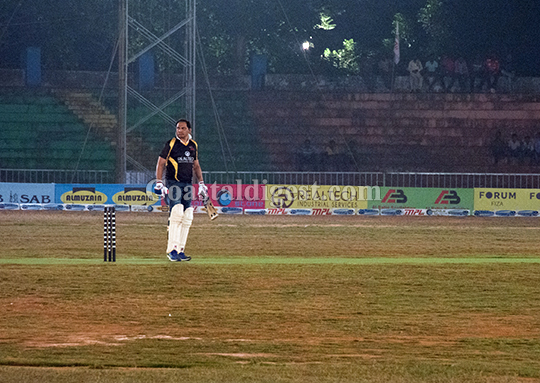
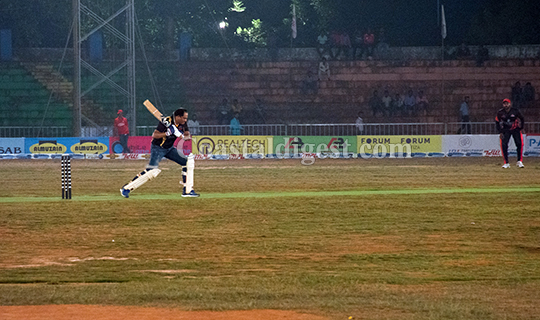
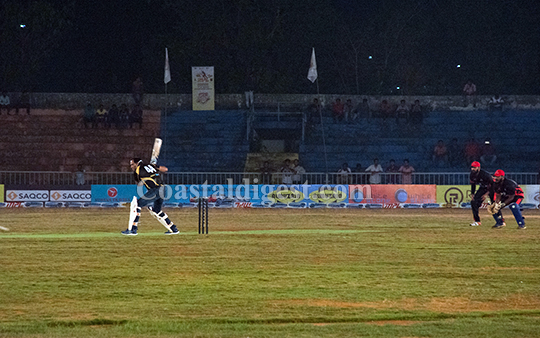
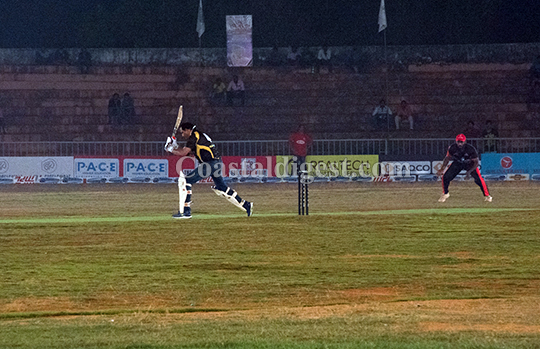
Mangaluru, Dec 18: Former Indian captain Mohammed Azharuddin, who entered the cricket field after several years, on Saturday hit a stylish 28 runs from 18 balls against the Coastalwood XI.

match 9

The 53-year-old legend padded up for an exhibition match and led Azhar XI after the formal opening ceremony of the Mangalore Premiere League 2016 at Dr Ambedkar ground, Panambur, Mangaluru.

The Azhar XI comprised of a players handpicked by Karnataka Regional Cricket Academy, which is organizing the third edition of MPL.

Azhar won the toss and opted for batting. However, after facing 18 balls, Azhar decided to return to dugout by retiring. Azhar XI scored 126 runs.

However, Coastalwood XI led by Tulu actor Arjun Kapikad, gave a good show. Thanks to the opener Suhan's 46 (not out), the cine stars' team managed to chase the target and win the match by six wickets.

Prior to the match, addressing the gathering at the inaugural ceremony of MPL, Azhar had said that he had not touched the bat for a long time.

Also Read: MPL 2016 off to dazzling start as Azhar spreads cricket fever in Mangaluru

match 8

matchN 3

match 1

match 2

match 3

match 4

match 5

match 6

match 7

matchN 1

matchN 2

azaruddin 1

azaruddin 2

azaruddin 3

azaruddin 4

azaruddin 5

azaruddin 6

azaruddin 7

azaruddin 8

Comments

imtiaz
 - 
Monday, 19 Dec 2016

most stylish player ....we r lucky to have witnessed d game of this GREAT LEGEND,,,,,,

Add new comment

  • Coastaldigest.com reserves the right to delete or block any comments.
  • Coastaldigset.com is not responsible for its readers’ comments.
  • Comments that are abusive, incendiary or irrelevant are strictly prohibited.
  • Please use a genuine email ID and provide your name to avoid reject.
News Network
April 27,2020

Bengaluru, Apr 27: Former Prime Minister H D Deve Gowda on Monday demanded that the Karnataka government announce a special package for farmers who are on the verge of quitting agriculture as their profession following losses due to the COVID-19 pandemic.

"Please announce special package for the farmers to bail them out of the loss due to the lockdown.

Drop many of the schemes in the budget but don't leave the farmers in distress," Gowda said in his letter to Chief Minister B S Yediyurappa.

The JD(S) supremo said the way relief has been announced for the milk producers by procuring the unsold milk and distributing it to the slum dwellers, the same assistance should be provided to the farmers of the state.

"If you don't come forward to assist the farmers, then they will be forced to sell their land," Gowda cautioned the Chief Minister.

The former prime minister said the farmers are on the verge of falling in the debt trap and may be compelled to take the extreme step of suicide due to the losses.

Gowda said the farmers are unable to sell their crop because they are not getting proper price for their produce and are selling their crop at a throwaway price to minimise their losses.

"In just one month farmers reached the brink of bankruptcy as they are unable to sell the standing crops in lakhs of acres of land," Gowda said.

The JD(S) supremo has been championing the cause of farmers in the state and highlighting their sufferings.

On April 3 Gowda has appealed to Prime Minister Narendra Modi to look into the plight of farmers, labourers and the middle class people due to the lockdown.

"In such times of crisis, we should see to it that there is no disruption in farming activities by ensuring proper marketing channels to agricultural produce, especially perishables.

Only then we can sustain our long battle against this pandemic," Gowda said in a tweet.

Comments

Add new comment

  • Coastaldigest.com reserves the right to delete or block any comments.
  • Coastaldigset.com is not responsible for its readers’ comments.
  • Comments that are abusive, incendiary or irrelevant are strictly prohibited.
  • Please use a genuine email ID and provide your name to avoid reject.
Media Release
March 12,2020

Manipal, Mar 12: Team WGSHA is proud to announce that the culinary museum in WGSHA has been listed in Limca Book of Records as India's First Living Culinary Arts Museum.

Limca Book of Records (LBR) is a catalogue of achievements made by Indians, at home and abroad in diverse fields of human endeavour. LBR is a celebration of exemplary exploits and recognizes accomplishments such as firsts, inventions, discoveries, honours, awards and the truly extraordinary.

Chef Thirugnanasambantham, Principal of WGSHA, while thanking MAHE and ITC Leadership for extending all support towards instituting this museum in Manipal and WGSHA, also appreciated and thanked all those who have directly or indirectly helped towards setting up this museum in Manipal.

"The process for WGSHA's culinary museum to make an entry into the popular Limca Book of Records started almost six months back and after validation by LBR recently, has been listed in the book of records. We are glad that we could be the first of its kind in such endeavour and we also hope to be in Guinness World Records soon", said Chef Thiru.

"We are indeed grateful to Michelin-starred Indian celebrity Chef Vikas Khanna, the founder and curator of this museum, who had this idea of establishing a culinary museum and donated thousands of kitchen tools and equipment worth millions of dollars to this museum for preserving the history of India's rich tradition of culinary arts and to educate the future generations. Chef Vikas Khanna, 'Distinguished Alumnus' of WGSHA, being very desirous of making such a museum in India, what better place it would be than in his own Alma Mater!", he said on the background of having the museum.

Chef Thiru mentioned that Udupi, popular for the famous 'Udupi Cuisine', and being a temple town, is adjacent to International University Town of Manipal Academy of Higher Education (MAHE).

MAHE is home to thousands of international students and visitors. With a great heritage of Udupi, combined with the large number of Indian and International students residing in and around Manipal, it was very apt for the college to create a museum for today's Indian youth and the International visitors to understand the rich culinary heritage of India, through the priceless kitchen tools and equipment donated by Chef Vikas Khanna.

"Has placed WGSHA in the global culinary map and we are proud to have joined all such efforts to preserve the history of cuisines and cultures across the world", said Chef Thiru.

The culinary art academic block housing the museum was opened in April 2018, spread approximately over 25,000 sq ft and is shaped in the form of a giant pot very similar to the ones found in Harappa.

There are historical as well as regular household items such as plates made by the Portuguese in India, a 100-year-old ladle used to dole out food at temples and bowls dating to the Harappan era, an old seed sprinkler, an ancient Kashmiri tea brewer known as 'samovar', vessels from the Konkan, Udupi and Chettinad regions, apart from a large collection of rolling pins, utensils of all shapes and sizes, tea strainers of different types etc.

Comments

Add new comment

  • Coastaldigest.com reserves the right to delete or block any comments.
  • Coastaldigset.com is not responsible for its readers’ comments.
  • Comments that are abusive, incendiary or irrelevant are strictly prohibited.
  • Please use a genuine email ID and provide your name to avoid reject.
Agencies
May 8,2020

Washington D.C., May 8: The prime time for brain development in a child's life is the first year, where the infant spends most of the time asleep. It is the time when neural connections form and sensory memories are encoded.

However, when sleep is disrupted, as occurs more often among children with autism, brain development may be affected, too.

New research led by the University of Washington finds that sleep problems in a baby's first 12 months may not only precede an autism diagnosis but also may be associated with altered growth trajectory in a key part of the brain, the hippocampus.

The study, which was published in the American Journal of Psychiatry, researchers report that in a sample of more than 400 taken of 6- to 12-month-old infants, those who were later diagnosed with autism were more likely to have had difficulty falling asleep.

It also states that this sleep difficulty was associated with altered growth trajectories in the hippocampus.

"The hippocampus is critical for learning and memory, and changes in the size of the hippocampus have been associated with poor sleep in adults and older children.

As many as 80 per cent of the children with autism spectrum disorder have sleep problems," said Annette Estes, director of the UW Autism Center and senior author of the study.

"In our clinical experience, parents have a lot of concerns about their children's sleep, and in our work on early autism intervention, we observed that sleep problems were holding children and families back," added Estes, who is also a UW professor of speech and hearing sciences.

"It could be that altered sleep is part-and-parcel of autism for some children. One clue is that behavioural interventions to improve sleep don't work for all children with autism, even when their parents are doing everything just right. This suggests that there may be a biological component to sleep problems for some children with autism," said Estes.

To consider links among sleep, brain development, and autism, researchers at the IBIS Network looked at MRI scans of 432 infants, surveyed parents about sleep patterns, and measured cognitive functioning using a standardized assessment.

At the outset of the study, infants were classified according to their risk for developing autism: Those who were at higher risk of developing autism -- about two-thirds of the study sample -- had an older sibling who had already been diagnosed.

Infant siblings of children with autism have a 20 per cent chance of developing autism spectrum disorder -- a much higher risk than children in the general population.

In the current study, 127 of the 432 infants were identified as "low risk" at the time the MRI scans were taken because they had no family history of autism.

They later evaluated all the participants at 24 months of age to determine whether they had developed autism. Of the roughly 300 children originally considered "high familial risk," 71 were diagnosed with autism spectrum disorder at that age.

Problems with sleep were more common among the infants later diagnosed with an autism spectrum disorder, as were larger hippocampi. No other subcortical brain structures were affected, including the amygdala, which is responsible for certain emotions and aspects of memory, or the thalamus, a signal transmitter from the spinal cord to the cerebral cortex.

The authors note that while parents reported more sleep difficulties among infants who developed autism compared to those who did not, the differences were very subtle and only observed when looking at group averages across hundreds of infants.

Sleep patterns in the first years of life change rapidly as infants transition from sleeping around the clock to a more adult-like sleep/wake cycle. Until further research is completed, Estes said, it is not possible to interpret challenges with sleep as an early sign of increased risk for autism.


Comments

Add new comment

  • Coastaldigest.com reserves the right to delete or block any comments.
  • Coastaldigset.com is not responsible for its readers’ comments.
  • Comments that are abusive, incendiary or irrelevant are strictly prohibited.
  • Please use a genuine email ID and provide your name to avoid reject.