Coastalwood XI win MPL exhibition match; Azharuddin wins hearts

[email protected] (CD Network | Satheesh)
December 18, 2016

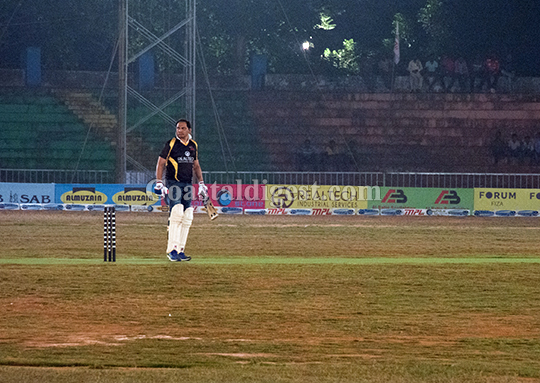
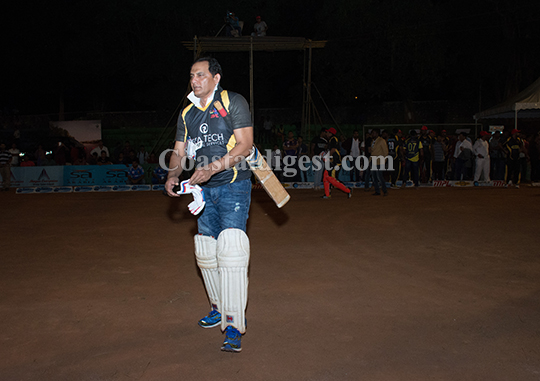
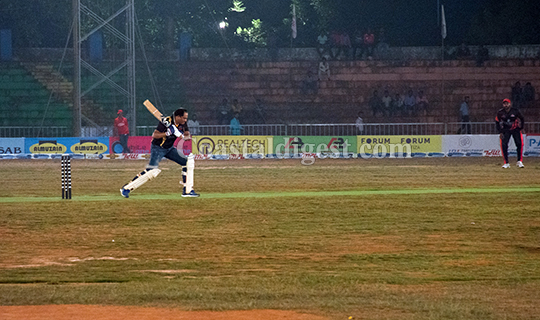
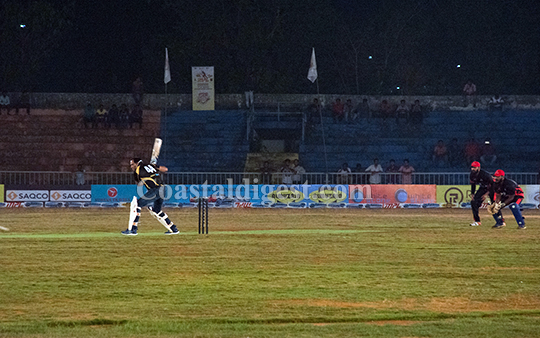
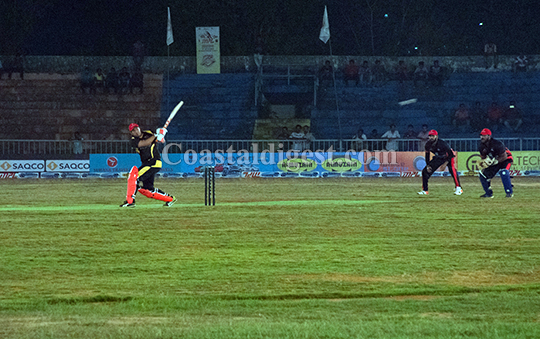
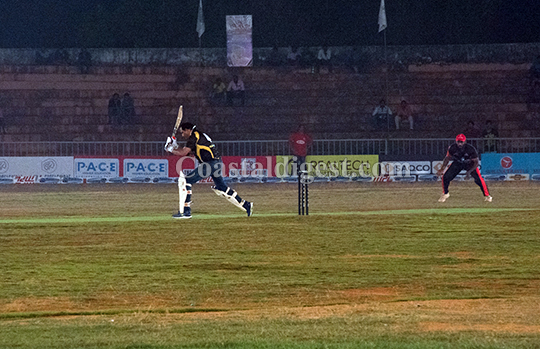
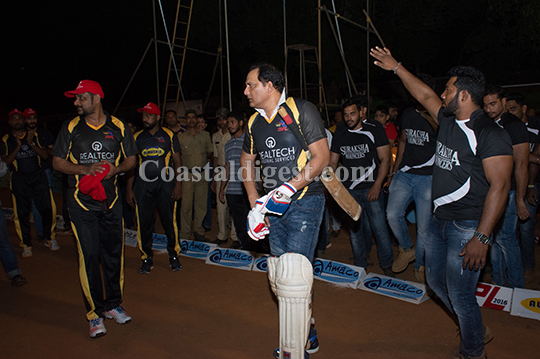
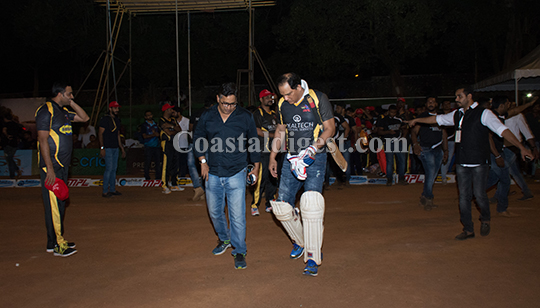
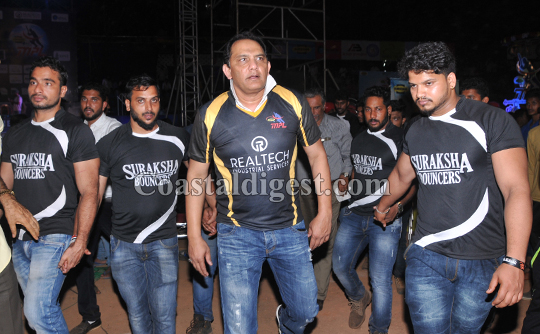
Mangaluru, Dec 18: Former Indian captain Mohammed Azharuddin, who entered the cricket field after several years, on Saturday hit a stylish 28 runs from 18 balls against the Coastalwood XI.

match 9

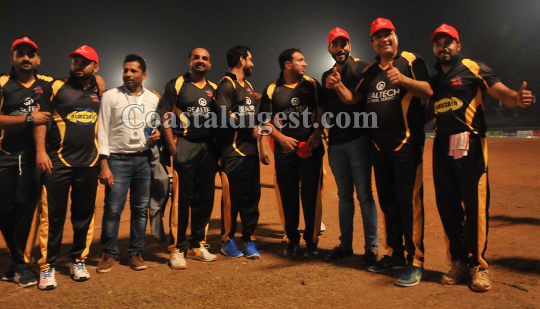
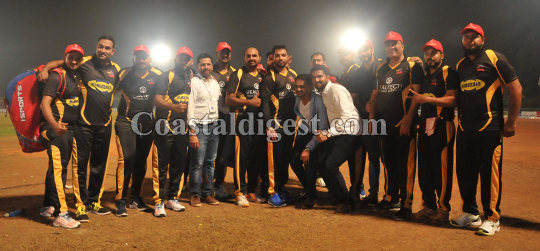
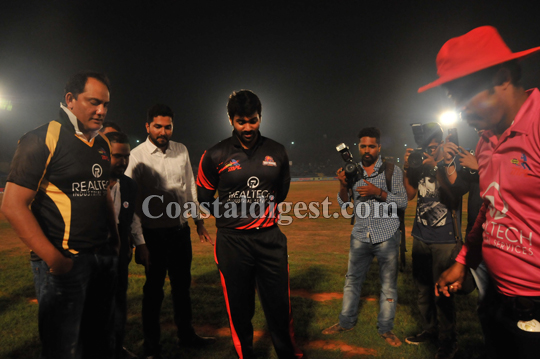
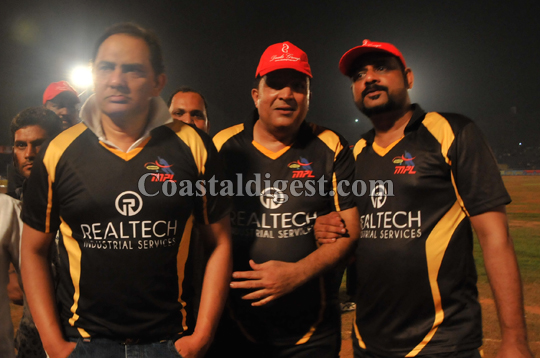
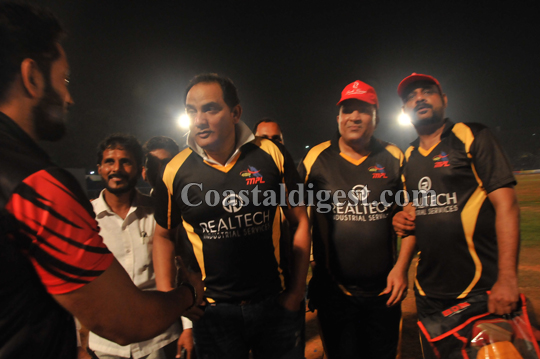
The 53-year-old legend padded up for an exhibition match and led Azhar XI after the formal opening ceremony of the Mangalore Premiere League 2016 at Dr Ambedkar ground, Panambur, Mangaluru.

The Azhar XI comprised of a players handpicked by Karnataka Regional Cricket Academy, which is organizing the third edition of MPL.

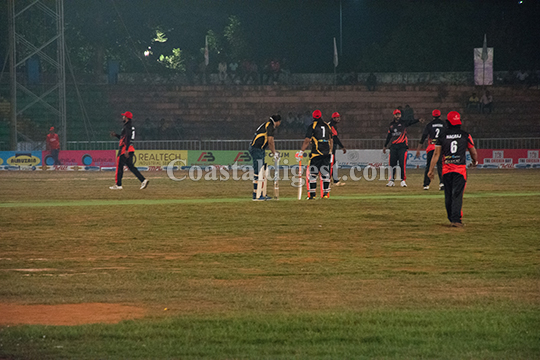
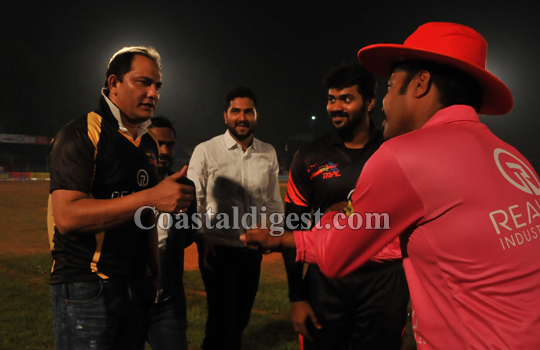
Azhar won the toss and opted for batting. However, after facing 18 balls, Azhar decided to return to dugout by retiring. Azhar XI scored 126 runs.

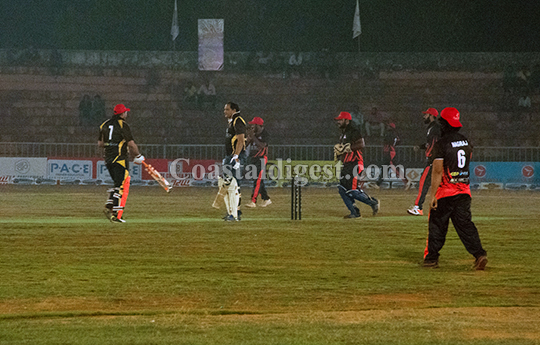
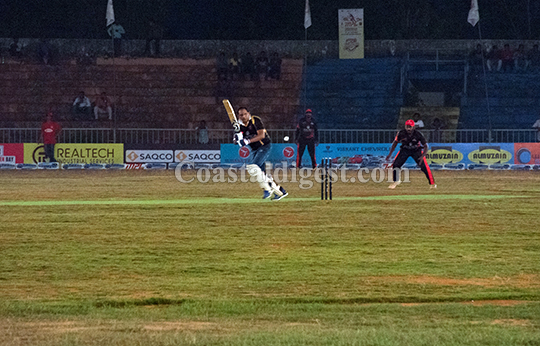
However, Coastalwood XI led by Tulu actor Arjun Kapikad, gave a good show. Thanks to the opener Suhan's 46 (not out), the cine stars' team managed to chase the target and win the match by six wickets.

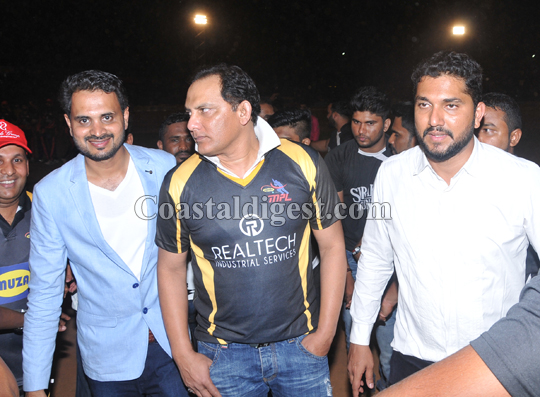
Prior to the match, addressing the gathering at the inaugural ceremony of MPL, Azhar had said that he had not touched the bat for a long time.

Also Read: MPL 2016 off to dazzling start as Azhar spreads cricket fever in Mangaluru

match 8

matchN 3

match 1

match 2

match 3

match 4

match 5

match 6

match 7

matchN 1

matchN 2

azaruddin 1

azaruddin 2

azaruddin 3

azaruddin 4

azaruddin 5

azaruddin 6

azaruddin 7

azaruddin 8

Comments

imtiaz
 - 
Monday, 19 Dec 2016

most stylish player ....we r lucky to have witnessed d game of this GREAT LEGEND,,,,,,

Add new comment

  • Coastaldigest.com reserves the right to delete or block any comments.
  • Coastaldigset.com is not responsible for its readers’ comments.
  • Comments that are abusive, incendiary or irrelevant are strictly prohibited.
  • Please use a genuine email ID and provide your name to avoid reject.
News Network
July 17,2020

Bengaluru, Jul 17: The Karnataka State Board of AUQAF has ordered that management committees at Muslim Khabarastans, shall not refuse burial to Muslims died due to COVID-19.

"...in exercise the powers conferred under Waqf Act 1995, it is hereby ordered that management Committees/Muthawallies/Administrators responsible for the management of Muslim Khabarastans in the state of Karnataka irrespective of registered or unregistered in the Waqf, shall not refuse the burial of Muslims died due to COVID-19 pandemic," read an order from the Karnataka State Board of AUQAF on Thursday.

"They shall co-operate with all the Nodal Officers designated for this purpose regarding the decent burial. Non co-operation or refusal on the part of the management will be construed as an insult committed to the deceased. Any violation of the above order will attract the punitive provision of Indian Penal Code and removal from the management as per the provisions of the Waqf Act 1995," the order read.

It further said that the Waqf Officers, District Wakf Advisory Committees of the state, shall ensure the adherence of this order, and circulate the same to all the Khabarastan managements, registered or unregistered in the state.

"No further deliberation in this regard is solicited except compliance of the order in letter and spirit. Any dereliction in this regard will be viewed seriously," it read.

Giving a background on the issue of burial of COVID-19 deceased, the order read, "It is observed that, number of deaths are being occurred in various Districts of Karnataka, due to COVID-19 pandemic and it is reported that, some of the management committees of Khabarastan, are not cooperating to bury the dead bodies of COVID-19."

"A decent burial is a right of the dead person" as per the law of the land and the Islamic jurisprudence. It is needless to emphasize the importance of burial of Muslim dead bodies in Shariah. The dead body of a Muslim is treated with the utmost respect by the Ummah, joining in the funeral (Tadfeen), participating in the Namaz-e-Janaza and the burial are considered as Farz-e-Kifaya in Muslim law. According to the tradition of Islam, the person who participates in the funeral is entitled to Mountain sized reward (Sawaab)," the order read.

As per the order, the board, in its earlier circular had also cautioned the management of Waqf institutions and Khabarastan which were reluctant to allow the decent burial in the Khabarastan would be punished under the provisions of Indian Penal Code and the punitive provisions of the Waqf Act 1995 as well.

"The District Magistrates and the Superintendent of Police in the districts have been requested to prosecute the erring management committees who are responsible for non co-operation in this regard. Hence, the following order," it added.

Comments

Add new comment

  • Coastaldigest.com reserves the right to delete or block any comments.
  • Coastaldigset.com is not responsible for its readers’ comments.
  • Comments that are abusive, incendiary or irrelevant are strictly prohibited.
  • Please use a genuine email ID and provide your name to avoid reject.
News Network
March 27,2020

Bengaluru, Mar 27: A 65-year-old coronavirus patient who died in Karnataka this morning after apparently contracting the infection on a train ride has raised concern about community transmission of the highly contagious disease.
The man, the 60th coronavirus patient in Karnataka, died in Tumakuru. It is not known for certain how he caught the virus. The Karnataka Health Department has posted a notice on Twitter asking whoever travelled with him on train to come forward.

He had no history of recent foreign travel but had apparently traveled to Delhi on March 5 by Sampark Kranti Express and returned on March 11.

On March 7, he arrived at Delhi's Nizamuddin station and participated in an event at Jamia Masjid.

The man took a train back on March 11 and arrived at Yeshwantpur in Bengaluru. From there, he took a bus on March 14 to his hometown Sira.

He first showed symptoms of COVID-19 on March 18 and was taken to a private hospital. He was sent home with medicines but his condition worsened.

On March 23, he was admitted to a district hospital, but checked himself out against all advice and went to a private hospital. When his health showed signs of deterioration, he was again sent to the district hospital, where he tested positive for coronavirus yesterday. He died around 10.30 am today.

The health department has since traced 24 people who came in direct contact with him and are so, in the high-risk category. Thirteen are in hospital and eight have tested negative.

"All passengers who had travelled with him on the train are being traced," K Rakesh Kumar, Deputy Commissioner, Tumakuru, was quoted as telling news agency ANI.

A 70-year old woman and a 76-year old man had died of coronavirus or COVID-19 earlier in Karnataka.

India has over 700 coronavirus cases, including 17 deaths.

Comments

Add new comment

  • Coastaldigest.com reserves the right to delete or block any comments.
  • Coastaldigset.com is not responsible for its readers’ comments.
  • Comments that are abusive, incendiary or irrelevant are strictly prohibited.
  • Please use a genuine email ID and provide your name to avoid reject.
Ram Puniyani
June 29,2020

In Minneapolis, US an African American, George Floyd lost his life as the white policeman, Derek Chauvin, caught hold of him and put his knee on his neck. This is a technique developed by Israel police. For nine long minutes the knee of the while policeman was on the neck of George, who kept shouting, I can’t breathe.

Following this gruesome murder America erupted with protests, ‘Black lives matter’. The protestors were not just African Americans but also a large section of whites. Within US one police Chief apologized for the act of this. In a touching gesture of apology the police force came on its knees. This had reverberations in different parts of the World.

The act was the outcome of the remnants of the racial hatred against blacks by the whites. It is the hatred and the perceptions which are the roots of such acts of violence. What was also touching that the state of democracy in US is so deep that even the police apologized, the nation, whites and blacks, stood up as a sensitive collective against this violence.

US is not the only country where the brutal acts of violence torment the marginalized sections of society. In India there is a list of dalits, minorities and adivasis who are regularly subjected to such acts. But the reaction is very different. We have witnessed the case of Tabrez Ansari, who was tied to the pole by the mob and beaten ruthlessly. When he was taken to police station, police took enough time to take him to hospital and Tabrez died.

Mohsin Sheikh, a Pune techie was murdered by Hindu Rashtra Sena mob, the day Modi came to power in 2014. Afrazul was killed by Shambhulal Regar, videotaped the act released on social media. Regar believed that Muslims are indulging in love Jihad, so deserve such a fate. Mohammad Akhlaq is one among many names who were mob lynched on the issue of beef cow. The list can fill pages after pages.

Recently a young dalit boy was shot dead for the crime of entering a temple. In Una four dalits were stripped above waste and beaten mercilessly. Commenting on this act the Union Minister Ramvilas Paswan commented that it is a minor incident. Again the list of atrocities against dalits is long enough. The question is what Paswan is saying is the typical response to such gruesome murders and tortures. In US loss of one black life, created the democratic and humane response. In India there is a general silence in response to these atrocities. Some times after a good lapse of time, the Prime Minister will utter, ‘Mother Bharati has lost a son’. Most of the time victim is blamed. Some social groups raise their voice in some fora but by and large the deafening silence from the country is the norm.

India is regarded as the largest democracy. Democracy is the rule of law, and the ground on which the injustices are opposed. In America though the present President is insensitive person, but its institutions and processes of democratic articulations are strong. The institutions have deepened their roots and though prejudices may be guiding the actions of some of the officers like the killer of George, there are also police officers who can tell their President to shut up if he has nothing meaningful to say on the issue. The prejudices against Blacks may be prevalent and deep in character, still there are large average sections of society, who on the principles of ‘Black lives matter’. There are large sections of vocal population who can protest the violation of basic norms of democracy and humanism.

In India by contrast there are multiple reasons as to why the lives of Tabrez Ansari, Mohammad Akhlaq, Una dalit victims and their likes don’t matter. Though we claim that we are a democracy, insensitivity to injustices is on the rise. The strong propaganda against the people from margins has become so vicious during last few decades that any violence against them has become sort of a new normal. The large populace, though disturbed by such brutalities, is also fed the strong dose of biases against the victims. The communal forces have a great command over effective section of media and large section of social media, which generates Hate against these disadvantaged groups, thereby the response is muted, if at all.

As such also the process of deepening of our democracy has been weak. Democracy is a dynamic process; it’s not a fixed entity. Decades ago workers and dalits could protest for their rights. Now even if peasants make strong protests, dominant media presents it as blocking of traffic! How the roots of democracy are eroded and are visible in the form where the criticism of the ruling dispensation is labelled as anti National..

Our institutions have been eroded over a period of time, and these institutions coming to the rescue of the marginalized sections have been now become unthinkable. The outreach of communal, divisive ideology, the ideology which looks down on minorities, dalits and Adivasis has risen by leaps and bounds.

The democracy in India is gradually being turned in to a hollow shell, the rule of law being converted in to rule of an ideology, which does not have faith in Indian Constitution, which looks down upon pluralism and diversity of this country, which is more concerned for the privileges of the upper caste, rich and affluent. The crux of the matter is the weak nature of democracy, which was on way to become strong, but from decades of 1980s, as emotive issues took over, the strength of democracy started dwindling, and that’s when the murders of the types of George Floyd, become passé. One does complement the deeper roots of American democracy and its ability to protect the democratic institutions, which is not the case in India, where protests of the type, which were witnessed after George Floyd’s murder may be unthinkable, at least in the present times. 

Comments

Add new comment

  • Coastaldigest.com reserves the right to delete or block any comments.
  • Coastaldigset.com is not responsible for its readers’ comments.
  • Comments that are abusive, incendiary or irrelevant are strictly prohibited.
  • Please use a genuine email ID and provide your name to avoid reject.