


College to jail in bomb case: How cops destroyed 12 yrs of his youth

February 18, 2017

New Delhi, Feb 18: Mohammad Rafiq Shah was a student of MA (final) at Shah-i-Hamadan, Institute of Islamic Studies, University of Kashmir, Srinagar, when on the midnight of November 21, 2005, his world plunged into darkness.
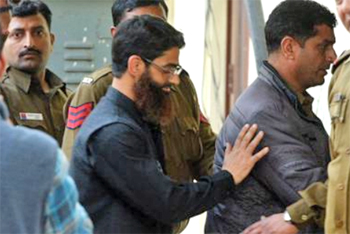
youthHe was picked up by officials of Delhi Police's special cell and Special Task Force (STF) of Kashmir Police.Two days later - after allegedly subjecting him to torture and humiliation at an STF camp - they brought him to Delhi. His crime: he was alleged to have planted a bomb in a DTC bus in Govindpuri on October 29, 2005, which injured many people.

Twelve years later, when he walked free on Thursday - after additional sessions judge Reetesh Singh acquitted him of all charges - the police were facing serious questions of credibility and human rights violations. Rafiq's claim that "he was made an accused to assuage the public perception that Delhi Police was incompetent to act against terrorism" and that "he was a vulnerable target... made a scapegoat" rang true. Police, it seems, deliberately ignored his alibi at every step to prove their case . They brushed aside his plea that it could be proved he was in his class on the day of the blast. It relied on dubious witness es who ended up contradicting themselves, exposed Rafiq to many people when he was in custody before a test identification parade (TIP) could be conducted and suppressed inconvenient facts.

TOI had as early as on February 12, 2006, raised the question whether it "could be a case of harried cops under pressure to show results, targeting an innocent boy?" In a front-page report, "Delhi bomber was in class on October 29", we had reported that Rafiq was actually attending his MA classes in his college in Srinagar. It was also reported that Rafiq had refused to appear for TIP as he had already been presented before some people, one of whom could be a witness in the Govindpuri blast.

The ground had been laid in Srinagar where Rafiq -according to his reply during framing of charges on January 21, 2008 which was cited by the judge - was allegedly forced to drink urine, kept naked and sexually abused, all in order to perhaps break his spirit. He had also alleged that rats were put in his trousers and attempts made to hurt his religious sentiments. "It seems I am being victimised only because I am a Kashmiri Muslim," he said, expressing his faith that justice would prevail and the police get exposed.

The court drew attention to Supreme Court's observation that when it comes to the notice of the investigating agency that a person accused of an offence has a good alibi, then it is the duty of that agency to investigate the genuineness of the plea of alibi and submit a report to the magistrate. "In the case of Manu Sharma versus the State (NCT) of Delhi....Supreme Court had observed that the criminal justice administration system in India places human rights and dignity for human life on a much higher pedestal. An accused is presumed to be innocent till proved guilty and is entitled to fairness and true investigation and a fair trial. The prosecution is expected to play a balanced role in the trial of crime and the investigation should be judicious, fair, transparent and expeditious to ensure compliance with the basic rule of law," the court asserted. Rafiq's case failed on all counts.

First Delhi Police produced a witness, Danbir Sharma, one of the passengers in the bus, on the basis of whose description, they got a portrait made. However, Sharma later couldn't identify Rafiq. The portrait then disappeared mysteriously - pointed out by the judge - even as another witness, Rajeev Sinha, surfaced.

His and Sharma's description of the bomber were at variance. Singh described the bomber as a young man, 22-24 years of age with a French-cut beard and prominent nose, who was wearing a cap with `New York' written on the right. He said he was wearing a white shirt with grey stripes and cotton trousers, either blue or black. Sharma, however, said the bomber was a boy of 5 feet, 10 inches height and had `sanwla' complexion. According to him, he was wearing a `coca cola' coloured shirt and white trousers.

The defence later claimed that Rafiq had a full-grown beard when he was arrested. It was alleged that on November 25, 2005, inspector Badrish Dutt brought a barber to the special cell office and got his beard trimmed to resemble a French cut. He then took a photo of his on his cellphone.

Significantly , Rafiq had refused to participate in a TIP on the ground that he had been exposed to many people while in custody at Lodi Colony and his photographs taken. He particularly mentioned a man wearing spectacles with his lawyers later alleging in court that it was Sinha, a planted witness. Sinha later accepted that he wore spectacles.

Sinha had produced a ticket to prove his presence on the bus that day . This had been left unverified by the police for long though it could have checked its authenticity with the depot manager and the registers he maintained quite easily. It chose not to do so.

The police wrote to the Registrar, University of Kashmir, on February 17, 2006, regarding verification of admission and attendance of Rafiq but chose to forget about it in court. Later, it was claimed that because of vacations, the information could not be procured from the university . However, the judge saw through the charade. DCP S K Tewari had on February 27 - just 10 days after writing the first letter - asked the Registrar "Whether " A" or "P" is marked in the attendance register of the class?" The court said this question could not have been put to the Registrar unless Tewari had access to the attendance records - the ones later produced by the defence and seen by the court - and hence the vacation plea for not being able to verify Rafiq's presence "seems to be false".The court said that in all probability the records had been collected by the police.

The police claimed the other accused, Mohammad Hussain Fazili - who too was acquitted - had led them to Rafiq. Rafiq, however, told the court that he met Fazili for the first time on November 21, 2005, at the STF camp. Fazili, too, denied taking the cops to Rafiq and claimed he was himself misled into believing by inspector Badrish Dutt that he was wanted in connection with an inquiry in a case under the Wildlife Protection Act. He too ended up in jail for 12 years.

Comments

Abdul Aziz
 - 
Saturday, 18 Feb 2017

No need to worry
Allah Almighty has his own plans to deal with injustice people
that day no one can rescue from the everlasting pain and torture

its true
since Truth will prevail and evil will perish

TRUTH
 - 
Saturday, 18 Feb 2017

The evil authorities or those authorities who do such evil acts think that they will getaway from their evil crimes... We Muslims believe, if we dont get justice here... We will surely get the justice in the Court of the lord of the worlds... Allah is just and he will give justice one day... That day the evil people will REGRET and their punishment will be permanent unless they REPENT in this world and help the society to become and stand with the TRUTH...

Shaad
 - 
Saturday, 18 Feb 2017

Without proof and knowingly they kept youth in jail for nothing and with all the proof and clear cut of involvement of Prajna singh, she gets bail.

Waav, incredible law, handler and our ruler.

Add new comment

  • Coastaldigest.com reserves the right to delete or block any comments.
  • Coastaldigset.com is not responsible for its readers’ comments.
  • Comments that are abusive, incendiary or irrelevant are strictly prohibited.
  • Please use a genuine email ID and provide your name to avoid reject.
coastaldigest.com news network
June 21,2020

Udupi, June 21: An entrepreneur lost his life after the car he was driving veered off the road and plunged into a roadside tank near Barkuru in Brahmavar taluk of Udupi district today.

The deceased has been identified as Santosh Shetty, a resident of Vakwadi in Kundapur taluk. He is the proprietor of Laxmi Glass and Plywood, Koteshwara. 

A woman, identified as Shweta, who was also on board the car suffered critical injuries.  

The mishap occurred when the duo was heading to Vakwadi from Brahmavar in Hyundai Car sedan car. 

Shetty lost control over his vehicle while negotiating a curve at Chaulikere and the car plunged off the road as there was no barricade. 

Even though local residents began rescue operation immediately, Shetty breathed his last on the spot. Shweta was rescued and shifted to a hospital in Manipal for treatment.

Comments

Add new comment

  • Coastaldigest.com reserves the right to delete or block any comments.
  • Coastaldigset.com is not responsible for its readers’ comments.
  • Comments that are abusive, incendiary or irrelevant are strictly prohibited.
  • Please use a genuine email ID and provide your name to avoid reject.
Ram Puniyani
February 22,2020

This January 2020, it is thirty years since the Kashmiri Pundits’ exodus from the Kashmir valley took place. They had suffered grave injustices, violence and humiliation prior to the migration away from the place of their social and cultural roots in Kashmir Valley. The phenomenon of this exodus had been due to the communalization of militancy in Kashmir in the decade of 1980s. While no ruling Government has applied itself enough to ‘solve’ this uprooting of pundits from their roots, there are communal elements who have been aggressively using ‘what about Kashmiri Pundits?’, every time liberal, human rights defenders talk about the plight of Muslim minority in India. This minority is now facing an overall erosion of their citizenship rights.

Time and over again in the aftermath of communal violence in particular, the human rights groups have been trying to put forward the demands for justice and rehabilitation of the victim minority. Instead of being listened to those particularly from Hindu nationalist combine, as a matter of routine shout back, where were you when Kashmiri Pundits were driven away from the Valley? In a way the tragedy being heaped on one minority is being justified in the name of suffering of Pundits and in the process violence is being normalized. This sounds as if two wrongs make a right, as if the suffering Muslim minority or those who are trying to talk in defense of minority rights have been responsible for the pain of Kashmiri Pundits.

During these three, many political formations have come to power, including BJP, Congress, third front and what have you. To begin with when the exodus took place Kashmir was under President’s rule and V. P. Singh Government was in power at the center. This Government had the external support of BJP at that time. Later BJP led NDA came to power for close to six years from 1998, under the leadership of Atal Bihari Vajpayee. Then from 2014 it is BJP, with Narerda Modi as PM, with BJP brute majority is in power. Other components of NDA are there to enjoy some spoils of power without any say in the policies being pursued by the Government. Modi is having absolute power with Amit Shah occasionally presenting Modi’s viewpoints.

Those blurting, ‘what about Kashmiri Pundits?’ are using it as a mere rhetoric to hide their communal color. The matters of Kashmir are very disturbing and cannot be attributed to be the making of Indian Muslims as it is being projected in an overt and subtle manner. Today, of course the steps taken by the Modi Government, that of abrogation of Article 370, abolition of clause 35 A, downgrading the status of Kashmir from a state to union territory have created a situation where the return of Kashmiri Pundits may have become more difficult, as the local atmosphere is more stifling and the leaders with democratic potential have been slapped with Public Safety Act, where they can be interned for long time without any answerability to the Courts. The internet had been suspended, communication being stifled in an atmosphere where democratic freedoms are curtailed which makes solution of any problem more difficult.

Kashmir has been a vexed issue where the suppression of the clause of autonomy, leading to alienation led to rise of militancy. This was duly supported by Pakistan. The entry of Al Qaeda elements, who having played their role against Russian army in 1980s entered into Kashmir and communalized the situation in Kashmir. The initial Kashmir militancy was on the grounds of Kashmiriyat. Kashmiriyat is not Islam, it is synthesis of teachings of Buddha, values of Vedant and preaching’s of Sufi Islam. The tormenting of Kashmiri Pundits begins with these elements entering Kashmir.

Also the pundits, who have been the integral part of Kashmir Valley, were urged upon by Goodwill mission to stay on, with local Muslims promising to counter the anti Pundit atmosphere. Jagmohan, the Governor, who later became a minister in NDA Government, instead of providing security to the Pundits thought, is fit to provide facilities for their mass migration. He could have intensified counter militancy and protected the vulnerable Pundit community. Why this was not done?

Today, ‘What about Kashmiri Pundits?’ needs to be given a serious thought away from the blame game or using it as a hammer to beat the ‘Muslims of India’ or human rights defenders? The previous NDA regime (2014) had thought of setting up enclosures of Pundits in the Valley. Is that a solution? Solution lies in giving justice to them. There is a need for judicial commission to identify the culprits and legal measures to reassure the Pundit community. Will they like to return if the high handed stifling atmosphere, with large number of military being present in the area? The cultural and religious spaces of Pundits need to be revived and Kashmiryat has to be made the base of any reconciliation process.

Surely, the Al Qaeda type elements do not represent the alienation of local Kashmiris, who need to be drawn into the process of dialogue for a peaceful Kashmir, which is the best guarantee for progress in this ex-state, now a Union territory. Communal amity, the hallmark of Kashmir cannot be brought in by changing the demographic composition by settling outsiders in the Valley. A true introspection is needed for this troubled area. Democracy is the only path for solving the emigration of Pundits and also of large numbers of Muslims, who also had to leave the valley due to the intimidating militancy and presence of armed forces in large numbers. One recalls Times of India report of 5th February 1992 which states that militants killed 1585 people from January 1990 to October 1992 out of which 982 were Muslims and 218 Hindus.

We have been taking a path where democratic norms are being stifled, and the promises of autonomy which were part of treaty of accession being ignored. Can it solve the problem of Pundits?

Comments

Add new comment

  • Coastaldigest.com reserves the right to delete or block any comments.
  • Coastaldigset.com is not responsible for its readers’ comments.
  • Comments that are abusive, incendiary or irrelevant are strictly prohibited.
  • Please use a genuine email ID and provide your name to avoid reject.
News Network
March 13,2020

Bengaluru, Mar 13: District administration in Kalaburagi, where the first death in India due to COVID-19 was reported, has identified over 25 people, who come close to the deceased and quarantined for observation, Minister for Health B Sreeramulu said on Friday.

In reply to a debate on the issue during Zero Hour of the Legislative Assembly, the Health Minister said that two members of the victim’s family and 23 others are suspected of COVID-19.

Mr. Sreeramulu said all the schools of the district have been as a preventive measure to contain the deadly virus.

Comments

Add new comment

  • Coastaldigest.com reserves the right to delete or block any comments.
  • Coastaldigset.com is not responsible for its readers’ comments.
  • Comments that are abusive, incendiary or irrelevant are strictly prohibited.
  • Please use a genuine email ID and provide your name to avoid reject.