


College to jail in bomb case: How cops destroyed 12 yrs of his youth

February 18, 2017

New Delhi, Feb 18: Mohammad Rafiq Shah was a student of MA (final) at Shah-i-Hamadan, Institute of Islamic Studies, University of Kashmir, Srinagar, when on the midnight of November 21, 2005, his world plunged into darkness.
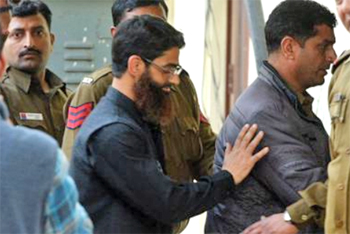
youthHe was picked up by officials of Delhi Police's special cell and Special Task Force (STF) of Kashmir Police.Two days later - after allegedly subjecting him to torture and humiliation at an STF camp - they brought him to Delhi. His crime: he was alleged to have planted a bomb in a DTC bus in Govindpuri on October 29, 2005, which injured many people.

Twelve years later, when he walked free on Thursday - after additional sessions judge Reetesh Singh acquitted him of all charges - the police were facing serious questions of credibility and human rights violations. Rafiq's claim that "he was made an accused to assuage the public perception that Delhi Police was incompetent to act against terrorism" and that "he was a vulnerable target... made a scapegoat" rang true. Police, it seems, deliberately ignored his alibi at every step to prove their case . They brushed aside his plea that it could be proved he was in his class on the day of the blast. It relied on dubious witness es who ended up contradicting themselves, exposed Rafiq to many people when he was in custody before a test identification parade (TIP) could be conducted and suppressed inconvenient facts.

TOI had as early as on February 12, 2006, raised the question whether it "could be a case of harried cops under pressure to show results, targeting an innocent boy?" In a front-page report, "Delhi bomber was in class on October 29", we had reported that Rafiq was actually attending his MA classes in his college in Srinagar. It was also reported that Rafiq had refused to appear for TIP as he had already been presented before some people, one of whom could be a witness in the Govindpuri blast.

The ground had been laid in Srinagar where Rafiq -according to his reply during framing of charges on January 21, 2008 which was cited by the judge - was allegedly forced to drink urine, kept naked and sexually abused, all in order to perhaps break his spirit. He had also alleged that rats were put in his trousers and attempts made to hurt his religious sentiments. "It seems I am being victimised only because I am a Kashmiri Muslim," he said, expressing his faith that justice would prevail and the police get exposed.

The court drew attention to Supreme Court's observation that when it comes to the notice of the investigating agency that a person accused of an offence has a good alibi, then it is the duty of that agency to investigate the genuineness of the plea of alibi and submit a report to the magistrate. "In the case of Manu Sharma versus the State (NCT) of Delhi....Supreme Court had observed that the criminal justice administration system in India places human rights and dignity for human life on a much higher pedestal. An accused is presumed to be innocent till proved guilty and is entitled to fairness and true investigation and a fair trial. The prosecution is expected to play a balanced role in the trial of crime and the investigation should be judicious, fair, transparent and expeditious to ensure compliance with the basic rule of law," the court asserted. Rafiq's case failed on all counts.

First Delhi Police produced a witness, Danbir Sharma, one of the passengers in the bus, on the basis of whose description, they got a portrait made. However, Sharma later couldn't identify Rafiq. The portrait then disappeared mysteriously - pointed out by the judge - even as another witness, Rajeev Sinha, surfaced.

His and Sharma's description of the bomber were at variance. Singh described the bomber as a young man, 22-24 years of age with a French-cut beard and prominent nose, who was wearing a cap with `New York' written on the right. He said he was wearing a white shirt with grey stripes and cotton trousers, either blue or black. Sharma, however, said the bomber was a boy of 5 feet, 10 inches height and had `sanwla' complexion. According to him, he was wearing a `coca cola' coloured shirt and white trousers.

The defence later claimed that Rafiq had a full-grown beard when he was arrested. It was alleged that on November 25, 2005, inspector Badrish Dutt brought a barber to the special cell office and got his beard trimmed to resemble a French cut. He then took a photo of his on his cellphone.

Significantly , Rafiq had refused to participate in a TIP on the ground that he had been exposed to many people while in custody at Lodi Colony and his photographs taken. He particularly mentioned a man wearing spectacles with his lawyers later alleging in court that it was Sinha, a planted witness. Sinha later accepted that he wore spectacles.

Sinha had produced a ticket to prove his presence on the bus that day . This had been left unverified by the police for long though it could have checked its authenticity with the depot manager and the registers he maintained quite easily. It chose not to do so.

The police wrote to the Registrar, University of Kashmir, on February 17, 2006, regarding verification of admission and attendance of Rafiq but chose to forget about it in court. Later, it was claimed that because of vacations, the information could not be procured from the university . However, the judge saw through the charade. DCP S K Tewari had on February 27 - just 10 days after writing the first letter - asked the Registrar "Whether " A" or "P" is marked in the attendance register of the class?" The court said this question could not have been put to the Registrar unless Tewari had access to the attendance records - the ones later produced by the defence and seen by the court - and hence the vacation plea for not being able to verify Rafiq's presence "seems to be false".The court said that in all probability the records had been collected by the police.

The police claimed the other accused, Mohammad Hussain Fazili - who too was acquitted - had led them to Rafiq. Rafiq, however, told the court that he met Fazili for the first time on November 21, 2005, at the STF camp. Fazili, too, denied taking the cops to Rafiq and claimed he was himself misled into believing by inspector Badrish Dutt that he was wanted in connection with an inquiry in a case under the Wildlife Protection Act. He too ended up in jail for 12 years.

Comments

Abdul Aziz
 - 
Saturday, 18 Feb 2017

No need to worry
Allah Almighty has his own plans to deal with injustice people
that day no one can rescue from the everlasting pain and torture

its true
since Truth will prevail and evil will perish

TRUTH
 - 
Saturday, 18 Feb 2017

The evil authorities or those authorities who do such evil acts think that they will getaway from their evil crimes... We Muslims believe, if we dont get justice here... We will surely get the justice in the Court of the lord of the worlds... Allah is just and he will give justice one day... That day the evil people will REGRET and their punishment will be permanent unless they REPENT in this world and help the society to become and stand with the TRUTH...

Shaad
 - 
Saturday, 18 Feb 2017

Without proof and knowingly they kept youth in jail for nothing and with all the proof and clear cut of involvement of Prajna singh, she gets bail.

Waav, incredible law, handler and our ruler.

Add new comment

  • Coastaldigest.com reserves the right to delete or block any comments.
  • Coastaldigset.com is not responsible for its readers’ comments.
  • Comments that are abusive, incendiary or irrelevant are strictly prohibited.
  • Please use a genuine email ID and provide your name to avoid reject.
News Network
April 4,2020

Bengaluru, Apr 4: As calamity struck the nation in the form of coronavirus, many philanthropists have generously opened their wallets to sustain the urban poor, especially the migrant labourers in the city and elsewhere in Karnataka.

These individuals either directly or through organisations opened up their kitchens to ensure that no one goes to bed hungry in this distressing time.

The Bruhat Bengaluru Mahanagara Palike, the nodal agency to feed urban poor, responded positively to requests by these organisations and individuals to supply food to the needy on their behalf.

"We had been serving food through our Indira canteens, which we continue to do even now. However, many philanthropists and corporates have come forward to feed the needy," the BBMP joint commissioner Sarfaraz Khan told reporters.

According to BBMP, Indira canteens used to provide two lakh meals a day on normal occasions.

However, since the lockdown has been clamped, the number swelled by almost 50 per cent.

"On Thursday alone, we served 2.85 lakh food, which comprises breakfast, lunch and breakfast," a Palike officer said.

The major aid came from Jain International Trade Organisation (JITO) and Azim Premji Foundation.

While JITO is feeding around 22,000 people, Azim Premji Foundation is taking care of 20,000 people.

Sajjanraj Mehta, an office bearer of JITO, told reporters that his organisation has been providing packaged cooked food since March 27.

"We got in touch with Bengaluru Mayor M Gautham Kumar, Police Commissioner Bhaskar Rao and the BBMP commissioner B H Anil Kumar. According to their list, 27,000 food packets were required daily," Mehta told.

The JITO members have arranged vehicles of their respective businesses to transport food packets to different locations as part of the campaign named as 'COVID-19 manav seva'.

The organisation has also decided to utilise the kitchen of Princess Golf, a marriage hall on Palace Grounds here to prepare food.

Palike officials said on Thursday alone JITO supplied 53,000 meals.

"We asked them to cover migrant labourers in those areas where Indira Canteen could not reach. We mapped the cluster and provided them info. Now, they are distributing it there," they said.

Another organisation engaged in charitable work is ISKCON Bengaluru.

Ever since the lockdown, it has been working in various parts of India providing food to various people.

"We are providing materials such as rice, wheat flour, Daal, oil, vegetables with long shelf life, salt, sugar and spices. Each packet can sustain for at least 21 days," Madhu Pandit Dasa, president of ISKCON Bengaluru.

The organisation has set a target to cover at least two lakh people but so far it has reached out to 30,000 people including 25,000 in Bengaluru alone.

"We are feeding about 50,000 people in Delhi, with the Telangana government we are feeding about 40,000 people in Hyderabad, about 10,000 people in Ahmedabad in association with the Gujarat government," Dasa told.

According to BBMP, other organisations providing food to the needy are KMFY, TVS Group, Vimal Bhandari, Radisson Blue Atria Hotel, Hitech Ecowood, Mohammed Shajid, Prestige Group.

Wipro Ltd also pitched in to feed the poor by opening up its industrial kitchen infrastructure.

In a statement, Global Head- Operations of the company Hariprasad Hegde said the humanitarian crisis we are faced with as part of the Covid-19 crisis has multiple dimensions to it, of which the need to deliver cooked meals to the stranded migrant workers and other vulnerable communities is probably the most critical and immediate one.

Recognising this, Wipro has decided to use the industrial kitchen infrastructure in our facilities to provide cooked meals, he said.

This kicked off on April 2 with the delivery of 43,000 meals from our Bangalore facility in Kodathi to the government.

"We have made use of our own procurement logistics to source the food provisions. This is a collaborative process, with the government taking responsibility for the logistics of last mile delivery to the communities that need it the most,” he said.

In the case of Bangalore, the Karnataka government has come forward to provide this kind of complementary delivery support. We are reaching out to other state governments and local administrations for similar efforts." he said.

Comments

Add new comment

  • Coastaldigest.com reserves the right to delete or block any comments.
  • Coastaldigset.com is not responsible for its readers’ comments.
  • Comments that are abusive, incendiary or irrelevant are strictly prohibited.
  • Please use a genuine email ID and provide your name to avoid reject.
coastaldigest.com web desk
June 17,2020

Remember social media memes of Chinese companies exporting #BoycottChina hats and t-shirts to India? This time India’s sensational and saffronite TV anchor Arnab Goswami vindicated those memes by hosting an anti-China debate show which was sponsored by Chinese companies!

While the last night's debate was all about boycotting Chinese products in the wake of massacre of over 20 Indian soldiers by their Chinese counterparts in eastern Ladakh, the show was brazenly promoting Chinese products through advertisement placements. 

During the debate, amongst the flashy headlines, there were two brand sponsorships that appeared: VIVO and Xiaomi. Both companies are giant Chinese multinational corporations. 

Twitter user Nirmala Tai, who was among those who spotted this irony, highlighted two instances during the debate where the logo of one of the brands popped up, and one where Xiaomi was found promoting the Mi 10. 

Many Twitterati used Goswami’s some of the favourite words such as ‘hypocrite’ and ‘anti-national’ to target him. They hit out at his channel for accepting sponsorship deals from Chinese brands at a time when anti-China sentiment is strong in the country.

Comments

Add new comment

  • Coastaldigest.com reserves the right to delete or block any comments.
  • Coastaldigset.com is not responsible for its readers’ comments.
  • Comments that are abusive, incendiary or irrelevant are strictly prohibited.
  • Please use a genuine email ID and provide your name to avoid reject.
News Network
June 9,2020

Bengaluru, Jun 9: A 24-year-old who wanted to experience the feeling of death lost his life after consuming pesticide — he recorded it all on TikTok — in Koratagere taluk of Tumakuru district on Saturday evening.

Chided by his mother for not earning money, Dhananjaya, a resident of Gouraganahalli, on Saturday evening bought pesticide from a shop and shot a 15-second TikTok video, saying, “I want to experience the feeling of what death would be like. I will try to kill myself.”

Locals rushed Dhananjaya to a nearby hospital where he breathed his last the next morning. Koratagere police registered a case of unnatural death.

According to police, Dhananjaya had in the past rammed his Bajaj Pulsar bike into a tree to ‘experience’ death but had survived with minor injuries. Villagers and family members had advised him to not to take such risks. But he continued to do so as he was obsessed with death and posted his opinion regularly on TikTok, where he had 431 followers.

He tied the knot four months ago and was running an autorickshaw on rent. However, his earnings reduced to zero during the lockdown and he wasn’t mentally stable, claimed villagers.

Investigators said Dhananjaya wanted to scare his mother with his suicide threat and wanted to ‘experience’ death. He consumed poison near a farm but later panicked thinking he would die. However, he was not in a position to ride back home. He called his friend, who visited the spot and shifted him to hospital on Saturday night, police said.

Comments

Add new comment

  • Coastaldigest.com reserves the right to delete or block any comments.
  • Coastaldigset.com is not responsible for its readers’ comments.
  • Comments that are abusive, incendiary or irrelevant are strictly prohibited.
  • Please use a genuine email ID and provide your name to avoid reject.