


College to jail in bomb case: How cops destroyed 12 yrs of his youth

February 18, 2017

New Delhi, Feb 18: Mohammad Rafiq Shah was a student of MA (final) at Shah-i-Hamadan, Institute of Islamic Studies, University of Kashmir, Srinagar, when on the midnight of November 21, 2005, his world plunged into darkness.
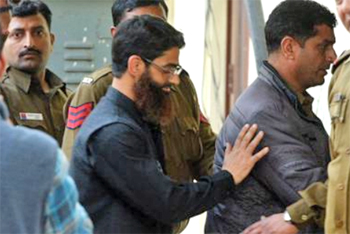
youthHe was picked up by officials of Delhi Police's special cell and Special Task Force (STF) of Kashmir Police.Two days later - after allegedly subjecting him to torture and humiliation at an STF camp - they brought him to Delhi. His crime: he was alleged to have planted a bomb in a DTC bus in Govindpuri on October 29, 2005, which injured many people.

Twelve years later, when he walked free on Thursday - after additional sessions judge Reetesh Singh acquitted him of all charges - the police were facing serious questions of credibility and human rights violations. Rafiq's claim that "he was made an accused to assuage the public perception that Delhi Police was incompetent to act against terrorism" and that "he was a vulnerable target... made a scapegoat" rang true. Police, it seems, deliberately ignored his alibi at every step to prove their case . They brushed aside his plea that it could be proved he was in his class on the day of the blast. It relied on dubious witness es who ended up contradicting themselves, exposed Rafiq to many people when he was in custody before a test identification parade (TIP) could be conducted and suppressed inconvenient facts.

TOI had as early as on February 12, 2006, raised the question whether it "could be a case of harried cops under pressure to show results, targeting an innocent boy?" In a front-page report, "Delhi bomber was in class on October 29", we had reported that Rafiq was actually attending his MA classes in his college in Srinagar. It was also reported that Rafiq had refused to appear for TIP as he had already been presented before some people, one of whom could be a witness in the Govindpuri blast.

The ground had been laid in Srinagar where Rafiq -according to his reply during framing of charges on January 21, 2008 which was cited by the judge - was allegedly forced to drink urine, kept naked and sexually abused, all in order to perhaps break his spirit. He had also alleged that rats were put in his trousers and attempts made to hurt his religious sentiments. "It seems I am being victimised only because I am a Kashmiri Muslim," he said, expressing his faith that justice would prevail and the police get exposed.

The court drew attention to Supreme Court's observation that when it comes to the notice of the investigating agency that a person accused of an offence has a good alibi, then it is the duty of that agency to investigate the genuineness of the plea of alibi and submit a report to the magistrate. "In the case of Manu Sharma versus the State (NCT) of Delhi....Supreme Court had observed that the criminal justice administration system in India places human rights and dignity for human life on a much higher pedestal. An accused is presumed to be innocent till proved guilty and is entitled to fairness and true investigation and a fair trial. The prosecution is expected to play a balanced role in the trial of crime and the investigation should be judicious, fair, transparent and expeditious to ensure compliance with the basic rule of law," the court asserted. Rafiq's case failed on all counts.

First Delhi Police produced a witness, Danbir Sharma, one of the passengers in the bus, on the basis of whose description, they got a portrait made. However, Sharma later couldn't identify Rafiq. The portrait then disappeared mysteriously - pointed out by the judge - even as another witness, Rajeev Sinha, surfaced.

His and Sharma's description of the bomber were at variance. Singh described the bomber as a young man, 22-24 years of age with a French-cut beard and prominent nose, who was wearing a cap with `New York' written on the right. He said he was wearing a white shirt with grey stripes and cotton trousers, either blue or black. Sharma, however, said the bomber was a boy of 5 feet, 10 inches height and had `sanwla' complexion. According to him, he was wearing a `coca cola' coloured shirt and white trousers.

The defence later claimed that Rafiq had a full-grown beard when he was arrested. It was alleged that on November 25, 2005, inspector Badrish Dutt brought a barber to the special cell office and got his beard trimmed to resemble a French cut. He then took a photo of his on his cellphone.

Significantly , Rafiq had refused to participate in a TIP on the ground that he had been exposed to many people while in custody at Lodi Colony and his photographs taken. He particularly mentioned a man wearing spectacles with his lawyers later alleging in court that it was Sinha, a planted witness. Sinha later accepted that he wore spectacles.

Sinha had produced a ticket to prove his presence on the bus that day . This had been left unverified by the police for long though it could have checked its authenticity with the depot manager and the registers he maintained quite easily. It chose not to do so.

The police wrote to the Registrar, University of Kashmir, on February 17, 2006, regarding verification of admission and attendance of Rafiq but chose to forget about it in court. Later, it was claimed that because of vacations, the information could not be procured from the university . However, the judge saw through the charade. DCP S K Tewari had on February 27 - just 10 days after writing the first letter - asked the Registrar "Whether " A" or "P" is marked in the attendance register of the class?" The court said this question could not have been put to the Registrar unless Tewari had access to the attendance records - the ones later produced by the defence and seen by the court - and hence the vacation plea for not being able to verify Rafiq's presence "seems to be false".The court said that in all probability the records had been collected by the police.

The police claimed the other accused, Mohammad Hussain Fazili - who too was acquitted - had led them to Rafiq. Rafiq, however, told the court that he met Fazili for the first time on November 21, 2005, at the STF camp. Fazili, too, denied taking the cops to Rafiq and claimed he was himself misled into believing by inspector Badrish Dutt that he was wanted in connection with an inquiry in a case under the Wildlife Protection Act. He too ended up in jail for 12 years.

Comments

Abdul Aziz
 - 
Saturday, 18 Feb 2017

No need to worry
Allah Almighty has his own plans to deal with injustice people
that day no one can rescue from the everlasting pain and torture

its true
since Truth will prevail and evil will perish

TRUTH
 - 
Saturday, 18 Feb 2017

The evil authorities or those authorities who do such evil acts think that they will getaway from their evil crimes... We Muslims believe, if we dont get justice here... We will surely get the justice in the Court of the lord of the worlds... Allah is just and he will give justice one day... That day the evil people will REGRET and their punishment will be permanent unless they REPENT in this world and help the society to become and stand with the TRUTH...

Shaad
 - 
Saturday, 18 Feb 2017

Without proof and knowingly they kept youth in jail for nothing and with all the proof and clear cut of involvement of Prajna singh, she gets bail.

Waav, incredible law, handler and our ruler.

Add new comment

  • Coastaldigest.com reserves the right to delete or block any comments.
  • Coastaldigset.com is not responsible for its readers’ comments.
  • Comments that are abusive, incendiary or irrelevant are strictly prohibited.
  • Please use a genuine email ID and provide your name to avoid reject.
Ram Puniyani
January 9,2020

‘Go to Pakistan’ has probably been most often used phrase used against Muslims in India. Recently in yet another such incident the SP of Meerut, UP has been in the news and a video is circulating where he, Akhilesh Narayan Singh, is allegedly using the jibe ‘Go to Pakistan’. In the video he is seen shouting at protestors at Lisari Gate area in Meerut, “The ones (protestors) wearing those black or yellow armbands, tell them to go to Pakistan”. His seniors stood by him calling it ‘natural reaction to shouting of pro Pakistan slogans. Many BJP leaders like Uma Bhararti also defended the officer. Breaking ranks with fellow politicians, Mukhtar Abbas Naqvi of BJP, criticised the said officer and asked for suitable action against him. Interestingly this is same Naqvi, who earlier when the beef related arguments were going on; had stated that those who want to eat beef can go to Pakistan.

Interestingly this is probably the first time that any BJP leader has opposed the use of this jibe against the Indian Muslims. True to the dominance of trolls who support divisive politics, Naqvi has been trolled on the issue. As such vibe ‘Go to Pakistan’ has been a strong tool in the hands of aggressive elements to demonise Muslims in general and to humiliate those with Muslim names. One recalls that when due to the rising intolerance in the society many eminent writers, film makers were returning their awards, Aamir Khan said that his wife Kiran Rao is worried about their son. Immediately BJP worthies like Giriraj Singh pounced on him that he can go to Pakistan.

The strategy of BJP combine has been on one hand to use this ‘go to Pakistan’ to humiliate Muslims on the other from last few years another Pakistan dimension has been added. Those who are critical of the policies of BJP-RSS have on one hand been called as anti National and on the other it is being said that ‘they are speaking the language of Pakistan’.

Use of Pakistan to label the Muslims and dissidents here in India has been a very shrewd tool in the hands of communal forces. One remembers that the ‘cricket nationalism’ was also the one to use it. In case of India-Pakistan cricket match, the national hysteria, which it created, was also aiming at Indian Muslims. What was propagated was that Indian Muslims cheer for Pakistan victory and they root for Pakistan. There was an unfortunate grain of truth in this as a section of disgruntled, alienated Muslim did that. That was not the total picture, as most Indian Muslims were cheering for Indian victory. Many a Muslim cricketers contributed massively to Indian cricket victories. The cricket legends like Nawab Mansoor Ali Khan Pataudi, Irfan Pathan, and Mohammad Azaruddin are just the few among the long list of those who brought glories for India in the field of cricket.

Even in matters of defence there are legions of Muslims who contributed to Indian efforts in the war against Pakistan all through. Abdul Hamid’s role in 1965 India Pak war and the role of Muslim soldiers in Kargil war will be part of Indian military history. There have been generals in army who contributed in many ways for the role which military has been playing in service of the nation. General Zamiruddin Shah, when asked to handle Gujarat carnage, does recount how despite the lack of support from local administration for some time, eventually the military was able to quell the violence in some ways.

During freedom movement Muslims were as much part of the struggle against British rule as any other community. While the perception has been created that Muslims were demanding Pakistan, the truth is somewhere else. It was only the elite section of Muslims who supported the politics of Muslim League and later the same Muslim League could mobilize some other section and unleash the violence like ‘Direct Action’ in Kolkata, which in a way precipitated the actual process of partition, which was the goal of British and aim of Muslim League apart from this being the outcome of ‘Two Nation theory’.

Not much is popularized about the role of great number of Muslims who were part of National movement, who steadfastly opposed the idea and politics which led to the sad partition of the subcontinent. Few excellent accounts of the role of Muslims in freedom movement like Syed Nasir Ahmad, Ubaidur Rahman, Satish Ganjoo and Shamsul Islam are few of these not too well know books which give the outline of the great Muslim freedom fighters like Khan Abdul Gaffar Khan, Maulana Abul Kalam Azad, Ansari Brothers, Ashfaqulla Khan.

Immediately after partition tragedy the communal propaganda did the overdrive to blame the whole partition process on Muslim separatism, this totally undermined the fact that how poor Muslims had taken out massive marches to oppose the Lahore Resolution of separate Pakistan moved by Mohammad Ali Jinnah. The whole Muslim community started being seen as the homogenous, ‘The other’ and other misconceptions started against the community, the one’s relating them to atrocities of Muslim kings started being made as the part of popular folklore, leading the Hate against them. This Hate in turn laid the foundation of violence and eventual ghettoisation of this community.

The interactive-syncretism prevalent in India well presented by Gandhi-Nehru was pushed to the margins as those believing in pluralism did not actively engage with the issue. The economic marginalization of this community, coupled with the increasing insecurity in turn led to some of them to identify with Pakistan, and this small section was again presented as the representative of the whole Muslim community.

Today the battle of perception is heavily tilted against the Muslim community. It is a bit of a surprise as Naqvi is differing from his other fellow colleagues to say that the action should be taken against the erring police officer. The hope is that all round efforts are stepped up to combat the perception constructed against this religious minority in India. 

Comments

Prakash SS
 - 
Thursday, 9 Jan 2020

it is very much understandable if Pakistan is bad country our PM Namo would never visited without any invitation, that time Pakistan was good he prised their Mutton biriyani and Karak chai in pakistan. we feel something is wrong with our PM and his chelas. 

Add new comment

  • Coastaldigest.com reserves the right to delete or block any comments.
  • Coastaldigset.com is not responsible for its readers’ comments.
  • Comments that are abusive, incendiary or irrelevant are strictly prohibited.
  • Please use a genuine email ID and provide your name to avoid reject.
News Network
July 17,2020

Bengaluru, July 17: A 60-year-old woman who tested positive for Covid-19 allegedly ended her life in the Covid ward at KC General Hospital in the early hours of Friday.

The woman, the fourth Covid positive patient to end her life since April, was a resident of Mariyappanapalya near Jnanabharathi in West Bengaluru. She was found hanging from a window grille in the passage of the Covid ward around 5 am. She had used her sari to hang herself.

The police said that the woman was admitted to the hospital on July 1. She was responding well to the treatment and was almost cured. Her son was infected first and admitted to the same hospital. As she later tested positive and got admitted, her son was discharged on July 11. The police suspect that the woman may have resorted to the extreme step due to depression.

An investigating officer quoted doctors telling the police that they were about to inform the woman about her discharge date on Friday. Doctors were waiting for the report on her latest test before discharging her.

The woman’s body will be subjected to an autopsy as per the Covid standard procedure. The Malleswaram police have taken up a case of unnatural death. Investigations are on. 

On July 11, a 70-year-old man ended his life in the toilet of the Covid ward in Victoria Hospital, while a suicide was reported in the same ward on June 26. A 60-year-old woman also hanged herself in the toilet. Her son, daughter-in-law, and grandson were also admitted to hospital for Covid-19.

Comments

Add new comment

  • Coastaldigest.com reserves the right to delete or block any comments.
  • Coastaldigset.com is not responsible for its readers’ comments.
  • Comments that are abusive, incendiary or irrelevant are strictly prohibited.
  • Please use a genuine email ID and provide your name to avoid reject.
News Network
May 22,2020

New Delhi: BJP leader Yogish Gowda, who was a member of the Dharwad Zilla Panchayath in Karnataka, was killed because of "political reasons", the CBI has alleged in its charge sheet filed against eight accused before a Dharwad court, officials said on Thursday.

Mr Gowda was killed on June 15, 2016 in front of a gym in Dharwad.

The charge sheet was filed before the Judicial Magistrate First Class Court in Dharwad against Santosh Savadatti, Dinesh M, Sunil KS, Harshith, Aswath S, Nazeer Ahamad, Shanawaz and Nutan K. All but one are in judicial custody.

"The accused allegedly came to Dharwad on two occasions in June 2016 and with the support of the other accused, allegedly planned the murder of Yogish Gowda. These accused fled after the crime," CBI spokesperson RK Gaur said.

The agency has alleged that the killing had "political reasons" behind it and was a result of political rivalry, the officials said.

The agency had taken over the case on September 24, 2019, nearly three years after the murder, on the request of the BJP government in Karnataka and a referral from the centre.

The case was earlier probed by the Karnataka Police which had charged six people for allegedly planning and executing the killing.

The CBI has arrested eight accused in the case of which seven are in judicial custody, they said.

"Further investigation into the role of the other accused and larger conspiracy in this case is continuing on a day-to-day basis," Mr Gaur said.

BJP leader murder caseYogish GowdaCentral Bureau of Investigation (CBI)

Comments

Add new comment

  • Coastaldigest.com reserves the right to delete or block any comments.
  • Coastaldigset.com is not responsible for its readers’ comments.
  • Comments that are abusive, incendiary or irrelevant are strictly prohibited.
  • Please use a genuine email ID and provide your name to avoid reject.