


College to jail in bomb case: How cops destroyed 12 yrs of his youth

February 18, 2017

New Delhi, Feb 18: Mohammad Rafiq Shah was a student of MA (final) at Shah-i-Hamadan, Institute of Islamic Studies, University of Kashmir, Srinagar, when on the midnight of November 21, 2005, his world plunged into darkness.
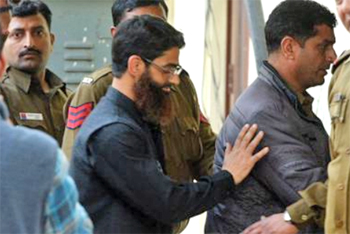
youthHe was picked up by officials of Delhi Police's special cell and Special Task Force (STF) of Kashmir Police.Two days later - after allegedly subjecting him to torture and humiliation at an STF camp - they brought him to Delhi. His crime: he was alleged to have planted a bomb in a DTC bus in Govindpuri on October 29, 2005, which injured many people.

Twelve years later, when he walked free on Thursday - after additional sessions judge Reetesh Singh acquitted him of all charges - the police were facing serious questions of credibility and human rights violations. Rafiq's claim that "he was made an accused to assuage the public perception that Delhi Police was incompetent to act against terrorism" and that "he was a vulnerable target... made a scapegoat" rang true. Police, it seems, deliberately ignored his alibi at every step to prove their case . They brushed aside his plea that it could be proved he was in his class on the day of the blast. It relied on dubious witness es who ended up contradicting themselves, exposed Rafiq to many people when he was in custody before a test identification parade (TIP) could be conducted and suppressed inconvenient facts.

TOI had as early as on February 12, 2006, raised the question whether it "could be a case of harried cops under pressure to show results, targeting an innocent boy?" In a front-page report, "Delhi bomber was in class on October 29", we had reported that Rafiq was actually attending his MA classes in his college in Srinagar. It was also reported that Rafiq had refused to appear for TIP as he had already been presented before some people, one of whom could be a witness in the Govindpuri blast.

The ground had been laid in Srinagar where Rafiq -according to his reply during framing of charges on January 21, 2008 which was cited by the judge - was allegedly forced to drink urine, kept naked and sexually abused, all in order to perhaps break his spirit. He had also alleged that rats were put in his trousers and attempts made to hurt his religious sentiments. "It seems I am being victimised only because I am a Kashmiri Muslim," he said, expressing his faith that justice would prevail and the police get exposed.

The court drew attention to Supreme Court's observation that when it comes to the notice of the investigating agency that a person accused of an offence has a good alibi, then it is the duty of that agency to investigate the genuineness of the plea of alibi and submit a report to the magistrate. "In the case of Manu Sharma versus the State (NCT) of Delhi....Supreme Court had observed that the criminal justice administration system in India places human rights and dignity for human life on a much higher pedestal. An accused is presumed to be innocent till proved guilty and is entitled to fairness and true investigation and a fair trial. The prosecution is expected to play a balanced role in the trial of crime and the investigation should be judicious, fair, transparent and expeditious to ensure compliance with the basic rule of law," the court asserted. Rafiq's case failed on all counts.

First Delhi Police produced a witness, Danbir Sharma, one of the passengers in the bus, on the basis of whose description, they got a portrait made. However, Sharma later couldn't identify Rafiq. The portrait then disappeared mysteriously - pointed out by the judge - even as another witness, Rajeev Sinha, surfaced.

His and Sharma's description of the bomber were at variance. Singh described the bomber as a young man, 22-24 years of age with a French-cut beard and prominent nose, who was wearing a cap with `New York' written on the right. He said he was wearing a white shirt with grey stripes and cotton trousers, either blue or black. Sharma, however, said the bomber was a boy of 5 feet, 10 inches height and had `sanwla' complexion. According to him, he was wearing a `coca cola' coloured shirt and white trousers.

The defence later claimed that Rafiq had a full-grown beard when he was arrested. It was alleged that on November 25, 2005, inspector Badrish Dutt brought a barber to the special cell office and got his beard trimmed to resemble a French cut. He then took a photo of his on his cellphone.

Significantly , Rafiq had refused to participate in a TIP on the ground that he had been exposed to many people while in custody at Lodi Colony and his photographs taken. He particularly mentioned a man wearing spectacles with his lawyers later alleging in court that it was Sinha, a planted witness. Sinha later accepted that he wore spectacles.

Sinha had produced a ticket to prove his presence on the bus that day . This had been left unverified by the police for long though it could have checked its authenticity with the depot manager and the registers he maintained quite easily. It chose not to do so.

The police wrote to the Registrar, University of Kashmir, on February 17, 2006, regarding verification of admission and attendance of Rafiq but chose to forget about it in court. Later, it was claimed that because of vacations, the information could not be procured from the university . However, the judge saw through the charade. DCP S K Tewari had on February 27 - just 10 days after writing the first letter - asked the Registrar "Whether " A" or "P" is marked in the attendance register of the class?" The court said this question could not have been put to the Registrar unless Tewari had access to the attendance records - the ones later produced by the defence and seen by the court - and hence the vacation plea for not being able to verify Rafiq's presence "seems to be false".The court said that in all probability the records had been collected by the police.

The police claimed the other accused, Mohammad Hussain Fazili - who too was acquitted - had led them to Rafiq. Rafiq, however, told the court that he met Fazili for the first time on November 21, 2005, at the STF camp. Fazili, too, denied taking the cops to Rafiq and claimed he was himself misled into believing by inspector Badrish Dutt that he was wanted in connection with an inquiry in a case under the Wildlife Protection Act. He too ended up in jail for 12 years.

Comments

Abdul Aziz
 - 
Saturday, 18 Feb 2017

No need to worry
Allah Almighty has his own plans to deal with injustice people
that day no one can rescue from the everlasting pain and torture

its true
since Truth will prevail and evil will perish

TRUTH
 - 
Saturday, 18 Feb 2017

The evil authorities or those authorities who do such evil acts think that they will getaway from their evil crimes... We Muslims believe, if we dont get justice here... We will surely get the justice in the Court of the lord of the worlds... Allah is just and he will give justice one day... That day the evil people will REGRET and their punishment will be permanent unless they REPENT in this world and help the society to become and stand with the TRUTH...

Shaad
 - 
Saturday, 18 Feb 2017

Without proof and knowingly they kept youth in jail for nothing and with all the proof and clear cut of involvement of Prajna singh, she gets bail.

Waav, incredible law, handler and our ruler.

Add new comment

  • Coastaldigest.com reserves the right to delete or block any comments.
  • Coastaldigset.com is not responsible for its readers’ comments.
  • Comments that are abusive, incendiary or irrelevant are strictly prohibited.
  • Please use a genuine email ID and provide your name to avoid reject.
News Network
March 3,2020

Dubai, Mar 3: Abu Dhabi-based Indian retail tycoon MA Yusuff Ali has become the first Indian to receive Saudi Arabia's premium residency, his office said in a statement on Monday.

Yusuff Ali, 64, is the chairman of the LuLu Group, who was ranked the richest expat in the UAE by the Forbes magazine last year.

The permit, informally known as Saudi Green Card, grants expatriates the right to live, work and own business and property in the Kingdom without need for a sponsor, the LULU group said in a statement.

The introduction of the Premium Residency comes as a part of Saudi Arabia's Vision 2030 reform plan, which was announced by Crown Prince Mohammed bin Salman to boost the Saudi economy, the statement said.

Yusuff Ali said "obviously a very proud and humbling moment in my life. This is a great honour not only for me but for the entire Indian expat community and I sincerely thank the HM the King Salman, HRH Crown Prince Mohamed bin Salman and the government of Saudi Arabia."

"@Yusuffali_MA , an investor from India, after obtaining Premium Residency in Saudi Arabia: ''The Kingdom became an attractive investment destination due to the remarkable growth in economy," Premium Residency tweeted on Monday.

Yusuff Ali said he was sure that this new permanent residency initiative will further boost Saudi Arabia's image as one of the key investments and business hubs of the region as well as attract and retain new investors.

This initiative is targeting key investors and prominent personalities from various fields, including sports, arts & culture, who have played a defining role in the nation building process.

The Lulu Group owns and operates more than 35 hypermarkets and supermarkets in Saudi Arabia, which includes ARAMCO Commissaries and National Guards super stores.

Comments

Add new comment

  • Coastaldigest.com reserves the right to delete or block any comments.
  • Coastaldigset.com is not responsible for its readers’ comments.
  • Comments that are abusive, incendiary or irrelevant are strictly prohibited.
  • Please use a genuine email ID and provide your name to avoid reject.
News Network
April 12,2020

Raipur, Apr 12: As many as 108 out of the 159 people that were quarantined by the Chhattisgarh government last week for allegedly taking part in Delhi’s Tablighi Jamaat congregation are Hindus, according to reliable sources. 

The names of these 159 people, who were said to be in Delhi’s Nizamuddin area when the Tablighi Jamaat congregation was held mid-March, were mentioned in a list issued by the state home department last month. 

The list has been accessed by the many media outlets. But, Raipur Collector S. Bharti Dasan and the state’s Principal Secretary, Home, Subrata Sahu, claimed no such list was issued.

However, a senior state home department official, who didn’t want to be named, said: “Listing of the names was done on the basis of location of mobile phones traced in Nizamuddin in the month of March during the period when congregation of Tablighi Jamaat was held.

“It was subsequently sent to the chief medical officers in the respective districts for further action,” the official added.

These 159 people have either been quarantined at their homes or at government isolation centres. The quarantine exercise took place between 31 March and 1 April.

Interestingly, almost all the people named in the list have denied attending the massive Jamaat congregation, which had seen the participation of over 3,000 people, including foreigners.

Under quarantine “forcefully”, these people alleged they are facing social boycott as they have been “linked to the Tablighi”.

Those placed under quarantine, told media if their phone locations have shown their presence in the Nizamuddin area that didn’t necessarily mean they had attended the Tablighi congregation.

“My neighbours are no longer like my family. After 31 March, I have received more than 500 calls (from relatives and friends) and had to convince them that I didn’t attend the Jamaat event,” Umesh Pandey, a resident of Ambikapur, said.

“People in my area have started saying that some Brahmins took part in the event. I have no objection to being kept in quarantine, but it should be explained why it is being done,” said Pandey, who is a consumer rights activist.

Pandey said, like every year, he had gone to Delhi in March to participate in a consumer protection programme and had stayed at a hotel in Nizamuddin. “I came back on 17 March. After I was quarantined, a false propaganda is being spread about me that I am linked with Tablighi Jamaat activities.”

Pandey said he and his family are now being “looked at as suspects”. 

Kamal Kumar Popatani, a businessman from Bilaspur district, has faced similar problems. Popatani and his family have been living in isolation since 31 March.

“I am completely flabbergasted by this step taken by the state government. I always visit Delhi to procure items for my shop. This time too I had completed my procurement and had returned home on 16 March. Everything was usual till 30 March, but suddenly after 31 March, when this so-called list of 159 alleged suspects was released by the government, we were placed under isolation,” Popatani said.

“My own family members, neighbours and everyone I know are now accusing me that I had joined the Tabligi Jamaat gathering. How can it ever happen? This strange attitude of the government has made my entire family a victim of social boycott.”

Trader Abdul Rahman, a resident of Lutra Sharif area of Bilaspur district, also echoed similar sentiments.

“I returned from Delhi along with my wife on 15 March, but my entire family has been kept in isolation since 31 March. All this is way beyond my comprehension… Blood samples of the entire family were taken. Now everyone is keeping a distance from us and calling us corona suspects,” said Rahman, who had gone to Delhi for a holiday.

“People not only from my village but also in the nearby villages are pointing fingers at me and my family… We are the ones who condemn Tablighi Jamaat and their activities. We have nothing to do with them. The quarantine… has brought…infamy to us,” he added.

In another goof-up, the list even includes names of some people who no longer live in the state but carried mobile numbers issued in Chhattisgarh. One such name is that of BSF sub-inspector Shantanu Mukherjee, who was working in Bhilai about two years ago, but is currently posted in Delhi.

“What kind of list is this? Who released it in the first place? At first, I received a call from the Covid-19 control room in Chhattisgarh and then from the State Police Control Centre. They inquired about my health and current place of posting,” said Mukherjee, whose office is located close to the Nizamuddin area. 

Makkhan Singh Yadav, a sub-inspector with the CRPF, is another case in point. Yadav, who is posted somewhere close to Nizamuddin, had bought a SIM card from Dantewada, when he was posted there five years ago.

“I had received calls from both Delhi and Chhattisgarh police after being marked as a corona suspect. But when I explained the reality to them, no calls were made thereafter. I could not understand how all this is taking place,” said Yadav, who is a native of Rampur, Uttar Pradesh.

A first-year Delhi University student, who belongs to Mahasamund district of Chhattisgarh, has been kept under isolation at a local government hospital.

The student, who didn’t want to be named, said she had gone to Nizamuddin railway station to catch a train for Chhattisgarh.

“I came home immediately after it was announced that educational institutions are shutting down. After returning from Delhi, I spent around 19 days at my own home, but suddenly I was admitted to the hospital on 1 April. Why have I been brought here (hospital) if I have no symptoms? All this feels like some sort of torture.”

“Despite my repeated denial, I was brought here by the health department on the pretext of being associated with the Tablighi Jamaat,” she said. 

Asked about the Tablighi quarantine list, principal secretary Sahu said: “The government has issued no such list. We have received inputs from the social media about three such lists but the state government has not officially prepared any list.

“All those put under quarantine have been done as per the orders issued by the state government. This order states that those who came to the state after 1 March should be kept under isolation,” he added.

Raipur Collector Dasan refused to say anything about the list and added that people have been kept under quarantine after obtaining their “detailed travel history” based on the guidelines issued by the ICMR.

On the allegation of social boycott, Dasan said: “No person or their families placed under home quarantine or isolation should be subjected to any social boycott or misconduct. They also need not have any social inferiority complex in their minds.

“If any person placed under quarantine feels like this (social inferiority complex), the government has arranged counsellors for them. Our counsellors are convincing and assuring such people by reaching out to them.”

Comments

Add new comment

  • Coastaldigest.com reserves the right to delete or block any comments.
  • Coastaldigset.com is not responsible for its readers’ comments.
  • Comments that are abusive, incendiary or irrelevant are strictly prohibited.
  • Please use a genuine email ID and provide your name to avoid reject.
News Network
July 22,2020

Bengaluru, Jul 22: Yellow alert has been issued for Karnataka's Shivamogga, Chikmagalur, Hassan, and Kodagu for July 23 and 24.

Some areas of Bengaluru may receive light rainfall today, said CS Patil, Director, IMD Centre, Bengaluru.

He added that coastal areas of the state are very likely to experience rainfall from on July 23 and July 24, and that rainfall may increase July 24 onwards. Widespread rainfall is predicted for July 24th, 25th, and 26th.

Comments

Add new comment

  • Coastaldigest.com reserves the right to delete or block any comments.
  • Coastaldigset.com is not responsible for its readers’ comments.
  • Comments that are abusive, incendiary or irrelevant are strictly prohibited.
  • Please use a genuine email ID and provide your name to avoid reject.