


College to jail in bomb case: How cops destroyed 12 yrs of his youth

February 18, 2017

New Delhi, Feb 18: Mohammad Rafiq Shah was a student of MA (final) at Shah-i-Hamadan, Institute of Islamic Studies, University of Kashmir, Srinagar, when on the midnight of November 21, 2005, his world plunged into darkness.
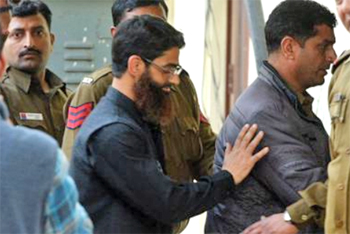
youthHe was picked up by officials of Delhi Police's special cell and Special Task Force (STF) of Kashmir Police.Two days later - after allegedly subjecting him to torture and humiliation at an STF camp - they brought him to Delhi. His crime: he was alleged to have planted a bomb in a DTC bus in Govindpuri on October 29, 2005, which injured many people.

Twelve years later, when he walked free on Thursday - after additional sessions judge Reetesh Singh acquitted him of all charges - the police were facing serious questions of credibility and human rights violations. Rafiq's claim that "he was made an accused to assuage the public perception that Delhi Police was incompetent to act against terrorism" and that "he was a vulnerable target... made a scapegoat" rang true. Police, it seems, deliberately ignored his alibi at every step to prove their case . They brushed aside his plea that it could be proved he was in his class on the day of the blast. It relied on dubious witness es who ended up contradicting themselves, exposed Rafiq to many people when he was in custody before a test identification parade (TIP) could be conducted and suppressed inconvenient facts.

TOI had as early as on February 12, 2006, raised the question whether it "could be a case of harried cops under pressure to show results, targeting an innocent boy?" In a front-page report, "Delhi bomber was in class on October 29", we had reported that Rafiq was actually attending his MA classes in his college in Srinagar. It was also reported that Rafiq had refused to appear for TIP as he had already been presented before some people, one of whom could be a witness in the Govindpuri blast.

The ground had been laid in Srinagar where Rafiq -according to his reply during framing of charges on January 21, 2008 which was cited by the judge - was allegedly forced to drink urine, kept naked and sexually abused, all in order to perhaps break his spirit. He had also alleged that rats were put in his trousers and attempts made to hurt his religious sentiments. "It seems I am being victimised only because I am a Kashmiri Muslim," he said, expressing his faith that justice would prevail and the police get exposed.

The court drew attention to Supreme Court's observation that when it comes to the notice of the investigating agency that a person accused of an offence has a good alibi, then it is the duty of that agency to investigate the genuineness of the plea of alibi and submit a report to the magistrate. "In the case of Manu Sharma versus the State (NCT) of Delhi....Supreme Court had observed that the criminal justice administration system in India places human rights and dignity for human life on a much higher pedestal. An accused is presumed to be innocent till proved guilty and is entitled to fairness and true investigation and a fair trial. The prosecution is expected to play a balanced role in the trial of crime and the investigation should be judicious, fair, transparent and expeditious to ensure compliance with the basic rule of law," the court asserted. Rafiq's case failed on all counts.

First Delhi Police produced a witness, Danbir Sharma, one of the passengers in the bus, on the basis of whose description, they got a portrait made. However, Sharma later couldn't identify Rafiq. The portrait then disappeared mysteriously - pointed out by the judge - even as another witness, Rajeev Sinha, surfaced.

His and Sharma's description of the bomber were at variance. Singh described the bomber as a young man, 22-24 years of age with a French-cut beard and prominent nose, who was wearing a cap with `New York' written on the right. He said he was wearing a white shirt with grey stripes and cotton trousers, either blue or black. Sharma, however, said the bomber was a boy of 5 feet, 10 inches height and had `sanwla' complexion. According to him, he was wearing a `coca cola' coloured shirt and white trousers.

The defence later claimed that Rafiq had a full-grown beard when he was arrested. It was alleged that on November 25, 2005, inspector Badrish Dutt brought a barber to the special cell office and got his beard trimmed to resemble a French cut. He then took a photo of his on his cellphone.

Significantly , Rafiq had refused to participate in a TIP on the ground that he had been exposed to many people while in custody at Lodi Colony and his photographs taken. He particularly mentioned a man wearing spectacles with his lawyers later alleging in court that it was Sinha, a planted witness. Sinha later accepted that he wore spectacles.

Sinha had produced a ticket to prove his presence on the bus that day . This had been left unverified by the police for long though it could have checked its authenticity with the depot manager and the registers he maintained quite easily. It chose not to do so.

The police wrote to the Registrar, University of Kashmir, on February 17, 2006, regarding verification of admission and attendance of Rafiq but chose to forget about it in court. Later, it was claimed that because of vacations, the information could not be procured from the university . However, the judge saw through the charade. DCP S K Tewari had on February 27 - just 10 days after writing the first letter - asked the Registrar "Whether " A" or "P" is marked in the attendance register of the class?" The court said this question could not have been put to the Registrar unless Tewari had access to the attendance records - the ones later produced by the defence and seen by the court - and hence the vacation plea for not being able to verify Rafiq's presence "seems to be false".The court said that in all probability the records had been collected by the police.

The police claimed the other accused, Mohammad Hussain Fazili - who too was acquitted - had led them to Rafiq. Rafiq, however, told the court that he met Fazili for the first time on November 21, 2005, at the STF camp. Fazili, too, denied taking the cops to Rafiq and claimed he was himself misled into believing by inspector Badrish Dutt that he was wanted in connection with an inquiry in a case under the Wildlife Protection Act. He too ended up in jail for 12 years.

Comments

Abdul Aziz
 - 
Saturday, 18 Feb 2017

No need to worry
Allah Almighty has his own plans to deal with injustice people
that day no one can rescue from the everlasting pain and torture

its true
since Truth will prevail and evil will perish

TRUTH
 - 
Saturday, 18 Feb 2017

The evil authorities or those authorities who do such evil acts think that they will getaway from their evil crimes... We Muslims believe, if we dont get justice here... We will surely get the justice in the Court of the lord of the worlds... Allah is just and he will give justice one day... That day the evil people will REGRET and their punishment will be permanent unless they REPENT in this world and help the society to become and stand with the TRUTH...

Shaad
 - 
Saturday, 18 Feb 2017

Without proof and knowingly they kept youth in jail for nothing and with all the proof and clear cut of involvement of Prajna singh, she gets bail.

Waav, incredible law, handler and our ruler.

Add new comment

  • Coastaldigest.com reserves the right to delete or block any comments.
  • Coastaldigset.com is not responsible for its readers’ comments.
  • Comments that are abusive, incendiary or irrelevant are strictly prohibited.
  • Please use a genuine email ID and provide your name to avoid reject.
Ram Puniyani
February 29,2020

Like most of the political phenomenon, even the practice of Nationalism is not a static one. It changes with the changing political equations of the political forces and assumes the expressions which are very diverse. As such the phenomenon of Nationalism has a long journey and various state policies in particular have used it for purposes which relate more to the power of the state ‘vis a vis’ its people, power of the state ‘vis a vis’ the neighboring countries among others.

In India there has been a certain change in the practices of the state which have transformed the meaning of Nationalism during last few years. Particularly with BJP, the Hindu Nationalist outfit gaining simple majority, it has unfolded the policies where one can discern the drastic change in the meaning and application of Nationalism in regard to its citizens, particularly those belonging to minority community, with regard to those who are liberal, and with those who stand with the concept of Human rights.

Our former Prime Minister of Dr. Manmohan Singh hit the nail on the head when he said that “Nationalism and the "Bharat Mata Ki Jai" slogan are being misused to construct a "militant and purely emotional" idea of India that excludes millions of residents and citizens. Former Prime Minister recently stated this in an apparent attack on the BJP.” The occasion was the release of a book, ‘Who is Bharat Mata’, edited by Purushottam Agarwal and Radhakrishna. This is a compilation of significant extracts from writings of Nehru, and important assessments of and contributions of Nehru by prominent personalities.

Dr. Singh went on to add "With an inimitable style…Nehru laid the foundation of the universities, academies and cultural institutions of Modern India. But for Nehru's leadership, independent India would not have become what it is today," This statement of Dr. Singh has great importance in contemporary times, as Nehru is being denigrated by Hindu nationalists for all the problems which India is facing today and attempts are on to undermine his role and glorifying Sardar Vallabh Bhai Patel. This is also significant as it gives us the glimpses of what Nationalism meant for Nehru.

As Singh’s statement captures the present nationalism being practiced by BJP and company, the Hindu nationalists, immediately shot back saying that Dr. Singh is supporting the anti India activities at JNU and Jamia and his party is supporting the anti India nationalists. They asked whether Singh likes the nationalism of the likes of Shashi Tharoor or Manishankar Ayer who are provoking the Shaheen Bagh protest rather than making the protestors quiet. Whether he likes the anti national protests which go on at JNU or Jamia? As per them there is no Nationalism in Congress. One more example being cited is the private visit of Shatrughan Sinha who talked to Pakistani President during his visit there recently!

Most of the arguments being used to oppose Dr. Singh are very superficial. What is being referred to; is not opposition to Indian nationalism and its central values which were the core of anti colonial struggles. While ‘Bharat Mata Ki Jai’ may not be acceptable to a section of population, even the book he was releasing has the title ‘Who is Bharat Mata’. What is being stated by Singh is the twist which slogan ‘Bharat Mata ki Jai’ has been used by Hindu nationalists to frighten the religious minorities.

Indian nation came into being on the values, which later were the foundation of Indian Constitution. Indian Constitution carefully picked up the terminology which was away from the concepts of Hindu or Muslim nationalism. That’s how the country came to be called as ‘India that is Bharat’. The freedom of expression which was the hallmark of freedom movement and it was given a pride of place in our Constitution. It respected the diversity and formulated rules where the nation was not based on particular culture, as Hindu nationalists will like us to believe, but cultural diversity was centrally recognized in the Constitution. In addition promoting good relations with neighbors and other countries of the World was also part of our principles.

JNU, Jamia and AMU are being demonized as most institutions so far regard the freedom of expression as a core part of Indian democracy. These institutions have been thriving on discussions and debates which have base in liberalism. Deliberately some slogans have been constructed to defame these institutions. While Constitution mandates good relations with neighbors, creation of ‘Anti Pakistan hysteria’ is the prime motive of many a channels and sections of other media, which are servile to the ideology of ruling Government. They also violate most of the norms of ethical journalism, where the criticism of the ruling party is an important factor to keep the ruling dispensation in toes.

A stifling atmosphere has been created during last six years. In this the Prime Minster can take a detour, land in Pakistan to have a cup of tea with Pakistan PM, but a Congress leader talking to Pakistani President is a sign of being anti National. Students taking out a march while reading the preamble of Indian Constitution are labeled as anti-national; and are stopped while those openly wielding guns near Jamia or Shaheen Bagh roam freely.

Nationalism should promote amity and love of the people; it should pave the way for growth and development. Currently the nationalism which is dominant and stalking the streets has weakened the very fraternity, which is one of the pillars of our democracy. Nehru did explain that Bharat Mata is not just our mountains, rivers and land but primarily the people who inhabit the land. Which nationalism to follow was settled during the freedom movement when Muslim nationalism and Hindu nationalism were rejected by the majority of people of India in favor of the Nationalism of Gandhi, Nehru, Patel and Maulana Azad, where minorities are equal citizens, deserving affirmative action. In today’s scenario the Hindu nationalists cannot accept any criticism of their policies.

Comments

Add new comment

  • Coastaldigest.com reserves the right to delete or block any comments.
  • Coastaldigset.com is not responsible for its readers’ comments.
  • Comments that are abusive, incendiary or irrelevant are strictly prohibited.
  • Please use a genuine email ID and provide your name to avoid reject.
News Network
May 13,2020

Bengaluru, May 13: Gym and hotels, which had remained closed due to lockdown to combat spread of Coronavirus, would be allowed to function from May 17, Karnataka Minister for Tourism C T Ravi said on Wednesday.

Speaking to the media, after a meeting with Chief Minister B S Yediyurappa here he said that the Chief Minister has agreed to give permission to gym, hotels and golf clubs to function and as they have assured to maintain social distance and follow other guidelines of the lockdown.

Mr Ravi, who is also Minister for Youth Empowerment and Sports, further said that reopening of hotel industry would help in attracting tourists. Opening of gym and fitness centre was important for sports persons and regular exercisers.

Comments

Add new comment

  • Coastaldigest.com reserves the right to delete or block any comments.
  • Coastaldigset.com is not responsible for its readers’ comments.
  • Comments that are abusive, incendiary or irrelevant are strictly prohibited.
  • Please use a genuine email ID and provide your name to avoid reject.
Ram Puniyani
March 14,2020

In the wake of Citizenship Amendment Act (CAA) UN High Commissioner, Michele Bachelet, has filed an intervention in the Supreme Court petition challenging the constitutionality of the Citizenship Amendment Act, as she is critical of CAA. Responding to her, India’s Foreign Minister S. Jai Shanker strongly rebutted her criticism, saying that the body (UNHCR) has been wrong and is blind to the problem of cross border terrorism. The issue on hand is the possibility of scores of people, mainly Muslims, being declared as stateless. The problem at hand is the massive exercise of going through the responses/documents from over 120 crore of Indian population and screening documents, which as seen in Assam, yield result which are far from truthful or necessary.

The issue of CAA has been extensively debated and despite heavy critique of the same by large number of groups and despite the biggest mass opposition ever to any move in Independent India, the Government is determined on going ahead with an exercise which is reminiscent of the dreaded regimes which are sectarian and heartless to its citizens, which have indulged in extinction of large mass of people on grounds of citizenship, race etc. The Foreign minister’s assertion is that it is a matter internal to India, where India’s sovereignty is all that matters! As far as sovereignty is concerned we should be clear that in current times any sovereign power has to consider the need to uphold the citizenship as per the principle of non-discrimination which is stipulated in Art.26 of the International Covenant on Civil and Political (ICCPR) rights.

Can such policies, which affect large number of people and are likely to affect their citizenship be purely regarded as ‘internal’? With the World turning into a global village, some global norms have been formulated during last few decades. The norms relate to Human rights and migrations have been codified. India is also signatory to many such covenants in including ICCPR, which deals with the norms for dealing with refugees from other countries. One is not talking of Chicago speech of Swami Vivekanand, which said that India’s greatness has been in giving shelter to people from different parts of the World; one is also not talking of the Tattariaya Upanishad’s ‘Atithi Devovhav’ or ‘Vasudhaiva Kutumbkam’ from Mahaupanishad today.

What are being talked about are the values and opinions of organizations which want to ensure to preserve of Human rights of all people Worldwide. In this matter India is calling United Nations body as ‘foreign party’; having no locus standi in the case as it pertains to India’s sovereignty. The truth is that since various countries are signatories to UN covenants, UN bodies have been monitoring the moves of different states and intervening at legal level as Amicus (Friend of the Court) to the courts in different countries and different global bodies. Just to mention some of these, UN and High Commissioner for Human Rights has often submitted amicus briefs in different judicial platforms. Some examples are their intervention in US Supreme Court, European Court of Human Rights, International Criminal Court, and the Inter-American Court of Human Rights. These are meant to help the Courts in areas where UN bodies have expertise.

 Expertise on this has been jointly formulated by various nations. These interventions also remind the nations as to what global norms have been evolved and what are the obligations of individual states to the values which have evolved over a period of time. Arvind Narrain draws our attention to the fact that, “commission has intervened in the European Court of Human Rights in cases involving Spain and Italy to underscore the principle of non-refoulement, which bars compulsory expulsion of illegal migrants… Similarly, the UN has intervened in the International Criminal Court in a case against the Central African Republic to explicate on the international jurisprudence on rape as a war crime.”

From time to time organizations like Amnesty International and Human Rights Watch have been monitoring the status of Human rights of different countries. This puts those countries in uncomfortable situation and is not welcome by those establishments. How should this contradiction between ‘internal matter’, ‘sovereignty’ and the norms for Human rights be resolved? This is a tough question at the time when the freedom indices and democratic ethos are sliding downwards all over the world. In India too has slid down on the scale of these norms.

In India we can look at the intervention of UN body from the angle of equality and non discrimination. Democratic spirit should encourage us to have a rethink on the matters which have been decided by the state. In the face of the greatest mass movement of Shaheen bagh, the state does need to look inwards and give a thought to international morality, the spirit of global family to state the least.

The popular perception is that when Christians were being persecuted in Kandhmal the global Christian community’s voice was not strong enough. Currently in the face of Delhi carnage many a Muslim majority countries have spoken. While Mr. Modi claims that his good relations with Muslim countries are a matter of heartburn to the parties like Congress, he needs to relook at his self gloating. Currently Iran, Malaysia, Indonesia and many Muslim majority countries have spoken against what Modi regime is unleashing in India. Bangladesh, our neighbor, has also seen various protests against the plight of Muslims in India. More than the ‘internal matter’ etc. what needs to be thought out is the moral aspect of the whole issue. We pride ourselves in treading the path of morality. What does that say in present context when while large section of local media is servile to the state, section of global media has strongly brought forward what is happening to minorities in India.   

The hope is that Indian Government wakes up to its International obligations, to the worsening of India’s image in the World due to CAA and the horrific violence witnessed in Delhi.

Comments

Add new comment

  • Coastaldigest.com reserves the right to delete or block any comments.
  • Coastaldigset.com is not responsible for its readers’ comments.
  • Comments that are abusive, incendiary or irrelevant are strictly prohibited.
  • Please use a genuine email ID and provide your name to avoid reject.