


College to jail in bomb case: How cops destroyed 12 yrs of his youth

February 18, 2017

New Delhi, Feb 18: Mohammad Rafiq Shah was a student of MA (final) at Shah-i-Hamadan, Institute of Islamic Studies, University of Kashmir, Srinagar, when on the midnight of November 21, 2005, his world plunged into darkness.
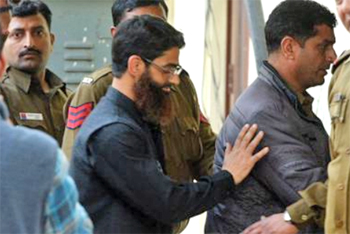
youthHe was picked up by officials of Delhi Police's special cell and Special Task Force (STF) of Kashmir Police.Two days later - after allegedly subjecting him to torture and humiliation at an STF camp - they brought him to Delhi. His crime: he was alleged to have planted a bomb in a DTC bus in Govindpuri on October 29, 2005, which injured many people.

Twelve years later, when he walked free on Thursday - after additional sessions judge Reetesh Singh acquitted him of all charges - the police were facing serious questions of credibility and human rights violations. Rafiq's claim that "he was made an accused to assuage the public perception that Delhi Police was incompetent to act against terrorism" and that "he was a vulnerable target... made a scapegoat" rang true. Police, it seems, deliberately ignored his alibi at every step to prove their case . They brushed aside his plea that it could be proved he was in his class on the day of the blast. It relied on dubious witness es who ended up contradicting themselves, exposed Rafiq to many people when he was in custody before a test identification parade (TIP) could be conducted and suppressed inconvenient facts.

TOI had as early as on February 12, 2006, raised the question whether it "could be a case of harried cops under pressure to show results, targeting an innocent boy?" In a front-page report, "Delhi bomber was in class on October 29", we had reported that Rafiq was actually attending his MA classes in his college in Srinagar. It was also reported that Rafiq had refused to appear for TIP as he had already been presented before some people, one of whom could be a witness in the Govindpuri blast.

The ground had been laid in Srinagar where Rafiq -according to his reply during framing of charges on January 21, 2008 which was cited by the judge - was allegedly forced to drink urine, kept naked and sexually abused, all in order to perhaps break his spirit. He had also alleged that rats were put in his trousers and attempts made to hurt his religious sentiments. "It seems I am being victimised only because I am a Kashmiri Muslim," he said, expressing his faith that justice would prevail and the police get exposed.

The court drew attention to Supreme Court's observation that when it comes to the notice of the investigating agency that a person accused of an offence has a good alibi, then it is the duty of that agency to investigate the genuineness of the plea of alibi and submit a report to the magistrate. "In the case of Manu Sharma versus the State (NCT) of Delhi....Supreme Court had observed that the criminal justice administration system in India places human rights and dignity for human life on a much higher pedestal. An accused is presumed to be innocent till proved guilty and is entitled to fairness and true investigation and a fair trial. The prosecution is expected to play a balanced role in the trial of crime and the investigation should be judicious, fair, transparent and expeditious to ensure compliance with the basic rule of law," the court asserted. Rafiq's case failed on all counts.

First Delhi Police produced a witness, Danbir Sharma, one of the passengers in the bus, on the basis of whose description, they got a portrait made. However, Sharma later couldn't identify Rafiq. The portrait then disappeared mysteriously - pointed out by the judge - even as another witness, Rajeev Sinha, surfaced.

His and Sharma's description of the bomber were at variance. Singh described the bomber as a young man, 22-24 years of age with a French-cut beard and prominent nose, who was wearing a cap with `New York' written on the right. He said he was wearing a white shirt with grey stripes and cotton trousers, either blue or black. Sharma, however, said the bomber was a boy of 5 feet, 10 inches height and had `sanwla' complexion. According to him, he was wearing a `coca cola' coloured shirt and white trousers.

The defence later claimed that Rafiq had a full-grown beard when he was arrested. It was alleged that on November 25, 2005, inspector Badrish Dutt brought a barber to the special cell office and got his beard trimmed to resemble a French cut. He then took a photo of his on his cellphone.

Significantly , Rafiq had refused to participate in a TIP on the ground that he had been exposed to many people while in custody at Lodi Colony and his photographs taken. He particularly mentioned a man wearing spectacles with his lawyers later alleging in court that it was Sinha, a planted witness. Sinha later accepted that he wore spectacles.

Sinha had produced a ticket to prove his presence on the bus that day . This had been left unverified by the police for long though it could have checked its authenticity with the depot manager and the registers he maintained quite easily. It chose not to do so.

The police wrote to the Registrar, University of Kashmir, on February 17, 2006, regarding verification of admission and attendance of Rafiq but chose to forget about it in court. Later, it was claimed that because of vacations, the information could not be procured from the university . However, the judge saw through the charade. DCP S K Tewari had on February 27 - just 10 days after writing the first letter - asked the Registrar "Whether " A" or "P" is marked in the attendance register of the class?" The court said this question could not have been put to the Registrar unless Tewari had access to the attendance records - the ones later produced by the defence and seen by the court - and hence the vacation plea for not being able to verify Rafiq's presence "seems to be false".The court said that in all probability the records had been collected by the police.

The police claimed the other accused, Mohammad Hussain Fazili - who too was acquitted - had led them to Rafiq. Rafiq, however, told the court that he met Fazili for the first time on November 21, 2005, at the STF camp. Fazili, too, denied taking the cops to Rafiq and claimed he was himself misled into believing by inspector Badrish Dutt that he was wanted in connection with an inquiry in a case under the Wildlife Protection Act. He too ended up in jail for 12 years.

Comments

Abdul Aziz
 - 
Saturday, 18 Feb 2017

No need to worry
Allah Almighty has his own plans to deal with injustice people
that day no one can rescue from the everlasting pain and torture

its true
since Truth will prevail and evil will perish

TRUTH
 - 
Saturday, 18 Feb 2017

The evil authorities or those authorities who do such evil acts think that they will getaway from their evil crimes... We Muslims believe, if we dont get justice here... We will surely get the justice in the Court of the lord of the worlds... Allah is just and he will give justice one day... That day the evil people will REGRET and their punishment will be permanent unless they REPENT in this world and help the society to become and stand with the TRUTH...

Shaad
 - 
Saturday, 18 Feb 2017

Without proof and knowingly they kept youth in jail for nothing and with all the proof and clear cut of involvement of Prajna singh, she gets bail.

Waav, incredible law, handler and our ruler.

Add new comment

  • Coastaldigest.com reserves the right to delete or block any comments.
  • Coastaldigset.com is not responsible for its readers’ comments.
  • Comments that are abusive, incendiary or irrelevant are strictly prohibited.
  • Please use a genuine email ID and provide your name to avoid reject.
News Network
March 30,2020

Bengaluru, Mar 30: The coronavirus scare has taken a toll on the poultry industry in Karnataka with many poultry farm owners culling the birds, insiders in the poultry industry said.

At least one lakh birds have been culled in the last one week, the sources said.

Ever since the news spread about novel coronavirus spreading rapidly, the poultry industry started feeling the heat.

The lockdown spelt further trouble for the industry with reduced business compelling farm owners to go in for the culling.

According to Muddukrishna of C N Nischchith Enterprises, a live chicken dealer in Bengaluru, the culling had taken place in Shivamogga, Kolar and other places.

"There is a drastic decline in business. There are neither customers nor enough supply of birds for sale. We are badly hit. There are many poultry farm owners who have incurred tremendous loss due to the lockdown," Muddukrishna told news agency.

Another major poultry industry owner, having his farms in Channapatna, Ramanagar, Anekal and surrounding places, said he had to get rid of at least 4,000 birds in each of these farms.

"This is not restricted to me alone. There are about 64 major poultry industries who have gone for the drastic measure of culling," said the farm owner.

He said in the last one week, at least one lakh birds have been culled as it was hard for them to maintain them.

"Each bird needs at least a kilogram of grains in three days to eat whereas each kg of poultry food costs about Rs 32. We have about two lakh birds in our farm. How can we maintain if there is no business," rued the poultry farm owner.

The industry has suffered a double whammy.

People gave up eating chicken following rumours that the novel coronavirus COVID-19 is similar to SARS, another virus.

Further, the lockdown has blocked the transportation of these birds, he added.

According to the farm owner, in the last one month, he had suffered a loss of around Rs 15 lakh and if the situation continues for the next three months, his condition would be beyond imagination.

Muddukrishna said the poultry farm association had given a memorandum to the animal husbandry and fisheries department seeking direction on the transportation of these birds.

Accordingly, the secretary in the department of Animal Husbandry and Fisheries A B Ibrahim issued a circular to all the city police commissioners, deputy commissioners of the district, superintendent of police and the CEO of Zilla Panchayath on Friday that the animal husbandry services have been declared as essential services.

Ibrahim said in his circular that the production of chicken birds, sheep, goat, pigs, etc in the farm and their transportation, manufacturing feed, liquid nitrogen meant for veterinary use and other items related to the Animal Husbandry should be permitted.

"Despite the order, our vehicles are stopped and drivers are harassed," alleged Muddukrishna.

Comments

Add new comment

  • Coastaldigest.com reserves the right to delete or block any comments.
  • Coastaldigset.com is not responsible for its readers’ comments.
  • Comments that are abusive, incendiary or irrelevant are strictly prohibited.
  • Please use a genuine email ID and provide your name to avoid reject.
News Network
May 7,2020

Bengaluru, May 7: Karnataka has revised its standard operating procedure (SOP) for international passengers. The first group of passengers will arrive in the state on May 8.

The number of categories has been reduced to two from three. Category A includes passengers symptomatic on arrival while Category B passengers are those asymptomatic on arrival. These are passengers who are either healthy or those having co-morbidities.

As per the revised SOP, the passenger will be released on the seventh day, if tested negative, to strict home quarantine for another seven days with stamping.

This norm is in contradiction to the Ministry of Home Affairs’ SOP for international passengers. As per the MHA’s SOP, the passengers (asymptomatic) will be under institutional quarantine for 14 days. Testing negative after 14 days, they will be allowed to go home and will undertake self-monitoring of their health for 14 more days.

On the contradiction, Pandey said, "We don't take chances as we rely on tests instead of just quarantining. Other states may be depending on just 14-day institutional quarantine."

"GOI SOP doesn't talk about Covid tests on international passengers. We have put an additional safety layer of three Covid tests on returnees -- one on arrival, second from 5-7 days and last on 12th day. This will ensure definite identification of positive cases even if they are asymptomatic and their subsequent treatment. We should look at the spirit behind the order," he added.

On the 14-day additional reporting period for category B, he said, "It is implied as category B patients should report to us for 14 days after their first 14-day quarantine period is over."

Medical Education Minister Dr K Sudhakar said that the State would follow the Centre’s norms.

Till Tuesday, Karnataka’s SOP had three categories. Under Category A (symptomatic), 14-day institutional quarantine at COVID-19 Health Care Centre was mandatory followed by 14-day reporting period. Under Category B (asymptomatic above 60 years with co-morbidities), seven-day institutional quarantine at hotel/hostel followed by seven-day home quarantine and 14-day reporting period had been recommended. The 14-day home quarantine and 14-day reporting period was mandatory for Category C (asymptomatic).

Comments

Add new comment

  • Coastaldigest.com reserves the right to delete or block any comments.
  • Coastaldigset.com is not responsible for its readers’ comments.
  • Comments that are abusive, incendiary or irrelevant are strictly prohibited.
  • Please use a genuine email ID and provide your name to avoid reject.
News Network
April 17,2020

Bengaluru, Apr 17: The Karnataka government on Friday asked Information Technology, biotechnology and allied companies not to go for closure or layoffs citing lack of work orders due to COVID-19 lockdown and instead consider measures like cutting salaries among other things.

It said IT/BT companies in the state can resume operations with 50 per cent from their office space after April 20.

Deputy chief minister C N Ashwath Narayan, who is also in charge of IT & BT department, held video consultation with the captains of the industry in light of the disruption caused due to the lockdown, and discussed on the way forward - both for effective implementation of the lockdown as well as the future course to deal with the unique circumstances.

"Immediately we are going to permit 50 per cent, but it doesn't mean that they will be able to mobilise 50 per cent immediately. It will take few weeks for them to do so. Gradually percentage will increase and it will start getting back to normalcy," Ashwath Narayan told reporters.

Stating that there were discussions regarding layoffs, he said, companies should not go for layoffs, instead of that gradation or deduction in the salary should be taken up, so that it doesn't affect the functioning of companies also that are facing less orders.

"On handling such financial crisis they (industry) wanted government consideration with mutual cooperation and understanding the concerns," he added.

Pointing out that concerns were also expressed regarding measures or protocol that needs to be followed if any positive cases are reported in any of the office spaces, Ashwath Narayan said, certain guidelines will be issued in consultation with the Health Department.

"Once the relaxation is given this may become the usual phenomena, as cases will be reported here and there... so in that scenario how we need to work and handle the situation is important, so we will be working on protocols how to handle the situation. So far we have planned for residential areas and not for work spaces," he said.

The deputy chief minister said the IT and BT industry leaders are extremely happy with regard to the support system or backup given by the government of Karnataka, particularly IT/BT department.

Even during this crisis period in the entire world, Karnataka and Bengaluru were able to get a good reputation and become reliable partner, as IT/BT service providers in both the city and the state were able to provide excellent quality services to their clients without any interruption, he said.

If you compare with any state or country, we have done extremely well, and hope that this would get more business, he added.

Biocon chief Kiran Mazumdar Shaw, Infosys co-founder Kris Gopalakrishnan, who is also the Chairman of Vision Group IT, were among others present at the video conferencing.

Noting that concerns expressed by the industry regarding passes for employees to commute to office, Ashwath Narayan said, the government would make necessary arrangements in this regard, considering measures that need to be taken after April 20.

Regarding providing transport facility, they can seek for services from public transport Bangalore Metropolitan Transport Corporation (BMTC) on a contract basis, he said, adding that "We will be ready to facilitate BMTC."

The minister said the industry leaders wanted internet services to continue with the same quality and without any interruption.

Comments

Add new comment

  • Coastaldigest.com reserves the right to delete or block any comments.
  • Coastaldigset.com is not responsible for its readers’ comments.
  • Comments that are abusive, incendiary or irrelevant are strictly prohibited.
  • Please use a genuine email ID and provide your name to avoid reject.