


College to jail in bomb case: How cops destroyed 12 yrs of his youth

February 18, 2017

New Delhi, Feb 18: Mohammad Rafiq Shah was a student of MA (final) at Shah-i-Hamadan, Institute of Islamic Studies, University of Kashmir, Srinagar, when on the midnight of November 21, 2005, his world plunged into darkness.
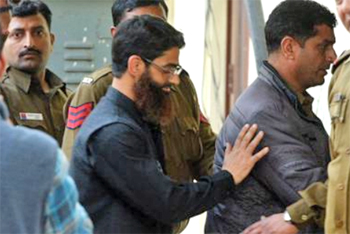
youthHe was picked up by officials of Delhi Police's special cell and Special Task Force (STF) of Kashmir Police.Two days later - after allegedly subjecting him to torture and humiliation at an STF camp - they brought him to Delhi. His crime: he was alleged to have planted a bomb in a DTC bus in Govindpuri on October 29, 2005, which injured many people.

Twelve years later, when he walked free on Thursday - after additional sessions judge Reetesh Singh acquitted him of all charges - the police were facing serious questions of credibility and human rights violations. Rafiq's claim that "he was made an accused to assuage the public perception that Delhi Police was incompetent to act against terrorism" and that "he was a vulnerable target... made a scapegoat" rang true. Police, it seems, deliberately ignored his alibi at every step to prove their case . They brushed aside his plea that it could be proved he was in his class on the day of the blast. It relied on dubious witness es who ended up contradicting themselves, exposed Rafiq to many people when he was in custody before a test identification parade (TIP) could be conducted and suppressed inconvenient facts.

TOI had as early as on February 12, 2006, raised the question whether it "could be a case of harried cops under pressure to show results, targeting an innocent boy?" In a front-page report, "Delhi bomber was in class on October 29", we had reported that Rafiq was actually attending his MA classes in his college in Srinagar. It was also reported that Rafiq had refused to appear for TIP as he had already been presented before some people, one of whom could be a witness in the Govindpuri blast.

The ground had been laid in Srinagar where Rafiq -according to his reply during framing of charges on January 21, 2008 which was cited by the judge - was allegedly forced to drink urine, kept naked and sexually abused, all in order to perhaps break his spirit. He had also alleged that rats were put in his trousers and attempts made to hurt his religious sentiments. "It seems I am being victimised only because I am a Kashmiri Muslim," he said, expressing his faith that justice would prevail and the police get exposed.

The court drew attention to Supreme Court's observation that when it comes to the notice of the investigating agency that a person accused of an offence has a good alibi, then it is the duty of that agency to investigate the genuineness of the plea of alibi and submit a report to the magistrate. "In the case of Manu Sharma versus the State (NCT) of Delhi....Supreme Court had observed that the criminal justice administration system in India places human rights and dignity for human life on a much higher pedestal. An accused is presumed to be innocent till proved guilty and is entitled to fairness and true investigation and a fair trial. The prosecution is expected to play a balanced role in the trial of crime and the investigation should be judicious, fair, transparent and expeditious to ensure compliance with the basic rule of law," the court asserted. Rafiq's case failed on all counts.

First Delhi Police produced a witness, Danbir Sharma, one of the passengers in the bus, on the basis of whose description, they got a portrait made. However, Sharma later couldn't identify Rafiq. The portrait then disappeared mysteriously - pointed out by the judge - even as another witness, Rajeev Sinha, surfaced.

His and Sharma's description of the bomber were at variance. Singh described the bomber as a young man, 22-24 years of age with a French-cut beard and prominent nose, who was wearing a cap with `New York' written on the right. He said he was wearing a white shirt with grey stripes and cotton trousers, either blue or black. Sharma, however, said the bomber was a boy of 5 feet, 10 inches height and had `sanwla' complexion. According to him, he was wearing a `coca cola' coloured shirt and white trousers.

The defence later claimed that Rafiq had a full-grown beard when he was arrested. It was alleged that on November 25, 2005, inspector Badrish Dutt brought a barber to the special cell office and got his beard trimmed to resemble a French cut. He then took a photo of his on his cellphone.

Significantly , Rafiq had refused to participate in a TIP on the ground that he had been exposed to many people while in custody at Lodi Colony and his photographs taken. He particularly mentioned a man wearing spectacles with his lawyers later alleging in court that it was Sinha, a planted witness. Sinha later accepted that he wore spectacles.

Sinha had produced a ticket to prove his presence on the bus that day . This had been left unverified by the police for long though it could have checked its authenticity with the depot manager and the registers he maintained quite easily. It chose not to do so.

The police wrote to the Registrar, University of Kashmir, on February 17, 2006, regarding verification of admission and attendance of Rafiq but chose to forget about it in court. Later, it was claimed that because of vacations, the information could not be procured from the university . However, the judge saw through the charade. DCP S K Tewari had on February 27 - just 10 days after writing the first letter - asked the Registrar "Whether " A" or "P" is marked in the attendance register of the class?" The court said this question could not have been put to the Registrar unless Tewari had access to the attendance records - the ones later produced by the defence and seen by the court - and hence the vacation plea for not being able to verify Rafiq's presence "seems to be false".The court said that in all probability the records had been collected by the police.

The police claimed the other accused, Mohammad Hussain Fazili - who too was acquitted - had led them to Rafiq. Rafiq, however, told the court that he met Fazili for the first time on November 21, 2005, at the STF camp. Fazili, too, denied taking the cops to Rafiq and claimed he was himself misled into believing by inspector Badrish Dutt that he was wanted in connection with an inquiry in a case under the Wildlife Protection Act. He too ended up in jail for 12 years.

Comments

Abdul Aziz
 - 
Saturday, 18 Feb 2017

No need to worry
Allah Almighty has his own plans to deal with injustice people
that day no one can rescue from the everlasting pain and torture

its true
since Truth will prevail and evil will perish

TRUTH
 - 
Saturday, 18 Feb 2017

The evil authorities or those authorities who do such evil acts think that they will getaway from their evil crimes... We Muslims believe, if we dont get justice here... We will surely get the justice in the Court of the lord of the worlds... Allah is just and he will give justice one day... That day the evil people will REGRET and their punishment will be permanent unless they REPENT in this world and help the society to become and stand with the TRUTH...

Shaad
 - 
Saturday, 18 Feb 2017

Without proof and knowingly they kept youth in jail for nothing and with all the proof and clear cut of involvement of Prajna singh, she gets bail.

Waav, incredible law, handler and our ruler.

Add new comment

  • Coastaldigest.com reserves the right to delete or block any comments.
  • Coastaldigset.com is not responsible for its readers’ comments.
  • Comments that are abusive, incendiary or irrelevant are strictly prohibited.
  • Please use a genuine email ID and provide your name to avoid reject.
News Network
March 29,2020

Karnataka on Saturday reported 12 new cases, the highest in a single day so far, taking the tally in the state to 76.

Late at night, the Mysuru district commissioner said five more people had tested positive in the district. But it was yet to be confirmed by the state health department.

Of the cases, 41 are from Bengaluru, eight from Chikkaballapur, while Uttara Kannada and Dakshina Kannada districts have seven each.

Interestingly, the highest number of patients are those from Dubai or those who had transit travel via Dubai. Out of 76 cases, 17 cases (22%) have travel history to Dubai, the capital of Emirate of Dubai and the most populous city in the United Arab Emirates (UAE).

Medical Education Minister Dr K Sudhakar, who is also in-charge of COVID-19 operations, said that Dubai has been a major concern as far as Karnataka COVID-19 patients are concerned. “Most of the positive cases have come through Dubai suggesting something amiss there,” he said. 

Echoing the same, Dr Prakash Kumar, Joint Director, Communicable Diseases, Department of Health and Family Welfare, said, “The layover in Dubai is around six to seven hours. We are seeing Dubai to be the new epicentre of the virus as far as India is concerned.”

UAE was initially not on the list of countries from where passengers were screened. It was added much later when clusters of patients with travel history to Dubai began popping up all over the country.

Patient-19 has infected the maximum so far.

Out of the 12 cases that tested positive on Saturday, five are contacts of Patient 19. All of them are being treated at a Chikkaballapur hospital. Two of them are from Hindupur, Andhra Pradesh, and three are residents of Gauribidanur taluk in Chikkabalapur district.

P19, a 31-year-old man from Chikkaballapur, had travelled to Mecca, Saudi Arabia, and returned to India on March 14. Existing patient clusters suggest that P19 had infected the maximum number of people. Officials did not reveal how many people he originally travelled with to Mecca.

Amid the rise in cases, Jawaid Akhtar, Additional Chief Secretary (Health), maintained that the state had not reached stage 3. But he had no definitive answer as to how the Mysuru patient contracted the virus despite health officials he was in touch with not testing positive.

Health Commissioner Pankaj Kumar Pandey said around 1,000 primary contacts of all positive cases have been classified as high-risk and low-risk. The high-risk patients are in government hospitals while the low-risk ones in quarantine facilities.

Comments

Add new comment

  • Coastaldigest.com reserves the right to delete or block any comments.
  • Coastaldigset.com is not responsible for its readers’ comments.
  • Comments that are abusive, incendiary or irrelevant are strictly prohibited.
  • Please use a genuine email ID and provide your name to avoid reject.
Media Release
February 14,2020

Veteran journalist P. Sainath has said that the nation is in a crisis. And this crisis is not limited to just the rural area. It has become a national crisis at various areas such as agriculture, education, economy, job creation etc.

He was delivering the endowment lecture on the topic ‘Indian democracy at the post-liberalization and post-truth era’ at Media Manthan 2020 organized by the PG department of journalism and mass communication at St Aloysius College (Autonomous). 

Mr Sainath said that the many policies adopted in the 90s led to India becoming unusually unequal. Referring to the speech Ambedkar had made at the Constituent Assembly while handing over the draft of the Constitution, Mr Sainath said, “Ambedkar had warned about the weakness of Indian democracy that liberty without equality allows the supremacy of a few over the multitude. Liberty, equality and fraternity must be kept together as we cannot have one without the other.” 

Mr Sainath stated that the agrarian crisis was no longer about the loss of productivity, employment or about farmer suicide; it was a societal, civilizational crisis. Commenting on the lopsided policies such as cow-slaughter ban, he explained how cow slaughter ban had adversely affected many industries due to their interdependency. While Muslims who slaughtered cows were rendered helpless, the cattle traders who were mostly OBCs lost their earnings as the cattle prices crashed. An important industry like Kolhapur sandals industry in Maharashtra went bankrupt as a result of the cow slaughter ban in Maharashtra. He said the policymakers had no idea how the rural industries were interconnected. Demonetisation too devastated the rural economy as 98 percent of rural transactions happen through cash. 

Mr Sainath also spoke about the crisis of inequality which affects the Dalits and the Adivasis far more than anyone else as 90 percent of the rural households take home less than Rs 10,000/- per month. “Women are yet another group whose labour is never counted in the gross domestic product. Women and girls globally do unpaid work which amounts to about 12.5 billion working hours per year. Monetarily speaking, this is worth 10.8 trillion dollars,” Mr Sainath added. 

Speaking about the crisis of jobs Mr Sainath said that major companies were laying off employees just to create more profits for the investors and the adoption of artificial intelligence in the industry would further destroy millions of jobs.

Rector of St Aloysius College Institutions Fr Dionysius Vaz SJ, Principal Dr (Fr) Praveen Martis SJ, HOD of Journalism and Mass Communication department Dr (Fr) Melwyn Pinto SJ were present.

‘Veerappan and Vijay Mallya’s business models are interesting!’

Addressing the gathering during his endowment lecture on Friday, Mr Sainath made an interesting comment on the so called ‘revenue model’. “Whenever I visit IIMs and IITs for lectures on my PARI project, the students there ask me what my revenue model for my project is. I tell them that I do not have a revenue model. In fact, journalism does not begin with a revenue model. Gandhiji, Ambedkar, Bhagat Singh were all great journalists. But they did not have a revenue model,” Mr Sainath said.

On a lighter note, he said that the best revenue model that he liked was that of forest brigand Veerappan and liquor baron Vijay Mallya. “Veerappan ruled the forest for forty years and from the top ministers to the villagers he could dictate terms and liver royally. Similarly, Mallya’s revenue model was to steal the banks and run away abroad and live like a king,” Mr Sainath added.

Journalism is not and can never be a business. It is a calling, he opined. While newspaper can be a business, television can be a business, journalism per se cannot be reduced to a business. “Unfortunately today, journalists are recruited on a contract basis and they have no bargaining power; and there are no unions to fight for their cause. Hence, they are at the mercy of the corporate media houses for their survival and are made to write stories that cannot be called journalism,” Mr Sainath said.

Answering a question as to the pressures he faced as a journalist, he said that external pressures from the government or others could be very well handled. It is the internal pressures from once own media house that journalists find it difficult to manage.


Comments

Add new comment

  • Coastaldigest.com reserves the right to delete or block any comments.
  • Coastaldigset.com is not responsible for its readers’ comments.
  • Comments that are abusive, incendiary or irrelevant are strictly prohibited.
  • Please use a genuine email ID and provide your name to avoid reject.
News Network
April 3,2020

Mangaluru, Apr 3: The laboratory at District Wenlock Hospital has initiated trial for Covid 19 testing, close on the heels of receiving permission from state government.

Doctors, elected representatives and stakeholders had repeatedly demanded that a laboratory should be set up in the port city. Without the lab, the samples were sent either to Shivamogga or to Bengaluru for testing. When Heath Minister Sriramulu had visited Mangaluru on March 17, he had promised a lab in the city for testing of the samples.

Accordingly, the government gave permission for starting the laboratory at Wenlock Hospital. The process of registering the lab with Indian Council for Medical Research (ICMR) will be completed shortly. The laboratory will be fully operational only after it is registered.

Comments

Add new comment

  • Coastaldigest.com reserves the right to delete or block any comments.
  • Coastaldigset.com is not responsible for its readers’ comments.
  • Comments that are abusive, incendiary or irrelevant are strictly prohibited.
  • Please use a genuine email ID and provide your name to avoid reject.