



‘Aasra’: Hope for Karnataka’s Muslim Women

[email protected] (Nigar Ataulla)
September 6, 2012

Located deep in a densely-populated, over-crowded and largely Muslim locality in Bangalore is a home of cheer and hope that I only very recently discovered. Founded by an amazing woman, Sajeeda Begum, Aasra is probably the only home for destitute and abandoned Muslim women in Karnataka, and, I suppose, one of the few such institutions in the whole country.

Housed in a double-storey rented bungalow, Aasra immediately struck me, as I entered, as a cheerful, neatly-maintained place, one that you could very well call ‘home’. Little girls flitted in and out of the room where I sat waiting for Sajeeda, while old women squatted on chairs sunning themselves. Sajeeda entered and introduced herself, and I felt immediately at ease. Smiling and simple, she seemed the sort of person one could get along with at the very outset itself.
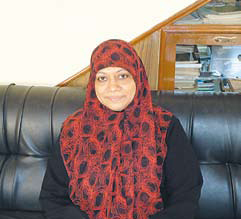
sajeeda

Sajeeda explained how and why she decided to establish Aasra. She related horrific case after case of Muslim women, deserted by their husbands or victimised by domestic violence, dowry oppression, sexual harassment or many other forms of abuse. Aasra was intended to be a short-stay home for such women, where, in a culturally-familiar atmosphere, they could receive shelter as well as legal and psychological counseling and help, including basic working skills, so as to enable them to re-build their lives.

Till date, Sajeeda and her team have handled several hundred such cases. Each case is analysed by experts and counsellors. This free counselling is provided in person or over the phone, through a helpline. Wherever needed, Aasra provides oppressed women police protection and offers legal aid, too. So far, some five hundred such women have received help from Sajeeda and her colleagues. More than a dozen women stay at Aasra at any time, many of them being divorcees and widows who have no other support and whose relatives don’t care for them. Some of them are young girls, whose education Aasra arranges for.

What Sajeeda is doing is, of course, a work of immense courage. How did she get into this, I asked her. “I hail from a business family. My father was a landlord but he was very charitable towards the poor and needy, irrespective of caste, creed or religion. He helped everybody. That really made a mark on me. He was a major inspiration, though my mother also encouraged me to be socially-engaged,” Sajeeda says.

Even after she graduated in Arts from the Maharani’s College in Bangalore and got married, Sajeeda continued her social involvement, running tailoring classes for the poor. She had three children, but yet, running a large family didn’t curb her passion of helping those in need.

In 1991, Sajeeda and some other socially-active Bangalore based Muslim women started the Tanzeemul Mohsinath as an organisation to help poor women and children. In 2004, it was registered as a Trust. In 2009, Aasra was set up as a home for the helpless Muslim women, under the aegis of the Trust. Prior to setting up Aasra, Sajeeda worked with a well-known Bangalore-based women’s group, Vimochana. “Their professionalism was really an inspiration,” she reveals. And that was how she decided to launch a platform for abandoned and mistreated Muslim women, because such women hardly had anyone to platform to reveal their anguish and problems. Many Muslim men, including “leaders”, remained indifferent to or silent on their problems, which meant that they needed to speak for and help themselves, Sajeeda says.

With mainly her own personal funds, Sajeeda rented out a house in Bangalore where Aasra has its premises. Aasra has no permanent sources of funding, and relies almost entirely on Sajeeda’s own personal funds and her friends and relatives to keep it going. Till about mid-2009, she received some funds from the Wakf Foundation, but that soon stopped. Yet, she did not give up and continued Aasra mainly with her money and funds contributed by own children. “Today, I get no funds from the bigwigs in the Muslim community. They do not want to help. Maybe because the cause of women for whom I am working is not considered big for them,” Sajeeda notes. “The patriarchal domination in our society is so much that it is a big task for me to change their mind-set. We are conditioned to believe that the father, husband, brother or son has to be the care taker of women and that women must always be dependent on men. That is why I think Muslim women need their own economic and educational independence and space.”

Luckily for Sajeeda and her team, Aasra was recently recognised by the state’s Women and Child Welfare Department and so is now eligible for some government support. “It’s not much, though, because I have to handle dozens of new cases each month, including of terrible abuse. It’s a tough job, but I am not going to give up,” says Sajeeda.

“My mission in life is to make a positive difference to the lives of helpless women. I have completely stopped shopping or indulging in extravagant spending. God says that doing your duty towards society and the people is very important. Many Muslims have forgotten this altogether. Many of them focus only on religious rituals alone but the real meaning of life is to help suffering humanity first,” beams Sajeeda as she puts her arm around a little, 10 year-old girl who was sold by her father for a few rupees but was recently rescued by Aasra.

Meeting Sajeeda really uplifted my spirits. At least somewhere in some corner of India, one woman was working towards giving Muslim women their right to a dignified life, and there could be nothing more positive than this as far as I was concerned.


Comments

sharique rahman
 - 
Saturday, 30 Apr 2016

kindly seek your email id

sharique rahman
 - 
Saturday, 30 Apr 2016

kindly seek your email address

sharique rahman
 - 
Saturday, 30 Apr 2016

kindly need your email iddress

sharique rahman
 - 
Saturday, 30 Apr 2016

kindly share your email address

Add new comment

  • Coastaldigest.com reserves the right to delete or block any comments.
  • Coastaldigset.com is not responsible for its readers’ comments.
  • Comments that are abusive, incendiary or irrelevant are strictly prohibited.
  • Please use a genuine email ID and provide your name to avoid reject.
Ram Puniyani
March 8,2020

They say ‘history repeats itself first as a tragedy and then as a farce’. In case of India, communal violence not only keeps repeating itself, the pattern of the tragedy keeps changing every next time. Some features of the violence are constant, but they are under the wraps mostly. The same can be said about the Delhi violence (February 2020). The interpretations, the causative factors are very discernible, but those who are generally the perpetrators have a knack of shifting the blame on the victim community or those who stand for the victims.

As the carnage began presumably in the aftermath of statement of Kapil Mishra of BJP, which was given in front of a top police official, in which he threatened to get the roads emptied. The roots of violence were sown earlier. The interpretations given by the Hindu Nationalist camp is that the riot is due to the changing demographic profile of the area with Muslims increasing in number in those areas, and coming up of Shaheen Bagh which was presented was like ‘Mini Pakistan’. As per them the policies of BJP in matters of triple talaq, Article 370 and CAA, NPR, NRC has unnerved the ‘radical’ elements and so this violence.

As such before coming to the observations of the activists and scholars of communal violence in India, we can in brief say that violence, in which nearly 46 people have died, include one from police and another from intelligence. Majority victims are Muslims. The violence started right under the nose of the police and the ruling party. From the videos and other eye accounts, police not only looked the other way around, at places it assisted those attacking the innocent victims and burning and looting selective shops. Home minister, Amit Shah, was nowhere on the scene. For first three days the rioters had free run. After the paramilitary force was brought in; the violence simmered and slowly reduced in intensity. The state AAP Government, which in a way is the byproduct of RSS supported Anna Hazare movement, was busy reading Hanuman Chalisa and praying at Rajghat with eyes closed to the mayhem going in parts of Delhi.

Communal violence is the sore point of Indian society. It did begin during colonial period due to British policy of ‘Divide and Rule’. At root cause was the communal view of looking at history and pro active British acts to sow the seeds of Hindu-Muslim divide. At other level the administrative and police the British were fairly neutral. On one hand was the national movement, uniting the people and creating and strengthening the fraternal feeling among all Indians. On the other were Muslim Communalists (Muslim League) and Hindu Communalists (Hindu Mahasabha, RSS) who assisted the British goal of ‘divide and rule’ promoting hatred between the communities. After partition the first major change was the change in attitude of police and administration which started tilting against Muslims. Major studies by Dr. Asghar Ali Engineer, Paul Brass and Omar Khalidi demonstrated that anti Muslim bias is discernible in during and after the riots.

Now the partisan role of police has been visible all through. Sri Krishna Commission report brought forth this fact; as did the research of the Ex DIG of UP police Dr. V.N.Rai. Dr. Rai’s studies also concluded that no communal violence can go on beyond 24 hours unless state administration is complicit in the carnage. In one of the violence, investigation of which was done by concerned Citizen’s team (Dhule, 2013) this author observed that police itself went on to undertake the rampage against Muslims and Muslim properties.

General observation about riots is that violence sounds to be spontaneous, as the Home Minister is pointing out, but as such it is well planned act. Again the violence is orchestrated in such a way that it seems Muslims have begun the riots. Who casts the First stone? To this scholars point out that the carnage is so organized that the encircled community is forced to throw the first stone. At places the pretext is made that ‘they’ (minorities) have thrown the first stone.

The pretexts against minorities are propagated, in Gujarat violence Godhra train burning, in Kandhamal the murder of Swami Laxamannand and now Shaheen bagh! The Hindu Muslim violence began as riots. But it is no more a riot, two sides are not involved. It is plain and simple anti Minority violence, in which some from the majority are also the victims.

This violence is possible as the ‘Hate against this minority’ is now more or less structural. The deeper Hate against Muslims and partly against Christians; has been cultivated since long and Hindu nationalist politics, right from its Shakhas to the social media have been put to use for spreading Hatred. The prevalent deeper hate has been supplanted this time by multiple utterances from BJP leaders, Modi (Can be recognized by clothes), Shah (press EVM machine button so hard that current is felt in Shaheen Bagh), Anurag Thakur (Goli (bullet) Maro) Yogi Aditya Nath (If Boli (Words)Do not work Goli will) and Parvesh Varma (They will be out to rape).

The incidental observation of the whole tragedy is the coming to surface of true colors of AAP, which not only kept mum as the carnage was peaking but also went on to praise the role of police in the whole episode. With Delhi carnage “Goli Maro” seems to be becoming the central slogan of Hindu nationalists. Delhi’s this violence has been the first one in which those getting killed are more due to bullets than by swords or knifes! Leader’s slogans do not go in vain! Courts the protectors of our Constitution seem to be of little help as if one of them like Murlidhar Rao gives the verdict to file against hate mongers, he is immediately transferred.

And lastly let’s recall the academic study of Yale University. It concludes; BJP gains in electoral strength after every riot’. In India the grip of communalism is increasing frighteningly. Efforts are needed to combat Hate and Hate mongers.

Comments

Add new comment

  • Coastaldigest.com reserves the right to delete or block any comments.
  • Coastaldigset.com is not responsible for its readers’ comments.
  • Comments that are abusive, incendiary or irrelevant are strictly prohibited.
  • Please use a genuine email ID and provide your name to avoid reject.
Ram Puniyani
February 13,2020

Forthcoming Census and RSS campaign

Currently massive protests are going on against NPR, NCR and CAA. At the same time we are going to begin the process of decadal census in 2021. Already RSS is active in promoting NPR, NCR and CAA. At the same time RSS wants that Adivasis should register themselves as Hindus rather than ticking the column of ‘Others’. As per their spokesperson in the 2011 census many Adivasis groups ticked that column because of which the population of Hindus came down to by 0.7 percent point to come down to 79.8 %. This has sent signals to this Hindu nationalist organization and is planning to ensures that Adivasis tick the column of Hindus in this census.

As such RSS has a very clever attitude in defining the term Hindu. The first formulation was by Savakakar who said that all those who regard the land east of Indus as their Holy land and Father land are Hindus. This left out Muslims and Christians, and brought all others in the ambit of Hindu fold. From the decade of 1980s due to electoral compulsions they have been trying to articulate that all those who are living in India are Hindus. Murli Manohar Joshi stated that Muslims are Ahmadiya Hindus and Christians are Christi Hindus. Recently there was a controversy when they restated that Sikhs are not a separate religion but are a sect of Hinduism. Many Sikh organizations stood up to say that Sikhism is a religion by itself and recalled the book of Kahan Singh Nabha, “Hum Hindu Nahin”

As far as Adivasis are concerned in contrast to what is being planned by Hindu nationalist RSS, many Adivasis groups have been meeting from last couple of years to demand just the contrary. As per them there should be a column where they can tick their identity of Adivasis.  There are active campaigns among Adivasis groups to uphold their Adivasi identity in Census. As per them in the first census which was conducted in Independent India, the column, Aborigines, was there, which was later removed forcing them to club themselves with other religions.

After 1951 in addition to Hindu, Muslim, Sikh, Christian, Jain and Buddha, the column ‘others’ was also there which was removed in 2011. Even during British period if you look at the censuses of the British era (from 1871 to 1931); there was provision for tribes to choose Aborigine as an option. There are nearly 83 religious practices being followed by Adivasis. Few major of these are Sarna, Gondi, Punem, Adi, and Koya. What they share in common is that they are animists, worship nature and spirit of ancestors; do not have priestly class or Holy Scriptures and Gods and Goddesses characteristic of the broad Hindu pantheon.

RSS as per its political agenda of Hindu Nation regards them as Vanvasi. They pontificate that they have been part of Hindu society who were driven away to forests to escape the forcible conversion being done by the Muslim invaders. This concoction is contrary to the interpretations based on the studies from population genetics. The Hindu nationalist argues that Aryans have been the original inhabitants of the country from where they spread to other parts of the World. The book by Tony Joseph, ‘Early Indians’ tells us that away from the race theory, we are all mixed up. The first inhabitants in our land were the ones who emigrated from South Asia over Sixty thousand years ago.

The Indo-Aryans came here nearly three thousand years ago and they pushed the aborigines to the forests and hills and that’s what constitutes the Adivasi community of India.

Hindu Nationalists like all the nationalists who construct their nationalism around their religion claim to be the most original inhabitants of the land, and their interpretations of past are molded according to that. RSS right from beginning has not been using the word Adivasi, it calls them Vanvasi. As per its agenda it wants them to be part of Hindu fold, despite Adivasis themselves saying that they are not Hindus, they have beliefs and practices which are far away from Hinduism in whatever form.

To enhance its political reach from the decades of 1980s in particular its work in Adivasis areas has been intensified. While ‘Vanvasis Kalyan Ashram’, part of RSS Combine which was formed much earlier, it was in the decades of 1980s that their work was jacked up by sending more Pracharaks in Adivasi areas. We see that in Gujarat, Dangs and nearby area, Swami Aseemanand, in MP, centered around Jhabua-the followers of Asaram Bapu and in Orissa Swami Laxmananad stationed them. They saw Christian missionaries working in the field of education and health as an obstacle to Hinduization of Adivasis. Their propaganda against Christian missionaries led to the ghastly murder of Pastor Graham Stains. It was this propaganda which led to anti Christian violence in various forms, the most horrific being the Kandhamal violence of 2008.

In order to culturally co-opt them into the fold of Hinduism they began series of religious congregations, Kumbhs. Shabri Kumbh in Dangs and many other Adivasis predominant areas created an atmosphere of fear, Adivasis were asked to be part of it, saffron flags were distributed and they were made to put it in their houses. Two religious icons were popularized in these areas, one was Shabri and other was Hanuman. To cap it all, Ekal Vidyalayas, started spreading RSS’s interpretation of history in these areas. The other angle of the whole thing is that Adivasis are living in the areas rich in minerals, which the BJP supporter Corporate World wants to take over.

World over aborigines have similar pattern. They are animists and what they practice is a culture as such. Many have converted to other religions out of their choice for sure, but finally in these matters what is important is the self perception. Hemant Soren the Chief Minister of Jharkhand pointed out that “Adivasis are not Hindus. ”Keeping that in mind; the column of Aborigines needs to find its place in our census forms.

Comments

Add new comment

  • Coastaldigest.com reserves the right to delete or block any comments.
  • Coastaldigset.com is not responsible for its readers’ comments.
  • Comments that are abusive, incendiary or irrelevant are strictly prohibited.
  • Please use a genuine email ID and provide your name to avoid reject.
Ram Puniyani
March 14,2020

In the wake of Citizenship Amendment Act (CAA) UN High Commissioner, Michele Bachelet, has filed an intervention in the Supreme Court petition challenging the constitutionality of the Citizenship Amendment Act, as she is critical of CAA. Responding to her, India’s Foreign Minister S. Jai Shanker strongly rebutted her criticism, saying that the body (UNHCR) has been wrong and is blind to the problem of cross border terrorism. The issue on hand is the possibility of scores of people, mainly Muslims, being declared as stateless. The problem at hand is the massive exercise of going through the responses/documents from over 120 crore of Indian population and screening documents, which as seen in Assam, yield result which are far from truthful or necessary.

The issue of CAA has been extensively debated and despite heavy critique of the same by large number of groups and despite the biggest mass opposition ever to any move in Independent India, the Government is determined on going ahead with an exercise which is reminiscent of the dreaded regimes which are sectarian and heartless to its citizens, which have indulged in extinction of large mass of people on grounds of citizenship, race etc. The Foreign minister’s assertion is that it is a matter internal to India, where India’s sovereignty is all that matters! As far as sovereignty is concerned we should be clear that in current times any sovereign power has to consider the need to uphold the citizenship as per the principle of non-discrimination which is stipulated in Art.26 of the International Covenant on Civil and Political (ICCPR) rights.

Can such policies, which affect large number of people and are likely to affect their citizenship be purely regarded as ‘internal’? With the World turning into a global village, some global norms have been formulated during last few decades. The norms relate to Human rights and migrations have been codified. India is also signatory to many such covenants in including ICCPR, which deals with the norms for dealing with refugees from other countries. One is not talking of Chicago speech of Swami Vivekanand, which said that India’s greatness has been in giving shelter to people from different parts of the World; one is also not talking of the Tattariaya Upanishad’s ‘Atithi Devovhav’ or ‘Vasudhaiva Kutumbkam’ from Mahaupanishad today.

What are being talked about are the values and opinions of organizations which want to ensure to preserve of Human rights of all people Worldwide. In this matter India is calling United Nations body as ‘foreign party’; having no locus standi in the case as it pertains to India’s sovereignty. The truth is that since various countries are signatories to UN covenants, UN bodies have been monitoring the moves of different states and intervening at legal level as Amicus (Friend of the Court) to the courts in different countries and different global bodies. Just to mention some of these, UN and High Commissioner for Human Rights has often submitted amicus briefs in different judicial platforms. Some examples are their intervention in US Supreme Court, European Court of Human Rights, International Criminal Court, and the Inter-American Court of Human Rights. These are meant to help the Courts in areas where UN bodies have expertise.

 Expertise on this has been jointly formulated by various nations. These interventions also remind the nations as to what global norms have been evolved and what are the obligations of individual states to the values which have evolved over a period of time. Arvind Narrain draws our attention to the fact that, “commission has intervened in the European Court of Human Rights in cases involving Spain and Italy to underscore the principle of non-refoulement, which bars compulsory expulsion of illegal migrants… Similarly, the UN has intervened in the International Criminal Court in a case against the Central African Republic to explicate on the international jurisprudence on rape as a war crime.”

From time to time organizations like Amnesty International and Human Rights Watch have been monitoring the status of Human rights of different countries. This puts those countries in uncomfortable situation and is not welcome by those establishments. How should this contradiction between ‘internal matter’, ‘sovereignty’ and the norms for Human rights be resolved? This is a tough question at the time when the freedom indices and democratic ethos are sliding downwards all over the world. In India too has slid down on the scale of these norms.

In India we can look at the intervention of UN body from the angle of equality and non discrimination. Democratic spirit should encourage us to have a rethink on the matters which have been decided by the state. In the face of the greatest mass movement of Shaheen bagh, the state does need to look inwards and give a thought to international morality, the spirit of global family to state the least.

The popular perception is that when Christians were being persecuted in Kandhmal the global Christian community’s voice was not strong enough. Currently in the face of Delhi carnage many a Muslim majority countries have spoken. While Mr. Modi claims that his good relations with Muslim countries are a matter of heartburn to the parties like Congress, he needs to relook at his self gloating. Currently Iran, Malaysia, Indonesia and many Muslim majority countries have spoken against what Modi regime is unleashing in India. Bangladesh, our neighbor, has also seen various protests against the plight of Muslims in India. More than the ‘internal matter’ etc. what needs to be thought out is the moral aspect of the whole issue. We pride ourselves in treading the path of morality. What does that say in present context when while large section of local media is servile to the state, section of global media has strongly brought forward what is happening to minorities in India.   

The hope is that Indian Government wakes up to its International obligations, to the worsening of India’s image in the World due to CAA and the horrific violence witnessed in Delhi.

Comments

Add new comment

  • Coastaldigest.com reserves the right to delete or block any comments.
  • Coastaldigset.com is not responsible for its readers’ comments.
  • Comments that are abusive, incendiary or irrelevant are strictly prohibited.
  • Please use a genuine email ID and provide your name to avoid reject.