Hand-made artifacts showcase India's culturally enriched regions

[email protected] (CD Network, Photos by Suresh Vamanjoor)
December 6, 2013

Mangalore, Dec 6: A ten-day exhibition featuring the rich and varied art and craft traditions from various parts of India,'Cottage Mela 2013' organised by Central Cottage Industries Emporium (CCIE) was inaugurated here on Friday, providing a platform for the cultural and artistic interchange between artisans and customers.

The exhibition-cum-sale was inaugurated by owner of Woodlands Hotel, Mangalore Ramesh Bhat in the premises of the hotel.

Several customers were seen interacting with artisans from Rajasthan, Kashmir, Tamil Nadu, Hyderabad and other parts of the country, admiring hand-made art objects and jewellery.

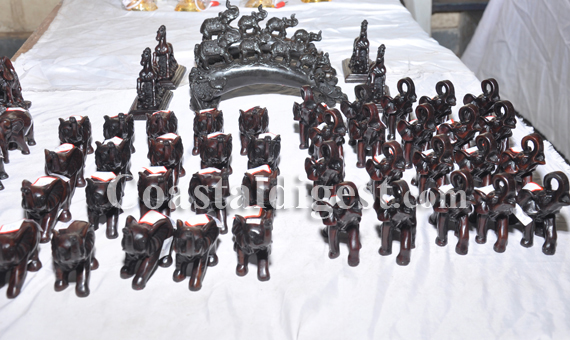
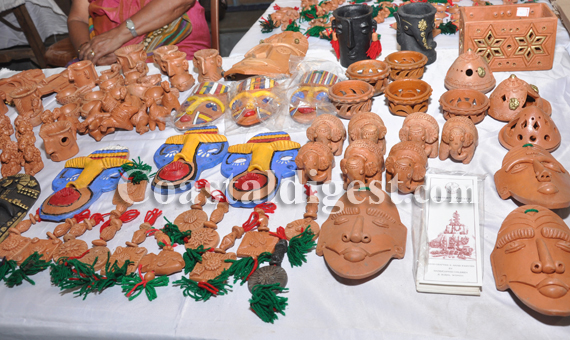
Exquisitely-made handicrafts such as silver jewellery, ethnic show pieces made from terra-cotta, paintings, metal ware, woodcraft, show pieces made of marble dust from Tamil Nadu, pottery, lamps, Kashmiri hand-woven carpets, hand-crafted wooden furniture, brass and bronze idols and semi-precious stone jewellery were on display at the exhibition.

The sale also presented several kinds of textiles such as handloom and cotton sarees and dresses, kurtas, jackets and scarves from Bihar, Rajasthan, Lucknow and Kashmir.

Apart from the special attraction of hand-knotted carpets, handmade silver jewellery made by artisans from Kashmir caught the fancy of women who walked into the mela.

Another crowd-puller were exquisite art products and show pieces creatively made out of terra-cotta that were kept on display by Mangalorean Merlin Raskina, who has been making show-pieces and conducting exhibitions from the past 20 years.

The mela will be open till December 15 from 10 a.m. to 7 p.m. For further details, contact Inayath Shah – 9448071867.

hm

hm1

hm2

hm3

Comments

Add new comment

  • Coastaldigest.com reserves the right to delete or block any comments.
  • Coastaldigset.com is not responsible for its readers’ comments.
  • Comments that are abusive, incendiary or irrelevant are strictly prohibited.
  • Please use a genuine email ID and provide your name to avoid reject.
News Network
January 27,2020

New Delhi, Jan 27: Non-Muslim refugees from Pakistan, Bangladesh and Afghanistan will have to provide proofs of their religious beliefs while applying for Indian citizenship under the controversial Citizenship Amendment Bill (CAA), officials said on Monday.

The applicants belonging to Hindu, Sikh, Christian, Buddhist, Jain or Parsi faiths will also have to furnish documents to prove that they entered India on or before December 31, 2014.

Those who will seek Indian citizenship under the CAA will have to provide proofs of their religious beliefs and this will be mentioned in the rules to be issued under the CAA, a government official said.

According to the CAA, members of Hindu, Sikh, Buddhist, Jain, Parsi and Christian communities who have come from Pakistan, Bangladesh and Afghanistan till December 31, 2014, due to religious persecution there will not be treated as illegal immigrants and will be given Indian citizenship.

The central government is also likely to give a relatively smaller window of just three months to those who want to apply for Indian citizenship in Assam under the CAA, another official said.

Some Assam-specific provisions are expected to be incorporated in the rules to be issued for the implementation of the CAA.

Assam chief minister Sarbananda Sonowal and his finance minister Himanta Biswa Sarma had made a request about a fortnight ago to keep a limited period window for applying under the CAA and also incorporate some other Assam-specific provisions in the CAA rules.

The move comes in view of continuing protests against the CAA in Assam that have been going on since the legislation was passed by Parliament in December last year.

There has been a growing feeling among the indigenous people of Assam that the newly enacted legislation will hurt their interests politically, culturally as well as socially.

The Assam Accord provides for detection and deportation of all illegal immigrants who have entered the country after 1971 and are living in the state, irrespective of their religion.

The protesters in Assam say that the CAA violates the provisions of the Assam Accord.

Comments

Add new comment

  • Coastaldigest.com reserves the right to delete or block any comments.
  • Coastaldigset.com is not responsible for its readers’ comments.
  • Comments that are abusive, incendiary or irrelevant are strictly prohibited.
  • Please use a genuine email ID and provide your name to avoid reject.
News Network
June 8,2020

Bengaluru, Jun 8: The Janata Dal (Secular) on Monday announced that former Prime Minister HD Deve Gowda has decided to contest the forthcoming Rajya Sabha elections.

"Former Prime Minister HD Deve Gowda has decided to contest the Rajya Sabha elections at the request of our party legislators, Congress President Sonia Gandhi and many other leaders of the country. Tomorrow, he will be filing nomination for the election. Thanks to the former PM for agreeing to everyone's consensus," JDS leader HD Kumaraswamy said.

The elections to fill the vacant 18 Rajya Sabha seats from seven states are scheduled to be held on June 19.

Four Rajya Sabha seats are up for grabs in the state, Congress has already nominated senior leader Mallikarjun Kharge as its candidate.

The ruling BJP will field candidates for two seats.

Comments

Add new comment

  • Coastaldigest.com reserves the right to delete or block any comments.
  • Coastaldigset.com is not responsible for its readers’ comments.
  • Comments that are abusive, incendiary or irrelevant are strictly prohibited.
  • Please use a genuine email ID and provide your name to avoid reject.
Agencies
May 8,2020

Washington D.C., May 8: The prime time for brain development in a child's life is the first year, where the infant spends most of the time asleep. It is the time when neural connections form and sensory memories are encoded.

However, when sleep is disrupted, as occurs more often among children with autism, brain development may be affected, too.

New research led by the University of Washington finds that sleep problems in a baby's first 12 months may not only precede an autism diagnosis but also may be associated with altered growth trajectory in a key part of the brain, the hippocampus.

The study, which was published in the American Journal of Psychiatry, researchers report that in a sample of more than 400 taken of 6- to 12-month-old infants, those who were later diagnosed with autism were more likely to have had difficulty falling asleep.

It also states that this sleep difficulty was associated with altered growth trajectories in the hippocampus.

"The hippocampus is critical for learning and memory, and changes in the size of the hippocampus have been associated with poor sleep in adults and older children.

As many as 80 per cent of the children with autism spectrum disorder have sleep problems," said Annette Estes, director of the UW Autism Center and senior author of the study.

"In our clinical experience, parents have a lot of concerns about their children's sleep, and in our work on early autism intervention, we observed that sleep problems were holding children and families back," added Estes, who is also a UW professor of speech and hearing sciences.

"It could be that altered sleep is part-and-parcel of autism for some children. One clue is that behavioural interventions to improve sleep don't work for all children with autism, even when their parents are doing everything just right. This suggests that there may be a biological component to sleep problems for some children with autism," said Estes.

To consider links among sleep, brain development, and autism, researchers at the IBIS Network looked at MRI scans of 432 infants, surveyed parents about sleep patterns, and measured cognitive functioning using a standardized assessment.

At the outset of the study, infants were classified according to their risk for developing autism: Those who were at higher risk of developing autism -- about two-thirds of the study sample -- had an older sibling who had already been diagnosed.

Infant siblings of children with autism have a 20 per cent chance of developing autism spectrum disorder -- a much higher risk than children in the general population.

In the current study, 127 of the 432 infants were identified as "low risk" at the time the MRI scans were taken because they had no family history of autism.

They later evaluated all the participants at 24 months of age to determine whether they had developed autism. Of the roughly 300 children originally considered "high familial risk," 71 were diagnosed with autism spectrum disorder at that age.

Problems with sleep were more common among the infants later diagnosed with an autism spectrum disorder, as were larger hippocampi. No other subcortical brain structures were affected, including the amygdala, which is responsible for certain emotions and aspects of memory, or the thalamus, a signal transmitter from the spinal cord to the cerebral cortex.

The authors note that while parents reported more sleep difficulties among infants who developed autism compared to those who did not, the differences were very subtle and only observed when looking at group averages across hundreds of infants.

Sleep patterns in the first years of life change rapidly as infants transition from sleeping around the clock to a more adult-like sleep/wake cycle. Until further research is completed, Estes said, it is not possible to interpret challenges with sleep as an early sign of increased risk for autism.


Comments

Add new comment

  • Coastaldigest.com reserves the right to delete or block any comments.
  • Coastaldigset.com is not responsible for its readers’ comments.
  • Comments that are abusive, incendiary or irrelevant are strictly prohibited.
  • Please use a genuine email ID and provide your name to avoid reject.