


India asks Pak to act against Jaish-e-Mohammed

January 6, 2016

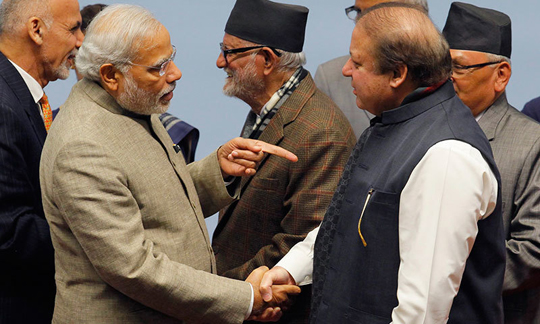
New Delhi, Jan 6: India has asked Pakistan to immediately act against the leadership of the terror organization, Jaish-e-Mohammed (JeM), beginning with the arrest of its three operatives, who were coordinating the Pathankot terror attack and were in touch with the terrorists who carried it out.
india

New Delhi also asked Islamabad to arrest Moulana Masood Azhar—the JeM founder, who has been subjected to sanctions by the US government for his links with terror networks at least since 2010, but lives free in Pakistan.

The “specific and actionable information” Prime Minister Narendra Modi’s National Security Advisor (NSA) Ajit Doval shared with his Pakistani counterpart Naseer Khan Janjua on Monday included recordings and transcripts of the calls between the terrorists, who carried out the attack on the IAF base at Pathankot and their ‘handlers’ at the control room JeM set up in Bahawalpur in Pakistan, sources in New Delhi told Deccan Herald.

The calls were intercepted by India’s intelligence agencies.

Sources said the JeM operatives, who had coordinated the attack from Pakistan, had been identified as Ashfaq Ahmad, Hafiz Abdul Shakur and Kasim Jaan.

Ashfaq is known as a close aide of Masood Azhar and is believed to have played a key role in reviving the JeM over the past couple of years.

Doval is understood to have also shared with Pakistan Prime Minister M Nawaz Sharif’s NSA the specific location of the control room set up by the JeM to coordinate the attacks.

Azhar was arrested by the Army in Kashmir in 1994, but New Delhi had to release him in 1999 in exchange of the passengers of the IC-814, which was hijacked by the terrorists and taken to Kandahar in Afghanistan.

The JeM, based in Bahawalpur in Pakistan, was designated as a Foreign Terrorist Organization by the US State Department in 2001. After Pakistan was forced to outlaw it in 2002, the outfit began using Al Rehmat Trust as a front for its operations.

The Al Rehmat Trust provided support for militant activities in Afghanistan and Pakistan, including financial and logistical support to foreign fighters operating in both countries.

In early 2009, several prominent members of Al Rehmat Trust were recruiting students for terrorist activities in Afghanistan, according to a report by the US Department of Treasury.

Comments

Shaad
 - 
Wednesday, 6 Jan 2016

How funny, it's like Pakistan ask India to take action against RSS.
Both Govt run by Terror organisation.

Add new comment

  • Coastaldigest.com reserves the right to delete or block any comments.
  • Coastaldigset.com is not responsible for its readers’ comments.
  • Comments that are abusive, incendiary or irrelevant are strictly prohibited.
  • Please use a genuine email ID and provide your name to avoid reject.
News Network
January 8,2020

Howrah, Jan 8: Following the 'Bharat Bandh' called by trade unions, protesters blocked railway tracks in Howrah and Kanchrapara in North 24 Parganas on Wednesday.

They raised anti-government slogans and criticised the Center for its policies. They were holding placards, posters and banners against the government.

Commuters faced difficulties as bus services were also affected. CPI (M) protesters also stopped the operation of state transport buses. In Odisha, the public agitation started around 6 am at Talcher, Bhubaneswar, Brahmapur, Bhadrak and Kendujhargarh.

Due to the protests, the following trains are detained enroute at different stations --Bhadrak-Brahmapur passenger at Bhadrak, Kendujhargarh-Bhubaneswar passenger at Kendujhargarh, Bhubaneswar-Balangir InterCity at Bhubaneswar, Howrah-Yesvantpur Express at Brahmapur, Ichhapur-Cuttack MEMU at

Brahmapur and Puri-Rourkela passenger at Bhubaneswar.

The ten central trade unions including Centre of Indian Trade Unions (CITU), Indian National Trade Union Congress (INTUC), among others have given the call for strike with a 12-point charter of demand. Trade union Bharatiya Mazdoor Sangh (BMS) is not taking part in the strike.

Comments

Add new comment

  • Coastaldigest.com reserves the right to delete or block any comments.
  • Coastaldigset.com is not responsible for its readers’ comments.
  • Comments that are abusive, incendiary or irrelevant are strictly prohibited.
  • Please use a genuine email ID and provide your name to avoid reject.
News Network
January 14,2020

New Delhi, Jan 14: The curative petitions of Vinay Sharma and Mukesh, who were sentenced to death in the Nirbhaya gang rape and murder case, was on Tuesday rejected by a five-judge Supreme Court Bench led by Justice N.V. Ramana.

In a three-page order, the Bench concluded, after an in chamber consideration that began about 1.45 p.m., that there was no merit in their pleas to spare them from the gallows.

“We have gone through the curative petitions and relevant documents. In our opinion, no case is made out within the parameters indicated in the decision of this Court in Rupa Ashok Hurra versus Ashok Hurra. Hence, the curative petitions are dismissed,” the court held.

Curative is a rare remedy devised by a Constitution Bench of the Supreme Court in its judgment in the Rupa Ashok Hurra case in 2002. A party can take only two limited grounds in a curative petition - one, he was not heard by the court before the adverse judgment was passed, and two, the judge was biased. A curative plea, which follows the dismissal of review petition, is the last legal avenue open for convicts in the Supreme Court. Sharma was the first among the four convicts to file a curative.

The Bench also rejected their pleas to stay the execution of their death sentence and for oral hearing in open court.

Besides Justice Ramana, the Bench comprised Arun Mishra, Rohinton Nariman, R. Banumathi and Ashok Bhushan.

Curative petitions were filed in the Supreme Court by both convicts on January 9. The petitions had come just days after a Delhi sessions court schedulled the execution of all the four convicts in Tihar jail on January 22.

Sharma and Mukesh, in separate curative petitions, argued that there was a “sea change” in the death penalty jurisprudence since their convictions. Carrying out the death sentence on such changed circumstances would be a “gross miscarriage of justice”.

In his plea, Sharma said the Court had commuted the death penalty in several rape and murder cases since 2017, when it first confirmed the death penalty to the Nirbhaya convicts.

“fter the pronouncement of judgment in 2017, there have been as many as 17 cases involving rape and murder in which various three-judge Benches of the Supreme Court have commuted the sentence of death,” the petition contended.

The Supreme Court recently dismissed a review petition filed by Akshay Singh, another of the four four condemned men, to review its May 5, 2017 judgment confirming the death penalty. It also refused his plea to grant him three weeks' time to file a mercy petition before the President of India.

A Bench led by Justice R. Banumathi had said it was open for the Nirbhaya case convicts to avail whatever time the law prescribes for the purpose of filing a mercy plea.

Akshay (33), Mukesh (30), Pawan Gupta (23) and Sharma (24) had brutally gang-raped a 23-year-old paramedical student in a moving bus on the intervening night of December 16-17, 2012. She died of her injuries a few days later.

The case shocked the nation and led to the tightening of anti-rape laws. Rape, especially gang rape, is now a capital crime.

One of the accused in the case, Ram Singh, allegedly committed suicide in the Tihar jail. A juvenile, who was among the accused, was convicted by a juvenile justice board. He was released from a reformation home after serving a three-year term.

Comments

Add new comment

  • Coastaldigest.com reserves the right to delete or block any comments.
  • Coastaldigset.com is not responsible for its readers’ comments.
  • Comments that are abusive, incendiary or irrelevant are strictly prohibited.
  • Please use a genuine email ID and provide your name to avoid reject.
Agencies
March 15,2020

Financially troubled Yes Bank on Saturday reported a standalone net loss of ₹ 18,560.31 crore for the third quarter of the financial year 2019-20. This is amongst the biggest losses reported by the India Inc.

At present, the private lender is under a moratorium and is controlled by the office of the administrator appointed by the RBI.

The bank had reported a net profit of ₹1,001.85 crore during the corresponding period of the previous financial year.

Besides, the bank's total income fell to Rs 6,268.50 crore from Rs 8,849.81 crore earned during the October-December quarter of the previous fiscal.

On consolidated basis, Yes Bank reported a net loss of ₹18,564.24 crore for the December quarter from a net profit of Rs 1,000.57 crore in the corresponding period of the previous fiscal.

The independent auditor's review report on the consolidated results pointed out that there is a "material uncertainty related to going concern" of the bank.

"The said assumption of going concern is dependent upon the degree of success of the final reconstruction scheme, the quantum of capital infused into the bank and the bank's ability to stabalise its deposit balances post withdrawal of the moratorium by the RBI. Our conclusion is not modified in respect of this matter," the auditor said.

Furthermore, the bank recognised additional loans of ₹ 5,150.2 crore as NPAs and related provisioning requirements of ₹772.5 crore for the quarter ended December 31, 2019.

The bank has recognised an additional provisions of ₹15,422.0 crore in the quarter ended December 31, 2019.

Last week, the RBI placed Yes Bank under moratorium and capped the withdrawal limit at ₹50,000 till next Wednesday.

Additionally, the central bank also superseded Yes Bank's board of directors and appointed former SBI CFO Prashant Kumar as its administrator.

Meanwhile, Kumar has been appointed as the new Chief Executive Officer of the financially troubled lender. He will take over his new responsibilities once the moratorium on the stressed lender is lifted on Wednesday.

Apart from Kumar, Sunil Mehta, former non-executive Chairman of Punjab National Bank, will take over as the non-executive Chairman of Yes Bank.

Other board members include Mahesh Krishnamurthy and Atul Bheda, both as non-executive Directors.

Additionally, six private lenders have joined the SBI to rescue Yes Bank with Federal Bank committing ₹300 crore by subscribing to 30 crore shares of ₹2 each at a premium of ₹8 per equity share.

The six private lenders have now committed an investment of ₹3,700 crore in the cash-strapped private sector bank.

On Friday, ICICI Bank and Housing Development Finance Corporation (HDFC) Ltd had announced that they will be investing ₹1,000 crore each in Yes Bank's equity. Axis Bank and Kotak Mahindra Bank will be investing ₹ 600 crore and ₹500 crore, respectively, while Bandhan Bank will invest ₹300 crore.

The SBI board has already approved up to 49 per cent stake purchase in Yes Bank, as per the RBI's reconstruction scheme for the lender. It had said on Thursday that an investment of ₹7,250 crore would be made in Yes Bank to pick up₹ 725 crore equity shares.

Comments

Add new comment

  • Coastaldigest.com reserves the right to delete or block any comments.
  • Coastaldigset.com is not responsible for its readers’ comments.
  • Comments that are abusive, incendiary or irrelevant are strictly prohibited.
  • Please use a genuine email ID and provide your name to avoid reject.