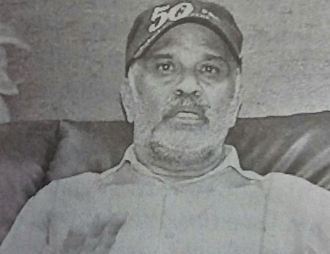
Kasaragod: Undocumented expat worker returns from Bahrain after 38 years

[email protected] (CD Network)
January 10, 2016

Kasaragod, Jan 10: Nearly four decades after he left Kasaragod and landed in Gulf, he could not return home till last week. 54-year-old Alambadu Balakrishnan who spent 38 years in Bahrain as an undocumented migrant worker returned home last Saturday under a six-month public amnesty for undocumented workers in Bahrain that ended on December 31, 2015.

balakrishnaBalakrishnan, who has been doing mundane jobs, did not go home even once as he was stuck without a passport and suffered from depression following the death of his mother and brother in the past.

Alambadu Balakrishnan, who hails from Kanjangadu, Madikkai in Kasargod, Kerala, was brought to Bahrain by his elder brother Kannan, who later fell sick due to cancer and returned home for treatment. His younger brother Kelu, too was in Bahrain, but he lost his job, leaving the responsibility of repatriating him to Balakrishnan.

“He used to send money to his mother till her death three years ago. When his friends visited Kerala, he used to send blankets and other gifts for his mother. He spoke for about one hour when his mother died and after three hours, he got another phone call informing about the death of his elder brother,” a Malayalam language has reported.

Balakrishnan’s ambition on returning home is to build a house and if anyone is ready to be his life partner at this age, he wishes to get married.

Over 42,000 expatriate workers in Bahrain benefited from the six-month general amnesty for workers staying in Bahrain illegally, the CEO of the Labour Market Regulatory Authority Ausamah Abdullah Al Absi has said. Bangladeshis, Indians and Pakistanis were the most beneficiaries of the amnesty.

Comments

Mohan
 - 
Sunday, 10 Jan 2016

we should blame our country for this injustice act,

jeevan
 - 
Sunday, 10 Jan 2016

lucky man finally get to his country

Mehaboob khan
 - 
Sunday, 10 Jan 2016

we should be thankful to saudi govt.

Add new comment

  • Coastaldigest.com reserves the right to delete or block any comments.
  • Coastaldigset.com is not responsible for its readers’ comments.
  • Comments that are abusive, incendiary or irrelevant are strictly prohibited.
  • Please use a genuine email ID and provide your name to avoid reject.
News Network
July 14,2020

Bengaluru, July 14: The Karnataka government has allowed some relaxations during the week-long lockdown in Bengaluru urban and rural districts. The lockdown will commence from 8p.m. today (July 14) and end at 5a.m. on July 22.  The government has released the guidelines for lockdown.

Restrictions

*No new flights or trains will be permitted; only flights and trains already scheduled will continue to operate. Flight and train tickets shall serve as passes for movement by taxis/cab aggregators/auto rickshaws.

* Metro rail services prohibited

* Taxis and services of cab aggregators will be prohibited except for emergency and as permitted in guidelines.

* Schools, colleges, educational/training/coaching institutions etc. will remain closed. Online/distance learning shall continue to be permitted. Examination already scheduled shall be permitted

* Hotels, restaurants, and hospitality services, prohibited except those meant for health/police/government officials/healthcare workers. Hotels and restaurants shall be permitted to operate kitchens for takeaway/home delivery of food items only.

* All cinema halls, shopping malls, gymnasiums, sports complexes, stadia, swimming pools, entertainment parks, theatres, bars and auditoriums, assembly halls and similar places.

* All social/political/sports/entertainment/academic/cultural religious functions/other gatherings and large congregations.

* All religious places/places of worship shall be closed for public. Religious congregations are strictly prohibited. Commercial and private establishment shall be closed down

Relaxations (outside containment zone)

* Shops including ration shops (PDS), dealing with food, groceries, fruits and vegetables, etc. to open only from 5 am to 12 noon. Home delivery of essential items shall be encouraged.

* All facilities in the supply chain of essential goods, whether involved in manufacturing, wholesale or retail of such goods through local stores, large brick and mortar stores or e-commerce companies.

* All food processing and related industries.

* Banks, insurance offices and ATM.

* Print and electronic media.

* Telecommunication, internet services, broadcasting and cable services, IT and IT-enabled services with minimum staff for essential purposes. As far as possible, work from home should be encouraged.

* Delivery of essential items such as food, medicines, pharmaceuticals, medical equipment through e-commerce.

* Power generation, transmission and distribution units and services.

* Capital and debt market services and notified by the Securities and Exchange Board of India (Sebi)

* Cold storage and warehousing services.

* Private security services.

* Delivery of goods by E-Commerce companies. Industries/industrial establishments as listed below will be allowed to operate (outside containment zones):

i. Production units which require continuous process, and their supply chain.

ii. Food processing industries, manufacturing of essential goods, including drugs, pharmaceuticals, medical devices, their raw material and intermediates.

iii. Manufacturing of packing materials.

iv. Manufacturing and other industrial establishment with access control in Special Economic Zones (SEZs) or outside municipal limits and Export Oriented Units (EoUs), Industrial townships. Construction activities will be allowed in continuation of works in construction projects, where workers are available on site.


Comments

Add new comment

  • Coastaldigest.com reserves the right to delete or block any comments.
  • Coastaldigset.com is not responsible for its readers’ comments.
  • Comments that are abusive, incendiary or irrelevant are strictly prohibited.
  • Please use a genuine email ID and provide your name to avoid reject.
Ram Puniyani
March 8,2020

They say ‘history repeats itself first as a tragedy and then as a farce’. In case of India, communal violence not only keeps repeating itself, the pattern of the tragedy keeps changing every next time. Some features of the violence are constant, but they are under the wraps mostly. The same can be said about the Delhi violence (February 2020). The interpretations, the causative factors are very discernible, but those who are generally the perpetrators have a knack of shifting the blame on the victim community or those who stand for the victims.

As the carnage began presumably in the aftermath of statement of Kapil Mishra of BJP, which was given in front of a top police official, in which he threatened to get the roads emptied. The roots of violence were sown earlier. The interpretations given by the Hindu Nationalist camp is that the riot is due to the changing demographic profile of the area with Muslims increasing in number in those areas, and coming up of Shaheen Bagh which was presented was like ‘Mini Pakistan’. As per them the policies of BJP in matters of triple talaq, Article 370 and CAA, NPR, NRC has unnerved the ‘radical’ elements and so this violence.

As such before coming to the observations of the activists and scholars of communal violence in India, we can in brief say that violence, in which nearly 46 people have died, include one from police and another from intelligence. Majority victims are Muslims. The violence started right under the nose of the police and the ruling party. From the videos and other eye accounts, police not only looked the other way around, at places it assisted those attacking the innocent victims and burning and looting selective shops. Home minister, Amit Shah, was nowhere on the scene. For first three days the rioters had free run. After the paramilitary force was brought in; the violence simmered and slowly reduced in intensity. The state AAP Government, which in a way is the byproduct of RSS supported Anna Hazare movement, was busy reading Hanuman Chalisa and praying at Rajghat with eyes closed to the mayhem going in parts of Delhi.

Communal violence is the sore point of Indian society. It did begin during colonial period due to British policy of ‘Divide and Rule’. At root cause was the communal view of looking at history and pro active British acts to sow the seeds of Hindu-Muslim divide. At other level the administrative and police the British were fairly neutral. On one hand was the national movement, uniting the people and creating and strengthening the fraternal feeling among all Indians. On the other were Muslim Communalists (Muslim League) and Hindu Communalists (Hindu Mahasabha, RSS) who assisted the British goal of ‘divide and rule’ promoting hatred between the communities. After partition the first major change was the change in attitude of police and administration which started tilting against Muslims. Major studies by Dr. Asghar Ali Engineer, Paul Brass and Omar Khalidi demonstrated that anti Muslim bias is discernible in during and after the riots.

Now the partisan role of police has been visible all through. Sri Krishna Commission report brought forth this fact; as did the research of the Ex DIG of UP police Dr. V.N.Rai. Dr. Rai’s studies also concluded that no communal violence can go on beyond 24 hours unless state administration is complicit in the carnage. In one of the violence, investigation of which was done by concerned Citizen’s team (Dhule, 2013) this author observed that police itself went on to undertake the rampage against Muslims and Muslim properties.

General observation about riots is that violence sounds to be spontaneous, as the Home Minister is pointing out, but as such it is well planned act. Again the violence is orchestrated in such a way that it seems Muslims have begun the riots. Who casts the First stone? To this scholars point out that the carnage is so organized that the encircled community is forced to throw the first stone. At places the pretext is made that ‘they’ (minorities) have thrown the first stone.

The pretexts against minorities are propagated, in Gujarat violence Godhra train burning, in Kandhamal the murder of Swami Laxamannand and now Shaheen bagh! The Hindu Muslim violence began as riots. But it is no more a riot, two sides are not involved. It is plain and simple anti Minority violence, in which some from the majority are also the victims.

This violence is possible as the ‘Hate against this minority’ is now more or less structural. The deeper Hate against Muslims and partly against Christians; has been cultivated since long and Hindu nationalist politics, right from its Shakhas to the social media have been put to use for spreading Hatred. The prevalent deeper hate has been supplanted this time by multiple utterances from BJP leaders, Modi (Can be recognized by clothes), Shah (press EVM machine button so hard that current is felt in Shaheen Bagh), Anurag Thakur (Goli (bullet) Maro) Yogi Aditya Nath (If Boli (Words)Do not work Goli will) and Parvesh Varma (They will be out to rape).

The incidental observation of the whole tragedy is the coming to surface of true colors of AAP, which not only kept mum as the carnage was peaking but also went on to praise the role of police in the whole episode. With Delhi carnage “Goli Maro” seems to be becoming the central slogan of Hindu nationalists. Delhi’s this violence has been the first one in which those getting killed are more due to bullets than by swords or knifes! Leader’s slogans do not go in vain! Courts the protectors of our Constitution seem to be of little help as if one of them like Murlidhar Rao gives the verdict to file against hate mongers, he is immediately transferred.

And lastly let’s recall the academic study of Yale University. It concludes; BJP gains in electoral strength after every riot’. In India the grip of communalism is increasing frighteningly. Efforts are needed to combat Hate and Hate mongers.

Comments

Add new comment

  • Coastaldigest.com reserves the right to delete or block any comments.
  • Coastaldigset.com is not responsible for its readers’ comments.
  • Comments that are abusive, incendiary or irrelevant are strictly prohibited.
  • Please use a genuine email ID and provide your name to avoid reject.
News Network
May 3,2020

Bengaluru, May 3: Karnataka Chief Minister BS Yediyurappa requested his Maharashtra counterpart Uddhav Thackeray to release six TMC water from his state's reservoirs to rivers in Karnataka to meet acute drinking water shortage in North Karnataka.

Yediyurappa pointed out that the North Karnataka districts, namely Belagavi, Vijayapura, Bagalkot, Kalaburagi, Yadagiri and Raichur are facing acute shortage of drinking water due to onset of summer during early days of March this year.

"I request you to kindly direct the concerned authorities to release 3 TMC of water from Warna/Koyna reservoirs to Krishna river and 3 TMC of water from Ujjaini reservoir to Bhima river on humanitarian grounds for drinking purpose," Yediyurappa said in his letter.

He reminded Thackeray that even in the past the Maharashtra government had released water from its reservoirs to meet the drinking water needs of both human beings and livestock in drought-affected areas of Karnataka.

Comments

Add new comment

  • Coastaldigest.com reserves the right to delete or block any comments.
  • Coastaldigset.com is not responsible for its readers’ comments.
  • Comments that are abusive, incendiary or irrelevant are strictly prohibited.
  • Please use a genuine email ID and provide your name to avoid reject.