



Dubai: Can anyone help these NRI sisters trace their mother?

January 11, 2016

Hyderabad, Jan 11: Two sisters from Dubai made an unusual request on Saturday when they called on V Satyanarayana, deputy commissioner of Hyderabad Police’s south zone. Could the police help them find their mother, whom they hadn’t met for 27 years? The only lead they could provide the officer was a faded photograph and an Indian passport, issued in 1981 and barely legible.
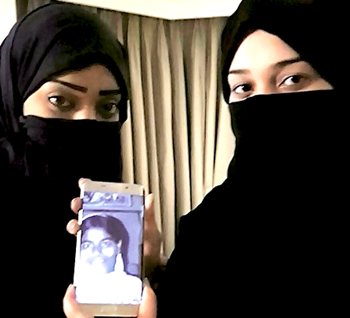
DubaiAyesha and Fatima, 33 and 32, last saw their mother when their father divorced her in 1988 and sent her back to Hyderabad, her hometown. They said they knew nothing else about her, because their father while alive had allegedly forbidden them to talk about her.

Their father Rasheed Obaid Masmary, a Dubai businessman, had married their mother Razia Sayeed in 1981, the marriage arranged by brokers. Rasheed arranged for his bride’s passport, issued by the erstwhile Madras Passport Office, and the couple settled in Dubai.

Ayesha was born a year after the marriage, Fatima the following year. After Rasheed divorced Razia in 1988, allegedly without legal proceedings, the daughters stayed with their father in Dubai. A couple of years later, Rasheed married a second time — the bride was again a Hyderabadi woman — and she settled with him in Dubai.

Ayesha and Fatima never saw their mother since 1988, when they were six and five, too young to remember much about her now. This is their first visit to Hyderabad. Their father never travelled here again although their stepmother would visit home sometimes. Rasheed died a few years ago, apparently without telling his two daughters who or where their mother was.

“Our father had cut off all contact with our mother and never told us anything about her,” said Ayesha. The sisters, fluent in Arabic, are communicating in broken English with people in Hyderabad.

“Except for a photo and a vague, almost illegible handwritten address on her passport, we know nothing about our mother. We don’t even know which part of Hyderabad she was from, or if she has any family here,” Ayesha said. “Our stepmother possibly knows about her but she has refused to tell us anything. We saw some posts on social media about the work done by Hyderabad police in tracing people, so we thought we will try too. Years have passed but we are hopeful we will get to meet her.”

Ayesha, who is married in Dubai, said her businessman husband supported her effort to search for their mother. The sisters flew to Hyderabad last week. They had made calls to police from Dubai earlier but, in the absence of local contacts, they could not make much headway. In Hyderabad, they came in touch with a local activist, Mohammed Abrar Sharif, who took them to the DCP.

The photo has been circulated among police stations. Police said they will try to trace the old address from the passport office in Chennai if those records are still available.

Comments

Naren kotian
 - 
Tuesday, 12 Jan 2016

result of contract marriages as per prefect manual :) hahaha ...pay 2 lakhs , marry 16 year old gal and stay with her for 2-3 months and later escape by giving talakh ... munchene sign bere ...shake bandre shake hand kottu airport nalle welcome maadi karkondu hogi hudugi na kottu madwe maadsi shake baby annistha idranthe howda ... hahahaha .. these saudis exploit innocent women from one particular community and sexcual abuse is very much high .. I have seen many ... papa hudugirna nodidre ayyo papa annisthade ...ummah gang help maadri ...

aharkul
 - 
Monday, 11 Jan 2016

Allahu Musta'an. Allah knows the best. We all pray for you sister to get your mother soon...

Add new comment

  • Coastaldigest.com reserves the right to delete or block any comments.
  • Coastaldigset.com is not responsible for its readers’ comments.
  • Comments that are abusive, incendiary or irrelevant are strictly prohibited.
  • Please use a genuine email ID and provide your name to avoid reject.
News Network
April 5,2020

Beirut, Apr 5: The novel coronavirus has put global trade on hold, placed half of the world population in confinement and has the potential to topple governments and reshape diplomatic relations.

The United Nations has appealed for ceasefires in all the major conflicts rocking the planet, with its chief Antonio Guterres on Friday warning "the worst is yet to come". But it remains unclear what the pandemic's impact will be on the multiple wars roiling the Middle East.

Here is an overview of the impact so far on the conflicts in Syria, Yemen, Libya and Iraq:

The COVID-19 outbreak turned into a pandemic just as a ceasefire reached by the two main foreign power brokers in Syria's nine-year-old war -- Russia and Turkey -- was taking effect.

The three million people living in the ceasefire zone, in the country's northwestern region of Idlib, had little hope the deal would hold.

Yet fears the coronavirus could spread like wildfire across the devastated country appear to have given the truce an extended lease of life.

According to the Syrian Observatory for Human Rights, the month of March saw the lowest civilian death toll since the conflict started in 2011, with 103 deaths.

The ability of the multiple administrations in Syria -- the Damascus government, the autonomous Kurdish administration in the northeast and the jihadist-led alliance that runs Idlib -- to manage the coronavirus threat is key to their credibility.

"This epidemic is a way for Damascus to show that the Syrian state is efficient and all territories should be returned under its governance," analyst Fabrice Balanche said.

However the pandemic and the global mobilisation it requires could precipitate the departure of US-led troops from Syria and neighbouring Iraq.

This in turn could create a vacuum in which the Islamic State jihadist group, still reeling from the demise of its "caliphate" a year ago, could seek to step up its attacks.

The Yemeni government and the Huthi rebels initially responded positively to the UN appeal for a ceasefire, as did neighbouring Saudi Arabia, which leads a military coalition in support of the government.

That rare glimmer of hope in the five-year-old conflict was short-lived however and last week Saudi air defences intercepted ballistic missiles over Riyadh and a border city fired by the Iran-backed rebels.

The Saudi-led coalition retaliated by striking Huthi targets in the rebel-held capital Sanaa on Monday.

Talks have repeatedly faltered but the UN envoy Martin Griffiths is holding daily consultations in a bid to clinch a nationwide ceasefire.

More flare-ups in Yemen could compound a humanitarian crisis often described as the worst in the world and invite a coronavirus outbreak of catastrophic proportions.

In a country where the health infrastructure has collapsed, where water is a rare commodity and where 24 million people require humanitarian assistance, the population fears being wiped out if a ceasefire doesn't allow for adequate aid.

"People will end up dying on the streets, bodies will be rotting in the open," said Mohammed Omar, a taxi driver in the Red Sea port city of Hodeida.

Much like Yemen, the main protagonists in the Libyan conflict initially welcomed the UN ceasefire call but swiftly resumed hostilities.

Fierce fighting has rocked the south of the capital Tripoli in recent days, suggesting the risk of a major coronavirus outbreak is not enough to make guns fall silent.

Turkey has recently played a key role in the conflict, throwing its weight behind the UN-recognised Government of National Accord.

Fabrice Balanche predicted that accelerated Western disengagement from Middle East conflicts could limit Turkish support to the GNA.

That could eventually favour forces loyal to eastern-based strongman Khalifa Haftar, who launched an assault on Tripoli one year ago and has the backing of Russia, Egypt and the United Arab Emirates.

Western countries have been hit hardest by the pandemic, which could prompt them to divert both military resources and peace-brokering capacity from foreign conflicts.

A report by the International Crisis Group said European officials had reported that efforts to secure a ceasefire in Libya were no longer receiving high-level attention due to the pandemic.

Iraq is no longer gripped by fully-fledged conflict but it remains vulnerable to an IS resurgence in some regions and its two main foreign backers are at each other's throats.

Iran and the United States are two of the countries most affected by the coronavirus but there has been no sign of any let-up in their battle for influence that has largely played out on Iraqi soil.

With most non-US troops in the coalition now gone and some bases evacuated, American personnel are now regrouped in a handful of locations in Iraq.

Washington has deployed Patriot air defence missiles, prompting fears of a fresh escalation with Tehran, whose proxies it blames for a spate of rocket attacks on bases housing US troops.

Comments

Add new comment

  • Coastaldigest.com reserves the right to delete or block any comments.
  • Coastaldigset.com is not responsible for its readers’ comments.
  • Comments that are abusive, incendiary or irrelevant are strictly prohibited.
  • Please use a genuine email ID and provide your name to avoid reject.
News Network
April 28,2020

Riyadh, Apr 28: The number of confirmed coronavirus cases in Saudi Arabia crossed the critical 20,000-mark on Tuesday with the discovery of 1,266 new cases. Eight new deaths were also recorded during the last 24 hours, bringing the virus-related death toll to 152.

Twenty-three percent of the new cases are of Saudi nationals, while 77 percent are of non-Saudi residents, Saudi Press Agency (SPA) quoted the ministry spokesman Dr. Muhammad Al-Abdel Ali as saying.

Out of the total 20,077 cases till Tuesday, 17,141 cases are active, he added. A total of 118 cases are currently critical, the spokesman said.

Out of the 1,266 new cases, 327 were reported in Makkah, 273 in Madinah, 262 in Jeddah, and 171 in Riyadh. There were 58 cases in Jubail, 35 in Dammam, 32 in Taif, 29 in Tabuk and 18 in Al-Zulfi. Additionally, nine cases were recorded in Khulais; eight in Buraidah; seven in Al-Khobar; five in Hufof; four each in Qatif and Ras Tanura; three in Adhum; two each in Al-Jafr, Al-Majaridah, Yanbu, Bisha and Diriyah; and one each in Abha, Khamis Mushayt, Baqeeq, Dhahran, Dhalum, Sabiya, Hafr Al Batin, Hail, Sakaka, Wadi Al-Dawasir and Sajr, the spokesman said.

The Kingdom saw a spike in cases when the health ministry began its field-testing efforts nearly two weeks ago, targeting suspected infection cluster areas. Since then, there has been a steady increase in daily cases.

Till Monday, around 1 million people were screened in various neighborhoods throughout the Kingdom.

Comments

Add new comment

  • Coastaldigest.com reserves the right to delete or block any comments.
  • Coastaldigset.com is not responsible for its readers’ comments.
  • Comments that are abusive, incendiary or irrelevant are strictly prohibited.
  • Please use a genuine email ID and provide your name to avoid reject.
Agencies
June 18,2020

Riyadh, Jun 18: Minister of Tourism Ahmed Al-Khateeb said that Saudi Arabia will resume tourist activities at the end of Shawwal (June 21) after a hiatus of more than three months due to lockdown measures imposed following the outbreak of coronavirus pandemic.

The minister made the remarks during a television interview after chairing the emergency meeting of the Arab Ministerial Council for Tourism on Wednesday. He said that the current indications are positive and that the Kingdom is ready to launch the summer program, which will be a boost for domestic tourism.

“It was revealed in a research study carried out by the Tourism Authority that 80 percent of Saudi citizens want to take advantage of domestic tourism. We will launch the domestic tourism program for the public after having made necessary coordination with the Ministry of Health and the concerned higher authorities,” he said.

Several Arab tourism ministers and officials of the relevant organizations attended the meeting, which discussed the challenges that the region’s tourism sector is facing due to the pandemic. Al-Khateeb pointed out that the Arab Ministerial Council for Tourism, headed by Saudi Arabia, held the virtual session in exceptional circumstances to discuss ways to get out of this pandemic and revitalize the tourism sector.

“Saudi Arabia has initiated a package of financial stimulus activities with a total value of more than $61 billion to protect jobs and businesses and reduce the economic burden of the crisis. The domestic tourism sector has benefited from it as one of the important economic sectors, as it covered 60 percent of salaries of Saudi employees in the private sector for a period of three months,” he added.

Comments

Add new comment

  • Coastaldigest.com reserves the right to delete or block any comments.
  • Coastaldigset.com is not responsible for its readers’ comments.
  • Comments that are abusive, incendiary or irrelevant are strictly prohibited.
  • Please use a genuine email ID and provide your name to avoid reject.