



Rediscover Prophet; clear misconceptions about Islam

[email protected] (MAJID HYDERI for DailyO)
January 10, 2016

In the 7th century AD, when dental hygiene was in its infancy, this man, while returning home, would ensure brushing his teeth with meswak, lest bad breath irk his family, particularly the wife and children.
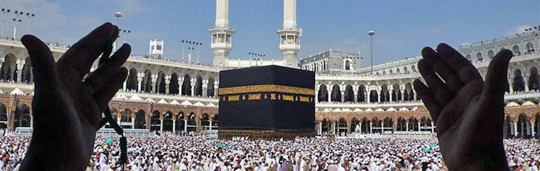
hajj

Despite having thousands of followers at his beck and call, he helped in household work.

And, in an era when women were cursed, he found heaven in the many avatars of mother, daughter and wife. This was Muhammad, the prophet of Islam, blessed with qualities an ideal family man should possess, to consolidate family, as the building block of a healthy society.

Now 1,400 years on, however, Islam is a misunderstood religion as Muslims and terrorists are often considered synonymous, making victims of hate keep the popular plea ready for defence: My name is Khan and I am not a terrorist!

Leave apart the globally-dreaded faces of terror like Abu Bakr Albaghdadi, who recently claimed to be global caliph, the image of a typical head of a Muslim family is often no less scary. These ugly faces of humanity are often attributed to Islam and its prophet.

Some accusations are downright chilling, blasphemous. A basic cause of unwanted Islamophobia is that the negatives of someone bearing a Muslim name get generalised for the entire community, without ascertaining the Prophet's preaching.

Islamic lifestyle is essentially driven by three entities, the first being Quran, which Muslims believe is the word of Allah. The other two are recorded prophetic sayings, the Hadith, and Muhammad's iconic lifestyle: Sunnah. The combination of these reflect Muhammad as the perfect man in all spheres of life, including family, which is central to Islamic society.

Also read: What Indian Muslims can learn from fatwa on AR Rahman

The ladies first: Muhammad lost his mother, Aaminah, at the age of five. His first encounter with a woman was his own wife, Khadijah. At the time of marriage, he was 25 and she a 40-year-old widow.

During her life, they lived in a society that welcomed multiple marriages for men. For 25 years, though, he did not opt for another marriage, a lesson for some of his followers who immediately after the first marriage start preparations for another.

After her death, however, Muhammad married nine women. Islamic beliefs give four main reasons for these multiple marriages: first, helping widows of his companions. Second, to create family ties between him and his illustrious companions (Muhammad married the daughters of Abu Bakr and Umar, whereas Uthman and Imam Ali married his daughters. He, therefore, had family bonds with all four of the first caliphs).

The third reason was to spread the message by uniting different clans or tribes through marriage. Another major reason was to increase credibility for his family values because confirmation from multiple sources is more credible.

From teaching how to eat, sleep or respond to nature's call, Muhammad shared with his followers the minutest details even pertaining to life in the bedroom, only to keep them guided.

As husband, his love for wife Aisha was romantic, more than many love stories that have been famous throughout history. Though most such stories are fables, Muhammad's love was real and human, not angelic.

As per recorded traditions, he once said to Aisha: "I know well when you are pleased or angry with me." Aisha replied: "How do you know that?" He said, "When you are pleased with me you swear by saying 'by the God of Muhammad' but when you are angry you swear by saying 'by the God of Ibrahim'.

She said: "You are right, I don't mention your name."

Hadith also reports that Muhammad used to search for the part that touched her lips from the utensil she used in drinking. Then, he would touch the same part with his lips when he would drink. To express love, he called her by different names, such as "Aish" and "Uaish". He would recline his head in her lap.

In a male-dominated society, where Muslim husbands often find household work demeaning, Aisha reported that Muhammad used to mend his shoes, sew his clothes and work at home.

With the exception of Aisha, he married only widows and divorced women, and he shared equal time and resources with all of them. Once, another wife, Safiyah, was on a journey with him. She was late, so he received her while she was crying. Muhammad wiped her tears with his own hands and tried his utmost to calm her down.

His affection for children was equally amazing. As soon as Fatimah, his daughter, entered the room, he would stand up, hold her hands, and make her sit where he was sitting. He would ask about her health and family, express his paternal love for her.

In a society that degraded women and rejected the birth of females to the extent that they would be buried alive, Muhammad made paradise the reward of every father who conducted himself well with his daughters and was patient in their upbringing.

As children, his grandsons, Imam Hussain and Imam Hassan, would often ride on his back. Muhammad's love was such that he would not lift his head from the ground till they would themselves not get down.

About parents, Muhammad said paradise lay beneath the mother's feet whereas in Allah's will is the father's will, and in Allah's anger is the father's anger. This again is in contrast to how Muslims often abandon aged parents, to be jihadi or "caliph" of a nuclear family, when the former need them the most.

Islam is not what Muslims do but what Muhammad wanted them to do. He was neither God nor angel, but a man of mercy, as Quran reveals in Chapter 21 verse 107: We have not sent you but as Mercy unto the mankind.

Comments

Sherin
 - 
Monday, 18 Jan 2016

May peace be upon him
Naren kotian- if u wanna make muslim youths to get angry through ua comments, sorry u r utterly wrong my dear!! May allah bless u in right path ameen

naren kotian
 - 
Wednesday, 13 Jan 2016

I read nearly 2-3 times in english ... it is exactly like what ISIS is saying ... it says kill jews , attack non muslims ... keep non muslim women as slaves .. its full halal... non muslims must clearly pay jaziya ... so there is no mis conception ... it is very much clear ... no rights for women , treat women as property ... no 72 virgins for females hahaha ... what this mama ...

Farzana Ubaid
 - 
Tuesday, 12 Jan 2016

May peace be upon him :)

Add new comment

  • Coastaldigest.com reserves the right to delete or block any comments.
  • Coastaldigset.com is not responsible for its readers’ comments.
  • Comments that are abusive, incendiary or irrelevant are strictly prohibited.
  • Please use a genuine email ID and provide your name to avoid reject.
Agencies
July 10,2020

In a first, the Supreme Court on Friday allowed the service of summons and notices, a necessity in almost all legal proceedings, through instant messenger like WhatsApp as well as by e-mail and fax.

A bench headed by Chief Justice SA Bobde observed that it has been brought to the notice of the court that it is not feasible to visit post offices for service of notices, summons, and pleadings. The bench also comprising Justices AS Bopanna and R Subhash Reddy observed that notice and summons should be sent through e-mail on the same day along with instant message through WhatsApp and other phone messenger services.

The bench clarified that all methods should be deployed for a valid service on the party. "Two blue ticks would convey that the receiver has seen the notice," noted the bench.

The bench declined the request of the Attorney General for specifically naming WhatsApp as a mode of effectuating service. The top court noted that it would not be practical to specify only WhatsApp. The apex court also permitted RBI to extend the validity of cheques in the backdrop of lockdown to contain the coronavirus outbreak.

Senior advocate V Giri representing RBI informed the bench that he had circulated the note regarding validity of a cheque as directions issued on the previous hearing.

The bench noted that it will be in discretion of the RBI to issue orders which are suitable to alter the validity of the period of a cheque.

During an earlier hearing on the matter on July 7, the Attorney General contended before the top court that the Centre had some reservations in connection with the utilization of mobile applications like WhatsApp and other apps for service of summons. The Centre's top law officer informed the apex court that these apps claimed to be encrypted, and they were not trustworthy.

The RBI counsel had contended before the top court that it was considering clarifying the validity of a cheque which has been reduced to 3 months from 6 months.

Comments

Add new comment

  • Coastaldigest.com reserves the right to delete or block any comments.
  • Coastaldigset.com is not responsible for its readers’ comments.
  • Comments that are abusive, incendiary or irrelevant are strictly prohibited.
  • Please use a genuine email ID and provide your name to avoid reject.
News Network
April 17,2020

Paris, Apr 17: Even as virologists zero in on the virus that causes COVID-19, a very basic question remains unanswered: do those who recover from the disease have immunity?

There is no clear answer to this question, experts say, even if many have assumed that contracting the potentially deadly disease confers immunity, at least for a while.

"Being immunised means that you have developed an immune response against a virus such that you can repulse it," explained Eric Vivier, a professor of immunology in the public hospital system in Marseilles.

"Our immune systems remember, which normally prevents you from being infected by the same virus later on."

For some viral diseases such a measles, overcoming the sickness confers immunity for life.

But for RNA-based viruses such as Sars-Cov-2 -- the scientific name for the bug that causes the COVID-19 disease -- it takes about three weeks to build up a sufficient quantity of antibodies, and even then they may provide protection for only a few months, Vivier told AFP.

At least that is the theory. In reality, the new coronavirus has thrown up one surprise after another, to the point where virologists and epidemiologists are sure of very little.

"We do not have the answers to that -- it's an unknown," Michael Ryan, executive director of the World Health Organization's Emergencies Programme said in a press conference this week when asked how long a recovered COVID-19 patient would have immunity.

"We would expect that to be a reasonable period of protection, but it is very difficult to say with a new virus -- we can only extrapolate from other coronaviruses, and even that data is quite limited."

For SARS, which killed about 800 people across the world in 2002 and 2003, recovered patients remained protected "for about three years, on average," Francois Balloux director of the Genetics Institute at University College London, said.

"One can certainly get reinfected, but after how much time? We'll only know retroactively."

A recent study from China that has not gone through peer review reported on rhesus monkeys that recovered from Sars-Cov-2 and did not get reinfected when exposed once again to the virus.

"But that doesn't really reveal anything," said Pasteur Institute researcher Frederic Tangy, noting that the experiment unfolded over only a month.

Indeed,several cases from South Korea -- one of the first countries hit by the new coronavirus -- found that patients who recovered from COVID-19 later tested positive for the virus.

But there are several ways to explain that outcome, scientists cautioned.

While it is not impossible that these individuals became infected a second time, there is little evidence this is what happened.

More likely, said Balloux, is that the virus never completely disappeared in the first place and remains -- dormant and asymptomatic -- as a "chronic infection", like herpes.

As tests for live virus and antibodies have not yet been perfected, it is also possible that these patients at some point tested "false negative" when in fact they had not rid themselves of the pathogen.

"That suggests that people remain infected for a long time -- several weeks," Balloux added. "That is not ideal."

Another pre-publication study that looked at 175 recovered patients in Shanghai showed different concentrations of protective antibodies 10 to 15 days after the onset of symptoms.

"But whether that antibody response actually means immunity is a separate question," commented Maria Van Kerhove, Technical Lead of the WHO Emergencies Programme.

"That's something we really need to better understand -- what does that antibody response look like in terms of immunity."

Indeed, a host of questions remain.

"We are at the stage of asking whether someone who has overcome COVID-19 is really that protected," said Jean-Francois Delfraissy, president of France's official science advisory board.

For Tangy, an even grimmer reality cannot be excluded.

"It is possible that the antibodies that someone develops against the virus could actually increase the risk of the disease becoming worse," he said, noting that the most serious symptoms come later, after the patient had formed antibodies.

For the moment, it is also unclear whose antibodies are more potent in beating back the disease: someone who nearly died, or someone with only light symptoms or even no symptoms at all. And does age make a difference?

Faced with all these uncertainties, some experts have doubts about the wisdom of persuing a "herd immunity" strategy such that the virus -- unable to find new victims -- peters out by itself when a majority of the population is immune.

"The only real solution for now is a vaccine," Archie Clements, a professor at Curtin University in Perth Australia, told AFP.

At the same time, laboratories are developing a slew of antibody tests to see what proportion of the population in different countries and regions have been contaminated.

Such an approach has been favoured in Britain and Finland, while in Germany some experts have floated the idea of an "immunity passport" that would allow people to go back to work.

"It's too premature at this point," said Saad Omer, a professor of infectious diseases at the Yale School of Medicine.

"We should be able to get clearer data very quickly -- in a couple of months -- when there will be reliable antibody tests with sensitivity and specificity."

One concern is "false positives" caused by the tests detecting antibodies unrelated to COVID-19.

The idea of immunity passports or certificates also raises ethical questions, researchers say.

"People who absolutely need to work -- to feed their families, for example -- could try to get infected," Balloux.

Comments

Add new comment

  • Coastaldigest.com reserves the right to delete or block any comments.
  • Coastaldigset.com is not responsible for its readers’ comments.
  • Comments that are abusive, incendiary or irrelevant are strictly prohibited.
  • Please use a genuine email ID and provide your name to avoid reject.
Agencies
May 15,2020

Kolkata, May 15: Veteran Bengali author Debesh Roy, who was conferred the Sahitya Akademi award for his novel 'Teesta Parer Brittanto', died at a private hospital in Kolkata on Thursday, his family members said.

Roy was 84 and he is survived by his son. His wife had died earlier.

He was admitted to the hospital near his residence at Baguihati, in the eastern fringes of the city, on Wednesday after having symptoms like sodium potasium imbalance, sugar problem and breathing problem, his family members said.

He suffered a massive cardiac arrest and died at 10.50 PM.

A regular contributor to a number of Bengali dailies, he was a staunch critic of the attacks on liberals by in the country in recent times and attended protest meetings despite his failing health.

He was born in Pabna in present-day Bangladesh on December 17, 1936. He had five decades of career as a writer.

Besides Teesta Parer Britanta', he will be remembered for books like Borisaler Jogen Mondal , Manush Khun Kore Keno and Samay Asamayer Brittanto . His first book was Jajati.

His last rites will be performed tomorrow.

Comments

Add new comment

  • Coastaldigest.com reserves the right to delete or block any comments.
  • Coastaldigset.com is not responsible for its readers’ comments.
  • Comments that are abusive, incendiary or irrelevant are strictly prohibited.
  • Please use a genuine email ID and provide your name to avoid reject.