



Rediscover Prophet; clear misconceptions about Islam

[email protected] (MAJID HYDERI for DailyO)
January 10, 2016

In the 7th century AD, when dental hygiene was in its infancy, this man, while returning home, would ensure brushing his teeth with meswak, lest bad breath irk his family, particularly the wife and children.
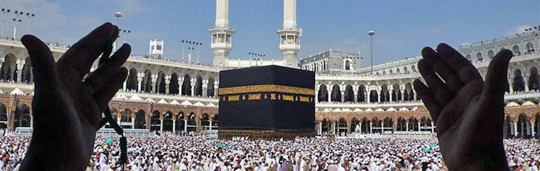
hajj

Despite having thousands of followers at his beck and call, he helped in household work.

And, in an era when women were cursed, he found heaven in the many avatars of mother, daughter and wife. This was Muhammad, the prophet of Islam, blessed with qualities an ideal family man should possess, to consolidate family, as the building block of a healthy society.

Now 1,400 years on, however, Islam is a misunderstood religion as Muslims and terrorists are often considered synonymous, making victims of hate keep the popular plea ready for defence: My name is Khan and I am not a terrorist!

Leave apart the globally-dreaded faces of terror like Abu Bakr Albaghdadi, who recently claimed to be global caliph, the image of a typical head of a Muslim family is often no less scary. These ugly faces of humanity are often attributed to Islam and its prophet.

Some accusations are downright chilling, blasphemous. A basic cause of unwanted Islamophobia is that the negatives of someone bearing a Muslim name get generalised for the entire community, without ascertaining the Prophet's preaching.

Islamic lifestyle is essentially driven by three entities, the first being Quran, which Muslims believe is the word of Allah. The other two are recorded prophetic sayings, the Hadith, and Muhammad's iconic lifestyle: Sunnah. The combination of these reflect Muhammad as the perfect man in all spheres of life, including family, which is central to Islamic society.

Also read: What Indian Muslims can learn from fatwa on AR Rahman

The ladies first: Muhammad lost his mother, Aaminah, at the age of five. His first encounter with a woman was his own wife, Khadijah. At the time of marriage, he was 25 and she a 40-year-old widow.

During her life, they lived in a society that welcomed multiple marriages for men. For 25 years, though, he did not opt for another marriage, a lesson for some of his followers who immediately after the first marriage start preparations for another.

After her death, however, Muhammad married nine women. Islamic beliefs give four main reasons for these multiple marriages: first, helping widows of his companions. Second, to create family ties between him and his illustrious companions (Muhammad married the daughters of Abu Bakr and Umar, whereas Uthman and Imam Ali married his daughters. He, therefore, had family bonds with all four of the first caliphs).

The third reason was to spread the message by uniting different clans or tribes through marriage. Another major reason was to increase credibility for his family values because confirmation from multiple sources is more credible.

From teaching how to eat, sleep or respond to nature's call, Muhammad shared with his followers the minutest details even pertaining to life in the bedroom, only to keep them guided.

As husband, his love for wife Aisha was romantic, more than many love stories that have been famous throughout history. Though most such stories are fables, Muhammad's love was real and human, not angelic.

As per recorded traditions, he once said to Aisha: "I know well when you are pleased or angry with me." Aisha replied: "How do you know that?" He said, "When you are pleased with me you swear by saying 'by the God of Muhammad' but when you are angry you swear by saying 'by the God of Ibrahim'.

She said: "You are right, I don't mention your name."

Hadith also reports that Muhammad used to search for the part that touched her lips from the utensil she used in drinking. Then, he would touch the same part with his lips when he would drink. To express love, he called her by different names, such as "Aish" and "Uaish". He would recline his head in her lap.

In a male-dominated society, where Muslim husbands often find household work demeaning, Aisha reported that Muhammad used to mend his shoes, sew his clothes and work at home.

With the exception of Aisha, he married only widows and divorced women, and he shared equal time and resources with all of them. Once, another wife, Safiyah, was on a journey with him. She was late, so he received her while she was crying. Muhammad wiped her tears with his own hands and tried his utmost to calm her down.

His affection for children was equally amazing. As soon as Fatimah, his daughter, entered the room, he would stand up, hold her hands, and make her sit where he was sitting. He would ask about her health and family, express his paternal love for her.

In a society that degraded women and rejected the birth of females to the extent that they would be buried alive, Muhammad made paradise the reward of every father who conducted himself well with his daughters and was patient in their upbringing.

As children, his grandsons, Imam Hussain and Imam Hassan, would often ride on his back. Muhammad's love was such that he would not lift his head from the ground till they would themselves not get down.

About parents, Muhammad said paradise lay beneath the mother's feet whereas in Allah's will is the father's will, and in Allah's anger is the father's anger. This again is in contrast to how Muslims often abandon aged parents, to be jihadi or "caliph" of a nuclear family, when the former need them the most.

Islam is not what Muslims do but what Muhammad wanted them to do. He was neither God nor angel, but a man of mercy, as Quran reveals in Chapter 21 verse 107: We have not sent you but as Mercy unto the mankind.

Comments

Sherin
 - 
Monday, 18 Jan 2016

May peace be upon him
Naren kotian- if u wanna make muslim youths to get angry through ua comments, sorry u r utterly wrong my dear!! May allah bless u in right path ameen

naren kotian
 - 
Wednesday, 13 Jan 2016

I read nearly 2-3 times in english ... it is exactly like what ISIS is saying ... it says kill jews , attack non muslims ... keep non muslim women as slaves .. its full halal... non muslims must clearly pay jaziya ... so there is no mis conception ... it is very much clear ... no rights for women , treat women as property ... no 72 virgins for females hahaha ... what this mama ...

Farzana Ubaid
 - 
Tuesday, 12 Jan 2016

May peace be upon him :)

Add new comment

  • Coastaldigest.com reserves the right to delete or block any comments.
  • Coastaldigset.com is not responsible for its readers’ comments.
  • Comments that are abusive, incendiary or irrelevant are strictly prohibited.
  • Please use a genuine email ID and provide your name to avoid reject.
Agencies
February 27,2020

Feb 27: With the window to submit comments on India's proposed personal data protection law closing on Tuesday, a period of anxious wait for final version of the Bill started for social media firms.

This comes even as global Internet companies have called on the government for improved transparency related to intermediary Guidelines (Amendment) Rules and allay fears about the prospect of increased surveillance and prompting a fragmentation of the Internet in India that would harm users.

As per the proposed amendments, an intermediary having over 50 lakh users in the country will have to be incorporated in India with a permanent registered office and address.

When required by lawful order, the intermediary shall, within 72 hours of communication, provide such information or assistance as asked for by any government agency or assistance concerning security of the state or cybersecurity.

This means that the government could pull down information provided by platforms such as Wikipedia, potentially hampering its functioning in India.

In the open letter to IT Minister Ravi Shankar Prasad, leading browser and software development platform like Mozilla, Microsoft-owned GitHub and Cloudflare earlier called for improved transparency by allowing the public an opportunity to see a final version of these amendments prior to their enactment.

According to a Business Insider report, Indian users may lose access to Wikipedia if the new intermediary rules for internet and social media companies are approved.

Since the rules would require the website to take down content deemed illegal by the government, it would require Wikipedia to show different content for different countries.

Anusha Alikhan, senior communications director for Wikimedia told Business Insider that the platform is built though languages and not geographies. Therefore, removing content from one country, while it is still visible to other country users may not work for the company’s model.

India is one of Wikipedia’s largest markets. Over 771 million Indian users accessed the site in just November 2019.

Also read: Explained: What is the Personal Data Protection Bill and why you should care

The Personal Data Protection Bill, 2019, which was introduced in Lok Sabha in the winter session last year, was referred to a Joint Parliamentary Committee (JPC) of both the Houses.

The government last month decided to seek views and suggestions on the Bill from individuals and associations and bodies concerned and the last date for submitting the comments was on Tuesday.

Prasad, while introducing the Personal Data Protection Bill, 2019, in the Lok Sabha on December 11, announced that the draft Bill empowers the government to ask companies including Facebook, Google and others for anonymised personal data and non-personal data.

There was a buzz when the Bill's latest version was introduced in the Lok Sabha, especially the provision seeking to allow the use of personal and non-personal data of users in some cases, especially when national security is involved.

Several legal experts red-flagged the issue and said the provision will give the government unaccounted access to personal data of users in the country.

In their submission to the JPC, several organisations also flagged that the power to collect non-personal and anonymised data by the government without notice and consent should not form part of the Bill because of issues regarding effective anonymisation and potential abuse.

"Clauses 35 and 36 of the Bill provide unbridled access to personal data to the Central Government by giving it powers to exempt its agencies from the application of the Bill on the basis of various broad worded grounds," SFLC.in, a New Delhi-based not-for-profit legal services organisation, commented.

The Software Alliance, also known as BSA, a trade group which includes tech giants such as Microsoft, IBM and Adobe, among others said that the current version of the privacy bill pose substantial challenges, including the sweeping new powers for the government to acquire non-personal data, restrictions on data transfers, and local storage requirements.

"We urge the Joint Parliamentary Committee, as it considers revisions to the Bill, to eliminate provisions concerning non-personal data from the Personal Data Protection Bill and to remove the data localisation requirements and restrictions on international data flows," said Venkatesh Krishnamoorthy, Country Manager-India, BSA.

The Personal Data Protection (PDP) Bill, 2019 draws its origins from the Justice B.N. Srikrishna Committee on data privacy, which produced a draft of legislation that was made public in 2018 ("the Srikrishna Bill").

The mandatory requirement for storing a mirror copy of all personal data in India as per Section 40 of the Srikrishna Bill has been done away with in the PDP Bill, 2019, meaning that companies like Facebook and Twitter would be able to store data of Indian users abroad if they so wish.

But the bill prohibits processing of sensitive personal data and critical personal data outside India.

What is more, what constitutes critical data has not been clearly defined.

As per the proposals, social media companies will have to modify their application as they are required to have a system in place by which a user can verify themselves.

So legal experts believe that some system to upload identification documents should be there and something like the Twitter blue tick mark should be there to identify verified accounts.

"The 2019 Bill introduces a new category of data fiduciaries called social media intermediaries ('SMIs'). SMIs are a subcategory of significant data fiduciaries ('SDFs') and will be notified by the Central government after due consultation with the DPA, or the Data Protection Authority. Clause 26(4) of the Bill defines SMIs as intermediaries who primarily or solely enable online interaction between two or more users," SFLC.in said.

"On a plain reading of the definition, online platforms like Facebook, Twitter, YouTube, TikTok, ShareChat and WhatsApp are likely to be notified as SMIs under the Bill," it added.

Comments

Add new comment

  • Coastaldigest.com reserves the right to delete or block any comments.
  • Coastaldigset.com is not responsible for its readers’ comments.
  • Comments that are abusive, incendiary or irrelevant are strictly prohibited.
  • Please use a genuine email ID and provide your name to avoid reject.
Agencies
June 18,2020

New Delhi, Jun 18: Vodafone Idea on Thursday told the Supreme Court that it has incurred Rs 1 lakh crore losses as it insisted it is not in a position to furnish bank guarantees.

A bench comprising Justices Arun Mishra, S. Abdul Nazeer, and M.R. Shah, taking up the adjusted gross revenue (AGR) matter through video conferencing, directed the telecom companies to submit their financial documents and books for the last 10 years.

Asking Vodafone if it was a foreign company, the bench said that how can the company say it would not furnish any bank guarantee.

"What if you fly away overnight in future without paying anything?" it asked.

Senior advocate Mukul Rohatgi, representing Vodafone Idea, denied his client is a completely foreign firm and cited before the bench its tie-ups and investments.

Vodafone owes over Rs 58,000 crore as AGR dues and so far, has paid close to Rs 7,000 crore.

Rohatgi contended before the court that the telecom company is in a tough situation, and cannot furnish any fresh bank guarantee, as profits have eluded the company in past many quarters. He submitted before the bench that Rs 15,000 crore bank guarantees are lying with the government, and his client's losses are over Rs 1 lakh crore.

"I cannot offer any more surety," he informed the bench.

Justice Mishra noted that this is public money and these dues should be recovered. "Do not tell us that you will pay if you were to make profits... the money must come," he noted.

Justice Shah observed that the telecom industry is the only industry which earned during the Covid-19 pandemic. "After all, this money will be used for public welfare", he said.

Rohatgi argued that his client would have to fold up if orders were issued to clear dues tomorrow. "11,000 employees will have to go without notice, as we cannot pay them," he added.

Senior advocate Abhishek Manu Singhvi, appearing for Bharti Airtel, contended before the court that out of Rs 21,000 crore AGR dues, the company has already deposited a sum of Rs 18,000 crore.

He argued that his client has given a bank guarantee, in excess of demand, to DoT, and supported the proposal for phased repayment of remaining AGR dues. He insisted that the company needs to sit down with the government and calculate the dues. Airtel owes Rs 25,976 crore after paying Rs 18,000 crore, as per the government.

Senior advocate Arvind Datar, representing Tata Telecom, informed the bench that his client has paid Rs 6,504 crore in AGR dues so far, and furnishing a bank guarantee may adversely impact investments in the sector.

The total AGR dues are close to Rs 1.5 lakh crore.

The top court will now take up the matter in the third week of July.

Comments

Add new comment

  • Coastaldigest.com reserves the right to delete or block any comments.
  • Coastaldigset.com is not responsible for its readers’ comments.
  • Comments that are abusive, incendiary or irrelevant are strictly prohibited.
  • Please use a genuine email ID and provide your name to avoid reject.
Agencies
July 13,2020

New Delhi, Jul 13: The Telecom Regulatory Authority of India (TRAI) has blocked Bharti Airtel's Platinum and Vodafone Idea's RedX premium plans that offer faster data speeds and priority services to customers as both the plans were violating net neutrality norms.

The telecom watchdog has asked Bharti Airtel to explain within seven days how such a similar plan being launched does not violate the rules of net neutrality.

Vodafone Idea's RedX plan has been in the market since November 2019. They made some modifications in May 2020 and the Bharti Airtel was soon going to launch a similar plan.

According to TRAI, the higher speed for premium customers discriminate against others and violates net neutrality.

Responding to TRAI's move, Airtel spokesperson said: "We are passionate about delivering the best network and service experience to all our customers. This is why we have a relentless obsession to eliminate faults and have been consistently recognised by international agencies as the best network in terms of speed, latency and video experience."

"At the same time, we want to keep raising the bar for our post-paid customers in terms of service and responsiveness. This is an ongoing effort at our end," the spokesperson said.

Comments

Add new comment

  • Coastaldigest.com reserves the right to delete or block any comments.
  • Coastaldigset.com is not responsible for its readers’ comments.
  • Comments that are abusive, incendiary or irrelevant are strictly prohibited.
  • Please use a genuine email ID and provide your name to avoid reject.