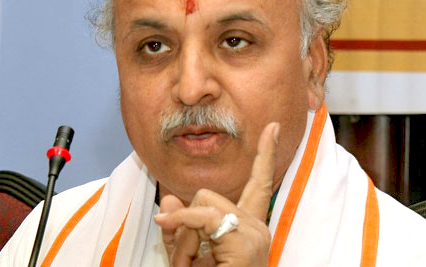
Muslims, Christians in India were Hindus: Praveen Togadia

December 19, 2014

Praveen TogadiaAhmedabad, Dec 19: Adding fuel to fire in the recent conversion-row, working president of right-wing organisation Vishwa Hindu Parishad (VHP), Pravin Togadia said ancestors of Indian Muslims and Christians were Hindus.

œThe ancestors of Indian Muslims were Hindus. The ancestors of Christians were Hindu too. History says that many people converted to Islam due to atrocities and by the force of the swords of Moghul emperors,  Togadia said last night at the golden jubilee celebration of VHP at Bhavnagar town in Gujarat.

œAt present, in this India, there is no atrocity or force on Hindus. In such a situation, if someone wants to return to the Hindu society, the Hindus should accept him whole heartedly,  added Togadia.

A controversy erupted after a right wing group'Dharma Jagran Manch' had organised a reconversion ceremony naming it as'Ghar-wapasi' (home-coming) and had allegedly converted about 100 people, mostly poor Muslim slum dwellers, through a ritual carried out by the Hindu organisation on December 8 in Agra of Uttar Pradesh.

BJP MP from Gorakhpur Yogi Adityanath had also justified the act of the Hindu organisation and said that it is an ongoing process and will continue to happen. Adityanath also batted for a strong anti-conversion law in Uttar Pradesh on the lines of legislation adopted by several states. This created ruckus in both houses of the Parliament as the Opposition demanded a statement from Prime Minister Narendra Modi on the alleged conversion. The main accused and convener of the organisation in Uttar Pradesh, Nand Kishore Balmiki was arrested on Tuesday by Agra police.

Comments

Zora
 - 
Friday, 11 Mar 2016

Macham Jakie sa przetworniki w podszybiu jako sie donich wystac plus jak sie przyjac do glosników
na tylnej pólce Wózek ostatnie chrysler stratus sedan z 98r
Z mansardy dziekuje przyimek gospodyni glosników na peryferyjnej pólce ,pragniesz wystawic biezaca pólke ,a
wpierw poparcie kanapy ,chyba uszczuplic przyjdzie ja do
turni

Also visit my blog post wzmacniacze estradowe: http://gift-1.com/comment/html/?2829.html

Branden
 - 
Monday, 7 Mar 2016

I think everything typed was actually very reasonable.
But, what about this? suppose you were to write a awesome title?
I am not suggesting your content isn't solid., however what if you added a headline
that grabbed people's attention? I mean Muslims, Christians in India were Hindus: Praveen Togadia is kinda
boring. You might glance at Yahoo's home page and watch how they create article headlines to grab viewers interested.
You might add a video or a related picture or two to get readers excited about everything've got to say.
In my opinion, it might make your blog a little livelier.

my blog post: próbki: http://www.nudny.net/user.php?op=userinfo&uname=uzsjgtwz

Mickey
 - 
Tuesday, 12 Jan 2016

Pozdrawiam Jakie sa glosniki w podszybiu niczym sie donich zdobyc oraz jako sie przyjac do przetworników na zadniej pólce Autobus wówczas chrysler stratus
sedan z 98r Z facjaty odprawia zbyt przysluge glosników na tylnej pólce
,wymagasz wydobyc wspólczesna pólke ,a uprzednio wezglowie lezanki ,bodajze zepsuc przystoi ja do sterty

Feel free to visit my web-site: glosniki szerokopasmowe: http://www.jcsz100.com/comment/html/?1158.html

Johnny
 - 
Sunday, 3 Jan 2016

Reagujcie uderzam sie nas zdrowa oczyszczalnia zlewów, jest ona
kawal przymiotów, a najwazniejszym istnieje obecny,
ze monitorujemy o bractwo Azaliz ktokolwiek stanowi taka
oczyszczalnie? Odszukalem obrazowa stronke przemawiam zbadajcie oraz wypowiedzcie sie na tenze topos Promujecie

my site - oczyszczanie biologiczne: http://q287626260.us126.6kc.info/comment/html/?1382.html&page=

Add new comment

  • Coastaldigest.com reserves the right to delete or block any comments.
  • Coastaldigset.com is not responsible for its readers’ comments.
  • Comments that are abusive, incendiary or irrelevant are strictly prohibited.
  • Please use a genuine email ID and provide your name to avoid reject.
News Network
July 28,2020

Hounde, Jul 28: Coronavirus and its restrictions are pushing already hungry communities over the edge, killing an estimated 10,000 more young children a month as meager farms are cut off from markets and villages are isolated from food and medical aid, the United Nations warned Monday.

In the call to action shared with The Associated Press ahead of publication, four UN agencies warned that growing malnutrition would have long-term consequences, transforming individual tragedies into a generational catastrophe.

Hunger is already stalking Haboue Solange Boue, an infant from Burkina Faso who lost half her former body weight of 5.5 pounds (2.5 kilograms) in just a month. Coronavirus restrictions closed the markets, and her family sold fewer vegetables. Her mother was too malnourished to nurse.

“My child,” Danssanin Lanizou whispered, choking back tears as she unwrapped a blanket to reveal her baby's protruding ribs.

More than 550,000 additional children each month are being struck by what is called wasting, according to the UN — malnutrition that manifests in spindly limbs and distended bellies. Over a year, that's up 6.7 million from last year's total of 47 million. Wasting and stunting can permanently damage children physically and mentally.

“The food security effects of the COVID crisis are going to reflect many years from now,” said Dr. Francesco Branca, the WHO head of nutrition. “There is going to be a societal effect.”

From Latin America to South Asia to sub-Saharan Africa, more poor families than ever are staring down a future without enough food.

In April, World Food Program head David Beasley warned that the coronavirus economy would cause global famines “of biblical proportions” this year. There are different stages of what is known as food insecurity; famine is officially declared when, along with other measures, 30% of the population suffers from wasting.

The World Food Program estimated in February that one Venezuelan in three was already going hungry, as inflation rendered salaries nearly worthless and forced millions to flee abroad. Then the virus arrived.

“Every day we receive a malnourished child,” said Dr. Francisco Nieto, who works in a hospital in the border state of Tachira.

In May, Nieto recalled, after two months of quarantine, 18-month-old twins arrived with bodies bloated from malnutrition. The children's mother was jobless and living with her own mother. She told the doctor she fed them only a simple drink made with boiled bananas.

“Not even a cracker? Some chicken?” he asked.

“Nothing,” the children's grandmother responded. By the time the doctor saw them, it was too late: One boy died eight days later.

The leaders of four international agencies — the World Health Organization, UNICEF, the World Food Program and the Food and Agriculture Organization — have called for at least dollar 2.4 billion immediately to address global hunger.

But even more than lack of money, restrictions on movement have prevented families from seeking treatment, said Victor Aguayo, the head of UNICEF's nutrition program.

“By having schools closed, by having primary health care services disrupted, by having nutritional programs dysfunctional, we are also creating harm,” Aguayo said. He cited as an example the near-global suspension of Vitamin A supplements, which are a crucial way to bolster developing immune systems.

In Afghanistan, movement restrictions prevent families from bringing their malnourished children to hospitals for food and aid just when they need it most. The Indira Gandhi hospital in the capital, Kabul, has seen only three or four malnourished children, said specialist Nematullah Amiri. Last year, there were 10 times as many.

Because the children don't come in, there's no way to know for certain the scale of the problem, but a recent study by Johns Hopkins University indicated an additional 13,000 Afghans younger than 5 could die.

Afghanistan is now in a red zone of hunger, with severe childhood malnutrition spiking from 690,000 in January to 780,000 — a 13% increase, according to UNICEF.

In Yemen, restrictions on movement have blocked aid distribution, along with the stalling of salaries and price hikes. The Arab world's poorest country is suffering further from a fall in remittances and a drop in funding from humanitarian agencies.

Yemen is now on the brink of famine, according to the Famine Early Warning Systems Network, which uses surveys, satellite data and weather mapping to pinpoint places most in need.

Some of the worst hunger still occurs in sub-Saharan Africa. In Sudan, 9.6 million people live from one meal to the next — a 65% increase from the same time last year.

Lockdowns across Sudanese provinces, as around the world, have dried up work and incomes for millions. With inflation hitting 136%, prices for basic goods have more than tripled.

“It has never been easy but now we are starving, eating grass, weeds, just plants from the earth,” said Ibrahim Youssef, director of the Kalma camp for internally displaced people in war-ravaged south Darfur.

Adam Haroun, an official in the Krinding camp in west Darfur, recorded nine deaths linked with malnutrition, otherwise a rare occurrence, over the past two months — five newborns and four older adults, he said.

Before the pandemic and lockdown, the Abdullah family ate three meals a day, sometimes with bread, or they'd add butter to porridge. Now they are down to just one meal of “millet porridge” — water mixed with grain. Zakaria Yehia Abdullah, a farmer now at Krinding, said the hunger is showing “in my children's faces.”

“I don't have the basics I need to survive,” said the 67-year-old, who who hasn't worked the fields since April. “That means the 10 people counting on me can't survive either.”


Comments

Add new comment

  • Coastaldigest.com reserves the right to delete or block any comments.
  • Coastaldigset.com is not responsible for its readers’ comments.
  • Comments that are abusive, incendiary or irrelevant are strictly prohibited.
  • Please use a genuine email ID and provide your name to avoid reject.
Agencies
February 20,2020

India ranked 77th on a sustainability index that takes into account per capita carbon emissions and ability of children in a nation to live healthy lives and secures 131st spot on a flourishing ranking that measures the best chance at survival and well-being for children, according to a UN-backed report.

The report was released on Wednesday by a commission of over 40 child and adolescent health experts from around the world. It was commissioned by the World Health Organization (WHO), UN Children's Fund (UNICEF) and The Lancet medical journal.

In the report assessing the capacity of 180 countries to ensure that their youngsters can survive and thrive, India ranks 77th on the Sustainability Index and 131 on the Flourishing Index, it said.

Flourishing is the geometric mean of Surviving and Thriving. For Surviving, the authors selected maternal survival, survival in children younger than 5 years old, suicide, access to maternal and child health services, basic hygiene and sanitation, and lack of extreme poverty.

For Thriving, the domains were educational achievement, growth and nutrition, reproductive freedom, and protection from violence.

Under the Sustainability Index, the authors noted that promoting today's national conditions for children to survive and thrive must not come at the cost of eroding future global conditions for children's ability to flourish.

The Sustainability Index ranks countries on excess carbon emissions compared with the 2030 target. This provides a convenient and available proxy for a country's contribution to sustainability in future.

The report noted that under realistic assumptions about possible trajectories towards sustainable greenhouse gas emissions, models predict that global carbon emissions need to be reduced from 39·7 giga­ tonnes to 22·8 gigatonnes per year by 2030 to maintain even a 66 per cent chance of keeping global warming below 1·5°C.

It said that the world's survival depended on children being able to flourish, but no country is doing enough to give them a sustainable future.

"No country in the world is currently providing the conditions we need to support every child to grow up and have a healthy future," said Anthony Costello, Professor of Global Health and Sustainability at University College London, one of the lead authors of the report.

"Especially, they're under immediate threat from climate change and from commercial marketing, which has grown hugely in the last decade," said Costello – former WHO Director of Mother, Child and Adolescent health.

Norway leads the table for survival, health, education and nutrition rates - followed by South Korea and the Netherlands. Central African Republic, Chad and Somalia come at the bottom.

However, when taking into account per capita CO2 emissions, these top countries trail behind, with Norway 156th, the Republic of Korea 166th and the Netherlands 160th.

Each of the three emits 210 per cent more CO2 per capita than their 2030 target, the data shows, while the US, Australia, and Saudi Arabia are among the 10 worst emitters. The lowest emitters are Burundi, Chad and Somalia.

According to the report, the only countries on track to beat CO2 emission per capita targets by 2030, while also performing fairly – within the top 70 – on child flourishing measures are: Albania, Armenia, Grenada, Jordan, Moldova, Sri Lanka, Tunisia, Uruguay and Vietnam.

"More than 2 billion people live in countries where development is hampered by humanitarian crises, conflicts, and natural disasters, problems increasingly linked with climate change," said Minister Awa Coll-Seck from Senegal, Co-Chair of the commission.

The report also highlights the distinct threat posed to children from harmful marketing.

Evidence suggests that children in some countries see as many as 30,000 advertisements on television alone in a single year, while youth exposure to vaping (e-cigarettes) advertisements increased by more than 250 per cent in the US over two years, reaching more than 24 million young people.

Studies in Australia, Canada, Mexico, New Zealand and the US – among many others – have shown that self-regulation has not hampered commercial ability to advertise to children.

Children's exposure to commercial marketing of junk food and sugary beverages is associated with purchase of unhealthy foods and overweight and obesity, linking predatory marketing to the alarming rise in childhood obesity, it said.

The number of obese children and adolescents increased from 11 million in 1975 to 124 million in 2016 – an 11-fold increase, with dire individual and societal costs, the report said.

To protect children, the authors call for a new global movement driven by and for children.

Specific recommendations include stopping CO2 emissions with the utmost urgency, to ensure children have a future on this planet; placing children and adolescents at the centre of global efforts to achieve sustainable development, the report said.

New policies and investment in all sectors to work towards child health and rights; incorporating children's voices into policy decisions and tightening national regulation of harmful commercial marketing, supported by a new Optional Protocol to the UN Convention on the Rights of the Child, it said.

Comments

Add new comment

  • Coastaldigest.com reserves the right to delete or block any comments.
  • Coastaldigset.com is not responsible for its readers’ comments.
  • Comments that are abusive, incendiary or irrelevant are strictly prohibited.
  • Please use a genuine email ID and provide your name to avoid reject.
News Network
January 2,2020

Mysuru, Jan 2: Mysuru-based Karnataka State Open University is gearing up to offer courses online from this year onwards and a proposal in this connection will be placed before the University Grants Commission (UGC) this month, after approval from the board of management.

As of now, the university offers 31 courses, including undergraduate, postgraduate, and diploma programmes.

Vice-chancellor Vidyashankar S Said that the university will submit its proposal to the UGC soon.

“This is being done to make learning convenient and help students study their courses of choices from the comfort of their homes.”

After launching online admissions for courses, this is another step to go paperless and towards an e-campus, the V-C explained.

The university has also proposed to launch 12 new courses for 2020-21.

A proposal in this regard will be placed before the board for approval on Thursday and the same will be submitted to the UGC for its nod.

Prof. Vidyashankar said the these courses will be in addition to the 31 already available.

The new courses include LLM, MA in Education, BBA, BSc, BCA, diploma in Information Technology, postgraduate diploma in Information Technology, BSc in Information Technology, MSc in Information Technology, MSc in Botany, PG diploma in Banking and Insurance, MSc in Zoology, MA in Telugu, Executive MBA, and MSc in Food Sciences and Nutrition.

The new courses had been proposed based on students’ feedback and the trend.

The V-C said the admissions for the January cycle have begun and over 380 students had so far taken admissions online.

“We are hoping for good admissions this cycle and are expecting around 12,000 admissions,” he replied.

Comments

Add new comment

  • Coastaldigest.com reserves the right to delete or block any comments.
  • Coastaldigset.com is not responsible for its readers’ comments.
  • Comments that are abusive, incendiary or irrelevant are strictly prohibited.
  • Please use a genuine email ID and provide your name to avoid reject.