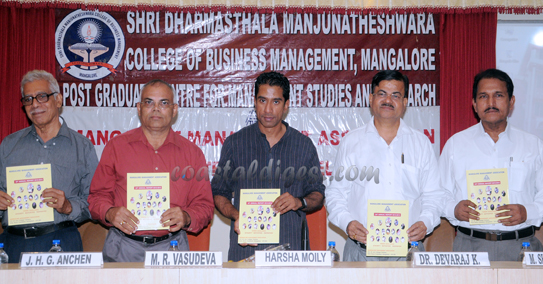
Harsha Moily: Progressive political leadership, communal harmony must for development of Dakshina Kannada

January 18, 2014

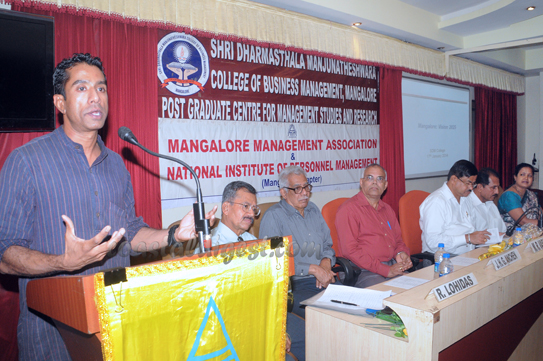
Mangalore, Jan 18: Stressing on the need for economic development in Dakshina Kannada, CEO of Milkroute, Bangalore Harsha Moily said that it was important to have progressive political leadership, dynamic leadership, an efficient social sector and communal harmony in the district.

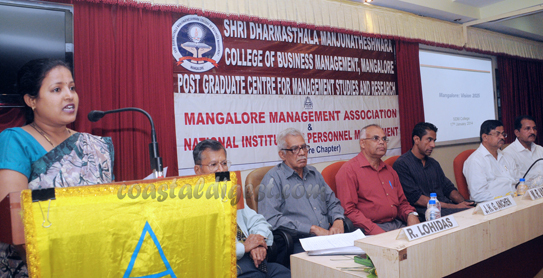
He was speaking on the topic 'Mangalore – Vision 2025' at a programme organised by Mangalore Management Association (MMA) and National Institute of Personnel Management (NIPM) at SDM Law College in the city on Friday.

“To impact the lives of roughly 2.2 million people, create prosperity in 354 villages, make productive use of 320 kms of coastline and 4.866 sq kms of undeveloped land and maintain the rich cultures and historic sites in Dakshina Kannada, we have to make the most of the resources available to make the district economically developed,” he said.

Six key pillars for economic development

He said that there were six strategic plans to act upon, for the realisation of the 'Vision 2025' for Mangalore city and the entire district, including achieving communal harmony, development of ports and fisheries sector, transformation of agriculture sectors, turning Mangalore into an IT hub, building physical and social infrastructure and implementation of government programmes.

It is critical to achieve communal harmony in the district, as high economic prosperity is possible only when there is a stable environment. It is also important to develop the ports and fisheries sector to enable creation of more jobs for youth. There should be focus on deployment of technology in agriculture and cultivation of crops such as paddy, arecanut, coconut and others with minimum water resources, he said.

“Mangalore has the potential to become an IT hub for which there should be increased pool of qualified manpower, power infrastructure and telecom services in the city. The district also needs to focus on increasing quality of primary and secondary schools, quality of healthcare and quality of roads. For effective implementation of governmental programmes, we need to strengthen gram panchayats and get rid of corruption at every level,” he said.

Vision statement

He said that his vision statement included the right to protection, participation in decision and policy-making and prosperity for every citizen in the district.

He also said that Mangalore had a lot of potential that was yet to be tapped, and the factor of utmost importance was the execution of the action plan.

Director of SDM PG Centre Dr Devaraj K made the presidential remarks.
SDM_17_1
SDM_17_2
SDM_17_3

Comments

Add new comment

  • Coastaldigest.com reserves the right to delete or block any comments.
  • Coastaldigset.com is not responsible for its readers’ comments.
  • Comments that are abusive, incendiary or irrelevant are strictly prohibited.
  • Please use a genuine email ID and provide your name to avoid reject.
News Network
April 2,2020

The current physical distancing guidelines provided by the World Health Organisation (WHO) and by the US Centers for Disease Control and Prevention (CDC) may not be adequate to curb the coronavirus spread, according to a research which says the gas cloud from a cough or sneeze may help virus particles travel up to 8 metres. The research, published in the Journal of the American Medical Association, noted that the the current guidelines issued by the WHO and CDC are based on outdated models from the 1930s of how gas clouds from a cough, sneeze, or exhalation spread.

Study author, MIT associate professor Lydia Bourouiba, warned that droplets of all sizes can travel 23 to 27 feet, or 7-8 metres, carrying the pathogen.

According to Bourouiba, the current guidelines are based on "arbitrary" assumptions of droplet size, "overly simplified", and "may limit the effectiveness of the proposed interventions" against the deadly pandemic.

 She explained that the old guidelines assume droplets to be one of two categories, small or large, taking short-range semi-ballistic trajectories when a person exhales, coughs, or sneezes.

However based on more recent discoveries, the MIT scientist said, sneezes and coughs are made of a puff cloud that carries ambient air, transporting within it clusters of droplets of a wide range of sizes.

Bourouiba warned that this puff cloud, with ambient air entrapped in it, can offer the droplets moisture and warmth that can prevent it from evaporation in the outer environment.

"The locally moist and warm atmosphere within the turbulent gas cloud allows the contained droplets to evade evaporation for much longer than occurs with isolated droplets," she said.

"Under these conditions, the lifetime of a droplet could be considerably extended by a factor of up to 1000, from a fraction of a second to minutes," the researcher explained in the study.

The MIT scientist, who has researched the dynamics of coughs and sneezes for years, added that these droplets settle along the trajectory of a cough or sneeze contaminating surfaces, with their residues staying suspended in the air for hours.

"Even when maximum containment policies were enforced, the rapid international spread of COVID-19 suggests that using arbitrary droplet size cutoffs may not accurately reflect what actually occurs with respiratory emissions, possibly contributing to the ineffectiveness of some procedures used to limit the spread of respiratory disease," Bourouiba wrote in the study

Comments

Add new comment

  • Coastaldigest.com reserves the right to delete or block any comments.
  • Coastaldigset.com is not responsible for its readers’ comments.
  • Comments that are abusive, incendiary or irrelevant are strictly prohibited.
  • Please use a genuine email ID and provide your name to avoid reject.
coastaldigest.com news network
July 30,2020

Mangaluru, July 30: Under the KKMA Dream House (Home for Homeless) project, the Karnataka Branch of Kuwait Kerala Muslim Association built two new houses at Nelyadi in Puttur taluk (house # 12 & 13) and handed over the keys on 29th July 2020 to the two widows as an Eid al-Adha gift for them.

Mr. S.M. Basha, president of Sea Food Buyers Association, Mangaluru, Mr. Sajid A.K, president of Highland Islamic Forum (HIF), Mangaluru, Mr. S.M. Farooq, president of KKMA Karnataka State Committee and Mr. Abubakker Thumbay, Vice President of Karnataka Branch Religious Affairs graced the occasion as Chief Guests.

Mr. S.M. Basha along with other dignitaries handed over the House # 12 key to a widow with three daughters at Bail house in Nelyadi and Mr. Sajid A.K. handed over the House # 13 key to another widow with two children at Alampadi in Nelyadi. 

Ustaad Haneef Saqafi, Qateeb Badriya Juma Masjid Nelyadi, Advocate Ismail, Ex-President and present committee member, Abdul Qader, Secretary of Jamaat, Taj Umar, Treasurer of Jamath, City Abbu, Ex-President of Jamath were present.  Ustaad Haneef Saqafi did the dua prayers. Mr. Abdul Rehman,  Contractor of the two houses was also present.

Kuwait Kerala Muslim Association being a leading Social Service Organization is an Extrordinary organization of ordinary people has successfully implemented several social development projects in Kerala and Karnataka states. KKMA Karnataka branch has previously handed over 11 houses for homeless at different places in Dakshina Kannada District.

Comments

Add new comment

  • Coastaldigest.com reserves the right to delete or block any comments.
  • Coastaldigset.com is not responsible for its readers’ comments.
  • Comments that are abusive, incendiary or irrelevant are strictly prohibited.
  • Please use a genuine email ID and provide your name to avoid reject.
News Network
July 7,2020

Bengaluru, Jul 7: There seems no impact of Covid-19 on kharif crop sowing in Karnataka with the current year actually being ahead of previous years, according to an official here on Monday.

"In agriculture, as far as sowing is concerned, there is no impact of COVID-19," Agriculture Commissioner Brijesh Kumar Dikshit told IANS. One of the reasons, according to Dikshit, is that people in rural areas are aware, but not scared of the pandemic.

"In rural India, coronavirus is there. People are aware, not scared. They are taking precautions, but don't have any phobia," he said.

Another reason was that by June the number of infections in Karnataka was not as high as other states, when a lot of sowing was done, he said.

By the end of June, Karnataka saw 15,242 Covid-19 cases. Of that, 7,074 were active.

The sowing is ahead of previous year as it's mostly dependent on weather. "It's ahead of previous years. Agriculture is directed by weather and rains had been slightly earlier this year," he said.

According to Karnataka State Natural Disaster Monitoring Centre, at 185 mm the state received 14 mm less rain in June against the normal 199 mm. "It's like a normal year, or slightly a good year," he said.

Some crops will be sown in the last fortnight of July and few more will extend up to August 15. "The last two weeks will be critical and on July 31 we should be able to tell whether we are short or ahead," he said.

According to preliminary indications, the Commissioner said the area under agriculture is increasing this year, which could also be because that labourers might have come back.

Comments

Add new comment

  • Coastaldigest.com reserves the right to delete or block any comments.
  • Coastaldigset.com is not responsible for its readers’ comments.
  • Comments that are abusive, incendiary or irrelevant are strictly prohibited.
  • Please use a genuine email ID and provide your name to avoid reject.