Harsha Moily: Progressive political leadership, communal harmony must for development of Dakshina Kannada

January 18, 2014

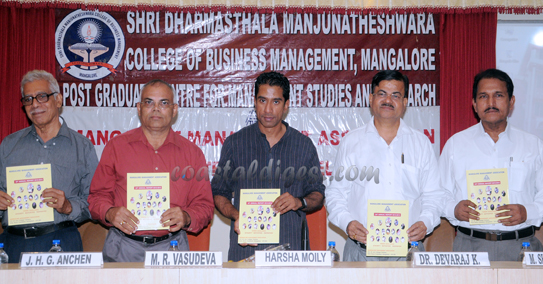
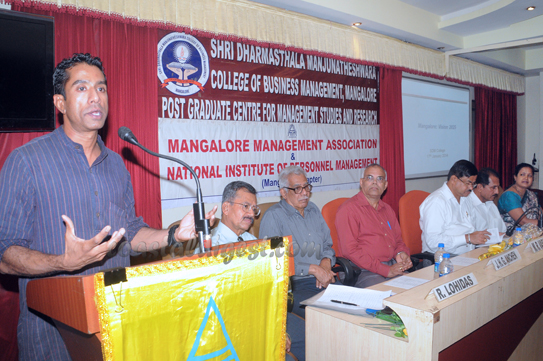
Mangalore, Jan 18: Stressing on the need for economic development in Dakshina Kannada, CEO of Milkroute, Bangalore Harsha Moily said that it was important to have progressive political leadership, dynamic leadership, an efficient social sector and communal harmony in the district.

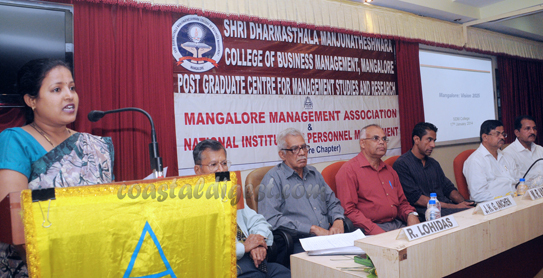
He was speaking on the topic 'Mangalore – Vision 2025' at a programme organised by Mangalore Management Association (MMA) and National Institute of Personnel Management (NIPM) at SDM Law College in the city on Friday.

“To impact the lives of roughly 2.2 million people, create prosperity in 354 villages, make productive use of 320 kms of coastline and 4.866 sq kms of undeveloped land and maintain the rich cultures and historic sites in Dakshina Kannada, we have to make the most of the resources available to make the district economically developed,” he said.

Six key pillars for economic development

He said that there were six strategic plans to act upon, for the realisation of the 'Vision 2025' for Mangalore city and the entire district, including achieving communal harmony, development of ports and fisheries sector, transformation of agriculture sectors, turning Mangalore into an IT hub, building physical and social infrastructure and implementation of government programmes.

It is critical to achieve communal harmony in the district, as high economic prosperity is possible only when there is a stable environment. It is also important to develop the ports and fisheries sector to enable creation of more jobs for youth. There should be focus on deployment of technology in agriculture and cultivation of crops such as paddy, arecanut, coconut and others with minimum water resources, he said.

“Mangalore has the potential to become an IT hub for which there should be increased pool of qualified manpower, power infrastructure and telecom services in the city. The district also needs to focus on increasing quality of primary and secondary schools, quality of healthcare and quality of roads. For effective implementation of governmental programmes, we need to strengthen gram panchayats and get rid of corruption at every level,” he said.

Vision statement

He said that his vision statement included the right to protection, participation in decision and policy-making and prosperity for every citizen in the district.

He also said that Mangalore had a lot of potential that was yet to be tapped, and the factor of utmost importance was the execution of the action plan.

Director of SDM PG Centre Dr Devaraj K made the presidential remarks.
SDM_17_1
SDM_17_2
SDM_17_3

Comments

Add new comment

  • Coastaldigest.com reserves the right to delete or block any comments.
  • Coastaldigset.com is not responsible for its readers’ comments.
  • Comments that are abusive, incendiary or irrelevant are strictly prohibited.
  • Please use a genuine email ID and provide your name to avoid reject.
News Network
June 8,2020

Bengaluru, Jun 8: The Bharatiya Janata Party (BJP) on Monday fielded Eranna Kadadi and Ashok Gasti as it's candidates for the June 19 Rajya Sabha elections from Karnataka, ignoring the recommendations of the state BJP unit.

The state unit had recommended the names of Prabhakar Kore, Ramesh Katti and Prakash Shetty.

The names of the two candidates were announced in a party statement in Delhi.

The election is scheduled on June 19 to fill four Rajya Sabha seats from Karnataka, represented by Rajeev Gowda and BK Hariprasad of Congress, Prabhakar Kore of BJP and D Kupendra Reddy of JD(S) that will fall vacant on June 25, with their retirement.

June 9 is the last date for filing nominations. Party sources said both Kadadi and Gasti come from an RSS background.

Kadadi hails from Belagavi, while Gasti is a resident of Raichur.

The 54-year-old Eranna Kadadi started his active political career in 1989 and unsuccessfully contested the assembly election from Arambhavi constituency in 1994 on a BJP ticket.

He had also served as the Belagavi district Panchayat president in 2010.

Ashok Gasti is a lawyer by profession and former general secretary of the BJP's OBC Cell.

He is the former chairperson of the Backward Class Development Corporation.

Comments

Add new comment

  • Coastaldigest.com reserves the right to delete or block any comments.
  • Coastaldigset.com is not responsible for its readers’ comments.
  • Comments that are abusive, incendiary or irrelevant are strictly prohibited.
  • Please use a genuine email ID and provide your name to avoid reject.
News Network
April 18,2020

Mangaluru, Apr 18: Three people, including a woman, who were being treated at the city's Wenlock Hospital have been discharged after they recovered from Novel Coronavirus (COVID-19).

With this, a total of 12 people who had tested positive for the virus until Thursday have been discharged from various hospitals in Dakshina Kannada.

A 39-year-old advocate from Uppinangady tested positive for Covid -19 on Friday, he has been admitted to the Wenlock Hospital and is being treated. With this, only one COVID-19 positive patient is being treated at Wenlock Hospital till Friday evening.

Comments

Add new comment

  • Coastaldigest.com reserves the right to delete or block any comments.
  • Coastaldigset.com is not responsible for its readers’ comments.
  • Comments that are abusive, incendiary or irrelevant are strictly prohibited.
  • Please use a genuine email ID and provide your name to avoid reject.
Media Release
February 14,2020

Veteran journalist P. Sainath has said that the nation is in a crisis. And this crisis is not limited to just the rural area. It has become a national crisis at various areas such as agriculture, education, economy, job creation etc.

He was delivering the endowment lecture on the topic ‘Indian democracy at the post-liberalization and post-truth era’ at Media Manthan 2020 organized by the PG department of journalism and mass communication at St Aloysius College (Autonomous). 

Mr Sainath said that the many policies adopted in the 90s led to India becoming unusually unequal. Referring to the speech Ambedkar had made at the Constituent Assembly while handing over the draft of the Constitution, Mr Sainath said, “Ambedkar had warned about the weakness of Indian democracy that liberty without equality allows the supremacy of a few over the multitude. Liberty, equality and fraternity must be kept together as we cannot have one without the other.” 

Mr Sainath stated that the agrarian crisis was no longer about the loss of productivity, employment or about farmer suicide; it was a societal, civilizational crisis. Commenting on the lopsided policies such as cow-slaughter ban, he explained how cow slaughter ban had adversely affected many industries due to their interdependency. While Muslims who slaughtered cows were rendered helpless, the cattle traders who were mostly OBCs lost their earnings as the cattle prices crashed. An important industry like Kolhapur sandals industry in Maharashtra went bankrupt as a result of the cow slaughter ban in Maharashtra. He said the policymakers had no idea how the rural industries were interconnected. Demonetisation too devastated the rural economy as 98 percent of rural transactions happen through cash. 

Mr Sainath also spoke about the crisis of inequality which affects the Dalits and the Adivasis far more than anyone else as 90 percent of the rural households take home less than Rs 10,000/- per month. “Women are yet another group whose labour is never counted in the gross domestic product. Women and girls globally do unpaid work which amounts to about 12.5 billion working hours per year. Monetarily speaking, this is worth 10.8 trillion dollars,” Mr Sainath added. 

Speaking about the crisis of jobs Mr Sainath said that major companies were laying off employees just to create more profits for the investors and the adoption of artificial intelligence in the industry would further destroy millions of jobs.

Rector of St Aloysius College Institutions Fr Dionysius Vaz SJ, Principal Dr (Fr) Praveen Martis SJ, HOD of Journalism and Mass Communication department Dr (Fr) Melwyn Pinto SJ were present.

‘Veerappan and Vijay Mallya’s business models are interesting!’

Addressing the gathering during his endowment lecture on Friday, Mr Sainath made an interesting comment on the so called ‘revenue model’. “Whenever I visit IIMs and IITs for lectures on my PARI project, the students there ask me what my revenue model for my project is. I tell them that I do not have a revenue model. In fact, journalism does not begin with a revenue model. Gandhiji, Ambedkar, Bhagat Singh were all great journalists. But they did not have a revenue model,” Mr Sainath said.

On a lighter note, he said that the best revenue model that he liked was that of forest brigand Veerappan and liquor baron Vijay Mallya. “Veerappan ruled the forest for forty years and from the top ministers to the villagers he could dictate terms and liver royally. Similarly, Mallya’s revenue model was to steal the banks and run away abroad and live like a king,” Mr Sainath added.

Journalism is not and can never be a business. It is a calling, he opined. While newspaper can be a business, television can be a business, journalism per se cannot be reduced to a business. “Unfortunately today, journalists are recruited on a contract basis and they have no bargaining power; and there are no unions to fight for their cause. Hence, they are at the mercy of the corporate media houses for their survival and are made to write stories that cannot be called journalism,” Mr Sainath said.

Answering a question as to the pressures he faced as a journalist, he said that external pressures from the government or others could be very well handled. It is the internal pressures from once own media house that journalists find it difficult to manage.


Comments

Add new comment

  • Coastaldigest.com reserves the right to delete or block any comments.
  • Coastaldigset.com is not responsible for its readers’ comments.
  • Comments that are abusive, incendiary or irrelevant are strictly prohibited.
  • Please use a genuine email ID and provide your name to avoid reject.