Muslim Personal Law Board chief inaugurates green mosque in Kodi

[email protected] (CD Network)
January 16, 2016

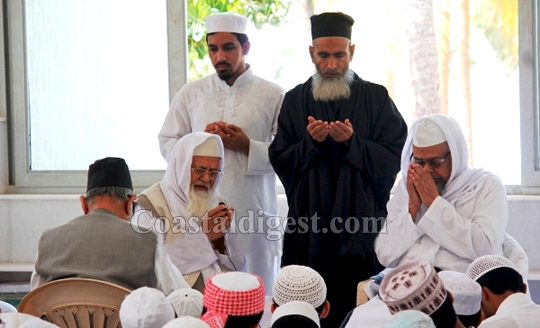
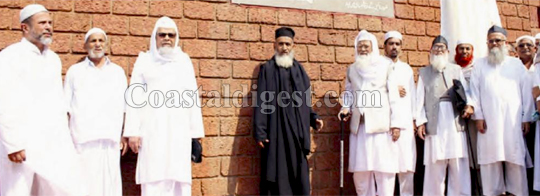
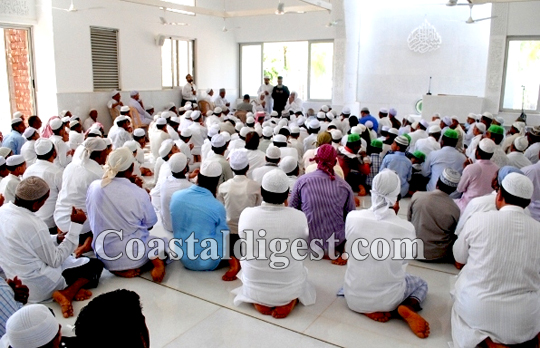
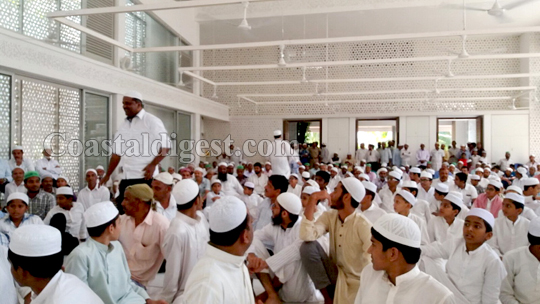
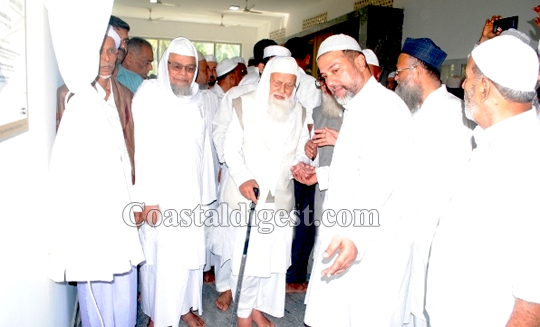
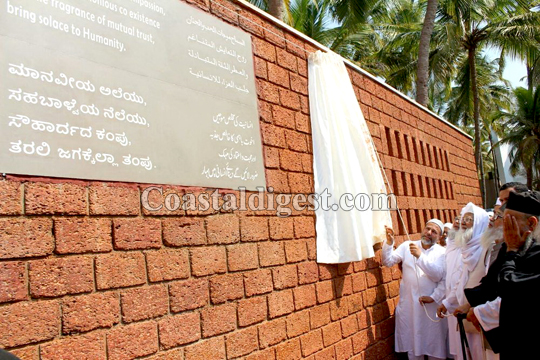
Udupi, Jan 16: Renovated with sustainable eco-friendly features by the Bearys Group, the Badriya Jum’a Masjid of Kodi in Kundapur taluk was formally inaugurated by Moulana Sayyed Mohammed Rabey Hasani Nadvi, president, All India Muslim Personal Law Board, in the presence of a galaxy of religious scholars.
kodimosque5

Speaking on the occasion he said that a mosque is centre of love, peace and humanity and it spreads the message of peace and brotherhood. He also called upon the Muslims to be harbingers of global peace by following the teachings of Quran and Sunnah.

Applauding Bearys Group for converting Badriya Jum’a Masjid into world’s first ‘zero energy’ eco-friendly green mosque, Maulana Mufti Mohammed Ashraf Ali Baqavi, principal of Darul Uloom Sabeelur Rashad, said that people of Kodi now bear the responsibility to spread peace and brotherhood through this facility.

Ibrahim Musliyar Bekal, Khazi of Udupi district, CMD, Bearys Group, UT Khader, Minister for Health and Family Welfare were present among others.

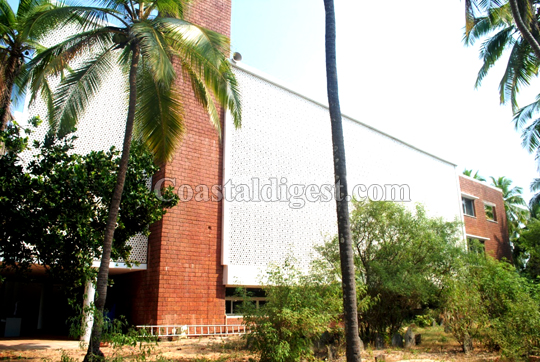
The mosque design has integrated Islamic architecture and sustainable technologies. The important feature of this green building is that its entire energy requirement is met through hybrid renewable energy, both wind and solar.

80 year old mosque

Mr Beary said that the mosque was built by his grandfather 80 years ago. It was renovated 40 years ago and now it was renovated again with eco-friendly measures. “It is our little contribution in India’s march towards sustainable development,” he said and hoped that the mosque will become a holistic place of worship where people from all over the world can come, pray and find true solace.

The mosque, built on 15,000 sqft area, at a cost of Rs 2 crore has come up in a palatial ground accommodating greenery in and around. The cooling of the building is achieved by using elements of nature. The building orientation minimizes solar heat gain.

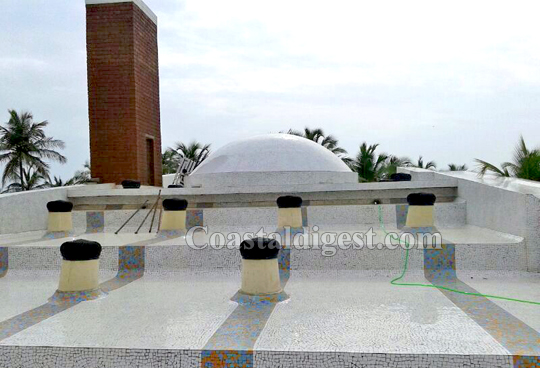
The ‘L’ shaped building plan and elevated nature of the prayer hall, green vegetation and water tanks around it offer a naturally cooled environment. The solar heat reflecting terrace floor, laid with white China mosaics and fitted with turbo vents, not only keep the prayer space cool, but also reduces warming of local micro climate, he said.

The power consumed is six kilo watts as against the actual requirement of 40 to 50 kilo watts. Its open envelope with sun rays travelling and non-conducting Glass Reinforced Concrete (GRC) Jallis with over 50 per cent openings, increase natural ventilation.

The natural cooling of the building is accentuated by the wind scoop on 70 foot multifunctional Minaret (from where the Azan, the call for prayer is given) which forces down draft of cool breeze into the prayer hall and also supports the tower structure of wind turbine mounted atop it.

Use of hybrid renewable energy (Wind and solar energy) in the mosque will produce more energy than used by the mosque, thus feeding energy to state grid and accruing (CER) credits for next 25 years.

“Reduce-Reuse-Recycle-Regenerate” technology has been implemented here and it is equipped with “Pressmatic” (Taps with technology that allows only a fixed quantity of water to flow with every press of its knob) water fixtures to conserve precious water, he claimed.

The calligraphy in Arabic, Chinese and Japanese languages on the walls of the mosque is done by Mukhthar Ahmed, the head of Institute of Indo-Islamic Art and culture, Bengaluru. The mosque also accommodates a library.

Also Read: World’s first ‘zero energy’ green mosque all set for inauguration in Udupi’s Kodi
kodimosque8

kodimosque3

kodimosque9

kodimosque10

kodimosque4

kodimosque6

kodimosque7

kodimosque11

Comments

Laurinda
 - 
Sunday, 31 Jan 2016

Dell has also made other strides toward becoming a greener technology company.
However, the industry believes that, at present,
China's household electrical appliance recycling enterprises
are facing difficulties. According to him, the practice of scrap metal recycling in Los Angeles will not only help us keep the environment clean but also make some
additional money.

Also visit my blog :: electronics recycling los angeles: http://Electronicrecycling-La.com/

Zahoor Ahmed
 - 
Saturday, 16 Jan 2016

May Allah accept all good deeds of Br. Syed Beary and his family and reward them the best in here and hereafter. Ameen

Salman
 - 
Saturday, 16 Jan 2016

Masha Allah. May allah accept the good deed of Syed Mohammed Beary, his grand father and all their family memebrs.

Add new comment

  • Coastaldigest.com reserves the right to delete or block any comments.
  • Coastaldigset.com is not responsible for its readers’ comments.
  • Comments that are abusive, incendiary or irrelevant are strictly prohibited.
  • Please use a genuine email ID and provide your name to avoid reject.
News Network
May 7,2020

Bengaluru, May 7: Karnataka has revised its standard operating procedure (SOP) for international passengers. The first group of passengers will arrive in the state on May 8.

The number of categories has been reduced to two from three. Category A includes passengers symptomatic on arrival while Category B passengers are those asymptomatic on arrival. These are passengers who are either healthy or those having co-morbidities.

As per the revised SOP, the passenger will be released on the seventh day, if tested negative, to strict home quarantine for another seven days with stamping.

This norm is in contradiction to the Ministry of Home Affairs’ SOP for international passengers. As per the MHA’s SOP, the passengers (asymptomatic) will be under institutional quarantine for 14 days. Testing negative after 14 days, they will be allowed to go home and will undertake self-monitoring of their health for 14 more days.

On the contradiction, Pandey said, "We don't take chances as we rely on tests instead of just quarantining. Other states may be depending on just 14-day institutional quarantine."

"GOI SOP doesn't talk about Covid tests on international passengers. We have put an additional safety layer of three Covid tests on returnees -- one on arrival, second from 5-7 days and last on 12th day. This will ensure definite identification of positive cases even if they are asymptomatic and their subsequent treatment. We should look at the spirit behind the order," he added.

On the 14-day additional reporting period for category B, he said, "It is implied as category B patients should report to us for 14 days after their first 14-day quarantine period is over."

Medical Education Minister Dr K Sudhakar said that the State would follow the Centre’s norms.

Till Tuesday, Karnataka’s SOP had three categories. Under Category A (symptomatic), 14-day institutional quarantine at COVID-19 Health Care Centre was mandatory followed by 14-day reporting period. Under Category B (asymptomatic above 60 years with co-morbidities), seven-day institutional quarantine at hotel/hostel followed by seven-day home quarantine and 14-day reporting period had been recommended. The 14-day home quarantine and 14-day reporting period was mandatory for Category C (asymptomatic).

Comments

Add new comment

  • Coastaldigest.com reserves the right to delete or block any comments.
  • Coastaldigset.com is not responsible for its readers’ comments.
  • Comments that are abusive, incendiary or irrelevant are strictly prohibited.
  • Please use a genuine email ID and provide your name to avoid reject.
News Network
June 9,2020

New Delhi, Jun 9: Elections to seven seats of the Karnataka Legislative Council will be held on June 29, the poll panel announced on Tuesday.

The seven seats are falling vacant on June 30, according to an Election Commission statement.

Members of the Karnataka Legislative Assembly will vote on June 29 to elect the seven new MLCs.

The Commission has directed the Karnataka chief secretary to depute a senior officer to ensure that the  instructions regarding COVID-19 containment measures are complied with during the elections.

The counting of votes will be held on the evening of June 29 after completion of polls, as per practice.

The notification for the elections will be issued on June 11, the statement said.

MLCs are usually elected by four types of electors -- MLAs, Graduates, Teachers and members of local authorities.

On Monday, the Commission had deferred elections to four seats of the Karnataka Legislative Council -- two each from Teachers and Graduate constituencies -- falling vacant on June 30 due to the outbreak of the novel coronavirus.

"If MLAs are electors, the size of the electorate is small and the assembly building is the only polling station. When the electorate is teachers or graduates, the number of those who can vote is higher.

Due to the virus, Commission only allowed polls to seats where MLAs are the electors to prevent large gatherings," explained a senior EC functionary.

Comments

Add new comment

  • Coastaldigest.com reserves the right to delete or block any comments.
  • Coastaldigset.com is not responsible for its readers’ comments.
  • Comments that are abusive, incendiary or irrelevant are strictly prohibited.
  • Please use a genuine email ID and provide your name to avoid reject.
News Network
June 21,2020

India on Sunday witnessed annual solar eclipse or 'surya grahan' 2020, the third eclipse even for this year after first two lunar eclipses took place in January and June and the last annual solar eclipse of this decade.

The solar eclipse started from around 9 a.m. across the Indian map as the Sun, the Moon, and the Earth came in a straight line, and the country witnessed the 'deepest' annular solar eclipse in over a century.

Astrologers said it a fourth super rare hybrid eclipse which is a mix between an annular and total solar eclipse.

Areas like Hyderabad, Chennai, Bhubaneshwar, Kolkata, Lucknow, Mumbai, Delhi, Patna, Shillong and more witnessed a partial phase of the annular solar eclipse from 9 a.m.

In the eclipse, the distance of the Moon and Earth will be larger than usual which means the moon will not be able to cover up the sun fully and will leave out the borders of the sun - giving an appearance of a "Ring of Fire".

Press Information Bureau in a tweet informed that it is the last annular solar eclipse in India of this decade.

People can catch glimpse of the partially covered sun between 10 a.m. and 2.28 p.m. as per the time differing as locations in India. The eclipse will continue for over three hours covering 84 per cent Sun.

There are three types of solar eclipses - total, partial, and annular.

Comments

Add new comment

  • Coastaldigest.com reserves the right to delete or block any comments.
  • Coastaldigset.com is not responsible for its readers’ comments.
  • Comments that are abusive, incendiary or irrelevant are strictly prohibited.
  • Please use a genuine email ID and provide your name to avoid reject.