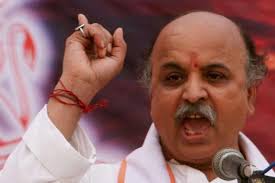
Togadia barred from entering Mangaluru between Jan 18 and 24

[email protected] (CD Network)
January 19, 2016

togadiaMangaluru, Jan 18: A few days after Islamic orator Zakir Naik was barred from Mangaluru, the police have barred the entry of Vishwa Hindu Parishad’s International Working President Praveen Togadia into the city between January 18 and January 24.

In a press note, Police Commissioner M. Chandra Sekhar said that the police have learnt of Dr. Togadia attending a meeting here on January 20.

The prohibitory order was issued as Dr. Togadia has the ability to make provocative speeches that could disturb peace and tranquillity.

“The region is sensitive. We need to take precautions to maintain peace,” Mr. Chandra Sekhar said.

Comments

Goodman
 - 
Tuesday, 19 Jan 2016

Justice is done fairly.
Commissioner Chandrashekhar is fair enough.

If Dr. Zakir Naik a peace preaching person, can not enter a place, then hate preachers can and should never enter that land.

Kushwant Bhat
 - 
Tuesday, 19 Jan 2016

I do not Understand why you media raising this type of Issues, why Ravan Thogadia Banned to Enter Hindustan's most popular City,
Really it is not Acceptable we are all Hindustanis not other Stanis, but you commented to Master Blaster Pump well there are lot of Pump wells, this is Irreducible to all in Hindustan if one Pump well become Criminal do not blame all, My Dearest Reader please find out \How the Name Pump Well\" started calling there was a big story behind it You Buffoons with out knowing the History Calling to all Idiots as Pump Well totally not acceptable my dear.

Jai Hindustan"

Mohidin
 - 
Tuesday, 19 Jan 2016

Dear Pump well, We believe district administration got permission from STRONG Bajrangi's to ban entry of P(ravan) Togadia.

Add new comment

  • Coastaldigest.com reserves the right to delete or block any comments.
  • Coastaldigset.com is not responsible for its readers’ comments.
  • Comments that are abusive, incendiary or irrelevant are strictly prohibited.
  • Please use a genuine email ID and provide your name to avoid reject.
News Network
January 18,2020

Kozhikode, Jan 18: A "fifth-generation dynast" Rahul Gandhi has no chance in Indian politics against a "hard-working and self-made" Narendra Modi, and Kerala did a disastrous thing by electing the the Congress leader to Parliament, historian Ramachandra Guha said here on Friday.

Guha said the reduction of the Congress from a "great party" during the freedom movement to a "pathetic family firm" now is one of the reasons for the ascendency of Hindutva and jingoism in India.

"I have nothing against Rahul Gandhi personally. He is a decent fellow, very well-mannered. But young India does not want a fifth-generation dynast. If you Malyalis make the mistake of re-electing Rahul Gandhi in 2024 too, you are merely handing over an advantage to Narendra Modi," said Guha on the second day of the ongoing Kerala Literature Festival (KLF) during his talk, "Patriotism Vs Jingoism".

Addressing the crowd, full of Keralites, he said, "Kerala, you have done many wonderful things for India, but one of the disastrous thing you did was to elect Rahul Gandhi to Parliament."

"Narendra Modi's great advantage is that he is not Rahul Gandhi. He is self-made. He has run a state for 15 years, he has an administrative experience, he is incredibly hard working and he never takes holidays in Europe. Believe me I am saying all this in all seriousness," he said.

But, even if Rahul Gandhi was "much more intelligent, more hard-working, never took a holiday in Europe, as a fifth generation dynast he still will be at a disadvantage against a self-made person", the 61-year-old author said.

He took on Congress president Sonia Gandhi too who, he said, reminded him of the "late Mughal dynasty" and how aloof they were of the state of their kingdom.

"India is becoming more democratic and less feudal, and the Gandhis just don't realise this. You (Sonia) are in Delhi, your kingdom is shrinking more and more but still your chamchas (sycophants) are telling you that you are still the badshah," he said.

Further, he quoted his teacher and noted Indian sociologist Andre Beteille to describe the story of Nehru-Gandhi family as a classic "reversal of the famous Biblical injunction": the sins of the father will be visited upon seven successive generations.

"In the Nehru's case, it is the sins of the seven successive generations have been re-visited upon Nehru... look at the national debate today. Why is Nehru evoked everytime? Why does Modi always say Nehru ne Kashmir mein yeh kiya, China mein yeh kiya, Triple Talaq mein yeh kiye ... because Rahul Gandhi is there.

"Now if Rahul Gandhi disappears, Modi has to talk about his own policies and why they failed," he said.

According to Guha, "Hypocrisy of the Indian Left -- the fact that they loved other nations more than India", "rise of aggressive nationalism worldwide" and "the rise of Islamic fundamentalism in neighbouring countries" are some other reasons behind the evident leap of Hindutva in India in the recent times.

Historian William Dalrymple, novelists like Benyamin, Namita Gokhale, Chetan Bhagat and journalists Karan Thapar and Rajdeep Sardesai are among the many other writers who will be attending the four-day festival.

The focus theme of KLF 2020 is environment and climate change.

Comments

Add new comment

  • Coastaldigest.com reserves the right to delete or block any comments.
  • Coastaldigset.com is not responsible for its readers’ comments.
  • Comments that are abusive, incendiary or irrelevant are strictly prohibited.
  • Please use a genuine email ID and provide your name to avoid reject.
News Network
April 29,2020

Bengaluru, Apr 29: Indian women have always been the epitome of beauty, strength, and intelligence. Today, the success of Indian women across various walks of life has proven that they have earned this reputation.

One such dedicated social worker is Dr Sunitha Manjunath, the Founder of 'Sumanaa Foundation' of Sanjay Nagar in Bengaluru.

Sumanaa Foundation, based out of Sanjay Nagar in Bengaluru has been on the forefront to support people in distress due to COVID-19. 

The foundation under the leadership of its founder Dr Sunitha Manjunath procured a total of 20000 kgs of farm-fresh produce in four phases from farmers who are unable to sell it due to the COVID Lockdown and have distributed it across 6000 families across Bengaluru city.

"We have procured these vegetables after identifying farmers who are unable to sell their produce due to the challenges of lockdown.

This initiative not only supports the farmers by helping them get the right price for their produce, but also gives us an opportunity to get vegetables at a reasonable price by escaping all middlemen and commissions. We have identified 6000 poor families mainly around Bengaluru city who have not been able to earn their daily wages and given them coupons.

The foundation members identify genuine cases and give them coupons which can be redeemed in exchange of an essential vegetables kit," said Dr Sunitha Manjunath, the founder of Sumanaa Foundation.

These vegetables have been procured from Chikkaballapura, Doddaballapura, and surrounding villages and included vegetables like onions, tomatoes, capsicum, green chillies, beans, carrots, brinjal, potatoes, beetroots etc. These farmers got a fair price for their produce and were overjoyed to know that their harvest is being distributed free of cost to needy and deserving families.

Sumanaa Foundation has been actively supporting the city administration in fighting COVID-19 pandemic. In the recent weeks the foundation has distributed sanitisers and masks to BBMP Pourakarmikas.

The foundation also cooked food for over 400 people each day. This food was handed over to the city administration, which further distributed this to the police department and other staff working across government departments during these testing times.

Dr Sunitha, an engineer by qualification, had enjoyed a high-flying corporate career with BOSCH. She was offered a global role, which she turned down to setup her NGO, 'Sumanaa Foundation' and to serve the needy in and around her locality. Over the past seven years, the NGO with 70 members has done a wide range of activities to support the poor and needy in Bengaluru.

The core team of Sumanaa Foundation works under the leadership of its president Dr Sunitha Manjunath and includes young and energetic individuals like Manjunath K, Prakash K, Vidya Prakash, Sindu Gowda, Byregowda, Nishita Arjun, Arjun Varadaraj and Manoj Kumar
'Meal of Humanity' is a notable initiative of Dr Sunitha Manjunath and her team. Under this program, over 300 poor people are served mid-day meals every day. 

This is currently a self-sustained program with no external funding. Dr Sunitha Manjunath, her family members, and friends contribute their hard-earned money to bring smiles to hundreds of migrant workers and daily wage laborers.

'Wall of Humanity' is another unique concept implemented by Sumanaa Foundation. People can leave used or unnecessary daily use products like clothes, toys, groceries, etc at a designated area. This can be picked by anyone in need of these items. This self-helping model has touched the lives of hundreds of people in and around the area of Sanjay Nagar.

Regular blood donation camps, eye checkups, scholarship for students, tailoring machine distribution, environmental initiatives, Swacch Bharath programs, wall painting across the roadside are just a few among the hundreds of activities undertaken by Sumanaa Foundation regularly under the leadership of Dr Sunitha Manjunath and her team of friends.

"A life without an aim is worthless and so is a death without achievement. The aim of my life is to touch the lives of the hundreds of people who are not as privileged as you and me. I'd like to thank my husband Manjunath, my In-Laws and my friends from Sumanaa Foundation who work tirelessly alongside me across all our initiatives," said an elated Dr Sunitha Manjuanth on receiving the 'ET Power Icons' award for Excellence in Social Service and Public Initiatives.

Dr Sunitha Manjunath has also been awarded the prestigious 'Kempegowda Award' and many more such awards for her contribution to the society.

Comments

Add new comment

  • Coastaldigest.com reserves the right to delete or block any comments.
  • Coastaldigset.com is not responsible for its readers’ comments.
  • Comments that are abusive, incendiary or irrelevant are strictly prohibited.
  • Please use a genuine email ID and provide your name to avoid reject.
Agencies
February 20,2020

India ranked 77th on a sustainability index that takes into account per capita carbon emissions and ability of children in a nation to live healthy lives and secures 131st spot on a flourishing ranking that measures the best chance at survival and well-being for children, according to a UN-backed report.

The report was released on Wednesday by a commission of over 40 child and adolescent health experts from around the world. It was commissioned by the World Health Organization (WHO), UN Children's Fund (UNICEF) and The Lancet medical journal.

In the report assessing the capacity of 180 countries to ensure that their youngsters can survive and thrive, India ranks 77th on the Sustainability Index and 131 on the Flourishing Index, it said.

Flourishing is the geometric mean of Surviving and Thriving. For Surviving, the authors selected maternal survival, survival in children younger than 5 years old, suicide, access to maternal and child health services, basic hygiene and sanitation, and lack of extreme poverty.

For Thriving, the domains were educational achievement, growth and nutrition, reproductive freedom, and protection from violence.

Under the Sustainability Index, the authors noted that promoting today's national conditions for children to survive and thrive must not come at the cost of eroding future global conditions for children's ability to flourish.

The Sustainability Index ranks countries on excess carbon emissions compared with the 2030 target. This provides a convenient and available proxy for a country's contribution to sustainability in future.

The report noted that under realistic assumptions about possible trajectories towards sustainable greenhouse gas emissions, models predict that global carbon emissions need to be reduced from 39·7 giga­ tonnes to 22·8 gigatonnes per year by 2030 to maintain even a 66 per cent chance of keeping global warming below 1·5°C.

It said that the world's survival depended on children being able to flourish, but no country is doing enough to give them a sustainable future.

"No country in the world is currently providing the conditions we need to support every child to grow up and have a healthy future," said Anthony Costello, Professor of Global Health and Sustainability at University College London, one of the lead authors of the report.

"Especially, they're under immediate threat from climate change and from commercial marketing, which has grown hugely in the last decade," said Costello – former WHO Director of Mother, Child and Adolescent health.

Norway leads the table for survival, health, education and nutrition rates - followed by South Korea and the Netherlands. Central African Republic, Chad and Somalia come at the bottom.

However, when taking into account per capita CO2 emissions, these top countries trail behind, with Norway 156th, the Republic of Korea 166th and the Netherlands 160th.

Each of the three emits 210 per cent more CO2 per capita than their 2030 target, the data shows, while the US, Australia, and Saudi Arabia are among the 10 worst emitters. The lowest emitters are Burundi, Chad and Somalia.

According to the report, the only countries on track to beat CO2 emission per capita targets by 2030, while also performing fairly – within the top 70 – on child flourishing measures are: Albania, Armenia, Grenada, Jordan, Moldova, Sri Lanka, Tunisia, Uruguay and Vietnam.

"More than 2 billion people live in countries where development is hampered by humanitarian crises, conflicts, and natural disasters, problems increasingly linked with climate change," said Minister Awa Coll-Seck from Senegal, Co-Chair of the commission.

The report also highlights the distinct threat posed to children from harmful marketing.

Evidence suggests that children in some countries see as many as 30,000 advertisements on television alone in a single year, while youth exposure to vaping (e-cigarettes) advertisements increased by more than 250 per cent in the US over two years, reaching more than 24 million young people.

Studies in Australia, Canada, Mexico, New Zealand and the US – among many others – have shown that self-regulation has not hampered commercial ability to advertise to children.

Children's exposure to commercial marketing of junk food and sugary beverages is associated with purchase of unhealthy foods and overweight and obesity, linking predatory marketing to the alarming rise in childhood obesity, it said.

The number of obese children and adolescents increased from 11 million in 1975 to 124 million in 2016 – an 11-fold increase, with dire individual and societal costs, the report said.

To protect children, the authors call for a new global movement driven by and for children.

Specific recommendations include stopping CO2 emissions with the utmost urgency, to ensure children have a future on this planet; placing children and adolescents at the centre of global efforts to achieve sustainable development, the report said.

New policies and investment in all sectors to work towards child health and rights; incorporating children's voices into policy decisions and tightening national regulation of harmful commercial marketing, supported by a new Optional Protocol to the UN Convention on the Rights of the Child, it said.


Comments

Add new comment

  • Coastaldigest.com reserves the right to delete or block any comments.
  • Coastaldigset.com is not responsible for its readers’ comments.
  • Comments that are abusive, incendiary or irrelevant are strictly prohibited.
  • Please use a genuine email ID and provide your name to avoid reject.