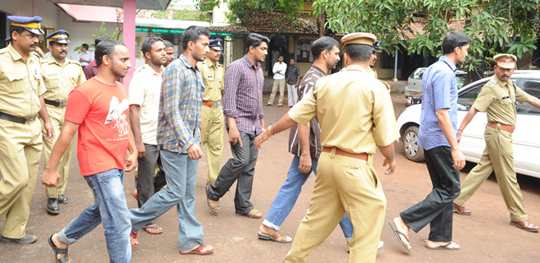
NIA court sends 21 PFI activists to jail for holding arms training camp

[email protected] (News Network)
January 21, 2016

Kasaragod, Jan 21: A special court of the National Investigation Agency (NIA) has sentenced 21 accused in the Narath arms training camp case to varying years of imprisonments after they were found guilty of offences charged under various sections of the Indian Penal Code, Arms Act, and the Unlawful Activities (Prevention) Act.

armstraining

While Special Judge S. Santhosh Kumar awarded seven-year imprisonment to the first accused, the other 20 accused were given five-year jail term each. The court acquitted the 22nd accused in the case.

The prosecution case was that the accused persons, Popular Front of India and Social Democratic Party of India activists, had organised an arms training camp at Narath in Kerala on April 23, 2013. The police had raided the training camp and taken into custody 21 PFI activists at Narath.

The NIA contended that the police officer who arrested the accused overheard the inflammatory speech of P.V. Abdul Azeez, the first accused in the case.

The accused wanted to impart training in weapons and explosives with intention to retaliate against the alleged tortures faced by Muslims in the country.

The court observed that the circumstances showed that the purpose of the assembly was unlawful and the accused could not satisfactorily explain the possession of weapon and country-bombs. Therefore, it could be safely concluded that there was a training camp and the accused were liable to be punished under Sections 18 and 18 A of the Unlawful Activities (Prevention) Act.”

The court concluded that the prosecution had succeeded in proving the offences under Section 120 B (Criminal Conspiracy), 143 and 149 (Unlawful assembly) of Indian Penal Code, section 153 A (Promoting enmity between different groups on grounds of religion) and 153 (B) (1) (C) (Imputations, assertions prejudicial to national-integration) of IPC, section 5 (1) (a) of the Arms Act and under Sections 18 and 18 A of the UAPA.

Comments

Optimistic
 - 
Friday, 22 Jan 2016

RSS openly using arms , they are also using Guns which is supplied for NCC cadets in colleges, for their personnel training.

Hareesh moodbidri
 - 
Friday, 22 Jan 2016

Oops..again proved by bloody communal govt.. Arms training UP by Hindu extremists , no punishment , no action,, suspected in arm training by Muslim, than there is regious punishments,, what is the hell by communal govt,, which is run by bloody chassis,,

Mohammed Mustafa
 - 
Thursday, 21 Jan 2016

Why coastaldigest team publishing hate comments from Kotian, Ajith.

Suraj
 - 
Thursday, 21 Jan 2016

Deport them to Pakistan or Syria

Ajit
 - 
Thursday, 21 Jan 2016

Now bearys will start screaming this fellow got bail that fellow got bail.. but anti-nationals always will be anti nationals. police and law should be ruthless towards them.

Viren Kotian
 - 
Thursday, 21 Jan 2016

hahaha.. Allahu Akbar... Jai Sri Ram... Jai Jesus... Hara Hara Modi...

Add new comment

  • Coastaldigest.com reserves the right to delete or block any comments.
  • Coastaldigset.com is not responsible for its readers’ comments.
  • Comments that are abusive, incendiary or irrelevant are strictly prohibited.
  • Please use a genuine email ID and provide your name to avoid reject.
News Network
February 24,2020

Lucknow, Feb 24: The Uttar Pradesh Sunni Central Waqf Board on Monday accepted the five acres of land provided for construction of the mosque in Ayodhya.

The Board also decided to form a trust to oversee the construction of the mosque.

The decision was taken in a meeting chaired by the Board's Chairman Zufar Faruqui.

Apart from this, the trust will also construct a charitable hospital, public library and a centre showcasing the heritage of Indo-Islamic civilisation which will also serve as a research and study centre for the same, according to a press release by the board.

The appointment of members to the trust will be announced following its creation, the release added.

The Supreme Court had on November 9 last year directed the Central government to hand over the disputed site at Ayodhya for the construction of a temple and set up a trust for the same.

The apex court had further directed the government to allocate an alternative five acres of land at a prominent location in Ayodhya for the construction of a mosque to the Sunni Waqf Board.

Comments

Add new comment

  • Coastaldigest.com reserves the right to delete or block any comments.
  • Coastaldigset.com is not responsible for its readers’ comments.
  • Comments that are abusive, incendiary or irrelevant are strictly prohibited.
  • Please use a genuine email ID and provide your name to avoid reject.
Wafa Sultana
April 4,2020

Over the last couple of days when the world was occupied with unifying efforts to fight the deadly Covid19 pandemic, sections of Indian media provided viewers a familiar scapegoat – the Indian Muslims – who are often stereotyped as a community being constantly at loggerheads with the citizenry and the State. Biased media channels were quick to resort to blaming the entire Muslim community for the spread of the disease in the country, thanks to an ill-timed Tablighi Jamaat gathering at its international headquarters in Delhi’s Nizamuddin. Unsurprisingly, the opprobrium was also marked by a sudden spike in WhatsApp forwards of videos with people wearing skullcaps licking spoons and performing Sufi breathing rituals, suggesting some sort of wild conspiracy on the part of the community to spread the virus.  Some media channels were quick to formulate, hypothesize and provide loose definitions of a newly discovered form of Jihad i.e. ‘Corona Jihad ’ thereby vilifying the Islamic faith and its followers.

While the investigation on the culpability of the organizers of the Nizamuddin event is still ongoing, there is enough information to suggest that the meeting was held before any lockdown was in force, and the problem began when there was no way of getting people out once the curfew was announced. Be that as it may, there is little doubt that organizing a meet of such a scale when there is a global pandemic smacks of gross misjudgment, and definitely the organizers should be held accountable if laws or public orders were defied. Attendees who attempt to defy quarantine measures must be dealt with strictly. However, what is alarming is that the focus and narrative have now shifted from the unfortunate event at Nizamuddin to the Tablighi Jamaat itself.

For those not familiar with the Tablighi Jamaat, the organization was founded in 1926 in Mewat by scholar Maulana Mohammad Ilyas. The Jamaat’s main objective was to get Muslim youth to learn and practice pristine Islam shorn of external influences. This is achieved through individuals dedicating time for moral and spiritual upliftment secluded from the rest of the world for a brief period of time. There is no formal membership process. More senior and experienced participants typically travel from one mosque to other delivering talks on religious topics, inviting local youth to attend and then volunteer for a spiritual retreat for a fixed number of days to a mosque in a nearby town or village to present the message to their co-religionists. Contrary to ongoing Islamophobic rhetoric, the movement does not actively proselytize. The focus is rather on getting Muslims to learn the teachings and practices of Islam.  This grassroots India-based movement has now grown to almost all countries with substantial Muslim populations. Its annual meets, or ‘ijtemas’ are among the largest Islamic congregations in the world after the annual Haj. One of the reasons for its popularity and wide network in the subcontinent and wordwide is the fact that it has eschewed the need for scholarly intervention, focusing on peer learning of fundamental beliefs and practice rather than high-falutin ideological debates. The Tablighi Jamaat also distinguishes itself from other Islamic movements through its strictly apolitical nature, with a focus on individual self-improvement rather than political mobilization. Hardships and difficulty in the world are expected to be face through ‘sabr’ (patience) and ‘dua’ (supplication),  than through quest for political power or influence. In terms of ideology, it is very much based on mainstream Sunni Islamic principles derived from the Deobandi school.

So, why is all this background important in the current context? While biased media entities have expectedly brought out their Islamophobic paraphernalia out for full display, more neutral commentators have tried to paint the Tablighi Jamaat as a fringe group and have tried to distance it from 'mainstream Muslims'. While the intent is no doubt innocent, this is a trap we must not fall into. This narrative, unfortunately, is also gaining ground due to apathy some Muslims have for the group, accusing it of being “disconnected from the realities of the world”. Unlike other Muslim organizations and movements, the Tablighi Jamat, by virtue of its political indifference, does not boast of high-profile advocates and savvy spokespersons who can defend it in mainstream or social media.  The use of adjectives such as 'outdated' and 'orthodox' by liberal columnists to describe the Jamaat feeds into the malignant attempt to change the narrative from the control of the spread of the pandemic due to the Nizamuddin gathering to 'raison d'etre' of the organization itself.

A large mainstream religious group like the Tablighi Jamaat with nearly a hundred-year history, normally considered to be peaceful, apolitical and minding its own business is now suddenly being villainized owing to unfortunate circumstances. Biased media reactions filled with disgust and hate seem to feed the Indian public conscience with a danngerous misconception - to be a nominal Muslim is okay but being a practicing one is not.  For those committed to the truth and fighting the spread of Islamophobia, the temptation to throw the entire Tablighi Jamaat under the bus must be resisted.

The writer is a lawyer and research scholar at Qatar University. Her research interests include Islamic law and politics.


Comments

zahoorahmed
 - 
Saturday, 4 Apr 2020

great article! provides a great perspective on tableeg jamat

Add new comment

  • Coastaldigest.com reserves the right to delete or block any comments.
  • Coastaldigset.com is not responsible for its readers’ comments.
  • Comments that are abusive, incendiary or irrelevant are strictly prohibited.
  • Please use a genuine email ID and provide your name to avoid reject.
News Network
April 20,2020

Hubballi, Apr 20: Dejected over failure to get alcohol for almost one month, a forty-five year old man and his sister died after consuming hand sanitizer in Kalghatgi taluk of Dharwad district on Sunday.

The deceased persons, identified as Basavaraj Venkappa Kuruvinkoppa and Jambavva Kattimani (50) of little hamlet Gambyapur, died at Karnataka Institute of Medical Sciences (KIMS).

The wife of the deceased person has lodged a complaint at Kalghatgi police station stating that her husband had been addicted to alcohol since the last 10-12 years.

Basavaraj and his sister have reportedly consumed hand sanitizer several times since the last 2-3 days, severely deteriorating their health as they felt it is replacement for liquor and has high levels of spirit content.

They were admitted to KIMS only by Sunday early morning after complaining of serious pain in the stomach. The KIMS director Dr Ramalingappa Anthartani said that the deceased appears to have consumed too much sanitizer and the doctors couldn't save their life as they approached the hospital very late.

He also claimed that he is awaiting the postmortem report to know how much quantity of hand sanitizer the deceased had consumed.

"Condition of the patients was very critical when they were admitted to KIMS hospital. It seems that they had drunk too much hand sanitizer for non-availability of liquor. Consumption of hand sanitizer could prove fatal as it has high chemical contents" KIMS director Dr Ramalingappa Anthartani said

The Karnataka government has prohibited the sale of liquor ever since the Centre declared lockdown to control the spread of Coronavirus. This has prompted the alcohol addicts to buy liquor by paying hefty prices in the black market.

But, many poor people in villages have started consuming cheaper hooch and this trade has recently flourished in the rural areas.

Hooch trade has also prompted officials of the excise department to conduct raids in several villages of North Karnataka region. The many theft cases of liquor shops are reported in Karnataka as drunkards have become desperate to get alcohol.

The Karnataka government was planning to allow the sale of liquor after the end of the first phase of lockdown. But, the rising cases of Corona positive cases has prompted it to extend the ban on liquor sale until May 3.

Comments

Add new comment

  • Coastaldigest.com reserves the right to delete or block any comments.
  • Coastaldigset.com is not responsible for its readers’ comments.
  • Comments that are abusive, incendiary or irrelevant are strictly prohibited.
  • Please use a genuine email ID and provide your name to avoid reject.