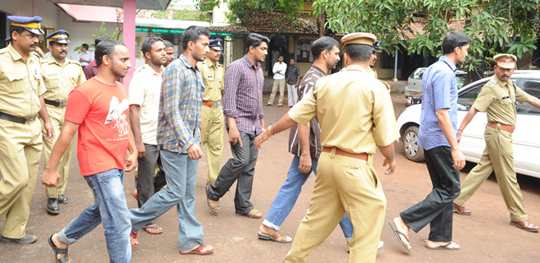
NIA court sends 21 PFI activists to jail for holding arms training camp

[email protected] (News Network)
January 21, 2016

Kasaragod, Jan 21: A special court of the National Investigation Agency (NIA) has sentenced 21 accused in the Narath arms training camp case to varying years of imprisonments after they were found guilty of offences charged under various sections of the Indian Penal Code, Arms Act, and the Unlawful Activities (Prevention) Act.

armstraining

While Special Judge S. Santhosh Kumar awarded seven-year imprisonment to the first accused, the other 20 accused were given five-year jail term each. The court acquitted the 22nd accused in the case.

The prosecution case was that the accused persons, Popular Front of India and Social Democratic Party of India activists, had organised an arms training camp at Narath in Kerala on April 23, 2013. The police had raided the training camp and taken into custody 21 PFI activists at Narath.

The NIA contended that the police officer who arrested the accused overheard the inflammatory speech of P.V. Abdul Azeez, the first accused in the case.

The accused wanted to impart training in weapons and explosives with intention to retaliate against the alleged tortures faced by Muslims in the country.

The court observed that the circumstances showed that the purpose of the assembly was unlawful and the accused could not satisfactorily explain the possession of weapon and country-bombs. Therefore, it could be safely concluded that there was a training camp and the accused were liable to be punished under Sections 18 and 18 A of the Unlawful Activities (Prevention) Act.”

The court concluded that the prosecution had succeeded in proving the offences under Section 120 B (Criminal Conspiracy), 143 and 149 (Unlawful assembly) of Indian Penal Code, section 153 A (Promoting enmity between different groups on grounds of religion) and 153 (B) (1) (C) (Imputations, assertions prejudicial to national-integration) of IPC, section 5 (1) (a) of the Arms Act and under Sections 18 and 18 A of the UAPA.

Comments

Optimistic
 - 
Friday, 22 Jan 2016

RSS openly using arms , they are also using Guns which is supplied for NCC cadets in colleges, for their personnel training.

Hareesh moodbidri
 - 
Friday, 22 Jan 2016

Oops..again proved by bloody communal govt.. Arms training UP by Hindu extremists , no punishment , no action,, suspected in arm training by Muslim, than there is regious punishments,, what is the hell by communal govt,, which is run by bloody chassis,,

Mohammed Mustafa
 - 
Thursday, 21 Jan 2016

Why coastaldigest team publishing hate comments from Kotian, Ajith.

Suraj
 - 
Thursday, 21 Jan 2016

Deport them to Pakistan or Syria

Ajit
 - 
Thursday, 21 Jan 2016

Now bearys will start screaming this fellow got bail that fellow got bail.. but anti-nationals always will be anti nationals. police and law should be ruthless towards them.

Viren Kotian
 - 
Thursday, 21 Jan 2016

hahaha.. Allahu Akbar... Jai Sri Ram... Jai Jesus... Hara Hara Modi...

Add new comment

  • Coastaldigest.com reserves the right to delete or block any comments.
  • Coastaldigset.com is not responsible for its readers’ comments.
  • Comments that are abusive, incendiary or irrelevant are strictly prohibited.
  • Please use a genuine email ID and provide your name to avoid reject.
News Network
February 6,2020

Kalaburagi, Feb 6: The State government will take steps to ensure that Kannada as a language is taught in all private schools, Chief Minister B.S. Yediyurappa announced today at the 85th Akhila Bharata Kannada Sahitya Sammelana in Kalaburagi.

This comes in the wake of the demand by some Kannada activists for making Kannada medium compulsory in all schools in the State. Sammelana president H.S. Venkatesh Murthy, who spoke after the Chief Minister, also made this demand.

The Chief Minister said “We are committed to putting in place a series of steps to see that Kannada is taught in all schools, aided and private, as a language. Kannada should be taught as the first or second language. We will also take steps to strengthen government schools. However, the government alone cannot do much. The community and parents should offer support to make sure that government schools provide quality education to all.”

To inculcate the spirit of scientific inquiry, the State government is setting up mobile planetariums. This will increase the interest of children in space technology and India’s efforts in space exploration.

The government is committed to protecting the interests of the State in Mahadayi and other river water disputes. It will take the border row issue, based on the Mahajan Commission report pending in the Supreme Court, to its logical end.

The government will also address backwardness and related issues. It will make sure that adequate funds are allocated to the development of Kalyana Karnataka. Among other things, it will establish a hostel for students from Kalaburagi region in Bengaluru. Land has been allotted in Nagarabavi for the hostel that can accommodate around 200 students. The government has decided to celebrate Kalyana Karnataka Utsav once every two years. This will showcase the culture of the region.

“We are working towards forging sentimental and emotional unity of the State other than unity based on language or administration. Our dream is to see that Karnataka remains a homogeneous unit with equality and equal opportunity for all,’’ the Chief Minister added.

Kambar bats for technology

Chandrashekar Kambar, Sahitya Akademi president and former president of the Akhila Bharata Kannada Sahitya Sammelana, favoured effective implementation of technology in administration and for universal use of Kannada in computing and e-governance.

Speaking at the Sammelana inauguration, he said “Several years ago, at the insistence of writer Poornachandra Tejaswi, I appealed to the State government to give a push to Kannada computing. We were convinced that no language can survive without the use of modern technology and use of the language in computers. The Department of Kannada and Culture, headed by then director Manu Baligar, released ₹2 crore for the project. The work began in earnest and teams of technologists came up with software and fonts. Some departments started using Kannada software. But this work has stopped or slowed down at some level. I appeal to Chief Minister B.S. Yediyurappa to continue the work and ensure that computerised Kannada is used at all levels of government and in e-governance.’’

Supports dubbing

Mr. Kambar batted for content dubbing of informative TV channels in Kannada. Channels such as Discovery and History produce good quality content that can be educative and informative. They are very useful for children. These channels are now available in Tamil, Telugu and Hindi and some other Indian languages. But they are not available in Kannada. That is because some people in the film industry are opposing dubbing. Such opposition is not good. Informative channels are our window to the world and allowing dubbing will enhance our knowledge base. There is no merit in not allowing dubbing. I appeal to C.T. Ravi, Minister for Kannada and Culture, to allow dubbing in Kannada, he said.

Mr. Kambar favoured primary education in the mother tongue of the child and urged the State government to introduce universal and compulsory education in Kannada medium in all schools. “This will help preserve our culture. Nothing else can,’’ he said.

He blamed the East India Company administration for inculcating a craze for English education among the people. “The introduction of English education by the British was strongly welcomed by the masses in India as they had been denied the opportunity for education for millenia. The deprived classes and Dalits who had not been exposed to education till then, were excited about the opportunity. However, along with English education, the British were successful in introducing inferiority in our minds. We are yet to escape from this inferiority complex.”

Quoting from Greek mythology, Mr. Kambar said that Hercules had killed his children and relatives in a fit of alcohol-induced rage. “We should not behave like that. We may be very strong, but we should not kill our mother tongue, in our power-induced rage,’’ he said.


Comments

Add new comment

  • Coastaldigest.com reserves the right to delete or block any comments.
  • Coastaldigset.com is not responsible for its readers’ comments.
  • Comments that are abusive, incendiary or irrelevant are strictly prohibited.
  • Please use a genuine email ID and provide your name to avoid reject.
News Network
April 2,2020

The current physical distancing guidelines provided by the World Health Organisation (WHO) and by the US Centers for Disease Control and Prevention (CDC) may not be adequate to curb the coronavirus spread, according to a research which says the gas cloud from a cough or sneeze may help virus particles travel up to 8 metres. The research, published in the Journal of the American Medical Association, noted that the the current guidelines issued by the WHO and CDC are based on outdated models from the 1930s of how gas clouds from a cough, sneeze, or exhalation spread.

Study author, MIT associate professor Lydia Bourouiba, warned that droplets of all sizes can travel 23 to 27 feet, or 7-8 metres, carrying the pathogen.

According to Bourouiba, the current guidelines are based on "arbitrary" assumptions of droplet size, "overly simplified", and "may limit the effectiveness of the proposed interventions" against the deadly pandemic.

 She explained that the old guidelines assume droplets to be one of two categories, small or large, taking short-range semi-ballistic trajectories when a person exhales, coughs, or sneezes.

However based on more recent discoveries, the MIT scientist said, sneezes and coughs are made of a puff cloud that carries ambient air, transporting within it clusters of droplets of a wide range of sizes.

Bourouiba warned that this puff cloud, with ambient air entrapped in it, can offer the droplets moisture and warmth that can prevent it from evaporation in the outer environment.

"The locally moist and warm atmosphere within the turbulent gas cloud allows the contained droplets to evade evaporation for much longer than occurs with isolated droplets," she said.

"Under these conditions, the lifetime of a droplet could be considerably extended by a factor of up to 1000, from a fraction of a second to minutes," the researcher explained in the study.

The MIT scientist, who has researched the dynamics of coughs and sneezes for years, added that these droplets settle along the trajectory of a cough or sneeze contaminating surfaces, with their residues staying suspended in the air for hours.

"Even when maximum containment policies were enforced, the rapid international spread of COVID-19 suggests that using arbitrary droplet size cutoffs may not accurately reflect what actually occurs with respiratory emissions, possibly contributing to the ineffectiveness of some procedures used to limit the spread of respiratory disease," Bourouiba wrote in the study

Comments

Add new comment

  • Coastaldigest.com reserves the right to delete or block any comments.
  • Coastaldigset.com is not responsible for its readers’ comments.
  • Comments that are abusive, incendiary or irrelevant are strictly prohibited.
  • Please use a genuine email ID and provide your name to avoid reject.
News Network
July 9,2020

New Delhi, Jul 9: The Central Board of Secondary Education has strongly defended its decision to drop topics like democratic rights, citizenship, federalism, secularism etc in the name of reducing the syllabus for Classes 9 to 12 due to COVID-19 pandemic. 

The board has claimed that the dropped lessons "are either being covered by the rationalised syllabus or in the Alternative Academic Calendar of NCERT".

The CBSE said it had to come up with the clarification after realizing its decision was "interpreted differently".

"The rationalisation of syllabus up to 30 per cent has been undertaken by the Board for nearly 190 subjects of class 9 to 12 for the academic session 2020-21 as a one-time measure only. The objective is to reduce the exam stress of students due to the prevailing health emergency situation and prevent learning gaps," it said.

While it has said that no questions can be asked from the reduced syllabus in the next board exams, the CBSE has also directed schools to follow alternative calendars prepared by the NCERT.

"Therefore each of the topics that have been wrongly mentioned in media as deleted have been covered under Alternative Academic Calendar of NCERT which is already in force for all the affiliated schools of the Board," it clarified.

On Wednesday, West Bengal CM Mamata Banerjee tweeted: "Shocked to know that the central Government has dropped topics like citizenship, federalism, secularism and partisan in the name of reducing CBSE course during the COVID crisis."

"We strongly object to this and appeal the HRD Ministry to ensure these vital lessons aren't curtailed at any cost," Banerjee added.

Comments

Add new comment

  • Coastaldigest.com reserves the right to delete or block any comments.
  • Coastaldigset.com is not responsible for its readers’ comments.
  • Comments that are abusive, incendiary or irrelevant are strictly prohibited.
  • Please use a genuine email ID and provide your name to avoid reject.