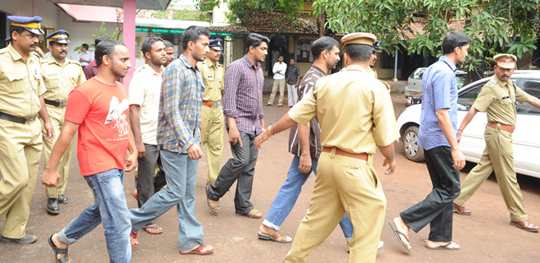
NIA court sends 21 PFI activists to jail for holding arms training camp

[email protected] (News Network)
January 21, 2016

Kasaragod, Jan 21: A special court of the National Investigation Agency (NIA) has sentenced 21 accused in the Narath arms training camp case to varying years of imprisonments after they were found guilty of offences charged under various sections of the Indian Penal Code, Arms Act, and the Unlawful Activities (Prevention) Act.

armstraining

While Special Judge S. Santhosh Kumar awarded seven-year imprisonment to the first accused, the other 20 accused were given five-year jail term each. The court acquitted the 22nd accused in the case.

The prosecution case was that the accused persons, Popular Front of India and Social Democratic Party of India activists, had organised an arms training camp at Narath in Kerala on April 23, 2013. The police had raided the training camp and taken into custody 21 PFI activists at Narath.

The NIA contended that the police officer who arrested the accused overheard the inflammatory speech of P.V. Abdul Azeez, the first accused in the case.

The accused wanted to impart training in weapons and explosives with intention to retaliate against the alleged tortures faced by Muslims in the country.

The court observed that the circumstances showed that the purpose of the assembly was unlawful and the accused could not satisfactorily explain the possession of weapon and country-bombs. Therefore, it could be safely concluded that there was a training camp and the accused were liable to be punished under Sections 18 and 18 A of the Unlawful Activities (Prevention) Act.”

The court concluded that the prosecution had succeeded in proving the offences under Section 120 B (Criminal Conspiracy), 143 and 149 (Unlawful assembly) of Indian Penal Code, section 153 A (Promoting enmity between different groups on grounds of religion) and 153 (B) (1) (C) (Imputations, assertions prejudicial to national-integration) of IPC, section 5 (1) (a) of the Arms Act and under Sections 18 and 18 A of the UAPA.

Comments

Optimistic
 - 
Friday, 22 Jan 2016

RSS openly using arms , they are also using Guns which is supplied for NCC cadets in colleges, for their personnel training.

Hareesh moodbidri
 - 
Friday, 22 Jan 2016

Oops..again proved by bloody communal govt.. Arms training UP by Hindu extremists , no punishment , no action,, suspected in arm training by Muslim, than there is regious punishments,, what is the hell by communal govt,, which is run by bloody chassis,,

Mohammed Mustafa
 - 
Thursday, 21 Jan 2016

Why coastaldigest team publishing hate comments from Kotian, Ajith.

Suraj
 - 
Thursday, 21 Jan 2016

Deport them to Pakistan or Syria

Ajit
 - 
Thursday, 21 Jan 2016

Now bearys will start screaming this fellow got bail that fellow got bail.. but anti-nationals always will be anti nationals. police and law should be ruthless towards them.

Viren Kotian
 - 
Thursday, 21 Jan 2016

hahaha.. Allahu Akbar... Jai Sri Ram... Jai Jesus... Hara Hara Modi...

Add new comment

  • Coastaldigest.com reserves the right to delete or block any comments.
  • Coastaldigset.com is not responsible for its readers’ comments.
  • Comments that are abusive, incendiary or irrelevant are strictly prohibited.
  • Please use a genuine email ID and provide your name to avoid reject.
News Network
February 4,2020

Bengaluru, Feb 4: Taking the state government to task, the Karnataka High Court on Monday opined there was a need to rehabilitate or compensate migrant workers whose homes in Tubarahalli and Kundalahalli were demolished by a BBMP engineer last month.

On January 19, the Bruhat Bengaluru Mahanagara Palike (BBMP) assistant executive engineer at Marathahalli had taken up a demolition drive stating that the migrant workers residing in the area were “illegal Bangladeshis”.

A division bench led by Chief Justice Abhay S Oka was hearing a petition by the People’s Union for Civil Liberties which contended that the evacuation of the workers was illegal. Stressing the need for relief, the court directed the state government to come clean on its stance and adjourned the hearing to February 10.

Advocate General Prabhuling K Navadgi submitted that the Union government had issued a circular last year to ascertain the presence of illegal Bangaladesh migrants. “On the basis of this circular, the BBMP officials had written a letter to Marathahalli police sub-inspector on January 18. Based on this letter, the residents in huts were evicted in a civilised manner,” he stated.

The bench, however, differed with the submission. “Who identified them as Bangladeshis before the eviction? Which is the competent authority to do so? Which police officer took up the inquiry?” the bench questioned.

The court also asked whether the government would take up similar eviction drives against illegal buildings of the rich. It also expressed displeasure over the action taken against the BBMP engineer.

“Instead of sending him home, you say you have transferred him. We can’t be mute spectators,” the bench said.

The court did not mince words as it castigated the authorities for failing to act judiciously. “The police and the BBMP are blaming each other. Your action appears to be dangerous. Going by the state of things, it seems that everything is not in order,” it said.

Comments

Add new comment

  • Coastaldigest.com reserves the right to delete or block any comments.
  • Coastaldigset.com is not responsible for its readers’ comments.
  • Comments that are abusive, incendiary or irrelevant are strictly prohibited.
  • Please use a genuine email ID and provide your name to avoid reject.
coastaldigest.com news network
May 31,2020

Bengaluru, May 31: As many as 299 fresh covid-19 cases reported in Karnataka today. Most of them have interstate travel history.

With this total number of covid-19 cases in Karnataka rose to 3221. 

District wise cases: Raichur 83, Yadgir 44, Bidar 33, Kalaburagi 28, Vijayapura 26, Bengaluru Urban 21, Dakshina Kannada 14, Mandya 13, Belagavi 13, Udupi 10, Davangere 6, Uttara Kannada 5, Ballari, Shivamogga, Kolar 1 each.

Two more deaths reported in the state. One of the patients is a 50 year old male from Raichuru district, who returned from Maharashtra. Another is a 75 year old man, a resident of containment zone in Bidar. With this the number of COVID 19 related deaths rose to 51.

Comments

Add new comment

  • Coastaldigest.com reserves the right to delete or block any comments.
  • Coastaldigset.com is not responsible for its readers’ comments.
  • Comments that are abusive, incendiary or irrelevant are strictly prohibited.
  • Please use a genuine email ID and provide your name to avoid reject.
Media Release
February 14,2020

Veteran journalist P. Sainath has said that the nation is in a crisis. And this crisis is not limited to just the rural area. It has become a national crisis at various areas such as agriculture, education, economy, job creation etc.

He was delivering the endowment lecture on the topic ‘Indian democracy at the post-liberalization and post-truth era’ at Media Manthan 2020 organized by the PG department of journalism and mass communication at St Aloysius College (Autonomous). 

Mr Sainath said that the many policies adopted in the 90s led to India becoming unusually unequal. Referring to the speech Ambedkar had made at the Constituent Assembly while handing over the draft of the Constitution, Mr Sainath said, “Ambedkar had warned about the weakness of Indian democracy that liberty without equality allows the supremacy of a few over the multitude. Liberty, equality and fraternity must be kept together as we cannot have one without the other.” 

Mr Sainath stated that the agrarian crisis was no longer about the loss of productivity, employment or about farmer suicide; it was a societal, civilizational crisis. Commenting on the lopsided policies such as cow-slaughter ban, he explained how cow slaughter ban had adversely affected many industries due to their interdependency. While Muslims who slaughtered cows were rendered helpless, the cattle traders who were mostly OBCs lost their earnings as the cattle prices crashed. An important industry like Kolhapur sandals industry in Maharashtra went bankrupt as a result of the cow slaughter ban in Maharashtra. He said the policymakers had no idea how the rural industries were interconnected. Demonetisation too devastated the rural economy as 98 percent of rural transactions happen through cash. 

Mr Sainath also spoke about the crisis of inequality which affects the Dalits and the Adivasis far more than anyone else as 90 percent of the rural households take home less than Rs 10,000/- per month. “Women are yet another group whose labour is never counted in the gross domestic product. Women and girls globally do unpaid work which amounts to about 12.5 billion working hours per year. Monetarily speaking, this is worth 10.8 trillion dollars,” Mr Sainath added. 

Speaking about the crisis of jobs Mr Sainath said that major companies were laying off employees just to create more profits for the investors and the adoption of artificial intelligence in the industry would further destroy millions of jobs.

Rector of St Aloysius College Institutions Fr Dionysius Vaz SJ, Principal Dr (Fr) Praveen Martis SJ, HOD of Journalism and Mass Communication department Dr (Fr) Melwyn Pinto SJ were present.

‘Veerappan and Vijay Mallya’s business models are interesting!’

Addressing the gathering during his endowment lecture on Friday, Mr Sainath made an interesting comment on the so called ‘revenue model’. “Whenever I visit IIMs and IITs for lectures on my PARI project, the students there ask me what my revenue model for my project is. I tell them that I do not have a revenue model. In fact, journalism does not begin with a revenue model. Gandhiji, Ambedkar, Bhagat Singh were all great journalists. But they did not have a revenue model,” Mr Sainath said.

On a lighter note, he said that the best revenue model that he liked was that of forest brigand Veerappan and liquor baron Vijay Mallya. “Veerappan ruled the forest for forty years and from the top ministers to the villagers he could dictate terms and liver royally. Similarly, Mallya’s revenue model was to steal the banks and run away abroad and live like a king,” Mr Sainath added.

Journalism is not and can never be a business. It is a calling, he opined. While newspaper can be a business, television can be a business, journalism per se cannot be reduced to a business. “Unfortunately today, journalists are recruited on a contract basis and they have no bargaining power; and there are no unions to fight for their cause. Hence, they are at the mercy of the corporate media houses for their survival and are made to write stories that cannot be called journalism,” Mr Sainath said.

Answering a question as to the pressures he faced as a journalist, he said that external pressures from the government or others could be very well handled. It is the internal pressures from once own media house that journalists find it difficult to manage.


 

Comments

Add new comment

  • Coastaldigest.com reserves the right to delete or block any comments.
  • Coastaldigset.com is not responsible for its readers’ comments.
  • Comments that are abusive, incendiary or irrelevant are strictly prohibited.
  • Please use a genuine email ID and provide your name to avoid reject.