



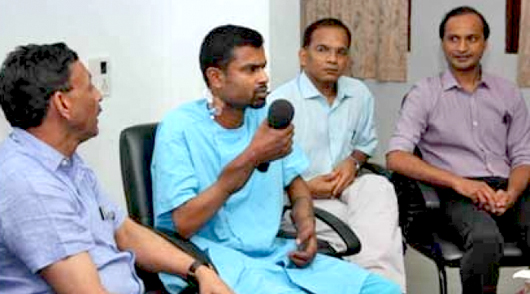
India's first double hand transplant successful, says doctors

February 1, 2015

hand transplant

Thiruvananthapuram, Feb 1: With the first successful double hand transplant, Indian doctorshave registered a rare feat of carrying out the world's first hand transplant of a coloured skin and the first hand transplant in any developing country.

So far, only 110 successful hand transplants have been done, since the first one in France 13 years ago, in USA, European countries, China and Australia.

The honour for the rare feat goes to a team of surgeons at the Kochi-based Amrita Institute of Medical Sciences. The transplant was carried out on January 12 and 13 to a train accident victim - 30-year-old Manu, who received both the hands of a 24-year-old road accident victim.

"The operation lasted for 16 hours with more than 20 surgeons participating in the procedure. Each hand required connecting two bones, two arteries, four veins and about 14 tendons," saidDr. Subramania Iyer, Professor and Head of the Plastic Surgery Department.

"The immune suppressant drugs were started before the start of the surgery and continued after it. He was shifted to a transplant ICU. Careful monitoring of the blood supply to the hands was done and all precautions to prevent infections was instituted in the nursing. Another operation to replace an area of bad skin was done for his left hand on the second day," he added.

Dr. Iyer further said, "After14 days post-surgery, both the hands have been accepted by the recipient's body and he started regaining movements. He has been shifted out of the ICU and post-surgical rehabilitation process has started under supervision."

"Manu will be able to move his hands since his own muscles of the forearm are working to move the fingers. The sensations will return only slowly and is expected in three to four months. His immunosuppressant drugs (to prevent rejection of the transplanted hands) will have to be continued indefinitely, but at a reduced rate from three months," he added.

Dr. Iyer said, the current transplant is important, since follow up of the transplanted skin is done by the appearance of the skin and skin biopsies every month to see signs of rejection.

He said the details of the transplant have been added to the International Registry of Hand Transplants, which maintains stringent standards in the follow-up of these cases.

The entire expense for the transplant was borne by Mata Amritanandamayiu Math.

"This transplant has put the Indian scientific community among the league of a few developed nations in the field of composite tissue allotransplant," said Dr. Iyer.

Comments

Add new comment

  • Coastaldigest.com reserves the right to delete or block any comments.
  • Coastaldigset.com is not responsible for its readers’ comments.
  • Comments that are abusive, incendiary or irrelevant are strictly prohibited.
  • Please use a genuine email ID and provide your name to avoid reject.
Agencies
June 27,2020

After admitting that the world may have a COVID-19 vaccine within one year or even a few months earlier, the World Health Organisation (WHO) on Friday said that UK-based AstraZeneca is leading the vaccine race while US-based pharmaceutical major Moderna is not far behind.

WHO Chief Scientist Soumya Swaminathan stated that the AstraZeneca's coronavirus vaccine candidate is the most advanced vaccine currently in terms of development.

"I think AstraZeneca certainly has a more global scope at the moment in terms of where they are doing and planning their vaccine trials," she told the media.

AstraZeneca's Covid-19 vaccine candidate developed by researchers from the Oxford University will likely provide protection against the disease for one year, the British drug maker's CEO told Belgian radio station Bel RTL this month.

The Oxford University last month announced the start of a Phase II/III UK trial of the vaccine, named AZD1222 (formerly known as ChAdOx1 nCoV-19), in about 10,000 adult volunteers. Other late-stage trials are due to begin in a number of countries.

Last week, Swaminathan had said that nearly 2 billion doses of the COVID-19 vaccine would be ready by the end of next year.

Addressing the media from Geneva, she said that "at the moment, we do not have a proven vaccine but if we are lucky, there will be one or two successful candidates before the end of this year" and 2 billion doses by the end of next year.

Scientists predict that the world may have a COVID-19 vaccine within one year or even a few months earlier, said the Director-General of the World Health Organization even as he underlined the importance of global cooperation to develop, manufacture and distribute the vaccines.

However, making the vaccine available and distributing it to all will be a challenge and will require political will, WHO chief Tedros Adhanom Ghebreyesus said on Thursday during a meeting with the European Parliament's Committee for Environment, Public Health and Food Safety.

One option would be to give the vaccine only to those who are most vulnerable to the virus.

There are currently over 100 COVID-19 vaccine candidates in various stages of development.

Comments

Add new comment

  • Coastaldigest.com reserves the right to delete or block any comments.
  • Coastaldigset.com is not responsible for its readers’ comments.
  • Comments that are abusive, incendiary or irrelevant are strictly prohibited.
  • Please use a genuine email ID and provide your name to avoid reject.
Agencies
June 23,2020

The record levels of new daily COVID-19 cases are due to the fact that the pandemic is peaking in a number of big countries at the same time and reflect a change in the virus' global activity, the World Health Organisation said.

At a media briefing on Monday, WHO's emergencies chief Dr Michael Ryan said that the numbers are increasing because the epidemic is developing in a number of populous countries at the same time.

Some countries have attributed their increased caseload to more testing, including India and the US But Ryan dismissed that explanation.

We do not believe this is a testing phenomenon, he said, noting that numerous countries have also noted marked increases in hospital admissions and deaths neither of which cannot be explained by increased testing.

There definitely is a shift in that the virus is now very well established, Ryan said. The epidemic is now peaking or moving towards a peak in a number of large countries.

He added the situation was definitely accelerating in a number of countries, including the US and others in South Asia, the Middle East and Africa.

Comments

Add new comment

  • Coastaldigest.com reserves the right to delete or block any comments.
  • Coastaldigset.com is not responsible for its readers’ comments.
  • Comments that are abusive, incendiary or irrelevant are strictly prohibited.
  • Please use a genuine email ID and provide your name to avoid reject.
Agencies
May 5,2020

The lockdown forced by the coronavirus in India has had some unexpected but positive fallouts: It has brought families together and reduced corporate politics, says an expert working in the field for the past decade.

"Today the whole world is on lockdown because of COVID-19, and all that we read, talk and hear is about life and death. We can't deny that the times are tough and the future is uncertain. But I would like to turn the coin and see the other side: the positive side," Shikha Mittal, Founder Director of Be.artsy told IANS in an interview.

Be.artsy is one of India's leading social awareness enterprises which deals with emotions at work and promotes arts as a communication tool for workplaces.

"In the 21st century, personally and professionally, people are practising politics over humanity, competition over collaboration, and have lost touch with themselves due to materialistic desires. During the lockdown, we are forced to confront our existing daily lives, and two interesting things that we can ponder upon, have emerged.

"First, have we ever looked at our family with the same lens as we are using today? What is it that we are doing differently with family today, and what can we do to carry our actions of today into our tomorrow? This is the premise of the #aajjaisakalcontest" that Be.artsy has launched across India.

The aim is "to encourage people to share one habit or life skill that they never practiced earlier, but post Covid-19 would like to continue and enjoy".

How did Be.artsy come about?

"I used to be in the corporate world, earning promotions and greater responsibility. However, the work conditions in those days were unfriendly to women and I had faced many instances of sexual harassment and workplace harassment in the six years of my corporate career. And that's when I had an epiphany."

Be.artsy's most popular programmes are on Prevention of Sexual Harassment (POSH) and on Financial Literacy which makes young people financially independent and better prepared to face the corporate world. "We know that a stitch in time (of planning for the future) saves nine (debt trap, dependence, health emergencies, expenses exceeding income, no savings, families without support, retirement in poverty, lost dreams, extravagance). This can only be achieved by sensitisation," Mittal explained.

Comments

Add new comment

  • Coastaldigest.com reserves the right to delete or block any comments.
  • Coastaldigset.com is not responsible for its readers’ comments.
  • Comments that are abusive, incendiary or irrelevant are strictly prohibited.
  • Please use a genuine email ID and provide your name to avoid reject.