


RSS recommends 12-hour schools, no co-education, compulsory Sanskrit

[email protected] (CD Network)
January 27, 2016

New Delhi, Jan 27: In a bizarre proposal submitted to the Prime Minister Narendra Modi led union government, the Rashtriya Swayam Sevak Sangh has recommended that schools in big cities work for longer hours to make the working parents by keeping their children away.
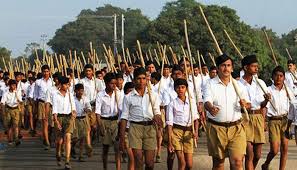
RSSThe proposal prepared by Vidya Bharati Akhil Bharatiya Shikshan Sansthan, the education wing of the RSS and submitted to the Human and Resource Development Ministry, also points out that co-education will have to be discontinued if working hours of schools are extended.

The proposal has also emphasised that the new policy should stress on “Indianization of Education” including learning Sanskrit from middle school level so that they do not need “the assistance of foreign words”.

The right wing outfit has now suggested that schools in metropolises work 12 hours a day (7.30 AM – 7.30 PM) to enable children learn more languages, apart from relieving "their (working) parents from the task of making children do homework... or (the) need for (sending) them to tuitions," according to a report.

The RSS and other saffron outfits, collectively called the Sangh Parivar, have grown more vocal about policy matters after the Narendra Modi-led BJP government came to power at the Centre in May 2014. The ruling party and its ideological partners have been accused by the opposition of trying to "saffronze" the education system in the name of “Indianization”

Earlier in the month, Vidya Bharati said it wanted to set up a model school in every block in the country. Formed in 1977, Vidya Bharati now runs 12,364 schools and 49 colleges across the country.

It also reasoned that learning Sanskrit will help improve the children’s pronunciation and spelling skills.

“It’s easy for children to learn languages in childhood. That’s why they should be taught various languages — their mother tongue, Sanskrit, Hindi, English and regional languages,” said the proposal.

The RSS also argued that extending school hours would give students time to extra-curricular activities. The Hindutva group has also advocated improvements in teachers’ training by introducing a minimum 50%-mark threshold for all aspirants who will then be selected through an entrance exam.

Comments

Married couple
 - 
Thursday, 28 Jan 2016

Bachelors club want to create rule for families.... First get married then U can follow this rules... and then dont stop modi to reunite his wife... U cheddis have ruined his family life...

S.M. Nawaz Kuk…
 - 
Thursday, 28 Jan 2016

It is RSS suggetion.. it means MAD

rikaz
 - 
Wednesday, 27 Jan 2016

Learing sanskrit in schools and colleges....i dont think it is an issue at all....we learned kannada, hindi, english...sanskrit is also one of that kind....interesting...

abumohammed
 - 
Wednesday, 27 Jan 2016

Well, everyone understand the sanskrit, people read & understand the vedas, githas. May they turn real religion

Mohammed
 - 
Wednesday, 27 Jan 2016

Who are they to decide education strategy. It seems RSS is the supreme authority of governance than indian government. It shows RSS is the decision maker and indian government is simply implementing.

May Allah save our country.

arm
 - 
Wednesday, 27 Jan 2016

Not all the suggestions are bad.

Support the idea:
- Banning co-education system.
- Relieving parents from Home works system.
- Learning Languages should be optional.
- Indianization of education is Ok, westernization has ruined the family values.
- Extra-curricular activity is good, to know the interest of children.
- Working parents can have option of having their children for long hours at schools where Hindus can study Sanskrit, Muslim can learn Arabic and Christians can have their preference.

Not supporting the idea:
- 12 hrs. is too much, most of the developed countries they limit the working hours of adults to 8 hrs. only.
- Forcing Sanskrit to all is too much.

Indian culture is good, family value is eroding which is bad for society as a whole. But forcing the ideas seems to be dangerous.

Goodman
 - 
Wednesday, 27 Jan 2016

12Hrs, we don't want to tell even our enemy's children
Samskri : Nothing should be imposed. It is the people's choice.
We should see where the world is heading.

English : Now the important language is for this worldly life is English.

Arabic : Arabic is also big plus point for job seekers. 22 Countries have mother toungue as Arabic. This is the 2nd highest spoken language

UMMAR
 - 
Wednesday, 27 Jan 2016

DEAR FRIENDS ,

WHO COMMENTED ABOVE.. YOU PEOPLE FORGOT TO ASK WHO ARE THEY TO TELL TO GOV WHAT TO DO AND ALL..

WHAT THEY KNOW ABOUT SANSKRIT.. FIRST OF ALL THEY HAVE TO LEARN TO WEAR PROPER DRESS....NOT CHADIIES ...

kaizer
 - 
Wednesday, 27 Jan 2016

RSS RSS RSS, in logo ko koi kaam nahin hain kya, indian citizens doesnt need your recommendations for education, go and teach your chaddis what to do and what not to do, hypocrites.

Asif
 - 
Wednesday, 27 Jan 2016

its a fact that children from India are spending 20~30% more time in Schools when compared to US/UK childrens..

For 8 Hours daily school times:
-> already they carry 5~6 kg school bags, this will raise to 8~9 kgs.
-> Children need to take healthy food, who will feed them during such a long period.
-> does all schools in states are eligible to keep the students for 12 hours with all such activities., if you survey our states may be hardly you can find 2~3% schools are fit with all activities...other 98% schools are hard to spend 8 hours.
-> why teachers must work for 12 hours daily (against labor law).

before, making any regulation gossips..pls just look for facts...

Ba RA
 - 
Wednesday, 27 Jan 2016

THE BACHELOR CLUB now wants to separate the FAMILIES ...
Wa re WA --- A clear Sign to those who think, the cheddis who are against women (Cheddis will never be successful with whatever they play with thier devilish agenda.)

Ali
 - 
Wednesday, 27 Jan 2016

Majority of their leaders arent married, hence any suggestion from them on how to raise children should be neglected!!!

Indian
 - 
Wednesday, 27 Jan 2016

None of the chaddis may know the sanskrit language before pushing others to learn

rikaz
 - 
Wednesday, 27 Jan 2016

RSS is terrorising children, 12 hours schooling is too much for small children....and its inhuman....its okay if they go with discontinuing co-education....well and fine and its islamic way of thinking....However, at the end more expenses for developing country like India, will have to build more schools and colleges separately for both....

Add new comment

  • Coastaldigest.com reserves the right to delete or block any comments.
  • Coastaldigset.com is not responsible for its readers’ comments.
  • Comments that are abusive, incendiary or irrelevant are strictly prohibited.
  • Please use a genuine email ID and provide your name to avoid reject.
Media Release
February 14,2020

Veteran journalist P. Sainath has said that the nation is in a crisis. And this crisis is not limited to just the rural area. It has become a national crisis at various areas such as agriculture, education, economy, job creation etc.

He was delivering the endowment lecture on the topic ‘Indian democracy at the post-liberalization and post-truth era’ at Media Manthan 2020 organized by the PG department of journalism and mass communication at St Aloysius College (Autonomous). 

Mr Sainath said that the many policies adopted in the 90s led to India becoming unusually unequal. Referring to the speech Ambedkar had made at the Constituent Assembly while handing over the draft of the Constitution, Mr Sainath said, “Ambedkar had warned about the weakness of Indian democracy that liberty without equality allows the supremacy of a few over the multitude. Liberty, equality and fraternity must be kept together as we cannot have one without the other.” 

Mr Sainath stated that the agrarian crisis was no longer about the loss of productivity, employment or about farmer suicide; it was a societal, civilizational crisis. Commenting on the lopsided policies such as cow-slaughter ban, he explained how cow slaughter ban had adversely affected many industries due to their interdependency. While Muslims who slaughtered cows were rendered helpless, the cattle traders who were mostly OBCs lost their earnings as the cattle prices crashed. An important industry like Kolhapur sandals industry in Maharashtra went bankrupt as a result of the cow slaughter ban in Maharashtra. He said the policymakers had no idea how the rural industries were interconnected. Demonetisation too devastated the rural economy as 98 percent of rural transactions happen through cash. 

Mr Sainath also spoke about the crisis of inequality which affects the Dalits and the Adivasis far more than anyone else as 90 percent of the rural households take home less than Rs 10,000/- per month. “Women are yet another group whose labour is never counted in the gross domestic product. Women and girls globally do unpaid work which amounts to about 12.5 billion working hours per year. Monetarily speaking, this is worth 10.8 trillion dollars,” Mr Sainath added. 

Speaking about the crisis of jobs Mr Sainath said that major companies were laying off employees just to create more profits for the investors and the adoption of artificial intelligence in the industry would further destroy millions of jobs.

Rector of St Aloysius College Institutions Fr Dionysius Vaz SJ, Principal Dr (Fr) Praveen Martis SJ, HOD of Journalism and Mass Communication department Dr (Fr) Melwyn Pinto SJ were present.

‘Veerappan and Vijay Mallya’s business models are interesting!’

Addressing the gathering during his endowment lecture on Friday, Mr Sainath made an interesting comment on the so called ‘revenue model’. “Whenever I visit IIMs and IITs for lectures on my PARI project, the students there ask me what my revenue model for my project is. I tell them that I do not have a revenue model. In fact, journalism does not begin with a revenue model. Gandhiji, Ambedkar, Bhagat Singh were all great journalists. But they did not have a revenue model,” Mr Sainath said.

On a lighter note, he said that the best revenue model that he liked was that of forest brigand Veerappan and liquor baron Vijay Mallya. “Veerappan ruled the forest for forty years and from the top ministers to the villagers he could dictate terms and liver royally. Similarly, Mallya’s revenue model was to steal the banks and run away abroad and live like a king,” Mr Sainath added.

Journalism is not and can never be a business. It is a calling, he opined. While newspaper can be a business, television can be a business, journalism per se cannot be reduced to a business. “Unfortunately today, journalists are recruited on a contract basis and they have no bargaining power; and there are no unions to fight for their cause. Hence, they are at the mercy of the corporate media houses for their survival and are made to write stories that cannot be called journalism,” Mr Sainath said.

Answering a question as to the pressures he faced as a journalist, he said that external pressures from the government or others could be very well handled. It is the internal pressures from once own media house that journalists find it difficult to manage.


Comments

Add new comment

  • Coastaldigest.com reserves the right to delete or block any comments.
  • Coastaldigset.com is not responsible for its readers’ comments.
  • Comments that are abusive, incendiary or irrelevant are strictly prohibited.
  • Please use a genuine email ID and provide your name to avoid reject.
Wafa Sultana
April 4,2020

Over the last couple of days when the world was occupied with unifying efforts to fight the deadly Covid19 pandemic, sections of Indian media provided viewers a familiar scapegoat – the Indian Muslims – who are often stereotyped as a community being constantly at loggerheads with the citizenry and the State. Biased media channels were quick to resort to blaming the entire Muslim community for the spread of the disease in the country, thanks to an ill-timed Tablighi Jamaat gathering at its international headquarters in Delhi’s Nizamuddin. Unsurprisingly, the opprobrium was also marked by a sudden spike in WhatsApp forwards of videos with people wearing skullcaps licking spoons and performing Sufi breathing rituals, suggesting some sort of wild conspiracy on the part of the community to spread the virus.  Some media channels were quick to formulate, hypothesize and provide loose definitions of a newly discovered form of Jihad i.e. ‘Corona Jihad ’ thereby vilifying the Islamic faith and its followers.

While the investigation on the culpability of the organizers of the Nizamuddin event is still ongoing, there is enough information to suggest that the meeting was held before any lockdown was in force, and the problem began when there was no way of getting people out once the curfew was announced. Be that as it may, there is little doubt that organizing a meet of such a scale when there is a global pandemic smacks of gross misjudgment, and definitely the organizers should be held accountable if laws or public orders were defied. Attendees who attempt to defy quarantine measures must be dealt with strictly. However, what is alarming is that the focus and narrative have now shifted from the unfortunate event at Nizamuddin to the Tablighi Jamaat itself.

For those not familiar with the Tablighi Jamaat, the organization was founded in 1926 in Mewat by scholar Maulana Mohammad Ilyas. The Jamaat’s main objective was to get Muslim youth to learn and practice pristine Islam shorn of external influences. This is achieved through individuals dedicating time for moral and spiritual upliftment secluded from the rest of the world for a brief period of time. There is no formal membership process. More senior and experienced participants typically travel from one mosque to other delivering talks on religious topics, inviting local youth to attend and then volunteer for a spiritual retreat for a fixed number of days to a mosque in a nearby town or village to present the message to their co-religionists. Contrary to ongoing Islamophobic rhetoric, the movement does not actively proselytize. The focus is rather on getting Muslims to learn the teachings and practices of Islam.  This grassroots India-based movement has now grown to almost all countries with substantial Muslim populations. Its annual meets, or ‘ijtemas’ are among the largest Islamic congregations in the world after the annual Haj. One of the reasons for its popularity and wide network in the subcontinent and wordwide is the fact that it has eschewed the need for scholarly intervention, focusing on peer learning of fundamental beliefs and practice rather than high-falutin ideological debates. The Tablighi Jamaat also distinguishes itself from other Islamic movements through its strictly apolitical nature, with a focus on individual self-improvement rather than political mobilization. Hardships and difficulty in the world are expected to be face through ‘sabr’ (patience) and ‘dua’ (supplication),  than through quest for political power or influence. In terms of ideology, it is very much based on mainstream Sunni Islamic principles derived from the Deobandi school.

So, why is all this background important in the current context? While biased media entities have expectedly brought out their Islamophobic paraphernalia out for full display, more neutral commentators have tried to paint the Tablighi Jamaat as a fringe group and have tried to distance it from 'mainstream Muslims'. While the intent is no doubt innocent, this is a trap we must not fall into. This narrative, unfortunately, is also gaining ground due to apathy some Muslims have for the group, accusing it of being “disconnected from the realities of the world”. Unlike other Muslim organizations and movements, the Tablighi Jamat, by virtue of its political indifference, does not boast of high-profile advocates and savvy spokespersons who can defend it in mainstream or social media.  The use of adjectives such as 'outdated' and 'orthodox' by liberal columnists to describe the Jamaat feeds into the malignant attempt to change the narrative from the control of the spread of the pandemic due to the Nizamuddin gathering to 'raison d'etre' of the organization itself.

A large mainstream religious group like the Tablighi Jamaat with nearly a hundred-year history, normally considered to be peaceful, apolitical and minding its own business is now suddenly being villainized owing to unfortunate circumstances. Biased media reactions filled with disgust and hate seem to feed the Indian public conscience with a danngerous misconception - to be a nominal Muslim is okay but being a practicing one is not.  For those committed to the truth and fighting the spread of Islamophobia, the temptation to throw the entire Tablighi Jamaat under the bus must be resisted.

The writer is a lawyer and research scholar at Qatar University. Her research interests include Islamic law and politics.

Comments

zahoorahmed
 - 
Saturday, 4 Apr 2020

great article! provides a great perspective on tableeg jamat

Add new comment

  • Coastaldigest.com reserves the right to delete or block any comments.
  • Coastaldigset.com is not responsible for its readers’ comments.
  • Comments that are abusive, incendiary or irrelevant are strictly prohibited.
  • Please use a genuine email ID and provide your name to avoid reject.
News Network
July 5,2020

Bengaluru, Jul 5: Karnataka Chief Minister BS Yediyurappa has asked officials to ensure that all necessary arrangements for COVID-19 patients must be carried out efficiently and transparently, Medical Education Minister Dr K Sudhakar said.

"Karnataka is in a better position due to the efforts and hard work of ministers, doctors, officials and all staff. The cases have increased in Bengaluru and some other districts in last few days due to various reasons. We all have to work hard and contain the spread of virus," Dr Sudhakar told media on Saturday.

"Responsibilities related to policy formulation, preparation of guidelines, communication to media and management of war room have been assigned to me. Deputy Chief Minister Ashwath Narayan has been given the responsibility of managing COVID-19 care centres and Revenue Minister R Ashoka and Chief Minister's political secretary Vishvanath have been given the responsibility of managing private hospitals. The Chief Minister has instructed all of us to work in synergy," he said.

Dr Sudhakar said the matter of imposing lockdown in the state again was discussed in the task force meeting. "I and Deputy Chief Minister suggested that lockdown is not necessary at this stage. The Chief Minister will take a decision on this matter," he added.

Home Minister Basavar Bommai, Health Minister B Sriramulu, Revenue Minister R Ashoka and senior officials were present in the task force meeting.

Comments

Add new comment

  • Coastaldigest.com reserves the right to delete or block any comments.
  • Coastaldigset.com is not responsible for its readers’ comments.
  • Comments that are abusive, incendiary or irrelevant are strictly prohibited.
  • Please use a genuine email ID and provide your name to avoid reject.