In a development which highlights the diversity in the United Kingdom’s legal system, a 40-year-old Muslim woman has become the first hijab-wearing judge in the country.
Raffia Arshad, a barrister, was appointed a deputy district judge on the Midlands circuit last week after 17-year career in law.
She said her promotion was great news for diversity in the world’s most respected legal system. She hopes to be an inspiration to young Muslims.
Ms Arshad, who grew up in Yorkshire, north England, has wanted to work in law since she was 11.
Ms Arshad said the judicial office was looking to promote diversity, but when they appointed her they did not know that she wore the hijab.
‘It’s definitely bigger than me,” she told Metro newspaper. "I know this is not about me.
"It’s important for all women, not just Muslim women, but it is particularly important for Muslim women."
Ms Arshad, a mother of three, has been practising private law dealing with children, forced marriage, female genital mutilation and other cases involving Islamic law for the past 17 years.
She was the first in her family to go to university and has also written a leading text on Islamic family law.
Although the promotion by the Lord Chief Justice was welcome news for her, Ms Arshad said the happiness from other people sharing the news was “far greater”.
“I’ve had so many emails from people, men and women," she said.
"It’s the ones from women that stand out, saying that they wear a hijab and thought they wouldn’t even be able to become a barrister, let alone a judge."
Ms Arshad is regularly the subject of discrimination in the courtroom because of her choice to wear the hijab.
She is sometimes mistaken for a court worker or a client.
Ms Arshad said that recently she was asked by an usher whether she was a client, an interpreter, and even if she were on work experience.
“I have nothing against the usher who said that but it reflects that as a society, even for somebody who works in the courts, there is still this prejudicial view that professionals at the top end don’t look like me,” she said.
A family member once advised her to not wear a hijab at an interview for a scholarship at the Inns of Court School of Law in 2001, warning that it would affect her chances of landing the role.
“I decided that I was going to wear my headscarf because for me it’s so important to accept the person for who they are," Ms Arshad said.
"And if I had to become a different person to pursue my profession, it’s not something I wanted.”
The joint heads of St Mary’s Family Law Chambers said they were “delighted” to hear the news of her appointment.
“Raffia has led the way for Muslim women to succeed in the law and at the bar, and has worked tirelessly to promote equality and diversity in the profession,” Vickie Hodges and Judy Claxton said.
“It is an appointment richly deserved and entirely on merit, and all at St Mary’s are proud of her and wish her every success.”





Comments
All these because of lacking of knowledge of fundamentals of Islam.
Islam is perfectly taught with boundaries for what to be done and what not to be done.
What to be done are : Farz, or obligatory deeds
What may be done : N compulsion, but doing can lead for extra reward
Not to be done Prohibitions : These should not be done. Like Associating someone with the True God who created us who only deserves to be worshipped. This is a biggest crime in Islamic point of view. Other prohibitions are eating pork, liquors, adultery, gambling,
Now the things what happening mostly in Dargah are worshipping the graves, which is the biggest crime. This is forbidden to both men and women. People can visit the dargah and pray for the dead people in that grave. But begging the dead there is prohibited.
Really those dead bodies can not help us, in contrary those bodies need prayers, wishes of living people.
We can visit the dargah in the intention to pray for the dead in the grave and to say Salam. Doing like this properly is not sin.
Wrongly Visiting Dargah can mislead to sin,
And not visiting Dargah does not amount to sin.
Therefore people lack basic teaching of Islam.
A MUSLIMAH ( True Muslim Women) will never ask with any other creation EXCEPT ALLAH... Those who depend on other than ALLAH will get what they want but in the end they will fall for the trap of deceivers who are attracting the people who are WEAK in IMAN to their way of worshiping the graves or asking with the graves.
THOSE who have faith in ALLAH will never ask or depend on, other than ALLAH. They are Satisfied with what ALLAH gave and Say ALHAMDULLILLAH in whatever situation comes their way... Congrats to such MUSLIMS and MUSlIMAH who trust ALLAH and follow the teaching of Prophet Muhammad pbuh... who never showed us Such CULTURE of DARGAH ViSIT..
Prophet MUHAMMED pbuh said... Visit GRAVES to Pray for the one who is in the GRAVE & REMEMBER that one day our fate will be same. So dont live in this life in ARROGANT or do injustice to Others.
Dear Sahil, if they knows the meaning of Namaz or Salah they never visit Dargah. Here may be RSS behind such kind of demands.
These so called muslim women don't know Islam. so they are asking entry to Dargah/Grave yard. Who stop them to go there go and enjoy.CD Editor please remove Muslim woman tag because muslim women never ask such kind of demands.Better tag Ahle biddah women ask entry to darga.
They dont bother about namaz..but worried about entry to do shirq
Haha..funny..they dont bother about performing namaz..
But worried about entry to dargah to do shirq..
Dear CD team. Please be careful when you posting one sided opinion about practice of Islam. You have reader from all sections.
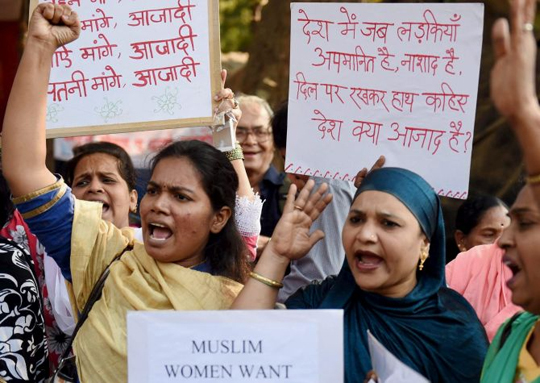
REALLY SURPRISED TO SEEE THESE MUSLIM LADIES IN ROAD PROTESTING FOR ENTERING THE DARGAH ,
FIRST THEY HAVE TO OFFER NAMAZ PERFECTLY I DONT KNOW WHAT THEY WILL GET IN DARGAH ....
THEY JUST VISIT TO ASK TO THEM.. THATS NOT GOOD WE HAVE TO ASK WITH ALLAH HE IS OUR ALL MIGHTY ..
Add new comment