


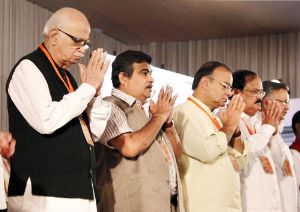
With eye on early Lok Sabha elections, BJP shedding saffron image?

September 30, 2012

BJP-Saffron

New Delhi, September 30: While anticipating that elections may be held earlier than scheduled, BJP has been trying to soften its "hardline Hindutva" image in what appears to be a move to blunt the hostility of Muslims, and reassure its existing allies while reaching out to new partners.


The three-day session of BJP's national executive saw both party president Nitin Gadkari and veteran leader LK Advani condemning the anti-Islam film that has triggered violence in different parts of the globe.


Gadkari on Thursday cited Swami Vivekananda, whose 150th birth anniversary is being planned by the party in a big way, to condemn the film that denigrates Prophet Mohammad.


"It's wrong to spread disrespect towards anybody who is revered by members of a faith. We should with full conviction reassure our brethren belonging to the minority communities that we brook no discrimination or injustice in dealing with different sections of our diverse society," Advani said in a speech that was well received by the audience.


He suggested that doing so would help reassure party's potential allies that "they have nothing to be apprehensive about partnering with BJP". Advani also emphasized the need for broadening the NDA, saying that the grouping has to be transformed into "NDA Plus".


The remark acquires significance in view of the apprehension of an existing ally, Bihar CM Nitish Kumar, as well as the recognition that the fear of losing Muslim support forces some of the anti-Congress players to maintain a distance from the saffron outfit. In fact, Advani's advice that party should undergo an image makeover to appear "secular" appears to articulate especially Kumar's anxiety.


The Bihar CM is apprehensive that the projection of his Gujarat counterpart Narendra Modi as BJP's choice for the PM will deal a setback to his assiduous attempts to woo Muslims away from his rival Lalu Prasad.


Regional players like TDP chief N Chandrababu Naidu and Odisha CM Naveen Patnaik, who are hostile to Congress, are loath to be seen in BJP's company because of the latter's "communal tag".


Though a handicap for the BJP, the "communal" brand works to the advantage of its allies, who cite it to justify their flexibility in choosing allies and taking positions.


On a larger plane, the same factor helps the "secular" rivals to seek to mobilize Muslims against the saffron party.


Comments

Hubert
 - 
Friday, 29 Jan 2016

Whatever might be your alternative, it's better that you simply
do a little analysis relating to the fame and customer help
provided by the binary brokers before you open an account with them to avoid any final minute hassles.

Review my webpage binary trading software review [Angela: http://s3.amazonaws.com/tradoptions/index/182.html]

Add new comment

  • Coastaldigest.com reserves the right to delete or block any comments.
  • Coastaldigset.com is not responsible for its readers’ comments.
  • Comments that are abusive, incendiary or irrelevant are strictly prohibited.
  • Please use a genuine email ID and provide your name to avoid reject.
Agencies
June 21,2020

New Delhi, June 21: Diesel prices rise to record high after 60 paise hike in rates, petrol up 35 paise; rates up by Rs 8.88 and Rs 7.97 in 15 days.

Petrol price in Delhi was hiked to Rs 79.23 per litre from Rs 78.88, while diesel rates were increased to Rs 78.27 a litre from Rs 77.67, according to a price notification of state oil marketing companies. 

In Bengaluru, petrol will be costlier by 37 paise at Rs 81.81 per litre, while diesel will cost 57 paise more per litre at Rs 74.43.

Rates have been increased across the country and vary from state to state depending on the incidence of local sales tax or VAT.

The 15th daily increase in rates since oil companies on June 7 restarted revising prices in line with costs after ending an 82-day hiatus in rate revision, has taken diesel prices to a new high. The petrol price too is at a two-year high.

Over 63 per cent of the retail selling price of diesel is taxes. Out of the total tax incidence of Rs 49.43 per litre, Rs 31.83 is by way of central excise and Rs 17.60 is VAT. 

Petrol in Mumbai costs Rs 86.04 per litre and diesel is priced at Rs 76.69.

Prior to the current rally, the peak diesel rates had touched was on October 16, 2018 when prices had climbed to Rs 75.69 per litre in Delhi. The highest-ever petrol price was on October 4, 2018 when rates soared to Rs 84 a litre in Delhi.

When rates had peaked in October 2018, the government had cut excise duty on petrol and diesel by Rs 1.50 per litre each. State-owned oil companies were asked to absorb another Re 1 a litre to help cut retail rates by Rs 2.50 a litre.

Oil companies had quickly recouped the Re 1 and the government in July 2019 raised excise duty by Rs 2 a litre.

The government on March 14 hiked excise duty on petrol and diesel by Rs 3 per litre each and then again on May 5 by a record Rs 10 per litre in case of petrol and Rs 13 on diesel. The two hikes gave the government Rs 2 lakh crore in additional tax revenues.

Oil PSUs Indian Oil Corp (IOC), Bharat Petroleum Corp Ltd (BPCL) and Hindustan Petroleum Corp Ltd (HPCL), instead of passing on the excise duty hikes to customers, adjusted them against the fall in the retail rates that was warranted because of a decline in international oil prices to two-decade lows.

International oil prices have since rebounded and oil firms are now adjusting retail rates in line with them.

In 15 days of hike, petrol price has gone up by Rs 7.97 per litre and diesel by Rs 8.88 a litre.

Comments

Add new comment

  • Coastaldigest.com reserves the right to delete or block any comments.
  • Coastaldigset.com is not responsible for its readers’ comments.
  • Comments that are abusive, incendiary or irrelevant are strictly prohibited.
  • Please use a genuine email ID and provide your name to avoid reject.
News Network
May 27,2020

New Delhi, May 27: Professor Johan Giesecke of the Karolinska Institute, Sweden, on Wednesday claimed that India will ruin its economy very quickly if it had a severe lockdown.

Claiming that a strict lockdown may disrupt India's economic growth, Giesecke during an interaction with Congress leader Rahul Gandhi said: "In India, you will do more harm than good with strict lockdown measures. India will ruin its economy very quickly if it had a severe lockdown."

While calling for a soft lockdown approach in India, he suggested that India has to ease restrictions one by one. It may, however, take months to completely come out of lockdown, he said.

He further criticised countries across the globe for having no post-lockdown strategy.

Emphasising on the disease, the Swedish health expert said that coronavirus is spreading like a wildfire across the world. "It is a very mild disease. Ninety-nine per cent infected people will have very less or no symptoms," he added.

Meanwhile, Ashish Jha, Director Harvard Global Health Institute and a recognised public health official, in interaction with Gandhi, called for a need to go in for an 'aggressive' COVID-19 testing to create confidence among people.

"When the economy is opened post-lockdown, you have to create confidence. There is a need for aggressive testing strategy in high-risk areas," he said.

He asserted that COVID-19 is not the last pandemic in the world, adding that "We are entering the age of large pandemics".

Jha further said that countries like South Korea, Taiwan and Hong Kong have responded the best to COVID-19 pandemic, while Italy, Spain, the US and the UK have responded the worst.

A few days ago, the Gandhi scion had interacted with former Reserve Bank of India Governor Raghuram Rajan and Nobel Prize Winner Abhijit Banerjee to discuss various issues related to the COVID-19 crisis.

Comments

Add new comment

  • Coastaldigest.com reserves the right to delete or block any comments.
  • Coastaldigset.com is not responsible for its readers’ comments.
  • Comments that are abusive, incendiary or irrelevant are strictly prohibited.
  • Please use a genuine email ID and provide your name to avoid reject.
News Network
May 15,2020

New Delhi, May 15: Union Health Minister Harsh Vardhan has appealed to all states and Union Territories to ban the sale of smokeless tobacco products and spitting in public places in line with the orders of the Rajasthan and Jharkhand governments to prevent the spread of coronavirus infection.

In a letter to all state health ministers, Vardhan said smokeless tobacco users have a tendency to spit in public places or otherwise and therefore, increase health risks especially those of spreading contagious diseases like COVID-19, tuberculosis, swine flu, encephalitis and others.

"Use of smokeless tobacco also creates an unhygienic environment which further spreads the diseases. The large gathering at the retail outlets where smokeless tobacco products are sold, also pose the risk of spread of COVID-19," he said.

In the letter dated May 11, the Union minister underlined that tobacco use is a major threat to public health globally. He also mentioned the Indian Council of Medical Research's (ICMR) appeal to the public not to consume and spit smokeless tobacco products in public places.

Chewing tobacco products and areca nut increases the production of saliva followed by a very strong urge to spit. Spitting in public places could enhance the spread of the COVID-19, Vardhan said.

"By banning spitting in public places, states and UTs can help in achieving not only Swachh Bharat but also Swasth Bharat (Clean India and Healthy India)," he said.

Vardhan also mentioned the May 1 guidelines issued by the Union Home Ministry under the National Disaster Management Act, 2005, which stipulate that "spitting in public places shall be punishable with fine as may be prescribed by the state/UT local authority and consumption of liquor, pan, gutkha, tobacco etc in public places is not allowed".

Appreciating the efforts of Rajasthan and Jharkhand in this direction, the Union Health Minister urged all states to take similar measures and create widespread awareness regarding the harm of spitting in public places.

The Rajasthan government had by an ordinance banned spinning in public places and sale of paan, gutka and tobacco in the wake of the coronavirus outbreak. The Jharkhand too has imposed a complete ban on all types of tobacco products to prevent spitting in public places that could increase the spread of coronavirus infection.

"I am happy to note that the governments of Jharkhand and Rajasthan have already completely banned the sale of tobacco products and spitting in public places. Therefore, I urge upon you to take similar measures and also create widespread awareness in your state/ UT regarding harms of spitting in public places.

"It is also requested that the directions of Ministry of Home Affairs in this regard may be implemented scrupulously and effectively," Vardhan said in the letter.

Tobacco smoking is a known risk factor for many respiratory infections and increases the severity of related diseases. A review of studies by public health experts convened by WHO on April 29 found that smokers are more likely to develop severe diseases, compared to non-smokers, said Binoy Mathew, senior programme officer of Voluntary Health Association of India.

It is one of the main risk factors for a number of chronic ailments, including cancer, lung and cardiovascular diseases, he said, adding that according to the Global Adult Tobacco Survey, with 268 million or 28.6 per cent of all adults in India, the country has the second largest number of tobacco users in the world.

At least 12 lakh die from tobacco-related diseases every year, Mathew said.

Those keen to quit smoking and smokeless products can avail of free of charge telephone-based services launched by the government. The Ministry of Health has set up a National Tobacco Quit Line Services to provide counselling services to help tobacco consumers quit the habit.

Comments

Add new comment

  • Coastaldigest.com reserves the right to delete or block any comments.
  • Coastaldigset.com is not responsible for its readers’ comments.
  • Comments that are abusive, incendiary or irrelevant are strictly prohibited.
  • Please use a genuine email ID and provide your name to avoid reject.