


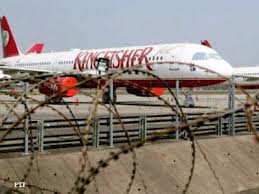
Kingfisher Airlines has lost licence: DGCA chief

January 1, 2013

Mumbai, Jan 1: India's troubled Kingfisher Airlines has lost its permit to fly after a deadline to renew its suspended licence expired, the national aviation regulator said on Tuesday.

The news is a fresh blow for the debt-laden carrier whose operations have been grounded since October after employees went on strike over unpaid wages.

"Kingfisher's flying permit has lapsed," DGCA chief Arun Mishra told AFP.

"They failed to provide additional details on the funding of operations," Mishra added, referring to Kingfisher's revival plan submitted to the DGCA last month.

But the airline said there is no "cause for concern" as the rules allow for the renewal of a permit within two years of expiry.kf
"Kingfisher is confident of securing approval from the regulator on the restart plan, licence approval and reinstatement of its operating permit," its spokesman Prakash Mirpuri said in a statement late Monday.

Kingfisher, controlled by liquor baron Vijay Mallya, owes millions of dollars to banks, airports, fuel suppliers and its staff and has been looking for a foreign investor to inject fresh funds.

The firm has been the worst-hit of India's airlines in 2012, with the industry plagued by high jet fuel prices, fierce competition, price wars and shabby airport infrastructure.

The carrier was India's second-largest until a year ago but its share shrank to just 3.5% — the smallest in the country —before operations stalled completely.

Kingfisher said it was in talks with foreign investors including Abu Dhabi-based Etihad Airways after the government cleared investment by foreign airlines in the key transport sector.

Aviation analysts have expressed doubt over Etihad's purported interest in Bangalore-based Kingfisher given the Indian firm's debt load, which is estimated at $2.5 billion by the consultancy firm Centre for Asia Pacific Aviation.

Comments

Add new comment

  • Coastaldigest.com reserves the right to delete or block any comments.
  • Coastaldigset.com is not responsible for its readers’ comments.
  • Comments that are abusive, incendiary or irrelevant are strictly prohibited.
  • Please use a genuine email ID and provide your name to avoid reject.
Agencies
June 13,2020

New Delhi, Jun 13: In a bid to provide relief to small businesses amid the coronavirus pandemic, the GST Council on Friday decided to halve the interest rate on late filing of GSTR-3B returns for the period of February, March and April 2020.

The interest rate on late return filing will be 9% from the usual 18% till September 30, 2020. The benefit will be available for small taxpayers with aggregate turnover of up to Rs 5 crore.

For the three months, small taxpayers will not be charged any interest till the notified dates for relief and thereafter 9% interest will be charged till September 30, a Finance Ministry statement said.

"For small taxpayers (aggregate turnover upto Rs 5 crore), for the supplies effected in the month of February, March and April 2020, the rate of interest for late furnishing of return for the said months beyond specified dates (staggered upto 6th July 2020) is reduced from 18 per cent per annum to 9 per cent per annum till 30.09.2020," said the statement.

The Council has also extended relief to small taxpayers for subsequent period of 2020 through waiver of late fees and interest if the returns in Form GSTR-3B for the supplies effected in the months of May, June and July are furnished by September 2020.

It has also decided to reduce the late fee on the filing of GSTR-3B returns for the period between July 2017 and January 2020. The late fee has been capped at Rs 500, but interest will be charged at the existing rate on the due tax liability.

Speaking to the media in New Delhi after a GST Council meet through videoconference, Union Finance Minister Nirmala Sitharaman said that those entities with no tax liability will not have to submit the late fee for the period.

For entities with tax liability but which have not filed returns or have filed returns late, the late fee has been capped at Rs 500 without interest. Interest will, however, be payable on the tax component at the applicable rate for delays.

To facilitate taxpayers who could not get their cancelled GST registrations restored in time, the Council has provided an opportunity for filing of application for revocation of cancellation of registration up to September 30, 2020, in all cases where registrations have been cancelled till June 12, 2020.

Comments

Add new comment

  • Coastaldigest.com reserves the right to delete or block any comments.
  • Coastaldigset.com is not responsible for its readers’ comments.
  • Comments that are abusive, incendiary or irrelevant are strictly prohibited.
  • Please use a genuine email ID and provide your name to avoid reject.
News Network
January 7,2020

Jan 7: India’s monetary authority allowed banks to offer foreign-currency transactions outside of local market hours, a move aimed at boosting trading volumes at home.

Interbank deals, as well as those with customers in and outside India, can be undertaken by banks or their overseas branches and units at all times, the Reserve Bank of India said in a statement late Monday. It stopped short of saying whether the timing of the onshore over-the-counter market has been extended from the current 9 a.m. to 5 p.m.

The move is in line with recent recommendations to reverse the trend of the partially convertible rupee being traded more abroad than in India. London has overtaken Mumbai to become the top center for trading the rupee, adding to a sense of urgency among local authorities to deepen the onshore market.

Average daily volumes for rupee in the U.K. soared to $46.8 billion in April, a more than fivefold jump from $8.8 billion in 2016, according to a survey from the Bank for International Settlements published in September. That exceeded the $34.5 billion recorded in India.

Analysts say more trading abroad could amplify volatility in the domestic market and reduce the effectiveness of policy actions.

India’s decision comes as the London Stock Exchange Group Plc has started asking market participants if they want the bourse to function fewer hours, signaling it’s open to an argument driven by changing trading patterns and calls for a better work-life balance.

Comments

Add new comment

  • Coastaldigest.com reserves the right to delete or block any comments.
  • Coastaldigset.com is not responsible for its readers’ comments.
  • Comments that are abusive, incendiary or irrelevant are strictly prohibited.
  • Please use a genuine email ID and provide your name to avoid reject.
News Network
June 24,2020

New Delhi, Jun 24: A litre of diesel on Wednesday was more expensive than a litre of petrol after the price of the former was hiked by 48 paise on the 18th successive day of fuel price revisions. While petrol price remained unchanged for the first time since June 7, diesel prices maintained upward trajectory to touch new highs.

It is for the first time in Delhi that diesel has become more expensive than petrol. A litre of the fuel now costs ₹79.88 as against ₹79.76 for a litre of petrol, as per a report in news agency ANI.

While surging fuel prices may generate much-needed revenue for governments, it would also have a detrimental impact on household budgets. The spike in diesel prices also has a wider impact on the transport and agricultural sectors which are largely dependent on the fuel.

The widest gap between the prices of the two fuels was on June 18 of 2012 when a litre of petrol was at ₹71.16 in Delhi while diesel was at ₹40.91. On June 28, the gap between the two fuels was 31.17 per litre in Mumbai. Around that time, there was a spurt in sales of diesel passenger vehicles while demand for such vehicles has come down significantly in current times. This has also led many manufacturers to ditch diesel engines completely.

The current trend of fuel price hikes are unlikely to do demand for petrol vehicles much good either.

Daily price revisions of the two fuel had been temporarily halted for 83 days till it was resumed on June 7.

India's demand for fuel doubled in May and has been steadily rising in June with the easing of restrictions. Indian refineries have already scaled up crude processing with Indian Oil Corp, the country's top refiner, looking to operate its plants at about 90% capacity in June.

The rising fuel prices, however, have resulted in political uproar with Congress leading the charge against the central government and accusing it of penalising consumers by imposing high taxes. A demand for including fuel prices under Goods and Services Tax (GST) has also been renewed by many but it is highly unlikely that it would happen. With oil companies looking to cut back on their previous loses and governments - central as well as states - aiming to generate revenue after tumultous weeks of lockdown, fuel price hikes are likely to stay till at least the end of June.

Comments

Add new comment

  • Coastaldigest.com reserves the right to delete or block any comments.
  • Coastaldigset.com is not responsible for its readers’ comments.
  • Comments that are abusive, incendiary or irrelevant are strictly prohibited.
  • Please use a genuine email ID and provide your name to avoid reject.