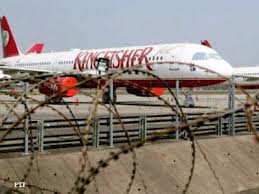
Kingfisher Airlines has lost licence: DGCA chief

January 1, 2013

Mumbai, Jan 1: India's troubled Kingfisher Airlines has lost its permit to fly after a deadline to renew its suspended licence expired, the national aviation regulator said on Tuesday.

The news is a fresh blow for the debt-laden carrier whose operations have been grounded since October after employees went on strike over unpaid wages.

"Kingfisher's flying permit has lapsed," DGCA chief Arun Mishra told AFP.

"They failed to provide additional details on the funding of operations," Mishra added, referring to Kingfisher's revival plan submitted to the DGCA last month.

But the airline said there is no "cause for concern" as the rules allow for the renewal of a permit within two years of expiry.kf

"Kingfisher is confident of securing approval from the regulator on the restart plan, licence approval and reinstatement of its operating permit," its spokesman Prakash Mirpuri said in a statement late Monday.

Kingfisher, controlled by liquor baron Vijay Mallya, owes millions of dollars to banks, airports, fuel suppliers and its staff and has been looking for a foreign investor to inject fresh funds.

The firm has been the worst-hit of India's airlines in 2012, with the industry plagued by high jet fuel prices, fierce competition, price wars and shabby airport infrastructure.

The carrier was India's second-largest until a year ago but its share shrank to just 3.5% — the smallest in the country —before operations stalled completely.

Kingfisher said it was in talks with foreign investors including Abu Dhabi-based Etihad Airways after the government cleared investment by foreign airlines in the key transport sector.

Aviation analysts have expressed doubt over Etihad's purported interest in Bangalore-based Kingfisher given the Indian firm's debt load, which is estimated at $2.5 billion by the consultancy firm Centre for Asia Pacific Aviation.

Comments

Add new comment

  • Coastaldigest.com reserves the right to delete or block any comments.
  • Coastaldigset.com is not responsible for its readers’ comments.
  • Comments that are abusive, incendiary or irrelevant are strictly prohibited.
  • Please use a genuine email ID and provide your name to avoid reject.
Agencies
August 8,2020

Idukki, Aug 8: Nine more bodies have been recovered from the landslide ravaged Pettimudi near Munnar in Idukki on Saturday. With this the death toll in the tragedy reached 26. Around 40 are feared to be still trapped under the debris or washed away.

The rescue operation by NDRF and Fire and Rescue Services that was stopped by Friday evening due to poor light and bad weather resumed by Saturday morning.

Horrifying scene prevailed in the area as relatives of the missing people screamed around in search of their beloved ones. As it is nearly 48 hours since the incident happened, the chances of recovering missing persons alive from the debris is becoming bleak. Three of the bodies recovered on Saturday could not be identified till evening.

Kerala Revenue Minster E Chandrasekharan, who visited the area on Saturday, said that search operation would be carried out until all the missing are recovered.

It was by around 11.30 pm on Thursday that landslide had hit the Nayamakkad estate of Kannan Devan Hills and Plantations. Settlement clusters of plantation workers where 83 persons were staying were reduced to debris as the huge rocks came bulldozing. Five of the residents were reported to be not in the spot while the mishap occured.

Meanwhile, heavy rains led to floods at many parts of the state. Red alert has been issued at Idukki, Malappuram and Wayanad districts for Sunday also. A total of 11,446 persons of 3,530 families were shifted to relief camps across the state, of which major chunk is at Wayanad.

Chief Minister Pinarayi Vijayan said that water level at most dams is increasing swiftly.

Comments

Add new comment

  • Coastaldigest.com reserves the right to delete or block any comments.
  • Coastaldigset.com is not responsible for its readers’ comments.
  • Comments that are abusive, incendiary or irrelevant are strictly prohibited.
  • Please use a genuine email ID and provide your name to avoid reject.
News Network
January 13,2020

Jan 13: For the first time in years, the government of India’s Prime Minister Narendra Modi is playing defense. Protests have sprung up across the country against an amendment to India’s laws — which came into effect on Friday — that makes it easier for members of some religions to become citizens of India. The government claims this is simply an attempt to protect religious minorities in the Muslim-majority countries that border India; but protesters see it as the first step toward a formal repudiation of India’s constitutionally guaranteed secularism — and one that must be resisted.

Modi was re-elected prime minister last year with an enhanced majority; his hold over the country’s politics is absolute. The formal opposition is weak, discredited and disorganized. Yet, somehow, the anti-Citizenship Act protests have taken hold. No political party is behind them; they are generally arranged by student unions, neighborhood associations and the like.

Yet this aspect of their character is precisely what will worry Modi and his right-hand man, Home Minister Amit Shah. They know how to mock and delegitimize opposition parties with ruthless efficiency. Yet creating a narrative that paints large, flag-waving crowds as traitors is not quite that easy.

For that is how these protests look: large groups of young people, many carrying witty signs and the national flag. They meet and read the preamble to India’s Constitution, into which the promise of secularism was written in the 1970’s.

They carry photographs of the Constitution’s drafter, the Columbia University-trained economist and lawyer B. R. Ambedkar. These are not the mobs the government wanted. They hoped for angry Muslims rampaging through the streets of India’s cities, whom they could point to and say: “See? We must protect you from them.” But, in spite of sometimes brutal repression, the protests have largely been nonviolent.

One, in Shaheen Bagh in a Muslim-dominated sector of New Delhi, began simply as a set of local women in a square, armed with hot tea and blankets against the chill Delhi winter. It has now become the focal point of a very different sort of resistance than what the government expected. Nothing could cure the delusions of India’s Hindu middle class, trained to see India’s Muslims as dangerous threats, as effectively as a group of otherwise clearly apolitical women sipping sweet tea and sharing their fears and food with anyone who will listen.

Modi was re-elected less than a year ago; what could have changed in India since then? Not much, I suspect, in most places that voted for him and his party — particularly the vast rural hinterland of northern India. But urban India was also possibly never quite as content as electoral results suggested. India’s growth dipped below 5% in recent quarters; demand has crashed, and uncertainty about the future is widespread. Worse, the government’s response to the protests was clearly ill-judged. University campuses were attacked, in one case by the police and later by masked men almost certainly connected to the ruling party.

Protesters were harassed and detained with little cause. The courts seemed uninterested. And, slowly, anger began to grow on social media — not just on Twitter, but also on Instagram, previously the preserve of pretty bowls of salad. Instagram is the one social medium over which Modi’s party does not have a stranglehold; and it is where these protests, with their photogenic signs and flags, have found a natural home. As a result, people across urban India who would never previously have gone to a demonstration or a political rally have been slowly politicized.

India is, in fact, becoming more like a normal democracy. “Normal,” that is, for the 2020’s. Liberal democracies across the world are politically divided, often between more liberal urban centers and coasts, and angrier, “left-behind” hinterlands. Modi’s political secret was that he was that rare populist who could unite both the hopeful cities and the resentful countryside. Yet this once magic formula seems to have become ineffective. Five of India’s six largest cities are not ruled by Modi’s Bharatiya Janata Party in any case — the financial hub of Mumbai changed hands recently. The BJP has set its sights on winning state elections in Delhi in a few weeks. Which way the capital’s voters will go is uncertain. But that itself is revealing — last year, Modi swept all seven parliamentary seats in Delhi.

In the end, the Citizenship Amendment Act is now law, the BJP might manage to win Delhi, and the protests might die down as the days get unmanageably hot and state repression increases. But urban India has put Modi on notice. His days of being India’s unifier are over: From now on, like all the other populists, he will have to keep one eye on the streets of his country’s cities.

Comments

Add new comment

  • Coastaldigest.com reserves the right to delete or block any comments.
  • Coastaldigset.com is not responsible for its readers’ comments.
  • Comments that are abusive, incendiary or irrelevant are strictly prohibited.
  • Please use a genuine email ID and provide your name to avoid reject.
News Network
February 13,2020

Guwahati, Feb 13: Hours after Assam's updated citizenship data disappeared from the website 'nrcassam.nic.in', an FIR was filed against a former NRC official for allegedly failing to submit the password to the sensitive document before quitting her job.

Talking to news agency on Thursday, NRC state coordinator Hitesh Dev Sarma said the complaint against former NRC project officer was filed under Official Secrets Act in Paltan Bazar police station here, as she "did not provide the password to the document, despite written reminders".

"She failed to surrender the password even after tendering her resignation on November 11 last year. She was a contractual employee and no longer authorised to hold the password, after quitting her job. An FIR has been filed against the former NRC project officer on Wednesday for violating the Official Secrets Act," he said.

Sarma also stated that the NRC office had written to her on several occasions for submitting the password, but did not get any response.

"We knew (she had resigned) and, therefore, sent several letters to her for handing over the password. But as she did not respond all these months, we filed a complaint against her yesterday for violating the Official Secrets Act.

"We must know if she has tampered with the sensitive information, after resigning," he added. The NRC state coordinator, however, refuted allegations of "malafide intent" involved in the matter.

"...this (cloud service provided by IT major Wipro) was not renewed by the earlier coordinator. So, the data went offline from December 15 last year. I assumed charge only on December 24," Sarma, who had gone on leave for a weeks after being appointed as the NRC state coordinator, clarified.

He also said that the state coordination committee had discussed the issue in its meeting on January 30 and wrote to Wipro during the first week of February.

"Once Wipro makes the data live, it will be available to the public. We hope that people will be able to access it in the next 2-3 days," Sarma claimed.

Reacting to the development, Wipro had said: "The IT Services Contract was not renewed by the authorities upon its expiry in October, 2019. However, as a gesture of goodwill, the company continued to pay the hosting service fee until January-end, 2020."

In another FIR filed with state criminal investigation department on Wednesday, NGO Assam Public Works (APW) alleged that former NRC Assam coordinator Prateek Hajela tampered with the final NRC list - published on August 31, 2019.

APW member Rajib Deka, in his complaint, accused Hajela of disobeying orders and directions of the Supreme Court, forgery of public register and committed offences under cyber laws for altering or changing public records by misusing his powers and position.

The NGO also said that after publication of the final list, several social networks and sections of the media had reported anomalies, insisting that many 'doubtful' persons were able to insert their names in the final list.

The Centre on Wednesday asserted that NRC data in Assam was safe even though some technical issues have been detected, which would be resolved soon.

Senior journalist-cum-RTI activist Saket Gokhale had sent an application to the NIC, the IT wing of the government, seeking a copy of the contract with Wipro.

"The Assam NRC data suddenly vanishing from the website (& the lack of data security) is incredibly shady. I've filed an RTI with the NIC specifically asking about details of the contract with Wipro, name of the cloud service provider, & all contracts signed for hosting this," he tweeted, while attaching a copy of the RTI application.

Leader of the Opposition in Assam Assembly and Congress leader Debabrata Saikia has also written to the Registrar General of India, requesting him to look into the fiasco urgently.

"It is a mystery as to why the online data should vanish all of a sudden, especially as the process to file appeals was yet to begin, all because of the go-slow attitude adopted by the NRC Authority. There is, therefore, ample scope to suspect that disappearance of online data is a malafide act," he had insisted.


Comments

Add new comment

  • Coastaldigest.com reserves the right to delete or block any comments.
  • Coastaldigset.com is not responsible for its readers’ comments.
  • Comments that are abusive, incendiary or irrelevant are strictly prohibited.
  • Please use a genuine email ID and provide your name to avoid reject.