


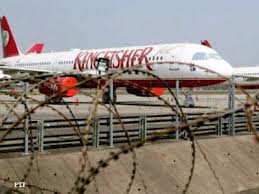
Kingfisher Airlines has lost licence: DGCA chief

January 1, 2013

Mumbai, Jan 1: India's troubled Kingfisher Airlines has lost its permit to fly after a deadline to renew its suspended licence expired, the national aviation regulator said on Tuesday.

The news is a fresh blow for the debt-laden carrier whose operations have been grounded since October after employees went on strike over unpaid wages.

"Kingfisher's flying permit has lapsed," DGCA chief Arun Mishra told AFP.

"They failed to provide additional details on the funding of operations," Mishra added, referring to Kingfisher's revival plan submitted to the DGCA last month.

But the airline said there is no "cause for concern" as the rules allow for the renewal of a permit within two years of expiry.kf
"Kingfisher is confident of securing approval from the regulator on the restart plan, licence approval and reinstatement of its operating permit," its spokesman Prakash Mirpuri said in a statement late Monday.

Kingfisher, controlled by liquor baron Vijay Mallya, owes millions of dollars to banks, airports, fuel suppliers and its staff and has been looking for a foreign investor to inject fresh funds.

The firm has been the worst-hit of India's airlines in 2012, with the industry plagued by high jet fuel prices, fierce competition, price wars and shabby airport infrastructure.

The carrier was India's second-largest until a year ago but its share shrank to just 3.5% — the smallest in the country —before operations stalled completely.

Kingfisher said it was in talks with foreign investors including Abu Dhabi-based Etihad Airways after the government cleared investment by foreign airlines in the key transport sector.

Aviation analysts have expressed doubt over Etihad's purported interest in Bangalore-based Kingfisher given the Indian firm's debt load, which is estimated at $2.5 billion by the consultancy firm Centre for Asia Pacific Aviation.

Comments

Add new comment

  • Coastaldigest.com reserves the right to delete or block any comments.
  • Coastaldigset.com is not responsible for its readers’ comments.
  • Comments that are abusive, incendiary or irrelevant are strictly prohibited.
  • Please use a genuine email ID and provide your name to avoid reject.
News Network
January 7,2020

New Delhi, Jan 7: When a reign of terror was unleashed by "masked goons" in the Jawaharlal Nehru University (JNU) on Sunday, Delhi Police registered two cases against varsity students union president Aishe Ghosh, who was badly injured in the attack, within a span of five minutes.

The registration of cases on two separate complaints against Ghosh and other students filed by JNU security department on January 3 and January 4 were registered on Sunday night when the violence was on, triggering questions about the motive behind the timing.

While the FIRs against Ghosh and others were registered between 8.44 pm and 8.49 pm after the JNUSU president was admitted to AIIMS, an FIR on the Sunday violence was registered on Monday at 5.36 am against unknown persons. The Sunday violence case has been transferred to Crime Branch for further investigations.

Questions are being raised over the registration of FIRs on Sunday while the complaints were filed on the previous days. Students allege that it was an afterthought from the police and authorities, as a nationwide outrage erupted as soon as the violence was reported.

Delhi Police is under attack for not coming to the aid of students targeted by the mob of ABVP activists armed with iron rods and sticks who went on a rampage on the campus. While no single person in the Sunday violence was arrested, the police are also accused of being a "mute spectator" by allowing the rioters to leave the campus without being arrested.

In its complaints, the JNU Security Department has alleged that Ghosh and others entered into a verbal and physical scuffle with security guards, including women, when officials tried to open the Centre for Information System (CIS) that was blocked by students protesting against the fee hike and registration process.

While the January 3 complaint claims that the students switched off the power supply to the CIS and evicted staff forcefully, the January 4 complaint alleged that they damaged the information system.

They also claimed the students damaged the servers, made it dysfunctional, severely damaged optic fibre cables and broke the biometric system in the CIS. The complaint also cited a Supreme Court order that prevented any protest within 100 metres of Administration Block and claimed the students violated the direction.

The FIR filed on Sunday violence on the basis of the statement of Inspector Anand Yadav said that the first phase of violence was reported at 3.45 pm when "40-50 unidentified" people who had "covered their faces" attacked students in Periyar Hostel and the situation was brought under control.

However at around 7 pm, "50-60 people with rods in their hands" targeted students in Sabarmati Hostel in which students were attacked and public property destroyed.

The FIR said that students were injured but skipped the mention of the attack on teachers, who were injured. At least two faculty members Sucharita Sen and Ameet Parameswaran were taken to AIIMS while several other teachers suffered minor injuries.

Comments

Add new comment

  • Coastaldigest.com reserves the right to delete or block any comments.
  • Coastaldigset.com is not responsible for its readers’ comments.
  • Comments that are abusive, incendiary or irrelevant are strictly prohibited.
  • Please use a genuine email ID and provide your name to avoid reject.
News Network
May 4,2020

Munbai/New Delhi, May 4: India expects bad debts at its banks could double after the coronavirus crisis brought the economy to a sudden halt, a senior government official and four top bankers said.

Indian banks are already grappling with 9.35 trillion rupees ($123 billion) of soured loans, which was equivalent to about 9.1% of their total assets at the end of September 2019.

"There is a considered view in the government that bank non-performing assets (NPAs) could double to 18-20% by the end of the fiscal year, as 20-25% of outstanding loans face a risk of default," the official with direct knowledge of the matter said.

A fresh surge in bad debt could hit credit growth and delay India's recovery from the coronavirus pandemic.

"These are unprecedented times and the way it's going we can expect banks to report double the amount of NPAs from what we've seen in earlier quarters," the finance head of a top public sector bank told Reuters.

The official and bankers declined to be named as they were not officially authorized to discuss the matter with media.

India's finance ministry declined to comment, while the Reserve Bank of India and Indian Banks' Association, the main industry body, did not immediately respond to emails seeking comment.

The Indian economy has ground to a standstill amid a 40-day nationwide lockdown to rein in the spread of coronavirus cases.

The lockdown has now been extended by a further two weeks, but the government has begun to ease some restrictions in districts that are relatively unscathed by the virus.

India has so far recorded nearly 40,000 cases of the coronavirus and more than 1,300 deaths from COVID-19, the respiratory disease caused by the coronavirus.

'RIDING THE TIGER'

Bankers fear it is unlikely that the economy will fully open up before June or July, and loans, especially those to small- and medium-sized businesses which constitute nearly 20% of overall credit, may be among the worst affected.

This is because all 10 of India's largest cities fall in high-risk red zones, where restrictions will remain stringent.

A report by Axis Bank said that these red zones, which contribute significantly to India's economy, account for roughly 83% of the overall loans made by its banks as of December.

One of the sources, an executive director of a public sector bank, said that economic growth had been sluggish and risks had been heightened, even ahead of the coronavirus crisis.

"Now we have this Black Swan event which means without any meaningful government stimulus, the economy will be in tatters for several more quarters," he said.

McKinsey & Co last month forecast India's economy could contract by around 20% in the three months through June, if the lockdown was extended to mid-May, and growth in the fiscal year was likely to fall 2% to 3%.

Bankers say the only way to stem the steep rise in bad loans is if the RBI significantly relaxes bad asset recognition rules.

Banks have asked the central bank to allow all loans to be categorized as NPAs only after 180 days, which is double the current 90-day window.

"The lockdown is like riding the tiger, once we get off it we'll be in a difficult position," a senior private sector banker said.

Comments

Add new comment

  • Coastaldigest.com reserves the right to delete or block any comments.
  • Coastaldigset.com is not responsible for its readers’ comments.
  • Comments that are abusive, incendiary or irrelevant are strictly prohibited.
  • Please use a genuine email ID and provide your name to avoid reject.
Agencies
June 22,2020

Mumbai, Jun 22: After downgrading India's outlook to negative from stable, Fitch Ratings on Monday revised the outlook on nine Indian banks to negative.

The outlook on the Long-Term Issuer Default Ratings (IDR) was revised to negative from stable due to the banks' high dependence on the Centre to re-capitalise them.

Accordingly, the IDR outlook of the Export-Import Bank of India, the State Bank of India, the Bank of Baroda, the Bank of Baroda (New Zealand), the Bank of India, the Canara Bank, the Punjab National Bank, ICICI Bank and Axis Bank Ltd have been downgraded to negative.

"At the same time, Fitch has affirmed IDBI Bank Limited's (IDBI) IDR while maintaining the outlook at negative," Fitch said in a statement.

The rating actions follow Fitch's revision of the outlook on the 'BBB-' rating on India to negative from stable on June 18, due to the impact of the escalating coronavirus pandemic on India's economy.

"The IDRs for all the above Indian banks are support-driven and anchored to their respective SRFs," the statement said.

"They are based on Fitch's assessment of high to moderate probability of extraordinary state support for these banks, which takes into account our assessment of the sovereign's ability and propensity to provide extraordinary support."

According to the statement, the negative outlook on India's sovereign rating reflects an increasing strain on the state's ability to provide extraordinary support, due to the sovereign's limited fiscal space and the significant deterioration in fiscal metrics due to challenges from the COVID-19 pandemic.

"The rating action does not affect the banks' Viability Rating (VR). EXIM does not have a VR as its role as a policy bank makes an assessment of its standalone credit profile less meaningful."

Comments

Add new comment

  • Coastaldigest.com reserves the right to delete or block any comments.
  • Coastaldigset.com is not responsible for its readers’ comments.
  • Comments that are abusive, incendiary or irrelevant are strictly prohibited.
  • Please use a genuine email ID and provide your name to avoid reject.