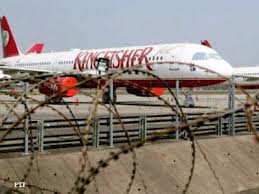
Kingfisher Airlines has lost licence: DGCA chief

January 1, 2013

Mumbai, Jan 1: India's troubled Kingfisher Airlines has lost its permit to fly after a deadline to renew its suspended licence expired, the national aviation regulator said on Tuesday.

The news is a fresh blow for the debt-laden carrier whose operations have been grounded since October after employees went on strike over unpaid wages.

"Kingfisher's flying permit has lapsed," DGCA chief Arun Mishra told AFP.

"They failed to provide additional details on the funding of operations," Mishra added, referring to Kingfisher's revival plan submitted to the DGCA last month.

But the airline said there is no "cause for concern" as the rules allow for the renewal of a permit within two years of expiry.kf

"Kingfisher is confident of securing approval from the regulator on the restart plan, licence approval and reinstatement of its operating permit," its spokesman Prakash Mirpuri said in a statement late Monday.

Kingfisher, controlled by liquor baron Vijay Mallya, owes millions of dollars to banks, airports, fuel suppliers and its staff and has been looking for a foreign investor to inject fresh funds.

The firm has been the worst-hit of India's airlines in 2012, with the industry plagued by high jet fuel prices, fierce competition, price wars and shabby airport infrastructure.

The carrier was India's second-largest until a year ago but its share shrank to just 3.5% — the smallest in the country —before operations stalled completely.

Kingfisher said it was in talks with foreign investors including Abu Dhabi-based Etihad Airways after the government cleared investment by foreign airlines in the key transport sector.

Aviation analysts have expressed doubt over Etihad's purported interest in Bangalore-based Kingfisher given the Indian firm's debt load, which is estimated at $2.5 billion by the consultancy firm Centre for Asia Pacific Aviation.

Comments

Add new comment

  • Coastaldigest.com reserves the right to delete or block any comments.
  • Coastaldigset.com is not responsible for its readers’ comments.
  • Comments that are abusive, incendiary or irrelevant are strictly prohibited.
  • Please use a genuine email ID and provide your name to avoid reject.
Agencies
January 12,2020

New Delhi, Jan 12: A fact-finding committee of the Congress on the JNU violence on Sunday said the January 5 attack inside the university campus was "state-sponsored" and recommended Vice Chancellor M Jagadesh Kumar be dismissed and criminal investigation initiated against him.

The Congress had appointed a four-member fact-finding committee to carry out a detailed inquiry into the violence at the Jawaharlal Nehru University (JNU).

Sushmita Dev, member of the committee, said the committee recommended that Kumar should be dismissed immediately and all the appointments in faculty should be probed and independent inquiry should take place.

"Criminal investigation must take place against the VC and faculty members and the security company," the Mahila Congress chief said.

"It is clear that the attack on JNU campus was state-sponsored," Dev said.

She also demanded a complete rollback of the JNU fee hike.

The other members of the fact-finding committee are Hibi Eden, MP and former NSUI president, Syed Naseer Hussain, MP and former president of JNU NSUI and Amrita Dhawan, a former NSUI president and ex-DUSU president.

On January 5 night, masked people armed with rods and sticks stormed the JNU campus and assaulted students and faculty members, and vandalised property, leaving several people injured.

Leftist outfits and the RSS-affiliated Akhil Bharatiya Vidyarthi Parishad (ABVP) blamed each other for the violence.

Comments

Add new comment

  • Coastaldigest.com reserves the right to delete or block any comments.
  • Coastaldigset.com is not responsible for its readers’ comments.
  • Comments that are abusive, incendiary or irrelevant are strictly prohibited.
  • Please use a genuine email ID and provide your name to avoid reject.
News Network
May 28,2020

May 28: Abdul Kareem was forced out of school and into a life of odd jobs like repairing bicycles before he finally managed to pull his family out of abject poverty transporting goods across Delhi in a mini truck.

The job, and the slim financial security that came with it, was the first stepping stone to a better life.

All that is now gone as India reels under the economic impact of its protracted coronavirus lockdown. Mr Kareem's out of a job and stranded in his village in Uttar Pradesh with his wife and two children. Their minuscule savings from his Rs 9,000 a month job have been exhausted, and the money he saved for books and school uniforms is spent.

"I don't know what the job situation will be in Delhi once we go back," Mr Kareem said. "We can't stay hungry so I will do whatever I find."

At least 49 million people across the world are expected to plunge into "extreme poverty" -- those living on less than $1.90 per day -- as a direct result of the pandemic's economic destruction and India leads that projection, with the World Bank estimating some 12 million of its citizens will be pushed to the very margins this year.

Some 122 million Indians were forced out of jobs last month alone, according to estimates from the Center for Monitoring Indian Economy, a private sector think tank. Daily wage workers and those employed by small businesses have taken the worst hit. These include hawkers, roadside vendors, workers employed in the construction industry and many who eke out a living by pushing handcarts and rickshaws.

For Prime Minister Narendra Modi, who came to power in 2014 promising to lift the poorest citizens out of poverty, the fallout from the lockdown brings with it significant political risk. He won an even larger second term majority last year on the strength of his government's popular social programs that directly targeted the poor, such as the provision of cooking gas cylinders, power and public housing. The breadth and depth of this renewed economic pain will only increase the pressure on his government as it works to steer the country's economy back on track.

"Much of the Indian government's efforts to mitigate poverty over the years could be negated in a matter of just a few months," said Ashwajit Singh, managing director of IPE Global, a development sector consultancy that advises several multinational aid agencies. Noting that he did not expect unemployment rates to improve this year, Singh said: "More people could die from hunger than the virus."

Desperate Times

Mr Singh points to a United Nations University study estimating 104 million Indians could fall below the World Bank-determined poverty line of $3.2 a day for lower-middle-income countries. This will take the proportion of people living in poverty from 60% -- or 812 million currently, to 68% or 920 million -- a situation last seen in the country more than a decade ago, he said.

A World Bank report found the country had been making significant progress and was close to losing its status as the country with the most poor citizens. The impact of PM Modi's lockdown risks reversing those gains.

The World Bank and the CMIE estimates were published in late April and early May respectively. Since then the situation has only become grimmer, with harrowing images of people making desperate attempts to reach their villages, on crowded buses, the flatbeds of trucks and even on foot or on bicycles dominating media coverage.

The Rustandy Center for Social Sector Innovation at the University of Chicago Booth School of Business analyzed the unemployment data from the CMIE, collected through surveys covering about 5,800 homes across 27 states in April.

Researchers found rural areas were the hardest hit, and the economic misery was the result of the lockdown, rather than the spread of infections in the hinterland. More than 80% of households had experienced a drop income and many won't survive much longer without aid, they wrote in a report.

The government has promised cheap credit to farmers, direct transfer of money to the poor and eased access to food security programs -- but these help people who have some documentation, which many of the poorest don't. With millions of impoverished people now in transit across the country, the food security situation is dire -- news reports are emerging of people foraging through piles of rotting fruit or eating leaves.

Shattered Economy

The economy was already growing at its slowest pace in over a decade when the virus struck. The lockdown, which came into effect on March 25, has hammered it, stalling business activity and putting a lid on consumption, pushing the economy to what may be its first full-year contraction in more than four decades.

It's dire enough to warrant the country exiting its lockdown, as it has been doing incrementally since May 4, even as its infections are surging. India is now Asia's virus hotspot with infections crossing 151,000 according to data from Johns Hopkins University.

PM Modi, who has come under criticism for the pain inflicted on the poor, has said his government will spend $265 billion or about 10% of its GDP to help Asia's third-largest economy weather the pandemic's fallout. But experts say only a part of it is direct fiscal stimulus, and probably smaller than the total damage done to the economy during the lockdown period.

"What is especially worrying is the government's response," said Reetika Khera, an economics professor at the Indian Institute of Technology in Delhi. "The epidemic will magnify existing -- and already high -- inequalities in India."

Still, the economic measures aren't going to kick in for some time and industry will likely struggle to restart because of the flight of labour from industrial hubs.

And as the harsh summer unfolds more pain lies in store in the villages now dealing with returning migrant workers.

"There are no factories or industries here, there are just hills," said Surendra Hadia Damor, who had walked nearly 100 km from Ahmedabad, Gujarat, before a voluntary organisation drove him to his village in the neighboring state of Rajasthan. "We can survive for a month or two and then try and find a job nearby -- we will see what happens."


Comments

Add new comment

  • Coastaldigest.com reserves the right to delete or block any comments.
  • Coastaldigset.com is not responsible for its readers’ comments.
  • Comments that are abusive, incendiary or irrelevant are strictly prohibited.
  • Please use a genuine email ID and provide your name to avoid reject.
News Network
February 14,2020

New Delhi/Washington, Feb 14: India has offered to partially open up its poultry and dairy markets in a bid for a limited trade deal during US President Donald Trump's first official visit to the country this month, people familiar with the protracted talks say.

India, the world's largest milk-producing nation, has traditionally restricted dairy imports to protect the livelihoods of 80 million rural households involved in the industry.

But Prime Minister Narendra Modi is trying to pull all the stops for the US President's February 24-25 visit, aimed at rebuilding bonds between the world's largest democracies.

In 2019, President Trump suspended India's special trade designation that dated back to 1970s, after PM Modi put price caps on medical devices, such as cardiac stents and knee implants, and introduced new data localization requirements and e-commerce restrictions.

President Trump's trip to India has raised hopes that he would restore some of the country's US trade preferences, in exchange for tariff reductions and other concessions.

The United States is India's second-largest trade partner after China, and bilateral goods and services trade climbed to a record $142.6 billion in 2018. The United States had a $23.2 billion goods trade deficit in 2019 with India, its 9th largest trading partner in goods.

India has offered to allow imports of US chicken legs, turkey and produce such as blueberries and cherries, government sources said, and has offered to cut tariffs on chicken legs from 100 per cent to 25 per cent. US negotiators want that tariff cut to 10 per cent. The Modi government is also offering to allow some access to India's dairy market, but with a 5 per cent tariff and quotas, the sources said. But dairy imports would need a certificate they are not derived from animals that have consumed feeds that include internal organs, blood meal or tissues of ruminants.

New Delhi has also offered to lower its 50 per cent tariffs on very large motorcycles made by Harley-Davidson, a tax that was a particular irritant for President Trump, who has labelled India the "tariff king." The change would be largely symbolic because few such motorcycles are sold in India.

President Trump will be feted in PM Modi's home state of Gujarat, then hold talks in New Delhi and attend a reception that the hosts have promised will be bigger than the one organised for former president Barack Obama in 2015.

But it is far from clear whether India's offers will be enough to satisfy US Trade Representative Robert Lighthizer, who cancelled plans for a trip to India this week. Instead, he has held telephone talks with Commerce Minister Piyush Goyal.

The US dairy industry remained sceptical on Thursday that a viable deal is at hand.

"We're always looking for market access, but in terms of India, as of today I'm not aware of any real progress going on," said Michael Dykes, president of the International Dairy Foods Association and a member of USTR's agricultural trade policy advisory committee.

Mr Dykes said the US dairy industry was looking for access in viable commercial quantities.

A USTR spokesman and India's trade ministry did not respond to requests for comment.

A parliament panel is reviewing a draft data privacy law that imposes stringent controls over cross-border data flows and gives the government powers to seek user data from companies.

It is not clear whether it will be passed, or in what form, but the possibilities have unnerved US companies and could raise compliance requirements for Google, Amazon.com Inc, and Facebook.

The draft law is not part of the trade discussions, Indian officials say, because the issue is too difficult to resolve at the same time.

"The privacy and localization piece will be raised independently and in concert with the trade discussions," said a Washington-based source with knowledge of the US administration's thinking.

President Trump on Tuesday was non-committal about sealing a trade deal before his visit. "If we can make the right deal, we'll do it," he told reporters.

Two US sources said progress had been made on proposed alterations to the medical device price caps. India's new import tariffs on medical devices, walnuts, toys, electronics and other products on February 1 surprised US negotiators, however.

The new tariffs were aimed at China, which also makes medical devices, according to an Indian government source. "We have to protect our market and our companies," the source said.

Comments

Add new comment

  • Coastaldigest.com reserves the right to delete or block any comments.
  • Coastaldigset.com is not responsible for its readers’ comments.
  • Comments that are abusive, incendiary or irrelevant are strictly prohibited.
  • Please use a genuine email ID and provide your name to avoid reject.